"The Greenhouse, Nursery, And Flowers Market is valued at $ 469.9 billion in 2025. Further, the market is expected to grow at a CAGR of 7.1% to reach $ 874.1 billion by 2034."
Greenhouse, Nursery, And Flowers Market Overview
The Greenhouse Nursery and Flowers Market is flourishing as global demand for ornamental plants, cut flowers, and container-grown crops grows in response to urbanization, indoor gardening trends, and year-round landscaping needs. Greenhouse cultivation enables year-round production with optimized environments—temperature, humidity, light, and nutrient control—resulting in higher-quality plants, improved crop consistency, and reduced pest pressure. This controlled approach supports both live plant and high-value floriculture production, feeding consumer interest in home décor, gifting, and wellness-oriented environments. Moreover, greenhouse systems facilitate local supply chains and reduce seasonal dependencies, enabling nurseries to deliver fresh, regionally adapted products with shorter lead times and lower logistical costs.
Innovation is reshaping how growers operate, with vertical farms, integrated pest management, climate automation, and eco-friendly practices driving productivity and sustainability. Growers are investing in LED lighting, hydroponic systems, and real-time environmental sensors to optimize crop cycles and reduce resource use. Consumer preferences for native plants, pollinator gardens, and eco-certified products are accelerating adoption of sustainable cultivation methods. On the business front, nurseries and floral producers increasingly engage with e-commerce platforms, subscription models, and B2B services tailored to landscapers, retailers, and hospitality. As greenhouse technology becomes more accessible, small- and medium-scale growers gain opportunities to compete in local and premium segments, while larger operations scale for export and integrated supply chains.
Global greenhouse cultivation area, 2018–2024 (thousand hectares)
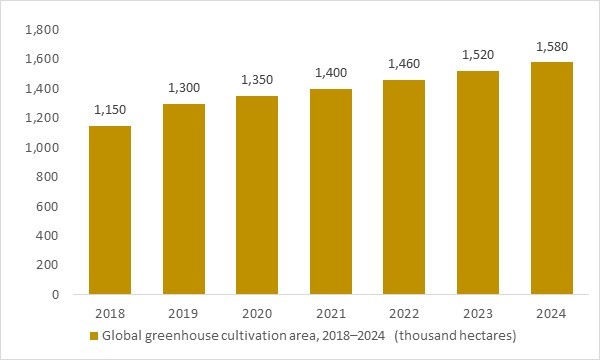
Figure: Global greenhouse cultivation area has expanded from around 1.15 million hectares in 2018 to nearly 1.6 million hectares by 2024. This rapid build-out of protected cultivation capacity – much of it dedicated to vegetables, ornamentals, nursery crops and cut flowers – underpins long-term growth in the greenhouse, nursery and flowers market. OG Analysis estimates, aligned with satellite-mapped greenhouse coverage and international horticulture statistics, illustrate how investment in climate-controlled structures is reshaping global floriculture and nursery supply.
- Satellite-based mapping shows that global greenhouse cultivation already covered around 1.3 million hectares by 2019 and has continued to expand since then. OG Analysis estimates indicate that total greenhouse area has risen from roughly 1.15 million hectares in 2018 to almost 1.6 million hectares by 2024. This rapid build-out of protected cultivation infrastructure – much of it devoted to high-value vegetables, ornamentals, nursery crops and flowers – underpins long-term growth in the greenhouse, nursery and flowers market. A larger, more technologically advanced greenhouse footprint enables year-round production, supports premium product positioning, and encourages investment in climate-controlled propagation and floriculture facilities.
Key Insights
-
Climate-controlled greenhouses with precise shading, temperature, and irrigation systems allow growers to produce premium-quality flowers and ornamentals year-round, meeting customer expectations for freshness, bloom consistency, and plant performance across seasons.
-
LED grow light systems customized by crop type improve photosynthesis efficiency, shorten production cycles, and lower energy costs while enabling growers to optimize flowering schedules and enhance plant quality under variable daylight conditions.
-
Vertical farming techniques—such as tiered racks and hydroponic setups—boost space utilization, enabling nurseries to produce more per square foot, expand urban horticulture operations, and reach niche consumers through localized supply.
-
Integrated pest management strategies, including beneficial insects, biological controls, and pathogen-resistant cultivars, reduce pesticide use, support certification standards, and deliver healthier ornamentals with lower environmental footprints.
-
Native and pollinator-friendly plant selections align with consumer demand for sustainable landscaping, biodiversity, and eco-conscious garden designs, giving growers differentiation and access to environmentally aware customer segments.
-
Subscription-based flower and plant delivery services offer recurring revenue, seasonal collections, and direct consumer engagement, allowing nursery operators to build brand loyalty and bypass traditional distribution systems.
-
E‑commerce platforms and online marketplaces allow growers to reach broader audiences, enable customization, provide educational content, and streamline order-to-delivery processes for live plants and floral products.
-
Eco‑certifications—such as organic or sustainably grown—help growers position products as premium, environmentally responsible, and compliant with emerging retail requirements and consumer preferences.
-
Automation systems—including greenhouse climate control, fertigation, and robotics—reduce manual labor needs and increase harvest precision, enabling scale‑appropriate operations without sacrificing crop quality.
-
Partnerships with landscapers, florists, interior designers, and hospitality sectors support larger B2B orders, recurring contract planting, and event-based floriculture, strengthening revenue diversity and operational stability.
Report Scope
| Parameter | Greenhouse, Nursery, And Flowers Market scope Detail |
| Base Year | 2024 |
| Estimated Year | 2025 |
| Forecast Period | 2026-2032 |
| Market Size-Units | USD billion |
| Market Splits Covered | By Product, By Application, By End User and By Technology |
| Countries Covered | North America (USA, Canada, Mexico) |
| Analysis Covered | Latest Trends, Driving Factors, Challenges, Trade Analysis, Price Analysis, Supply-Chain Analysis, Competitive Landscape, Company Strategies |
| Customization | 10% free customization (up to 10 analyst hours) to modify segments, geographies, and companies analyzed |
| Post-Sale Support | 4 analyst hours, available up to 4 weeks |
| Delivery Format | The Latest Updated PDF and Excel Data file |
Market Segmentation
By Type
- Food Crops Grown Under Cover
- Nursery And Floriculture Production
By Application
- Agricultural Products
- Ornamental Plant
- Grow Plants
- Consumer Goods
- Other Applications
By End-User
- Business-to-Business
- B2B
- Business-to-Consumer
- B2C
By Geography
- North America (USA, Canada, Mexico)
- Europe (Germany, UK, France, Spain, Italy, Rest of Europe)
- Asia-Pacific (China, India, Japan, Australia, Vietnam, Rest of APAC)
- The Middle East and Africa (Middle East, Africa)
- South and Central America (Brazil, Argentina, Rest of SCA)
Key Market Players
- Cargill Incorporated
- Bunge Limited
- Olam International Limited
- Bayer Aktiengesellschaft
- Syngenta Flowers LLC
- WH Group Limited
- Dairy Farmers of America Inc.
- Corteva Agriscience Inc.
- Charoen Pokphand Foods Public Company Limited
- Land O'Lakes Inc.
- Wens Foodstuff Group Co. Ltd.
- Royal FloraHolland
- The Scotts Miracle-Gro Company
- Netafim Ltd.
- Monrovia Company
- Ball Horticultural Company
- Dümmen Orange
- Costa Farms LLC
- Duerr Nursery & Perennials Inc.
- Wayside Gardens
- PanAmerican Seed Company
- A.M.A. Horticulture
- United Plant Growers Inc.
- Kientzler Forest Products LLC
- Grodan Holding B.V.
- Priva Holding B.V.
- Svensson International BV
- Hilverda Florist
- Rose Parade
- Four Winds Growers Inc.
Recent Developments
July 2025 – Ball Horticultural Company unveiled a new greenhouse automation system integrating climate control and AI-driven crop monitoring to enhance plant quality and resource efficiency.
June 2025 – Costa Farms expanded its greenhouse operations in North America, focusing on the production of specialty flowers and high-value ornamental plants for retail and landscaping markets.
May 2025 – Dümmen Orange introduced a range of disease-resistant flower varieties, supporting sustainable cultivation and reducing the need for chemical treatments in nurseries.
April 2025 – Rising demand for locally grown flowers prompted several greenhouse operators to invest in energy-efficient technologies and eco-friendly growing methods to improve sustainability and competitiveness.
FAQ's
The Global Greenhouse, Nursery, And Flowers Market is estimated to generate USD 469.9 billion in revenue in 2025.
The Global Greenhouse, Nursery, And Flowers Market is expected to grow at a Compound Annual Growth Rate (CAGR) of 7.1% during the forecast period from 2025 to 2034.
The Greenhouse, Nursery, And Flowers Market is estimated to reach USD 874.1 billion by 2034.
Didn’t find what you’re looking for? TALK TO OUR ANALYST TEAM
Need something within your budget? NO WORRIES! WE GOT YOU COVERED!


