"The Kiwi Fruit Market is valued at $ 2.5 billion in 2025. Further, the market is expected to grow at a CAGR of 7.6% to reach $ 4.9 billion by 2034."
The global kiwi fruit market is steadily expanding as consumers increasingly associate kiwifruit with premium nutrition, digestive health, and immunity support, positioning it as a high-value fruit within the broader fresh produce category. Kiwi is transitioning from a niche, seasonal fruit to a year-round staple in many households, driven by its use in fresh consumption, fruit salads, juices and smoothies, bakery and confectionery, dairy and yogurt products, and foodservice menus. Major producing and exporting countries are scaling orchard productivity, diversifying varieties, and investing in cold-chain and controlled-atmosphere storage to extend availability and reduce post-harvest losses. Rapid growth of modern retail, e-commerce grocery platforms, and specialty fruit chains is further improving access to branded, graded kiwifruit targeting health-conscious urban consumers, while marketing campaigns emphasize vitamin content, fibre, and antioxidant benefits.
On the demand side, rising disposable incomes, changing diets, and the popularity of “superfruits” underpin premium pricing and encourage portfolio innovation such as yellow-flesh and organic kiwifruit, convenient ready-to-eat packs, and mixed-fruit offerings. The market is also shaped by evolving trade flows, phytosanitary regulations, and competition from other vitamin-C rich fruits, requiring exporters to differentiate through taste, branding, certification, and consistent quality. At the same time, growers face structural challenges including vulnerability to plant diseases, climate variability, labour availability, and the need for sustainable water and land-use practices. Leading industry participants are responding with integrated supply-chain models, varietal development, and long-term contracts with retailers and foodservice players to stabilize prices and secure market access. Overall, the kiwi fruit market is expected to maintain a positive growth trajectory, supported by strong health positioning, widening geographic penetration, and ongoing product and packaging innovation across both fresh and processed kiwi-based applications.
Key Insights Of Market
-
The kiwi fruit market is benefiting from its strong positioning as a nutrient-dense “superfruit,” with high vitamin C, fibre, and antioxidant content supporting demand from health-conscious consumers, especially in functional foods, smoothies, and wellness-oriented snacking.
-
Expansion of modern grocery retail, e-commerce grocery platforms, and cold-chain logistics is improving year-round availability of fresh kiwifruit in both mature and emerging markets, helping convert the fruit from a seasonal, niche purchase into a more regular consumption item.
-
Product diversification into different flesh colours and taste profiles—such as green, gold/yellow, and newer red-fleshed cultivars—is widening consumer appeal, enabling premium pricing, and allowing suppliers to target distinct taste preferences and use cases.
-
Branded kiwifruit programs and strong intellectual property control over premium varieties are giving leading exporters and marketer-cooperatives a competitive edge through consistent quality, marketing investments, and tight grower–marketer integration across geographies.
-
Rising interest in immunity, gut health, and natural digestive support is driving usage of kiwifruit in functional food and beverage formulations, dietary supplements, and refrigerated fruit-based snacks, creating additional demand beyond conventional fresh produce channels.
-
Climate variability, water stress, and vulnerability to plant diseases and pests remain key supply-side risks, prompting growers to invest in controlled agronomy practices, disease-resistant varieties, and geographic diversification to stabilise yields and secure export commitments.
-
Trade flows are increasingly shaped by shifting import regulations, sanitary and phytosanitary standards, and bilateral trade agreements, influencing which exporting countries can access high-value consumer markets and how quickly new origins can scale.
-
Adoption of improved post-harvest handling, storage, and packaging technologies is helping extend shelf life, reduce losses, and maintain firmness and sweetness during long-distance shipping, which is critical as exporters target distant markets with long transit times.
-
Sustainability expectations from retailers and consumers are encouraging kiwifruit producers to adopt eco-friendlier farming, water-use optimisation, reduced agrochemical inputs, and recyclable or lightweight packaging, using these practices as points of differentiation and brand value.
-
In the medium to long term, market growth will be shaped by expanding per capita consumption in emerging economies, continued innovation in varieties and branding, and the sector’s ability to manage biosecurity risks and climate challenges without compromising quality or reliability of supply.
World kiwifruit production, 2018–2024(million tonnes)
Figure: World kiwifruit production remained within a narrow band of roughly 4.3 to 4.5 million tonnes between 2018 and an estimated 4.5 million tonnes in 2024e, highlighting a stable yet gradually expanding supply base for the global kiwi fruit market. Concentrated output in China, New Zealand, Italy, Greece and Chile underpins year-round availability through counter-seasonal trade flows, while incremental yield gains and varietal diversification support growth in both fresh and processed kiwi segments. OG Analysis estimates, derived from FAO kiwifruit statistics and global fruit market studies, illustrate how resilient production volumes strengthen long-term planning, export development and value-added innovation opportunities across the kiwi fruit value chain.
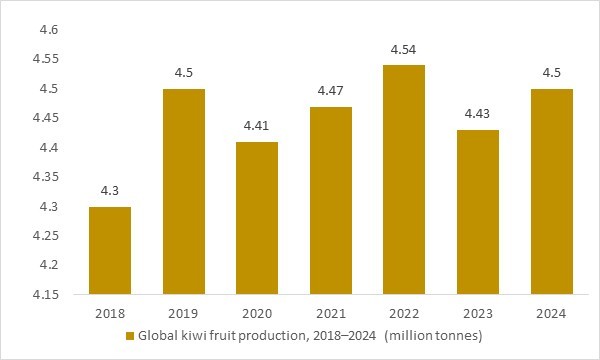
Global kiwifruit production remained consistently within the 4.3–4.5 million-tonne range between 2018 and 2024e, reflecting a stable yet gradually expanding supply base despite climatic volatility in key origins. China continues to dominate output, while New Zealand, Italy, Greece and Chile provide strong counter-seasonal supply that supports year-round availability in global markets. This steady production platform enables growth across fresh retail, export trade, and value-added kiwi segments such as juices, purees and nutraceuticals. Overall, the resilience and predictability of global kiwifruit production strengthen long-term demand prospects for the kiwi fruit market.
Report Scope
| Parameter | Kiwi Fruit Market scope Detail |
| Base Year | 2024 |
| Estimated Year | 2025 |
| Forecast Period | 2026-2032 |
| Market Size-Units | USD billion |
| Market Splits Covered | By Product, By Application, By End User and By Technology |
| Countries Covered | North America (USA, Canada, Mexico) |
| Analysis Covered | Latest Trends, Driving Factors, Challenges, Trade Analysis, Price Analysis, Supply-Chain Analysis, Competitive Landscape, Company Strategies |
| Customization | 10% free customization (up to 10 analyst hours) to modify segments, geographies, and companies analyzed |
| Post-Sale Support | 4 analyst hours, available up to 4 weeks |
| Delivery Format | The Latest Updated PDF and Excel Data file |
Market Segmentation
By Product Type
- Fresh Kiwi
- Processed Kiwi
By Nature
- Organic
- Conventional
By Distribution Channel
- Supermarkets
- Specialty Retailers
- Convenience Stores
- E-Commerce
- Other Channels
By Application
- Direct Consumption
- Jams
- Sauce
- Ice cream
- Salad
- Other Applications
By Geography
- North America (USA, Canada, Mexico)
- Europe (Germany, UK, France, Spain, Italy, Rest of Europe)
- Asia-Pacific (China, India, Japan, Australia, Vietnam, Rest of APAC)
- The Middle East and Africa (Middle East, Africa)
- South and Central America (Brazil, Argentina, Rest of SCA)
Key Market Players
- Dole plc
- Del Monte Fresh Produce N.A. Inc.
- Chiquita Brands International Inc.
- Zespri Group Limited
- Calavo Growers Inc.
- Enza Zaden
- Seeka Limited
- Fresh Fruits Company
- Eastpack Limited
- Driscoll's Inc.
- Limoneira Company
- Sunkist Growers Inc.
- Plant & Food Research
- Apata Group Limited
- Oppy (The Oppenheimer Group)
- Freshmax Group
- Naturipe Farms LLC
- DMS Progrowers Limited
- Southern Produce Limited
- Auckland Pack and Cool
- Birchwood Packhouse Limited
- Trinity Fruit Company Inc.
- Salix Fruits LLC
FAQ's
The Global Kiwi Fruit Market is estimated to generate USD 2.5 billion in revenue in 2025.
The Global Kiwi Fruit Market is expected to grow at a Compound Annual Growth Rate (CAGR) of 7.6% during the forecast period from 2025 to 2034.
The Kiwi Fruit Market is estimated to reach USD 4.9 billion by 2034.
Didn’t find what you’re looking for? TALK TO OUR ANALYST TEAM
Need something within your budget? NO WORRIES! WE GOT YOU COVERED!


