"Organic Coffee Market is valued at $10.5 billion in 2025. Further, the market is expected to grow at a CAGR of 14.7% to reach $36 billion by 2034."
The organic coffee market is experiencing significant growth driven by increasing consumer preference for healthier, chemical-free products and sustainability-focused purchasing behaviors. Organic coffee is cultivated without synthetic pesticides or fertilizers, supporting soil health and biodiversity while appealing to eco-conscious consumers seeking clean-label beverages. The market includes Arabica and Robusta varieties, with Arabica dominating due to its smooth flavor and premium positioning. Rising demand for specialty coffee, fair-trade certifications, and single-origin offerings is further boosting market value. Growth is supported by innovations such as compostable pods, sustainable packaging, and traceability technologies, which align with consumer expectations for environmental responsibility and ethical sourcing across retail, online, and specialty café channels globally.
North America holds the largest share of the organic coffee market, driven by strong coffee culture, health awareness, and established distribution networks. Europe follows closely, supported by stringent sustainability regulations and high demand for premium organic products. Asia Pacific is the fastest-growing region, fueled by rising disposable incomes, expanding urban coffee culture, and rapid growth in specialty coffee consumption in countries like China, Japan, and India. However, challenges remain due to high production costs, limited availability of certified organic farmland, and complex supply chain certification requirements. Companies are addressing these issues by investing in agroforestry, vertical integration, and digital traceability solutions. The market outlook remains positive as consumers increasingly prioritize ethical, healthy, and premium beverage options in their daily consumption patterns worldwide.
Arabica is the largest segment by origin in the organic coffee market. This dominance is due to its superior taste, smoother acidity, and aromatic profile, making it the preferred choice among specialty roasters, premium café chains, and health-conscious consumers who prioritize high-quality organic coffee varieties for daily consumption.
Gourmet coffee is the fastest-growing segment by type in the organic coffee market. Its growth is driven by increasing consumer demand for premium, single-origin, and specialty-grade organic coffees that offer unique flavors, ethical sourcing, and artisanal roasting, supporting the rising trend of premiumization and experiential consumption in global coffee markets.

Key Insights
- The organic coffee market is driven by rising consumer demand for health-conscious, chemical-free products, supported by sustainability and ethical sourcing trends that align with clean-label and premiumization preferences globally.
- Arabica beans hold the largest market share within organic coffee due to their superior taste, aroma, and premium positioning, making them the preferred choice among specialty roasters and café chains worldwide.
- North America remains the largest market, driven by a strong café culture, health-conscious consumers, and mature distribution networks across supermarkets, specialty stores, and online channels offering diverse organic coffee options.
- Asia Pacific is the fastest-growing region in the organic coffee market, fueled by increasing disposable incomes, rapid urbanization, and growing adoption of specialty coffee consumption in countries such as China, Japan, and India.
- Supermarkets and hypermarkets dominate distribution due to their large shelf space and wide brand availability, while online retail is growing rapidly as consumers seek convenience and direct access to specialty roasters and subscription services.
- Certification schemes such as USDA Organic, Fairtrade, and Rainforest Alliance are essential for brand differentiation and consumer trust, ensuring quality, sustainability, and ethical sourcing standards are maintained throughout supply chains.
- High production costs, limited certified farmland, and complex certification processes remain challenges, driving companies to adopt vertical integration, direct trade relationships, and agroforestry investments to secure sustainable supplies.
- Premiumization trends support market growth, with consumers increasingly opting for single-origin, micro-lot, and specialty-grade organic coffee that offer unique flavor profiles and transparent sourcing stories.
- Technological innovations include digital traceability solutions and blockchain-based verification, enhancing supply chain transparency and meeting regulatory and consumer demands for origin authenticity and ethical practices.
- The competitive landscape is evolving as major brands invest in compostable packaging, carbon-neutral production processes, and community development programs to strengthen brand loyalty and address sustainability-focused consumer expectations globally.
Global organic coffee area, 2018–2024 (hectares)
Figure: Global organic coffee area (hectares), 2018–2024. The 2024 value reflects an OG Analysis estimate based on recent trends, illustrating the expanding certified raw material base that underpins the organic coffee market outlook.
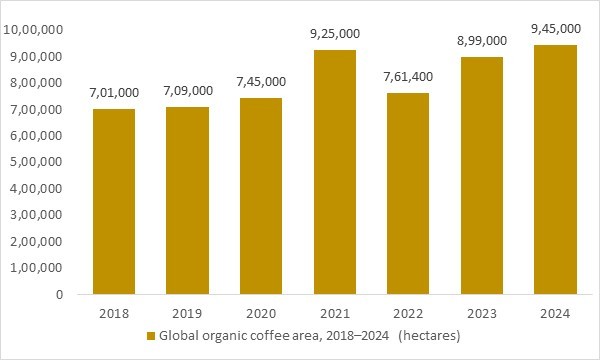
- The steady expansion of global organic coffee cultivation from 2018 to 2024 reflects the strengthening certified raw-material base supporting the organic coffee market. This upward trend highlights growing farmer adoption, improved supply chain capacity, and rising consumer preference for sustainably produced coffee, reinforcing the market’s long-term growth outlook.
Regional Insights
North America Organic coffee market
In North America, the chickweed extract market is shaped by a strong culture of herbal wellness, clean beauty, and indie natural brands. Demand is concentrated in topical skincare, salves, and balms sold through organic retailers, online apothecaries, and practitioner lines. Naturopathic clinics, herbalists, and small-batch formulators often specify chickweed for gentle soothing and comfort-positioned products, especially for dry or easily irritated skin. Contract manufacturers and private-label houses increasingly offer chickweed extracts as part of broader “European and North American botanicals” libraries. Regulatory expectations around cosmetic safety, labelling transparency, and quality testing encourage suppliers to provide documentation on contaminants, allergens, and extraction methods. Overall, growth is gradual and premium-led, with chickweed used as a differentiating ingredient in curated formulas rather than in mass-market commodity ranges.
Europe Organic coffee market
In Europe, the chickweed extract market benefits from a long tradition of Western herbal medicine and a sophisticated natural cosmetics sector. Chickweed appears in ointments, creams, and rinses positioned for skin comfort and gentle cleansing, often in combination with chamomile, calendula, and plantain. Established herbal manufacturers and pharmacy brands integrate chickweed into dermatological and family-care lines, while organic and natural beauty brands emphasize its garden-herb heritage and low-irritant profile. Stringent cosmetic regulations require clear documentation of botanical identity, plant part, and safety assessment, driving demand for standardized and well-characterized extracts. The trend toward minimalist, fragrance-light, and sensitive-skin formulations favors chickweed as a mild supporting active. Growth is strongest in markets with robust herbal traditions and high consumer awareness of plant-based remedies.
Asia-Pacific Organic coffee market
In Asia-Pacific, chickweed extract remains a niche botanical compared with long-established regional herbs, but it is gaining visibility through global natural beauty and wellness trends. International and hybrid brands that blend Western and Eastern herbal traditions sometimes include chickweed in multi-herb complexes for calming and moisturizing skin care. Ingredient distributors in developed markets such as Japan, South Korea, Australia, and New Zealand stock chickweed alongside other European botanicals for formulators targeting premium, nature-inspired ranges. In emerging markets, adoption is still limited, but cross-border e-commerce and K-beauty or J-beauty influences are slowly increasing interest in a wider palette of gentle plant actives. Over time, as sensitive-skin, baby-care, and dermo-cosmetic segments continue to expand, chickweed may secure a modest but stable role within regional botanical portfolios.
Reort Scope
| Parameter | Organic coffee Market scope Detail |
| Base Year | 2024 |
| Estimated Year | 2025 |
| Forecast Period | 2026-2034 |
| Market Size-Units | USD billion |
| Market Splits Covered | By Product, By Application, By End User and By Technology |
| Countries Covered | North America (USA, Canada, Mexico) |
| Analysis Covered | Latest Trends, Driving Factors, Challenges, Trade Analysis, Price Analysis, Supply-Chain Analysis, Competitive Landscape, Company Strategies |
| Customization | 10% free customization (up to 10 analyst hours) to modify segments, geographies, and companies analyzed |
| Post-Sale Support | 4 analyst hours, available up to 4 weeks |
| Delivery Format | The Latest Updated PDF and Excel Data file |
Market Segmentation
By Origin
- Arabica
- Robusta
By Roast
- Light
- Medium
- Dark
By Type
- Fair Trade Coffee
- Gourmet Coffee
- Espresso Coffee
- Coffee Pods
By Distribution Channel
- Supermarkets and Hypermarkets
- Convenience Stores
- Specialist Retailers
- Other Distribution Channels
By End-user
- Household
- Commercial
By Geography
- North America (USA, Canada, Mexico)
- Europe (Germany, UK, France, Spain, Italy, Rest of Europe)
- Asia-Pacific (China, India, Japan, Australia, Vietnam, Rest of APAC)
- The Middle East and Africa (Middle East, Africa)
- South and Central America (Brazil, Argentina, Rest of SCA)
Key Market Players
- Nestlé SA
- Cameron’s Coffee
- Rogers Family Co
- Jim's Organic Coffee
- The Kraft Heinz Company
- Starbucks Corporation
- FS Gourmet Private Limited
- Wessanen BV
- Complete Coffee Limited
- Luigi Lavazza SpA
- Java Trading Co LLC
- Dr Pepper Snapple Group Inc.
- Organic Coffee Company
- LIMITLESS COFFEE & TEA
- Shearwater Organic Coffee Roasters LLC
- Fresh Roasted Coffee LLC
- Camano Island Coffee
- Keurig Dr Pepper Inc.
- Allegro Coffee Company
- Dean's Beans Organic Coffee Company
- Jungle Products Cr.
- Ethical Bean Coffee Canada
- Clean Foods Inc.
- Grupo Nutresa SA
- International Coffee & Tea LLC
- Kicking Horse Coffee Co Ltd.
- Luigi Lavazza SpA
- Marley Coffee
- Melitta Group
- Mount Hagen Coffee
Recent Industry Developments
-
Dec 2025 – Holistic Roasters & Swiss Water: Partnered to launch a Biodynamic decaf coffee positioned as the “world’s first” in this niche, combining Demeter-aligned biodynamic sourcing with chemical-free decaffeination. The move elevates premium organic positioning (regenerative + biodynamic) within specialty/organic coffee.
-
Aug 2025 – Keurig Dr Pepper & JDE Peet’s: Keurig Dr Pepper announced an agreement to acquire JDE Peet’s and later split into two separate public companies (coffee-focused and beverages). The deal is expected to reshape global coffee portfolios and scale efficiencies, influencing organic coffee sourcing and branded distribution strategies across regions.
-
May 2025 – ELLE Café: Announced the national retail rollout of USDA Organic single-serve coffee pods at Sprouts Farmers Market, expanding organic options in mainstream natural retail. The launch targets convenience-led consumption while keeping sustainability and organic credentials front-and-center.
-
May 2025 – One Village Coffee: Expanded nationally into Sprouts Farmers Market, strengthening distribution for its organic coffee portfolio. The move reflects continued shelf-space competition among mission-led organic roasters in natural and specialty grocery.
-
Jan 2025 – Natural Grocers: Launched house-brand organic coffee pods certified organic (and fair-trade aligned), broadening private-label organic coffee offerings in value-focused natural retail. The rollout also emphasized more sustainable packaging/format choices to support eco-positioning.
-
Mar 2024 – Chameleon Organic Coffee: Expanded its ready-to-drink portfolio with cold brew cans, pushing organic coffee further into convenience formats. The launch supports wider consumption occasions beyond at-home brewing and concentrates.
What You Receive
• Global Organic Coffee market size and growth projections (CAGR), 2024- 2034
• Impact of recent changes in geopolitical, economic, and trade policies on the demand and supply chain of Organic Coffee.
• Organic Coffee market size, share, and outlook across 5 regions and 27 countries, 2025- 2034.
• Organic Coffee market size, CAGR, and Market Share of key products, applications, and end-user verticals, 2025- 2034.
• Short and long-term Organic Coffee market trends, drivers, restraints, and opportunities.
• Porter’s Five Forces analysis, Technological developments in the Organic Coffee market, Organic Coffee supply chain analysis.
• Organic Coffee trade analysis, Organic Coffee market price analysis, Organic Coffee Value Chain Analysis.
• Profiles of 5 leading companies in the industry- overview, key strategies, financials, and products.
• Latest Organic Coffee market news and developments.
The Organic Coffee Market international scenario is well established in the report with separate chapters on North America Organic Coffee Market, Europe Organic Coffee Market, Asia-Pacific Organic Coffee Market, Middle East and Africa Organic Coffee Market, and South and Central America Organic Coffee Markets. These sections further fragment the regional Organic Coffee market by type, application, end-user, and country.
Who can benefit from this research
The research would help top management/strategy formulators/business/product development/sales managers and investors in this market in the following ways
1. The report provides 2024 Organic Coffee market sales data at the global, regional, and key country levels with a detailed outlook to 2034, allowing companies to calculate their market share and analyze prospects, uncover new markets, and plan market entry strategy.
2. The research includes the Organic Coffee market split into different types and applications. This segmentation helps managers plan their products and budgets based on the future growth rates of each segment
3. The Organic Coffee market study helps stakeholders understand the breadth and stance of the market giving them information on key drivers, restraints, challenges, and growth opportunities of the market and mitigating risks
4. This report would help top management understand competition better with a detailed SWOT analysis and key strategies of their competitors, and plan their position in the business
5. The study assists investors in analyzing Organic Coffee business prospects by region, key countries, and top companies' information to channel their investments.
Available Customizations
The standard syndicate report is designed to serve the common interests of Organic Coffee Market players across the value chain and include selective data and analysis from entire research findings as per the scope and price of the publication.
However, to precisely match the specific research requirements of individual clients, we offer several customization options to include the data and analysis of interest in the final deliverable.
Some of the customization requests are as mentioned below :
Segmentation of choice – Our clients can seek customization to modify/add a market division for types/applications/end-uses/processes of their choice.
Organic Coffee Pricing and Margins Across the Supply Chain, Organic Coffee Price Analysis / International Trade Data / Import-Export Analysis
Supply Chain Analysis, Supply–Demand Gap Analysis, PESTLE Analysis, Macro-Economic Analysis, and other Organic Coffee market analytics
Processing and manufacturing requirements, Patent Analysis, Technology Trends, and Product Innovations
Further, the client can seek customization to break down geographies as per their requirements for specific countries/country groups such as South East Asia, Central Asia, Emerging and Developing Asia, Western Europe, Eastern Europe, Benelux, Emerging and Developing Europe, Nordic countries, North Africa, Sub-Saharan Africa, Caribbean, The Middle East and North Africa (MENA), Gulf Cooperation Council (GCC) or any other.
Capital Requirements, Income Projections, Profit Forecasts, and other parameters to prepare a detailed project report to present to Banks/Investment Agencies.
Customization of up to 10% of the content can be done without any additional charges.
Note: Latest developments will be updated in the report and delivered within 2 to 3 working days.
FAQ's
The Global Organic Coffee Market is estimated to generate USD 10.5 billion in revenue in 2025.
The Global Organic Coffee Market is expected to grow at a Compound Annual Growth Rate (CAGR) of 14.7% during the forecast period from 2025 to 2034.
The Organic Coffee Market is estimated to reach USD 36 billion by 2034.
Didn’t find what you’re looking for? TALK TO OUR ANALYST TEAM
Need something within your budget? NO WORRIES! WE GOT YOU COVERED!


