Pet Food Extrusion Market Analysis and Outlook Report: Industry Size, Share, Growth Trends, and Forecast (2026-2034)

Published On: Mar, 2026
|
Pages: 152

"Pet Food Extrusion Market is valued at $81.1 billion in 2025. Further, the market is expected to grow at a CAGR of 7.4% to reach $154 billion by 2034."

The pet food extrusion market is expanding rapidly, driven by the increasing demand for high-quality, nutritious, and processed pet food products. Extrusion is a widely used method in pet food manufacturing that involves cooking raw ingredients under high pressure and temperature to create kibble, treats, and other dry pet food forms. This process enhances digestibility, improves shelf life, and allows for the incorporation of vitamins, minerals, and functional ingredients that promote pet health. Pet owners are becoming more conscious about their pets' nutrition, leading to a shift toward premium and specialized pet food formulations, including grain-free, organic, and protein-rich diets. The growing humanization of pets and the demand for pet food with improved texture, flavor, and nutritional value have also driven market growth. Additionally, technological advancements in extrusion techniques have enabled manufacturers to produce pet food with better digestibility, palatability, and functional benefits. As pet food brands continue to innovate and develop extruded products that cater to specific dietary needs, the market is expected to experience steady growth, fueled by changing consumer preferences and advancements in food processing technology.

In 2024, the pet food extrusion market has witnessed key developments, particularly in ingredient innovation and processing efficiency. With a strong focus on sustainability and alternative protein sources, manufacturers are increasingly using plant-based proteins, insect-based proteins, and novel ingredients such as algae and mycoproteins in extruded pet food. These alternatives cater to the rising demand for eco-friendly and ethically sourced pet nutrition. Additionally, advancements in twin-screw extrusion technology have improved production efficiency, allowing manufacturers to create highly digestible and nutrient-dense pet food while maintaining cost-effectiveness. Another notable development is the increasing use of functional ingredients such as probiotics, omega fatty acids, and antioxidants in extruded pet food to support gut health, joint health, and overall pet well-being. Brands are also adopting cold extrusion techniques for the production of minimally processed pet food, which helps retain natural nutrients and flavors. The rise of premiumization in the pet food industry has further fueled the demand for customized and specialized extruded pet food formulas, targeting breed-specific, age-specific, and health-condition-specific dietary requirements. As a result, 2024 has marked a shift toward more science-driven, functional, and personalized pet nutrition.

Looking ahead to 2025 and beyond, the pet food extrusion market is expected to continue evolving with further innovations in ingredient sourcing, processing technology, and nutritional formulations. Artificial intelligence (AI) and machine learning are likely to play a larger role in optimizing extrusion processes, ensuring consistency in texture, nutritional value, and production efficiency. Sustainability will remain a key focus, with an increased emphasis on reducing carbon footprints, minimizing waste, and using biodegradable packaging for extruded pet food products. Additionally, personalized nutrition is expected to gain traction, with brands offering tailor-made extruded pet food solutions based on a pet’s breed, age, weight, and specific health conditions. The integration of blockchain technology in pet food production is also anticipated, enhancing transparency and traceability in ingredient sourcing and quality control. Moreover, the demand for grain-free, gluten-free, and hypoallergenic extruded pet food will continue to rise as pet owners become more aware of food sensitivities and dietary intolerances in their pets. With these advancements, the pet food extrusion market is set to experience sustained growth, driven by health-conscious pet owners, technological innovations, and increasing demand for premium and functional pet nutrition.

Key Insights

  • Historically, pet food extrusion developed from snack and breakfast cereal technologies, giving manufacturers a proven, scalable method to produce dry pet diets. This heritage established a strong engineering base and know-how around expansion, shaping, and drying, which remains central to current processing lines. Over time, dedicated pet food extruders have evolved with design tweaks specific to animal nutrition needs.

  • Dry extruded kibbles remain the dominant format in many markets, providing convenient, shelf-stable, and cost-effective diets for dogs and cats. Extrusion allows consistent sizing, density control, and surface structure that influence palatability and chewing behavior. The ability to tailor kibble shape and hardness for small, medium, and large breeds is a key value driver for brand differentiation.

  • Product diversification has extended extrusion beyond basic kibbles into co-extruded treats, dental chews, filled pillows, and semi-moist snacks. These formats use combinations of single- and twin-screw extruders, co-extrusion dies, and specialized drying and coating systems. As treats and snacks grow faster than staple diets in many markets, this segment represents an important growth frontier for extrusion technology.
  • Raw-material flexibility is a major advantage of extrusion, enabling the use of cereals, pulses, rendered meals, fresh and frozen meats, by-product streams, and emerging protein sources. Modern extruders are designed to handle high-protein, high-fat, and low-starch formulations associated with grain-free, high-meat, and limited-ingredient diets. This versatility helps manufacturers maintain agility in the face of volatile ingredient markets.
  • Functional and health-focused pet nutrition is pushing processors to achieve more precise control over temperature, moisture, and residence time to protect sensitive ingredients. Probiotics, heat-labile vitamins, omega-rich oils, and specialty fibers often require gentle processing and carefully sequenced addition. Extrusion lines increasingly integrate pre-conditioning, vacuum coating, and post-addition technologies to safeguard nutrient integrity.
  • Automation and digitalisation are transforming the pet food extrusion landscape, with advanced control systems managing recipe changes, process parameters, and real-time quality monitoring. Data logging, predictive maintenance, and remote diagnostics are becoming standard, helping operators reduce downtime, improve consistency, and respond quickly to formulation and demand changes. This also supports tighter traceability and audit requirements.
  • Energy efficiency and sustainability considerations are influencing equipment design and plant layouts. Manufacturers focus on optimizing steam usage in pre-conditioners, reducing specific energy consumption of extruders, and improving heat recovery in dryers. The ability to process local ingredients, co-products, and novel proteins also supports broader sustainability narratives for pet food brands and retailers.
  • The competitive landscape is characterized by a mix of global extrusion specialists and regional machinery suppliers offering standard and customized lines. Successful vendors combine mechanical engineering expertise with application laboratories, pilot plants, and formulation support, enabling customers to co-develop new recipes and rapidly scale from trials to commercial production. After-sales service and spare-part availability are critical purchasing criteria.
  • Regulatory and safety expectations drive continuous refinement of hygienic design, allergen control, and cleaning protocols in extrusion plants. Equipment with accessible, easy-to-clean contact surfaces, reduced dead zones, and validated cleaning procedures helps minimize cross-contamination risks. As pet food recalls remain high-profile events, processors prioritize extruder and dryer designs that support robust food safety management systems.
  • Looking ahead, the pet food extrusion market is expected to benefit from continued pet population growth, humanization, and premiumization, as well as the rise of emerging markets. Future opportunities include extruded formats for alternative species, greater integration with wet and fresh pet food portfolios, and hybrid lines capable of handling both conventional and novel ingredient sets. Suppliers that offer flexible, scalable, and digitally enabled extrusion solutions are well positioned to capture long-term demand.

Global pet food production (million tonnes), 2018–2024

Figure: Global pet food production (million tonnes), 2018–2024, illustrating the strong, expanding throughput base driving demand for advanced pet food extrusion equipment and processing lines.
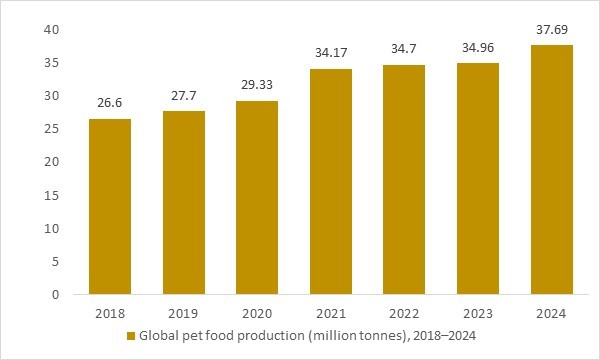
Global pet food production, 2018–2024 (million tonnes), illustrating the growing raw material throughput driving demand in the pet food extrusion market

  • Global pet food production rose from around 26.6 million tonnes in 2018 to nearly 38 million tonnes in 2024, reflecting sustained growth in dry kibble and extruded pet formulations. This steady expansion in raw material throughput directly supports rising investment in high-capacity, energy-efficient pet food extrusion lines, advanced process controls, and tailored after-sales services across key pet food manufacturing regions worldwide.

Regional Insights

North America Pet food extrusion market

In North America, the pet food extrusion market is underpinned by a large, premium-oriented pet food industry and high levels of plant automation. Major brand owners and private-label co-packers invest in advanced single- and twin-screw extruders to support a wide range of dry kibbles and treats, from economy lines to super-premium, high-meat recipes. The region’s strong focus on pet humanization drives demand for novel shapes, textures, and functional inclusions, requiring highly flexible extrusion setups and quick recipe changeovers. Labour constraints and rising operating costs are encouraging greater use of process automation, real-time monitoring, and data-driven optimization in extrusion plants. Strict food safety, traceability, and labelling expectations push processors toward hygienic designs, robust control systems, and tighter integration between extrusion, drying, coating, and packaging. Growth is further supported by the expansion of e-commerce and specialty retail, which continually create niches for differentiated, extruded pet food and snack formats.

Europe Pet food extrusion market

In Europe, the pet food extrusion market is shaped by mature pet ownership, strong regulatory frameworks, and a pronounced shift toward natural, sustainable, and specialty nutrition. Extruded dry diets and treats remain core formats, but recipe design is increasingly influenced by grain-free, limited-ingredient, and alternative-protein trends across key markets. European processors tend to emphasize energy-efficient, low-waste extrusion lines that align with environmental and corporate sustainability goals. The presence of several leading equipment manufacturers supports continuous innovation in extruder design, process control, and hygienic engineering. Regulatory scrutiny on ingredient sourcing, additives, and claims pushes manufacturers to tightly control thermal profiles, residence times, and post-extrusion coating steps to preserve sensitive nutrients. Cross-border trade within the region also encourages plants to operate with high uptime and consistent quality, keeping demand steady for reliable, upgradeable extrusion solutions.

Asia-Pacific Pet food extrusion market

Asia-Pacific is the fastest-growing region for pet food extrusion, driven by rising pet ownership, urbanization, and the shift from table scraps and home-prepared feeds to commercial diets. As local and regional brands scale up, investment in modern extrusion plants is increasing to meet demand for dry dog and cat foods as well as emerging snack and treat categories. International and domestic equipment suppliers are supplying both entry-level and high-spec lines, with many facilities designed to accommodate future capacity expansions. Formulations in the region often balance cost sensitivity with rising expectations for quality, leading to extruded products that blend regional ingredient bases with global nutrition concepts. Growing use of contract manufacturers and co-packers is also expanding the installed base of flexible extrusion lines capable of producing multiple brands and recipes. Over time, stricter regulatory standards and retailer expectations are expected to push more producers toward advanced automation, process control, and food safety features in extrusion systems.

Market Scope

Parameter

Pet food extrusion Market scope Detail

Base Year

2024

Estimated Year

2025

Forecast Period

2026-2034

Market Size-Units

USD billion

Market Splits Covered

By Product, By Application, By End User and By Technology

Countries Covered

North America (USA, Canada, Mexico)
Europe (Germany, UK, France, Spain, Italy, Rest of Europe)
Asia-Pacific (China, India, Japan, Australia, Rest of APAC)
The Middle East and Africa (Middle East, Africa)
South and Central America (Brazil, Argentina, Rest of SCA)

Analysis Covered

Latest Trends, Driving Factors, Challenges, Trade Analysis, Price Analysis, Supply-Chain Analysis, Competitive Landscape, Company Strategies

Customization

10% free customization (up to 10 analyst hours) to modify segments, geographies, and companies analyzed

Post-Sale Support

4 analyst hours, available up to 4 weeks

Delivery Format

The Latest Updated PDF and Excel Data file

Market Segmentation


By Extruder Type
- Single Screw
- Twin Screw

By Process
- Hot Extrusion
- Cold Extrusion

By Type
- Complete Diets
- Treats
- Other Types

By Ingredient
- Animal Derivatives
- Vegetables And Fruits
- Grains And Oilseeds
- Vitamins And Minerals
- Additives
- Other Ingredients

By Animal Type
- Dog
- Cat
- Fish
- Birds
- Other Animal Types

By Geography
- North America (USA, Canada, Mexico)
- Europe (Germany, UK, France, Spain, Italy, Rest of Europe)
- Asia-Pacific (China, India, Japan, Australia, Vietnam, Rest of APAC)
- The Middle East and Africa (Middle East, Africa)
- South and Central America (Brazil, Argentina, Rest of SCA)

Key Market Players

  • Nestlé S.A.
  • Mars Petcare Inc.
  • Andtriz AG
  • The J.M. Smucker Company
  • Ingredion Incorporated
  • SunPring
  • Buhler Industries Inc.
  • Pavan Group
  • Reading Bakery Systems Inc.
  • Clextral SAS
  • Brabender GmbH & Co. KG
  • Baker Perkins Ltd.
  • Lindquist Machine
  • American Extrusion International
  • Nanjing Haisi Extrusion Equipment Co. Ltd.
  • Diamond America Corporation
  • Doering Systems Inc
  • Coperion Ideal Private Limited
  • The Bonnot Company
  • IDAH Company
  • Shandong Loyal Industrial Co. Ltd.
  • Kairong Group
  • Kahl Group
  • Wenger Manufacturing Inc.
  • Triott Group.

  Recent Industry Developments

  • Sep 2025 – ANDRITZ: Launched the ExMax S1021 high-performance extruder for pet food and aquafeed, emphasizing automated control of cooking/expansion for more consistent kibble quality. The design focus is on higher hygiene, faster recipe changeovers, and reduced cross-contamination risk.

  • May 2025 – Wenger + Extru-Tech: Jointly launched EXPRO AI, an AI-driven extrusion optimization software that predicts outcomes and tunes setpoints to reduce variability. It is positioned to improve throughput stability, product consistency, and operating efficiency for pet food lines.

  • Mar 2025 – CPM: Unveiled an expanded pet food processing equipment lineup at VIV Asia 2025, including twin-screw extrusion platforms and downstream systems (drying/coating/milling). The announcement reflects continued push toward integrated, turnkey extrusion lines for premium pet food.

  • Mar 2025 – VIV (Petfood & Aquafeed Extrusion Conference): Hosted a specialized extrusion conference centered on pet food/aquafeed extrusion equipment and process control. The event spotlighted the industry shift toward advanced automation, sanitation-by-design, and flexible lines for novel formulations.

  • 2024 – Coperion (Baker Perkins): Promoted co-extrusion technology (e.g., filled pet treats) as a value-add route for premiumization, supporting more complex shapes and filled formats. This points to rising investment in higher-margin treat extrusion versus standard kibble.

  • Jun 2024 – Baker Perkins: Highlighted modular, sanitation-friendly baking systems used after extrusion to improve texture and throughput in pet food processing. The focus aligns with processors upgrading post-extrusion steps to increase line uptime and reduce cleaning time.

You can purchase individual sections of this report. Explore pricing options for specific sections.

FAQ's

The Global Pet Food Extrusion Market is estimated to generate USD 81.1 billion in revenue in 2025.

The Global Pet Food Extrusion Market is expected to grow at a Compound Annual Growth Rate (CAGR) of 7.4% during the forecast period from 2025 to 2034.

The Pet Food Extrusion Market is estimated to reach USD 154 billion by 2034.

License

Didn’t find what you’re looking for? TALK TO OUR ANALYST TEAM

Need something within your budget? NO WORRIES! WE GOT YOU COVERED!

Related Products

Dried Fruit Snacks Market Analysis and Outlook Report: Industry Size, Share, Growth Trends, and Forecast (2026-2034)

The Dried Fruit Snacks Market has developed into a vibrant segment within the broader healthy snacking industry, supported by rising consumer interest in convenient, naturally derived, and minimally processed snack choices. Dried fruit snacks include products such as raisins, dates, apricots, prunes, figs, berries, mango, apple chips, tropical fruit blends, and mixed fruit snack packs designed for direct consumption across home, office, travel, school, and outdoor occasions. Their appeal lies in combining portability, shelf stability, natural sweetness, and a fruit-based positioning that resonates with consumers seeking alternatives to conventional salty and sugary snacks. The market is also benefiting from increasing snackification of daily diets, as more consumers replace traditional eating patterns with smaller, more frequent snack occasions. Dried fruit snacks are widely used as standalone snacks and in lunchboxes, trail mixes, breakfast bowls, yogurt toppings, and bakery inclusions, which broadens their relevance across age groups and consumption settings. Category innovation has accelerated in recent years, with manufacturers introducing organic lines, no-added-sugar products, freeze-dried fruit crisps, infused fruit variants, and fruit-based bites blended with seeds, nuts, and functional ingredients. These developments are helping brands reposition dried fruit from a traditional pantry item into a modern, lifestyle-oriented snack solution. As wellness, clean-label preferences, and on-the-go convenience continue to influence purchase decisions, the market is gaining momentum across both mass-market and premium retail channels. Competitive dynamics in the Dried Fruit Snacks market are shaped by raw material quality, sourcing transparency, texture differentiation, packaging innovation, and brand positioning around health, simplicity, and authenticity. Established dried fruit processors compete alongside organic snack specialists, better-for-you food brands, and emerging innovators developing premium and functional fruit-based snack formats. One of the most important trends in the market is the emphasis on clean ingredient profiles, with brands highlighting whole fruit content, absence of artificial additives, and natural sweetness as key differentiators. Another notable development is the growing popularity of portion-controlled packs, resealable pouches, and family-friendly formats that improve portability and encourage repeat consumption. Demand is also being reinforced by consumer preference for plant-based, gluten-free, and recognizable snacks that offer sensory satisfaction without appearing overly processed. At the same time, the market faces challenges related to fruit sourcing consistency, seasonal availability, moisture and texture control, and pricing sensitivity in premium segments. Companies that can balance taste, appearance, nutritional appeal, and affordability are best positioned to gain market share. Overall, the Dried Fruit Snacks market is evolving toward broader flavor diversity, stronger wellness credentials, and more sophisticated segmentation by consumer lifestyle, usage occasion, and ingredient purity, making it an increasingly important category within the global healthy snacks landscape. Key Market Insights Healthy snacking continues to serve as the strongest foundation for the Dried Fruit Snacks market. Consumers are increasingly choosing snacks that appear natural, fruit-based, and less processed than traditional indulgent alternatives. Dried fruit fits well within this shift because it offers familiarity, convenience, and a wholesome image. Its acceptance is growing among families, working professionals, and wellness-oriented consumers seeking better everyday snack options. This positioning has helped dried fruit snacks move from a niche category into broader mainstream consumption. Future market growth will remain closely tied to the continued expansion of health-conscious snacking habits. Product format innovation is reshaping the competitive landscape of the market. While traditional dried fruits such as raisins, dates, apricots, and prunes remain important, the category is expanding through fruit crisps, mixed fruit blends, bite-sized clusters, and infused fruit snacks. These formats create stronger visual appeal, greater texture variety, and better relevance for younger and more experimental consumers. Innovation in shape, texture, and combination formats is helping brands refresh a category that was once seen as traditional and limited. This evolution is increasing the market’s reach across premium retail, convenience channels, and wellness-led product segments. Clean-label positioning is becoming one of the most important purchase drivers in the category. Consumers are paying closer attention to ingredient simplicity and are increasingly drawn to products with recognizable, minimally processed components. Dried fruit snacks naturally benefit from this trend because they can be positioned around whole-fruit content, straightforward labeling, and natural sweetness. Products marketed with no added sugar, no preservatives, and limited ingredients tend to attract greater interest in health-focused and premium channels. As clean eating preferences continue to shape retail demand, brands that communicate purity and transparency effectively are likely to gain stronger traction. Convenience and portability are expanding consumption across multiple everyday occasions. Dried fruit snacks are easy to carry, store, portion, and consume, which makes them highly compatible with modern lifestyles. They are used in lunchboxes, office snacking, travel, fitness routines, and casual at-home eating, giving the category broad daypart relevance. Packaging formats such as resealable pouches and portion-controlled packs further strengthen convenience-driven appeal. This adaptability has become especially important as consumers increasingly replace formal eating habits with smaller and more frequent snack moments. The category’s portability advantage will remain a major factor behind repeat demand. Natural sweetness gives dried fruit snacks a strong edge in the better-for-you snacking space. Many consumers want snacks that satisfy sweet cravings without feeling overly artificial or heavily processed. Dried fruit addresses this need by delivering sweetness through fruit itself, which supports a more wholesome and naturally indulgent product image. This makes the category competitive against confectionery, sugar-based snack bars, and other sweet packaged snacks. Fruits such as mango, berries, dates, and figs are especially effective in this role because of their rich taste and broad appeal. Natural sweetness will continue to be a central advantage in category messaging and product development. Premiumization is elevating the category beyond its traditional commodity roots. Brands are increasingly differentiating themselves through fruit quality, origin positioning, organic credentials, and improved drying techniques. These factors help transform dried fruit snacks into more aspirational and lifestyle-oriented products rather than simple pantry staples. Premium offerings also support innovation in packaging, flavor combinations, and targeted wellness positioning. As consumers become more willing to explore specialized fruit varieties and cleaner product concepts, premiumization is expected to remain a powerful driver of category evolution. It also offers suppliers an opportunity to improve differentiation in a crowded healthy-snack landscape. Functional snacking trends are broadening the role of dried fruit in modern food products. Dried fruit is now being used not only as a standalone snack but also in blended formats that include nuts, seeds, grains, and other health-positioned ingredients. In these applications, fruit provides sweetness, chewiness, and binding functionality while enhancing the product’s natural appeal. This makes it highly relevant in energy bites, breakfast snacks, active-lifestyle products, and balanced snacking solutions. The intersection of fruit with functional and wellness-led product concepts is creating new growth paths for the category. This trend is likely to deepen as snack makers seek cleaner ways to deliver taste and texture. Versatility across multiple end-use occasions is strengthening the market’s long-term resilience. Dried fruit snacks are consumed directly, but they also fit naturally into breakfast bowls, yogurt toppings, bakery mixes, trail blends, and family snack combinations. This flexibility allows the category to maintain relevance across various retail placements and household consumption patterns. Products that serve multiple functions tend to see stronger repeat usage because consumers can integrate them into different eating routines. This multi-occasion appeal reduces dependence on a single use case and supports broader market stability. Brands that promote dried fruit as both a snack and an ingredient can unlock wider consumer engagement. Geographic expansion is improving the global outlook for dried fruit snacks. Rising demand for healthier packaged foods, ongoing retail modernization, and growing awareness of fruit-based snacking are helping the category gain traction across diverse markets. Urban consumers in developing regions are increasingly open to portable, shelf-stable snacks that combine convenience with a natural image. At the same time, mature markets continue to drive premium, organic, and innovative product formats. This combination of mass-market expansion and premium-category development gives dried fruit snacks a favorable long-term growth profile. Success across regions will depend on adapting flavors, pack sizes, and price points to local preferences. Future competitive success will depend on balancing health appeal with taste, texture, and affordability. Consumers may initially be drawn to dried fruit snacks because of their natural and clean-label image, but repeat purchases depend heavily on product enjoyment and value perception. Texture consistency, moisture control, visual appeal, and satisfying flavor are critical to maintaining brand loyalty. At the same time, pricing must remain accessible enough to compete with other convenient snack options. The most successful brands will be those that combine wellness positioning with strong sensory performance and practical value. This balance will shape leadership in both mainstream and premium segments of the dried fruit snacks market. Regional Insights North AmericaDried Fruit Snacks market North America is a mature but highly innovation-driven market for dried fruit snacks, supported by strong consumer interest in healthier snacking, meal replacement through snacks, and convenient portable food formats. The region benefits from broad retail availability across supermarkets, club stores, natural-food chains, and e-commerce platforms, which helps dried fruit snacks reach both mainstream and premium buyers. Demand is being shaped by preferences for clean-label, no-added-sugar, organic, and portion-controlled offerings, especially among families, office consumers, and wellness-focused shoppers. Product development is also moving toward fruit blends, functional snack packs, and lunchbox-friendly formats that widen category usage across dayparts. EuropeDried Fruit Snacks market Europe’s dried fruit snacks market is characterized by strong emphasis on healthier snacking, clean ingredient positioning, and demand for products that align with organic, plant-based, and low-additive preferences. Consumers across the region increasingly view dried tropical fruits and fruit snacks as alternatives to more indulgent sweet snacks, which supports steady category relevance in both mass and specialty retail channels. Markets such as Germany, the United Kingdom, France, and the Netherlands remain important for premium and innovative fruit-snack launches, especially where sustainability, traceability, and ingredient transparency influence purchase decisions. Retailers are also expanding assortments with low-sugar, organic, and on-trend fruit snack varieties that support further category diversification. Asia-PacificDried Fruit Snacks market Asia-Pacific is emerging as the most dynamic growth region for dried fruit snacks, driven by urbanization, changing eating habits, rising disposable incomes, and the expansion of modern retail and digital commerce. Consumers in major markets are increasingly seeking healthier packaged snacks with natural ingredients, clean-label claims, and stronger nutritional positioning, which supports dried fruit’s appeal as a convenient better-for-you option. The region also benefits from strong familiarity with fruit-based foods and growing interest in packaged nuts, dried fruits, and blended snack products as both direct snacks and versatile food ingredients. Manufacturers that tailor flavors, formats, and price points to local preferences are well placed to capture demand across both premium and mass-market channels. Middle East & AfricaDried Fruit Snacks market The Middle East & Africa market is developing steadily as urbanization, a youthful population, and rising demand for ready-to-eat foods continue to expand the overall snack category. Dried fruit snacks are well aligned with regional demand for convenient products that can offer a healthier image than conventional snack alternatives, particularly in modern retail environments across the Gulf and selected African markets. Growth is also being supported by increasing investment in local food manufacturing and wider distribution through supermarkets, convenience stores, and promotional retail channels. Fruit-based snacks are gaining traction alongside broader healthy-snack adoption, especially where consumers are seeking portable products with simple ingredients and longer shelf life. South & Central AmericaDried Fruit Snacks market South & Central America presents a growing opportunity for dried fruit snacks as consumers increasingly shift toward natural, nutritious, and convenience-led snack choices. Brazil is a key market within the region, where demand is moving toward products perceived as cleaner, lower in artificial ingredients, and more aligned with wellness-oriented eating habits. In Chile and other developing markets, on-the-go lifestyles and rising interest in plant-based, low-sugar, and single-serve healthy snacks are improving the category outlook for dried fruits and fruit-nut blends. The region’s growth potential is further supported by increasing acceptance of dehydrated fruits in packaged food retail, especially where brands can balance affordability with health-focused positioning. Report Scope Parameter Dried Fruit Snacks market Detail Base Year 2024 Estimated Year 2025 Forecast Period 2026-2034 Market Size-Units USD million Market Splits Covered By Product Type, By Fruit Type, By Nature, By End-User Countries Covered North America (USA, Canada, Mexico) Europe (Germany, UK, France, Spain, Italy, Rest of Europe) Asia-Pacific (China, India, Japan, Australia, Rest of APAC) The Middle East and Africa (Middle East, Africa) South and Central America (Brazil, Argentina, Rest of SCA) Analysis Covered Latest Trends, Driving Factors, Challenges, Trade Analysis, Price Analysis, Supply-Chain Analysis, Competitive Landscape, Company Strategies Customization 10% free customization (up to 10 analyst hours) to modify segments, geographies, and companies analyzed Post-Sale Support 4 analyst hours, available up to 4 weeks Delivery Format The Latest Updated PDF and Excel Data file

Published:Mar-2026

Cold Water Swelling Starch Market Analysis and Outlook Report: Industry Size, Share, Growth Trends, and Forecast (2026-2034)

The Cold Water Swelling Starch market is gaining strategic importance across food processing and selected industrial applications as manufacturers seek ingredients that deliver instant viscosity, smooth texture, and process convenience without the need for heat activation. Cold water swelling starches are designed to hydrate rapidly in ambient conditions, making them highly suitable for formulations where fast dispersion, simplified processing, and stable texture are essential. In the food industry, these starches are widely used in instant soups, sauces, gravies, salad dressings, dairy desserts, bakery fillings, snack seasonings, convenience meals, and dry mix products, where they contribute to thickening, binding, moisture retention, and mouthfeel improvement. Their role has also expanded in ready-to-drink beverages, plant-based formulations, frozen foods, and nutritional products, where producers value their ability to maintain texture through varying processing conditions. Beyond food, the market also sees demand from paper coatings, adhesives, personal care formulations, and specialty industrial blends that require quick hydration and uniform consistency. A major trend shaping the market is the shift toward clean-label starch solutions derived from corn, potato, tapioca, and other botanical sources, especially as brands reformulate to replace more synthetic texturizers. Manufacturers are increasingly focusing on starch variants that offer improved freeze-thaw stability, acid tolerance, shear resistance, and neutral flavor performance. The market is also benefiting from wider adoption of convenience-oriented product formats, growing consumer preference for instant and easy-to-prepare foods, and the need for operational efficiency in large-scale manufacturing. As a result, cold water swelling starch is evolving from a functional additive into a formulation-enabling ingredient that supports product differentiation, label modernization, and texture innovation across multiple end-use sectors. Competitive dynamics in the Cold Water Swelling Starch market are defined by product customization, raw material flexibility, application-specific performance, and close technical collaboration with end users. Leading suppliers are competing through portfolios that include native, pregelatinized, modified, and specialty starch solutions tailored for distinct texture, stability, and processing requirements. Companies with strong expertise in starch chemistry, regional sourcing, and application development are better positioned to serve food processors seeking rapid formulation support and consistent ingredient functionality. One of the strongest current drivers is the expansion of convenience foods and instant meal formats, which depend heavily on ingredients that can deliver reliable viscosity and texture under simplified preparation conditions. Another major growth catalyst is the rising demand for clean-label and plant-based food systems, where starches are increasingly used to improve body, creaminess, suspension, and sensory appeal. At the same time, the market is shaped by pressure to balance performance with cost efficiency, especially in applications sensitive to raw material price movements and supply chain disruptions tied to corn, potato, or tapioca availability. Innovation is moving toward multi-functional starch systems that combine rapid hydration with process tolerance, shelf-life stability, and improved compatibility with proteins, fibers, and hydrocolloids. Regional competition is also intensifying as local suppliers strengthen their capabilities in specialty starch processing and target mid-sized manufacturers with customized offerings. Overall, the market outlook remains positive as cold water swelling starch continues to benefit from evolving food habits, demand for faster manufacturing cycles, and the need for versatile texture solutions that align with modern formulation, labeling, and product performance expectations. Key Market Insights Convenience food demand continues to shape the Cold Water Swelling Starch market. The ingredient has built strong relevance in instant soups, ready mixes, sauces, gravies, bakery premixes, and convenience meals because it hydrates quickly and delivers viscosity without heat processing. As consumers increasingly prefer easy-to-prepare food formats, manufacturers are relying on cold water swelling starch to improve process efficiency while maintaining desirable texture, consistency, and product stability across a wide range of food applications. Clean-label formulation trends are strengthening demand for starches from familiar botanical sources. Food manufacturers are under growing pressure to simplify ingredient declarations and improve label appeal, especially in packaged foods, plant-based products, and premium convenience categories. This is increasing interest in cold water swelling starches derived from corn, potato, tapioca, and other natural feedstocks. Suppliers that can balance consumer-friendly positioning with high functional performance are expected to gain stronger competitive traction in both mainstream and specialty segments. Pregelatinized and specialty starch variants are becoming central to product innovation. These starches offer rapid hydration, easy dispersion, and stable functionality in cold processing environments, making them particularly attractive for manufacturers looking to reduce thermal processing steps. The market is increasingly moving toward customized starch solutions designed for specific texture, viscosity, and stability targets. This evolution is expanding the role of cold water swelling starch from a basic thickener to a specialized ingredient with formulation-driven value. Texture enhancement remains one of the most important performance drivers in end-use adoption. Cold water swelling starch is widely used not only for thickening but also for improving mouthfeel, creaminess, body, and sensory consistency. In applications such as dairy desserts, dressings, bakery fillings, and instant foods, texture quality directly influences brand perception and repeat purchase behavior. As a result, manufacturers are placing greater emphasis on starches that provide smooth hydration, reduced lumping, and balanced viscosity development during product preparation and storage. Plant-based and alternative food products are opening new avenues for starch utilization. As food developers formulate dairy alternatives, meat analogues, protein beverages, and vegan ready meals, they require ingredients that can compensate for texture loss and improve structure. Cold water swelling starch is increasingly used in these systems to support suspension, creaminess, moisture control, and overall product integrity. Its compatibility with plant-based matrices is making it an important functional ingredient in one of the fastest-evolving areas of modern food development. Operational efficiency in food manufacturing is a major factor supporting market growth. Since cold water swelling starch can hydrate and perform without extensive heating, it helps processors reduce energy use, simplify production flow, and improve batch consistency. This is especially beneficial in large-scale food processing environments where speed, uniformity, and cost control are critical. The ability to shorten processing cycles while still achieving target functional outcomes makes this starch category increasingly attractive in both established and emerging food manufacturing systems. Application diversification beyond food is adding depth to the market structure. Although food remains the dominant end-use sector, cold water swelling starch is also used in paper processing, adhesives, personal care products, and selected industrial formulations that require instant hydration and thickening performance. This broader application base supports market resilience and encourages product development tailored to non-food functional requirements. Over time, industrial diversification may provide suppliers with additional growth channels and reduced dependence on any single demand segment. Product performance under challenging processing conditions is becoming a critical area of competition. End users increasingly seek starches that can withstand freeze-thaw cycles, acidic environments, shear stress, and prolonged storage without breaking down or losing consistency. This has led to higher demand for application-specific starch solutions engineered for stability under diverse manufacturing and usage conditions. Suppliers with strong technical capabilities and formulation support are better positioned to differentiate themselves as customers move away from generic starch procurement toward performance-based ingredient selection. Raw material sourcing and feedstock flexibility are influencing supplier competitiveness. The market depends heavily on agricultural raw materials such as corn, potato, and tapioca, and fluctuations in availability, pricing, and regional supply can affect production economics and purchasing decisions. Companies that maintain diversified sourcing strategies and regional processing strength are better able to ensure consistent supply and product reliability. In a competitive market, supply chain resilience is becoming nearly as important as product functionality in building long-term customer relationships. Customized solutions and technical collaboration are defining the future competitive landscape. Food and ingredient manufacturers increasingly expect suppliers to provide more than standard starch products; they want formulation guidance, application testing, and tailored ingredient systems that match specific product goals. This is encouraging closer partnerships between starch producers and end users across product development cycles. Going forward, the strongest growth opportunities are likely to favor companies that combine ingredient innovation, application expertise, and customer-specific problem solving in a market that is steadily becoming more specialized and performance driven. Regional Insights North AmericaCold Water Swelling Starch market North America represents a mature and innovation-driven market for cold water swelling starch, supported by strong demand from convenience foods, instant meals, dressings, sauces, bakery premixes, and dairy-based formulations. Food manufacturers in the region are increasingly focused on clean-label reformulation, simplified processing, and texture optimization, which supports the adoption of specialty starch ingredients. The market also benefits from advanced food processing infrastructure and high penetration of ready-to-eat and ready-to-mix product categories. Demand for plant-based and health-positioned foods is further expanding the role of starch as a functional texturizer and stabilizer. Competitive activity is centered on formulation support, product customization, and high-performance starch systems for premium packaged foods. EuropeCold Water Swelling Starch market Europe’s cold water swelling starch market is shaped by strong emphasis on ingredient transparency, product quality, and formulation efficiency across food and beverage applications. Manufacturers are increasingly adopting starches that align with clean-label expectations while still delivering targeted viscosity, mouthfeel, and stability in soups, sauces, bakery fillings, desserts, and chilled prepared foods. The region also shows steady interest in specialty starches for organic, plant-based, and allergen-conscious product lines. Regulatory sensitivity around labeling and food composition is encouraging innovation in minimally processed and consumer-friendly starch solutions. Suppliers with strong technical capabilities and localized application development are well positioned in this quality-focused market environment. Asia-PacificCold Water Swelling Starch market Asia-Pacific is emerging as the fastest-expanding regional market, driven by rising consumption of processed foods, instant noodles, snacks, convenience mixes, and quick-service meal formats. Rapid urbanization, changing dietary habits, and growth in modern retail channels are increasing the use of cold water swelling starch in mass-market as well as premium food products. The region benefits from a large manufacturing base and strong raw material availability in several countries, supporting both domestic use and export-oriented processing. Demand is also growing in beverage, dairy alternative, and frozen food applications where fast hydration and consistent texture are important. Regional suppliers are becoming more competitive by offering cost-effective and application-specific starch solutions. Middle East & AfricaCold Water Swelling Starch market The Middle East & Africa market is developing steadily, supported by rising demand for convenience foods, imported packaged products, instant desserts, sauces, and bakery applications. Growth is closely linked to expanding food processing activity, urban consumer lifestyles, and increasing demand for products with longer shelf life and easy preparation. In several markets, cold water swelling starch is gaining traction as manufacturers seek ingredients that improve texture and simplify production in ambient or low-heat processing environments. The region also presents opportunities in foodservice, institutional catering, and selected industrial uses such as adhesives. Market expansion is gradual but promising, especially where local food manufacturing investments are increasing. South & Central AmericaCold Water Swelling Starch market South & Central America offers a developing opportunity landscape for cold water swelling starch, supported by growth in processed foods, instant beverage mixes, sauces, dairy desserts, and bakery fillings. Regional demand is influenced by evolving consumer preferences toward affordable convenience foods and improved product texture in packaged offerings. The presence of starch-rich agricultural raw materials in parts of the region creates a favorable base for local sourcing and starch processing development. Manufacturers are increasingly exploring functional starches to enhance product stability, consistency, and ease of preparation across retail and foodservice channels. Competitive growth in the region is likely to come from value-added starch solutions that balance performance, cost efficiency, and local application needs. Report Scope Parameter Cold Water Swelling Starch Market Detail Base Year 2024 Estimated Year 2025 Forecast Period 2026-2034 Market Size-Units USD million Market Splits Covered By Source, By Type, By Application, By Process Countries Covered North America (USA, Canada, Mexico) Europe (Germany, UK, France, Spain, Italy, Rest of Europe) Asia-Pacific (China, India, Japan, Australia, Rest of APAC) The Middle East and Africa (Middle East, Africa) South and Central America (Brazil, Argentina, Rest of SCA) Analysis Covered Latest Trends, Driving Factors, Challenges, Trade Analysis, Price Analysis, Supply-Chain Analysis, Competitive Landscape, Company Strategies Customization 10% free customization (up to 10 analyst hours) to modify segments, geographies, and companies analyzed Post-Sale Support 4 analyst hours, available up to 4 weeks Delivery Format The Latest Updated PDF and Excel Data file

Published:Mar-2026

Rotisserie Market Analysis and Outlook Report: Industry Size, Share, Growth Trends, and Forecast (2026-2034)

The Rotisserie Market is gaining steady momentum across foodservice, retail food, hospitality, quick-service restaurants, supermarkets, convenience stores, catering, cloud kitchens, and household cooking applications. Rotisserie refers to slow-roasting food on a rotating spit, most commonly poultry, but also meats, seafood, vegetables, and specialty prepared meals. The market is supported by consumer preference for freshly prepared, protein-rich, ready-to-eat, and convenient meal solutions. Supermarkets and hypermarkets use rotisserie products, especially cooked chicken, as a strong traffic-driving category, while restaurants and foodservice operators use rotisserie cooking to offer flavorful, visually appealing, and operationally efficient menu items. Demand is also supported by the expansion of prepared foods, grab-and-go meals, meal replacement options, and premium roasted food concepts. In equipment terms, the market includes commercial rotisserie ovens, countertop rotisserie units, gas and electric rotisseries, self-cleaning systems, display rotisseries, and household appliances designed for consistent roasting and product presentation. The market is evolving with increased focus on healthier cooking, clean-label marinades, premium proteins, energy-efficient equipment, automated cooking controls, compact kitchen formats, and food safety compliance. Key trends include flavored and seasoned rotisserie offerings, hot food merchandising, high-capacity supermarket rotisserie programs, smart cooking equipment, and integration of rotisserie menus into delivery and takeaway models. Growth is driven by busy consumer lifestyles, rising demand for affordable prepared meals, expansion of retail foodservice, higher protein consumption, and the need for food operators to deliver consistent quality with controlled labor requirements. However, challenges include raw material price volatility, food waste management, energy costs, skilled labor needs, cleaning and maintenance requirements, and competition from other prepared meal formats. The competitive landscape includes commercial kitchen equipment manufacturers, supermarket prepared-food operators, restaurant chains, appliance brands, poultry processors, and foodservice distributors. Future market development will depend on product innovation, cooking efficiency, merchandising quality, protein diversification, and the ability to serve both convenience-driven and premium food consumers. Regional Analysis North America Rotisserie Market The North America Rotisserie Market is supported by strong demand from supermarkets, hypermarkets, convenience stores, quick-service restaurants, casual dining chains, catering operators, and household cooking appliance users. Market dynamics are shaped by busy consumer lifestyles, high consumption of prepared foods, strong poultry demand, and the popularity of rotisserie chicken as an affordable ready-to-eat meal option. Lucrative opportunities exist for companies offering commercial rotisserie ovens, hot food merchandising systems, premium marinades, clean-label seasoning solutions, and prepared meal bundles. Latest trends include grocery-led foodservice expansion, protein-rich meal solutions, automated cooking controls, energy-efficient equipment, and healthier roasted alternatives to fried foods. The forecast outlook remains positive as retailers and foodservice operators continue investing in prepared-food counters, grab-and-go meals, and off-premise dining formats. Recent developments are focused on menu innovation, improved hot-holding systems, premium poultry programs, and equipment upgrades that enhance cooking consistency, labor efficiency, and food safety. Asia Pacific Rotisserie Market The Asia Pacific Rotisserie Market is expanding with growth in urban foodservice, retail prepared foods, hospitality, quick-service restaurants, cloud kitchens, and modern grocery formats. Market dynamics are influenced by rising disposable incomes, growing appetite for convenient meals, increasing poultry consumption, and strong demand for roasted and grilled food formats across diverse local cuisines. Lucrative opportunities are visible for companies offering compact commercial rotisserie equipment, flavored marinades, ready-to-eat poultry products, and customized roasting systems for supermarkets, restaurants, hotels, and catering kitchens. Latest trends include fusion-style roasted meats, convenience-led meal solutions, premium supermarket deli counters, and adoption of electric and gas rotisserie ovens in foodservice outlets. The forecast outlook is strong as urbanization, modern retail expansion, and delivery-oriented dining continue to reshape meal consumption. Recent developments include expansion of prepared-food sections in retail stores, wider use of automated cooking equipment, and growing demand for standardized rotisserie solutions among food chains. Europe Rotisserie Market The Europe Rotisserie Market is shaped by mature food retailing, strong culinary traditions around roasted meats, growing demand for convenient premium meals, and widespread adoption of hot food counters in supermarkets and specialty food stores. Market dynamics are supported by consumer preference for fresh, high-quality, ready-to-eat foods, along with rising interest in responsibly sourced poultry, clean-label marinades, and energy-efficient kitchen equipment. Lucrative opportunities exist for suppliers of advanced rotisserie ovens, self-cleaning systems, sustainable packaging, premium seasoning blends, and compact equipment suited to urban foodservice formats. Latest trends include gourmet rotisserie concepts, organic and free-range poultry positioning, Mediterranean and regional flavor profiles, and improved merchandising of hot roasted meals. The forecast outlook remains steady as retailers and restaurants balance convenience, quality, sustainability, and operational efficiency. Recent developments are centered on equipment modernization, premium prepared-food expansion, energy-saving cooking systems, and broader use of rotisserie formats in retail foodservice. Middle East & Africa Rotisserie Market The Middle East & Africa Rotisserie Market is developing with demand from hotels, restaurants, catering companies, supermarkets, malls, convenience food outlets, and household consumers. Market dynamics are supported by urban development, hospitality growth, tourism, strong meat and poultry consumption, and consumer preference for freshly cooked roasted and grilled foods. Lucrative opportunities exist for companies offering durable commercial rotisserie ovens, high-capacity foodservice systems, spice and marinade solutions, and hot display units suited to restaurants, supermarkets, and institutional kitchens. Latest trends include flavored roasted chicken, shawarma-inspired rotisserie formats, premium hotel buffet applications, and growth of takeaway roasted meals. The forecast outlook is improving as modern retail, food courts, hospitality projects, and organized foodservice networks expand across key urban centers. Recent developments include greater adoption of commercial kitchen equipment, expansion of ready-to-eat counters, and stronger demand for consistent cooking systems that support hygiene, throughput, and product presentation. South & Central America Rotisserie Market The South & Central America Rotisserie Market is supported by strong poultry consumption, established roasted chicken culture, expanding supermarkets, foodservice growth, and demand for affordable prepared meals. Market dynamics are influenced by urban lifestyles, family meal occasions, price-sensitive consumers, and the popularity of roasted meats across retail and restaurant channels. Lucrative opportunities exist for companies supplying commercial rotisserie ovens, seasoning systems, hot display counters, poultry processing support, and takeaway meal packaging. Latest trends include supermarket rotisserie programs, regional spice-based marinades, grilled and roasted protein meal bundles, and increased use of rotisserie formats in casual dining and convenience food outlets. The forecast outlook is moderately positive as consumers continue seeking convenient, value-oriented, and flavorful meal options. Recent developments are focused on prepared-food retail expansion, modernization of foodservice kitchens, improved holding equipment, and broader use of rotisserie offerings in urban grocery and restaurant environments. Key Market Insights Ready-to-eat meal demand is one of the strongest growth drivers for the Rotisserie Market. Consumers increasingly prefer freshly cooked, convenient, protein-rich meals that reduce preparation time while offering restaurant-style taste at accessible price points. Supermarkets and grocery retailers remain major demand centers, using rotisserie chicken and roasted meal options to increase store traffic, improve prepared-food sales, and strengthen customer loyalty through affordable meal solutions. Foodservice operators are expanding rotisserie menus because the cooking method delivers strong flavor, consistent texture, and attractive product presentation. Rotisserie formats are especially suitable for chicken, lamb, pork, beef, seafood, and specialty regional recipes. Health-conscious consumers are supporting demand for roasted products perceived as less oily than deep-fried alternatives. Clean-label marinades, lower-sodium seasoning, natural spices, and lean protein positioning are becoming more important in product development. Commercial rotisserie equipment innovation is improving kitchen efficiency through programmable controls, better heat distribution, energy-saving systems, self-cleaning features, and compact designs suitable for restaurants, supermarkets, catering kitchens, and convenience stores. Poultry remains the dominant product category because rotisserie chicken offers strong consumer appeal, operational simplicity, and high menu versatility. It is widely used as a standalone meal, family dinner option, sandwich ingredient, salad topping, and meal-kit component. Delivery and takeaway channels are creating new opportunities for rotisserie-based meals. Operators are adapting packaging, holding systems, and menu formats to maintain product quality, temperature, and freshness during off-premise consumption. Premiumization is emerging through organic poultry, specialty marinades, regional flavors, gourmet sides, and chef-inspired roasted meal bundles. This trend helps retailers and restaurants move beyond basic rotisserie offerings into differentiated food experiences. Operational challenges remain important, particularly around labor, cleaning, food safety, shrinkage, and demand forecasting. Efficient scheduling, automated equipment, standardized cooking programs, and better hot-holding practices are essential for profitability. Future growth will be shaped by prepared-food expansion, protein diversification, smart equipment, sustainability-focused operations, and improved merchandising. Companies that combine flavor innovation, reliable equipment, strong supply chains, and convenient meal formats are expected to remain competitive. Report Scope Parameter Rotisserie Market Detail Base Year 2024 Estimated Year 2025 Forecast Period 2026-2032 Market Size-Units USD billion Market Splits Covered By Protein Type, By Format, By Pack Size, By End User, By Distribution Channel Countries Covered North America (USA, Canada, Mexico) Europe (Germany, UK, France, Spain, Italy, Rest of Europe) Asia-Pacific (China, India, Japan, Australia, Rest of APAC) The Middle East and Africa (Middle East, Africa) South and Central America (Brazil, Argentina, Rest of SCA) Analysis Covered Latest Trends, Driving Factors, Challenges, Trade Analysis, Price Analysis, Supply-Chain Analysis, Competitive Landscape, Company Strategies Customization 10% free customization (up to 10 analyst hours) to modify segments, geographies, and companies analyzed Post-Sale Support 4 analyst hours, available up to 4 weeks Delivery Format The Latest Updated PDF and Excel Data file

Published:Feb-2026