"The Quick Service Restaurant (QSR) Equipment Market Size is valued at $ 24.48 Billion in 2025. Worldwide sales of Quick Service Restaurant (QSR) Equipment Market are expected to grow at a significant CAGR of 6.5%, reaching $ 38.15 Billion by the end of the forecast period in 2032."
The Quick Service Restaurant (QSR) Equipment Market is experiencing dynamic growth as fast-casual chains, delivery ecosystems, and health-conscious consumer demand reshape the industry. The rise of digital ordering platforms, ghost kitchens, and drive-thru models has accelerated the need for specialized equipment designed for efficiency, speed, and hygiene. Equipment such as high-speed ovens, automated fryers, modular refrigeration, smart grills, and touchless dispensers are being adopted to optimize throughput and reduce labor. Compact footprint solutions, stainless steel construction, and energy-efficient designs are becoming essential for both brick-and-mortar units and emerging pop-up or mobile concepts. Major equipment manufacturers are focusing on adaptability, ease of cleaning, and integration with digital systems to meet evolving QSR operational models and consumer expectations.
The market is also fueled by heightened emphasis on food safety, sustainability, and cost control. IoT-enabled monitoring systems support predictive maintenance, energy management, and real-time performance analytics, helping operators minimize downtime and maintain compliance with health codes. Suppliers are innovating with modular cooking platforms that support multiple menu formats, rapid temperature cycling, and auto-cleaning cycles to reduce manual labor. As sustainability becomes a major driver, equipment featuring eco-friendly refrigerants, water-saving cycles, and efficient insulation are gaining traction. The convergence of automation, smart connectivity, and durability ensures QSR operators can deliver consistent quality and speed across high-volume rush periods while managing overhead—and empowering franchise growth and delivery-focused strategies.
Key Takeaways
-
IoT-connected fryers, ovens, and grills provide real-time alerts for maintenance, temperature drift, and energy use, enabling QSR operators to reduce equipment downtime, ensure consistent cooking outcomes, and extend asset lifespan across multiple units.
-
Modular cooking platforms that accommodate interchangeable inserts (e.g., griddles, fry baskets, smokers) allow QSR kitchens to adapt their menus flexibly without purchasing dedicated appliances for each item.
-
High-speed, compact ovens using impingement or forced convection deliver rapid cooking cycles suitable for pizza, sandwiches, and baked goods, enabling high throughput in limited kitchen footprints.
-
Touchless dispensing systems for sauces, dressings, or condiments enhance hygiene while reducing waste and labor, aligning with consumer expectations for safety and modern service.
-
Automated fryers that monitor oil quality and adjust filtration schedules help maintain food quality, reduce waste, and ensure consistent taste across service cycles—critical for brand consistency.
-
Energy-efficient refrigeration units with eco-friendly refrigerants and vacuum-insulated panels lower electricity costs and support sustainability goals, important for single-unit QSRs and large chains alike.
-
Digital integration with POS and kitchen-display systems ensures cooking priorities, order accuracy, and speed of preparation are optimized during peak service hours and delivery runs.
-
Self-cleaning features—such as steam clean cycles and auto-lift grates—reduce manual labor and cleaning time, supporting QSRs’ need for rapid kitchen turnover and consistent sanitation.
-
Compact equipment for ghost kitchens and mobile QSRs enhances mobility, supports pop-up trends, and enables delivery-first operators to maintain quality while scaling geographically.
-
Predictive maintenance systems powered by usage tracking and sensor data reduce emergency breakdowns, help schedule proactive servicing, and simplify operations for multi-unit franchisors.
Global poultry meat production, 2018–2024(million tonnes)
Figure: Global poultry meat production increased from about 125 million tonnes in 2018 to nearly 140 million tonnes in 2023 and is forecast to exceed 141 million tonnes in 2024e, reflecting strong, sustained growth in the core protein used by quick-service restaurants. As more chicken flows through QSR kitchens in both mature and emerging markets, operators face rising pressure to invest in high-capacity fryers, grills, ovens, holding units and refrigeration systems to maintain speed, consistency and food safety. OG Analysis estimates, based on FAO meat statistics and international poultry industry outlooks, highlight how expanding poultry volumes underpin long-term demand for energy-efficient, digitally enabled QSR equipment.
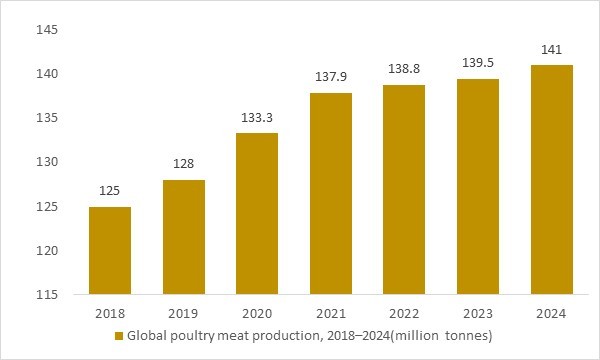
The QSR equipment market continues to strengthen in line with rising global poultry meat production, which has expanded from about 125 million tonnes in 2018 to nearly 140 million tonnes in 2023 and is forecast to exceed 141 million tonnes in 2024e. As poultry remains the core protein for fast-food menus worldwide, growing supply directly supports higher kitchen throughput and transaction volumes across franchise and chained restaurant formats. This increasing demand pressures operators to invest in advanced fryers, grills, ovens, holding units, refrigeration and automated preparation systems to maintain speed, consistency and food safety. With rapid QSR expansion in emerging markets and menu diversification in mature regions, the market for durable, energy-efficient and digitally enabled QSR equipment continues to show strong long-term momentum.
Report Scope
| Parameter | Quick Service Restaurant (QSR) Equipment Market scope Detail |
| Base Year | 2024 |
| Estimated Year | 2025 |
| Forecast Period | 2026-2032 |
| Market Size-Units | USD billion |
| Market Splits Covered | By Product, By Application, By End User and By Technology |
| Countries Covered | North America (USA, Canada, Mexico) |
| Analysis Covered | Latest Trends, Driving Factors, Challenges, Trade Analysis, Price Analysis, Supply-Chain Analysis, Competitive Landscape, Company Strategies |
| Customization | 10% free customization (up to 10 analyst hours) to modify segments, geographies, and companies analyzed |
| Post-Sale Support | 4 analyst hours, available up to 4 weeks |
| Delivery Format | The Latest Updated PDF and Excel Data file |
Quick Service Restaurant (QSR) Equipment Market Segmentation
By Type
- Cooking Equipment
- Refrigeration Equipment
- Food Preparation Equipment
- Serving Equipment
By Application
- In-store
- Drive-thru
- Delivery
By End User
- Chain QSRs
- Independent QSRs
By Technology
- Traditional Equipment
- Smart Equipment
By Distribution Channel
- Online
- Offline
By Geography
- North America (USA, Canada, Mexico)
- Europe (Germany, UK, France, Spain, Italy, Rest of Europe)
- Asia-Pacific (China, India, Japan, Australia, Vietnam, Rest of APAC)
- The Middle East and Africa (Middle East, Africa)
- South and Central America (Brazil, Argentina, Rest of SCA)
Companies in the Quick Service Restaurant (QSR) Equipment Market
- Hobart
- Vollrath
- Middleby Corporation
- ITW Food Equipment Group
- Alto-Shaam
- Ali Group
- Welbilt (Part of Ali Group)
- Rational AG
- TurboChef (Middleby Corporation)
- Electrolux Professional
- Hatco Corporation
- Henny Penny
- Manitowoc Ice
- Frymaster (Welbilt)
- Waring Commercial
Recent Developments
July 2025 – Middleby Corporation introduced a new line of energy-efficient kitchen equipment tailored for quick service restaurants, focusing on reducing operational costs and improving food preparation speed.
June 2025 – Welbilt expanded its smart equipment range with IoT-enabled fryers and ovens, allowing QSR operators to monitor performance and schedule maintenance remotely for enhanced uptime.
May 2025 – Hoshizaki America launched advanced ice machines and beverage dispensers designed specifically for high-volume QSR operations, addressing rising demand for reliable and rapid service solutions.
April 2025 – Demand for automated cooking and food preparation systems surged among global QSR chains, prompting equipment manufacturers to invest in robotics and AI-driven technologies for increased efficiency.
FAQ's
The Global Quick Service Restaurant (QSR) Equipment Market is estimated to generate USD 24.48 Billion in revenue in 2025.
The Global Quick Service Restaurant (QSR) Equipment Market is expected to grow at a Compound Annual Growth Rate (CAGR) of 6.5% during the forecast period from 2025 to 2032.
The Quick Service Restaurant (QSR) Equipment Market is estimated to reach USD 38.15 Billion by 2032.
Didn’t find what you’re looking for? TALK TO OUR ANALYST TEAM
Need something within your budget? NO WORRIES! WE GOT YOU COVERED!


