"The Skin And Hide Market is valued at $ 127.7 billion in 2025. Further, the market is expected to grow at a CAGR of 6.5% to reach $ 224.4 billion by 2034."
The global skin and hide market plays a foundational role in the leather supply chain, serving as a primary raw material source for industries such as footwear, automotive upholstery, furniture, and fashion. It encompasses the trading and processing of raw animal hides (primarily bovine, ovine, and porcine) and skins used in producing finished leather products. Market growth is influenced by both supply-side factors, like livestock population and slaughter rates, and demand-side drivers such as rising leather consumption, fashion cycles, and automotive seating upgrades. Environmental regulations, traceability issues, and growing interest in synthetic alternatives are reshaping the dynamics of traditional hide and skin processing. The sector is also being challenged by shifting consumer preferences toward cruelty-free and sustainable products, although premium leather continues to enjoy high demand, particularly in luxury and performance segments.
Developing countries in Africa, South America, and Asia remain crucial suppliers of raw hides and skins due to large livestock bases, while North America and Europe dominate in high-value processing and export of finished leather. Technological advancements in tanning, sustainability in processing (such as chrome-free tanning), and traceable supply chains are gaining attention across the industry. Global fluctuations in meat consumption, disease outbreaks (e.g., foot-and-mouth), and leather alternatives also affect supply patterns. Meanwhile, government-supported livestock initiatives and export promotions continue to influence regional market competitiveness. Price volatility, geopolitical tensions affecting trade routes, and increasing scrutiny over environmental compliance remain key market concerns for stakeholders.
Cattle hides represent the largest segment by products in the skin and hide market, as they are widely used in the global leather industry due to their abundance, consistent quality, and strong demand from footwear, automotive, and furniture sectors. Their superior durability and large surface area make them the preferred choice for high-value leather goods.
Natural hides hold the dominant share by type, driven by increasing demand for genuine leather in luxury goods, automotive interiors, and premium upholstery. The authenticity, comfort, and unique texture of natural leather continue to attract both manufacturers and consumers despite the growth of artificial alternatives.
Key Insights
-
The market for raw hides and skins is directly impacted by global meat industry trends, as hides are a by-product of slaughterhouses, making meat consumption and processing volumes primary growth drivers.
-
Asia-Pacific dominates global hide and skin processing volumes, especially China and India, owing to high livestock populations and extensive tanning capacities catering to footwear and apparel industries.
-
Demand for full-grain and top-grain leather from bovine hides continues to outpace other hide types due to its superior quality, durability, and preference in luxury and automotive segments.
-
Environmental regulations on effluent discharge, chemical usage (like chromium), and carbon footprint are pushing tanneries to adopt sustainable and eco-friendly practices across all major markets.
-
Technological upgrades, including enzyme-assisted dehairing and waterless tanning, are reshaping how skins and hides are processed, with a focus on improving yield and reducing environmental impact.
-
Consumer demand for sustainable and traceable leather goods is compelling suppliers to improve transparency in sourcing and invest in supply chain certification and origin tracking tools.
-
Africa is emerging as a key exporter of raw hides and skins, especially from Ethiopia, Nigeria, and Kenya, due to favorable livestock demographics and supportive government policies for the leather sector.
-
Leather substitutes like PU and mushroom leather are affecting hide demand in specific fashion and retail segments, although they currently lack the performance durability of genuine leather.
-
Volatility in hide prices is common due to fluctuations in livestock supply, changes in consumer leather preferences, and disruptions like animal disease outbreaks or trade restrictions.
-
Global efforts to reduce animal waste and improve by-product utilization from the meat sector are providing new opportunities for efficient hide and skin processing in both developed and emerging markets.
Global cattle hides production, 2018–2024 (million tonnes)
Figure: Global production of cattle hides increased from roughly 8.2 million tonnes in 2018 to about 9.0 million tonnes by 2024. As cattle hides account for the majority of raw material used in leather, this steady expansion in hides availability underpins long-term growth in the skin and hide market, supporting tannery capacity utilisation and downstream demand from footwear, upholstery, automotive interiors and industrial leather applications. OG Analysis estimates, aligned with international livestock and hides statistics, highlight how upstream cattle slaughter trends shape the skins and hides value chain.
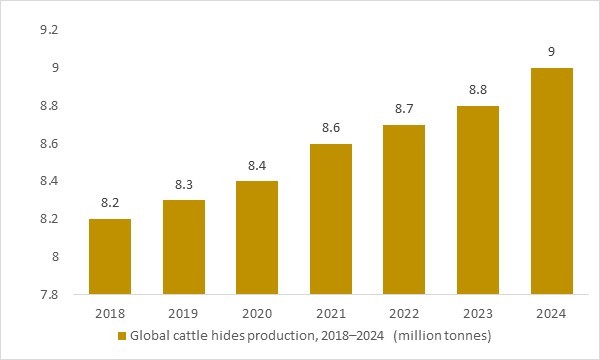
Global cattle hides output – the core raw material for the skins and hides value chain – has risen from roughly 8.2 million tonnes in 2018 to almost 9.0 million tonnes by 2024. FAO-based statistics show that total cattle hides production reached about 8.7 million tonnes in 2022, an all-time high, and continues to expand in line with beef slaughter and livestock population growth in key producing regions such as China, the United States, Brazil and India. As cattle hides account for the majority of raw material used in leather, this gradual but steady increase in hides availability underpins long-term growth in the skin and hide market, supporting tannery capacity utilisation and supplying downstream demand from footwear, upholstery, automotive interiors, fashion accessories and industrial leather goods.
Reort Scope
| Parameter | skin and hide Market scope Detail |
| Base Year | 2024 |
| Estimated Year | 2025 |
| Forecast Period | 2026-2032 |
| Market Size-Units | USD billion |
| Market Splits Covered | By Product, By Application, By End User and By Technology |
| Countries Covered | North America (USA, Canada, Mexico) |
| Analysis Covered | Latest Trends, Driving Factors, Challenges, Trade Analysis, Price Analysis, Supply-Chain Analysis, Competitive Landscape, Company Strategies |
| Customization | 10% free customization (up to 10 analyst hours) to modify segments, geographies, and companies analyzed |
| Post-Sale Support | 4 analyst hours, available up to 4 weeks |
| Delivery Format | The Latest Updated PDF and Excel Data file |
Market Segmentation
By Products
- Cattle Hides
- Buffalo Hides
- Horse Hides
By Type
- Natural
- Artificial
By Application
- Household
- Commercial
By Geography
- North America (USA, Canada, Mexico)
- Europe (Germany, UK, France, Spain, Italy, Rest of Europe)
- Asia-Pacific (China, India, Japan, Australia, Vietnam, Rest of APAC)
- The Middle East and Africa (Middle East, Africa)
- South and Central America (Brazil, Argentina, Rest of SCA)
Key Market Players
- Norilia Nordic AS
- Sanimax Corporation
- Texpac Hide & Skin Ltd.
- AI Bravo Leather Industries
- J & E Sedgwick & Co. Ltd.
- OZ-YUKSEL Leather Company
- JBS Couros S.A.
- Koktaslar Leather
- Siddiq Leather Works Pvt. Ltd.
- Gruppo Mastrotto SpA
- Leather Working Group
- Horween Leather Co.
- Baker Commodities Inc.
- The Hide & Leather House Inc.
- Maverick Leather Company
- PrimeAsia Leather Corporation
- Scottish Leather Group Limited
- Couro Azul S.A.
- Couroart Indústria e Comércio de Couros Ltda.
- Dani Leather
- Eagle Ottawa LLC
- GST AutoLeather Inc.
- Elmo Leather AB
- Garrett Leather
- Shoe Repair And Leather Goods
- Nugget Co.
- Darling International Inc.
- Exeter Machine Co.
- Bandera USA
- Spinneybeck Enterprises Inc. .
What You Receive
• Global Skin And Hide market size and growth projections (CAGR), 2024- 2034
• Impact of recent changes in geopolitical, economic, and trade policies on the demand and supply chain of Skin And Hide.
• Skin And Hide market size, share, and outlook across 5 regions and 27 countries, 2025- 2034.
• Skin And Hide market size, CAGR, and Market Share of key products, applications, and end-user verticals, 2025- 2034.
• Short and long-term Skin And Hide market trends, drivers, restraints, and opportunities.
• Porter’s Five Forces analysis, Technological developments in the Skin And Hide market, Skin And Hide supply chain analysis.
• Skin And Hide trade analysis, Skin And Hide market price analysis, Skin And Hide Value Chain Analysis.
• Profiles of 5 leading companies in the industry- overview, key strategies, financials, and products.
• Latest Skin And Hide market news and developments.
The Skin And Hide Market international scenario is well established in the report with separate chapters on North America Skin And Hide Market, Europe Skin And Hide Market, Asia-Pacific Skin And Hide Market, Middle East and Africa Skin And Hide Market, and South and Central America Skin And Hide Markets. These sections further fragment the regional Skin And Hide market by type, application, end-user, and country.
Who can benefit from this research
The research would help top management/strategy formulators/business/product development/sales managers and investors in this market in the following ways
1. The report provides 2024 Skin And Hide market sales data at the global, regional, and key country levels with a detailed outlook to 2034, allowing companies to calculate their market share and analyze prospects, uncover new markets, and plan market entry strategy.
2. The research includes the Skin And Hide market split into different types and applications. This segmentation helps managers plan their products and budgets based on the future growth rates of each segment
3. The Skin And Hide market study helps stakeholders understand the breadth and stance of the market giving them information on key drivers, restraints, challenges, and growth opportunities of the market and mitigating risks
4. This report would help top management understand competition better with a detailed SWOT analysis and key strategies of their competitors, and plan their position in the business
5. The study assists investors in analyzing Skin And Hide business prospects by region, key countries, and top companies' information to channel their investments.
FAQ's
The Global Skin And Hide Market is expected to grow at a Compound Annual Growth Rate (CAGR) of 6.5% during the forecast period from 2025 to 2034.
The Skin And Hide Market is estimated to reach USD 224.4 billion by 2034.
The Global Skin And Hide Market is estimated to generate USD 127.7 billion in revenue in 2025.
Didn’t find what you’re looking for? TALK TO OUR ANALYST TEAM
Need something within your budget? NO WORRIES! WE GOT YOU COVERED!


