Smart Bathroom Market Analysis and Outlook Report: Industry Size, Share, Growth Trends, and Forecast (2026-2034)

Published On: Jan, 2026
|
Pages: 151

"The Global Smart Bathroom Market valued at USD 9.3 Billion in 2024, is expected to grow by 12.3% CAGR to reach market size worth USD 30.1 Billion by 2034."

The Smart Bathroom Market is witnessing a transformative wave of innovation, driven by increasing consumer demand for convenience, sustainability, and advanced technology. As 2024 unfolds, we observe significant advancements in smart bathroom solutions, ranging from intelligent water management systems to IoT-enabled fixtures. These innovations not only enhance user experience but also contribute to energy and water conservation, aligning with the growing trend towards eco-friendliness. The integration of artificial intelligence in bathroom products, such as smart mirrors that provide personalized health insights and smart showers that optimize water usage, is shaping a new paradigm in personal care spaces.

Looking ahead to 2025, the market is poised for robust growth, supported by the expansion of smart home ecosystems and the continuous evolution of consumer preferences towards connected devices. Emerging technologies, such as voice control and mobile applications, will play a crucial role in enhancing user interaction with bathroom products, allowing for seamless integration and control. This trend is further fueled by the rising influence of millennials and tech-savvy consumers who prioritize smart living. As manufacturers innovate and adapt to these preferences, we can expect a dynamic landscape that caters to diverse needs, ensuring that smart bathrooms become an integral part of modern households.
The Global Smart Bathroom Market Analysis Report will provide a comprehensive assessment of business dynamics, offering detailed insights into how companies can navigate the evolving landscape to maximize their market potential through 2034. This analysis will be crucial for stakeholders aiming to align with the latest industry trends and capitalize on emerging market opportunities.
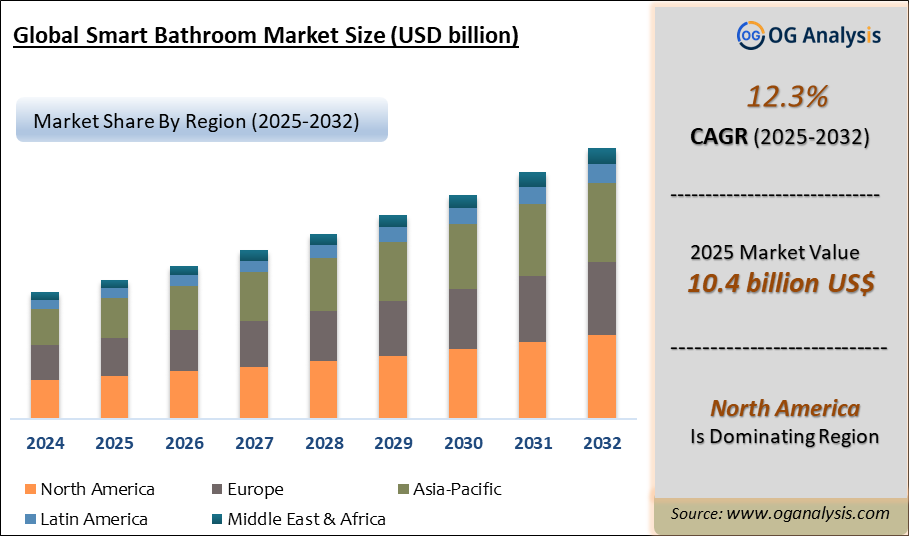
 

Global Smart Bathroom Market Analysis 2025-2032: Industry Size, Share, Growth Trends, Competition and Forecast Report

Smart Bathroom Market Strategy, Price Trends, Drivers, Challenges and Opportunities to 2034

In terms of market strategy, price trends, drivers, challenges, and opportunities from2025 to 2034, Smart Bathroom market players are directing investments toward acquiring new technologies, securing raw materials through efficient procurement and inventory management, enhancing product portfolios, and leveraging capabilities to sustain growth amidst challenging conditions. Regional-specific strategies are being emphasized due to highly varying economic and social challenges across countries.

Factors such as global economic slowdown, the impact of geopolitical tensions, delayed growth in specific regions, and the risks of stagflation necessitate a vigilant and forward-looking approach among Smart Bathroom industry players. Adaptations in supply chain dynamics and the growing emphasis on cleaner and sustainable practices further drive strategic shifts within companies.

The market study delivers a comprehensive overview of current trends and developments in the Smart Bathroom industry, complemented by detailed descriptive and prescriptive analyses for insights into the market landscape until 2034.
The North America Smart Bathroom Market Outlook

The North America Smart Bathroom market experienced notable growth in 2024, driven by advancements in sustainable materials and smart infrastructure solutions. Increasing investment in green building initiatives, alongside stringent environmental regulations, has bolstered demand for high-performance products. The Smart Bathroom market is poised for accelerated growth from 2025, supported by factors such as federal incentives for energy-efficient buildings, a rebound in construction activity, and the adoption of smart technologies across residential and commercial projects. The competitive landscape features key players focusing on innovation, partnerships, and expansion, leveraging advancements in digital design and manufacturing to enhance efficiency and cost-effectiveness.
 

Europe Smart Bathroom Market Outlook

In Europe, the Smart Bathroom market flourished in 2024, driven by regulatory mandates emphasizing sustainability and energy efficiency. Urban redevelopment projects, coupled with the EU's green initiatives, have catalyzed demand for eco-friendly construction materials. Growth from 2025 is expected to be propelled by continued technological innovation and funding for smart city projects, with emphasis on renewable energy integration and resilient infrastructure. Key competitors in the region are investing in circular economy models and expanding production capacity to address rising demand, particularly in markets like Germany, France, and the UK.

Asia-Pacific Smart Bathroom Market Forecast

The Asia-Pacific Smart Bathroom market witnessed robust growth in 2024, underpinned by rapid urbanization, infrastructure expansion, and rising residential construction activity in countries such as China and India. Significant demand was observed in markets like shotcrete, protective packaging, and pressure vessels, driven by large-scale infrastructure projects and industrial development. From 2025, growth is anticipated to accelerate due to government initiatives aimed at affordable housing and modernizing aging infrastructure. Competitive dynamics in the region are shaped by strategic alliances, local manufacturing setups, and R&D investments, with global and regional players striving to meet the surging demand for high-performance materials and smart solutions.

Middle East, Africa, Latin America Smart Bathroom Market Overview

The Middle East, Africa, Latin America Smart Bathroom market showed steady progress in 2024, fueled by infrastructure development in regions like the Middle East and Africa and industrial growth in South America. Markets such as bulk terminals, busway-bus duct, and shore power benefited from growing trade, port development, and energy efficiency mandates. Anticipated growth from 2025 will be driven by investment in megaprojects, such as smart cities and renewable energy installations, alongside increasing adoption of sustainable construction practices. Regional competitors focus on cost optimization and localization strategies, while global players expand their footprint through partnerships and customized offerings tailored to local needs.

Smart Bathroom Market Dynamics and Future Analytics

The research analyses the Smart Bathroom parent market, derived market, intermediaries’ market, raw material market, and substitute market are all evaluated to better prospect the Smart Bathroom market outlook. Geopolitical analysis, demographic analysis, and Porter’s five forces analysis are prudently assessed to estimate the best Smart Bathroom market projections.

Recent deals and developments are considered for their potential impact on Smart Bathroom's future business. Other metrics analyzed include the Threat of New Entrants, Threat of New Substitutes, Product Differentiation, Degree of Competition, Number of Suppliers, Distribution Channel, Capital Needed, Entry Barriers, Govt. Regulations, Beneficial Alternative, and Cost of Substitute in Smart Bathroom market.

Smart Bathroom trade and price analysis helps comprehend Smart Bathroom's international market scenario with top exporters/suppliers and top importers/customer information. The data and analysis assist our clients in planning procurement, identifying potential vendors/clients to associate with, understanding Smart Bathroom price trends and patterns, and exploring new Smart Bathroom sales channels. The research will be updated to the latest month to include the impact of the latest developments such as the Russia-Ukraine war on the Smart Bathroom market.

Smart Bathroom Market Structure, Competitive Intelligence and Key Winning Strategies

The report presents detailed profiles of top companies operating in the Smart Bathroom market and players serving the Smart Bathroom value chain along with their strategies for the near, medium, and long term period.

OGAnalysis’ proprietary company revenue and product analysis model unveils the Smart Bathroom market structure and competitive landscape. Company profiles of key players with a business description, product portfolio, SWOT analysis, Financial Analysis, and key strategies are covered in the report. It identifies top-performing Smart Bathroom products in global and regional markets. New Product Launches, Investment & Funding updates, Mergers & Acquisitions, Collaboration & Partnership, Awards and Agreements, Expansion, and other developments give our clients the Smart Bathroom market update to stay ahead of the competition.
Company offerings in different segments across Asia-Pacific, Europe, the Middle East, Africa, and South and Central America are presented to better understand the company strategy for the Smart Bathroom market. The competition analysis enables users to assess competitor strategies and helps align their capabilities and resources for future growth prospects to improve their market share.

Smart Bathroom Market Research Scope
• Global Smart Bathroom market size and growth projections (CAGR), 2024- 2034
• Policies of USA New President Trump, Russia-Ukraine War, Israel-Palestine, Middle East Tensions Impact on the Smart Bathroom Trade and Supply-chain
• Smart Bathroom market size, share, and outlook across 5 regions and 27 countries, 2023- 2034
• Smart Bathroom market size, CAGR, and Market Share of key products, applications, and end-user verticals, 2023- 2034
• Short and long-term Smart Bathroom market trends, drivers, restraints, and opportunities
• Porter’s Five Forces analysis, Technological developments in the Smart Bathroom market, Smart Bathroom supply chain analysis
• Smart Bathroom trade analysis, Smart Bathroom market price analysis, Smart Bathroom supply/demand
• Profiles of 5 leading companies in the industry- overview, key strategies, financials, and products
• Latest Smart Bathroom market news and developments
The Smart Bathroom Market international scenario is well established in the report with separate chapters on North America Smart Bathroom Market, Europe Smart Bathroom Market, Asia-Pacific Smart Bathroom Market, Middle East and Africa Smart Bathroom Market, and South and Central America Smart Bathroom Markets. These sections further fragment the regional Smart Bathroom market by type, application, end-user, and country.


Regional Insights
North America Smart Bathroom market data and outlook to 2034
United States
Canada
Mexico

Europe Smart Bathroom market data and outlook to 2034
Germany
United Kingdom
France
Italy

Market Scope

Parameter

Detail

Base Year

2024

Estimated Year

2025

Forecast Period

2026-2032

Market Size-Units

USD billion

Market Splits Covered

By Product, By Application and By End-User

Countries Covered

North America (USA, Canada, Mexico)
Europe (Germany, UK, France, Spain, Italy, Rest of Europe)
Asia-Pacific (China, India, Japan, Australia, Rest of APAC)
The Middle East and Africa (Middle East, Africa)
South and Central America (Brazil, Argentina, Rest of SCA)

Analysis Covered

Latest Trends, Driving Factors, Challenges, Trade Analysis, Price Analysis, Supply-Chain Analysis, Competitive Landscape, Company Strategies

Customization

10% free customization (up to 10 analyst hours) to modify segments, geographies, and companies analysed

Post-Sale Support

4 analyst hours, available up to 4 weeks

Delivery Format

The Latest Updated PDF and Excel Data file

Spain
BeNeLux
Russia

Asia-Pacific Smart Bathroom market data and outlook to 2034
China
Japan
India
South Korea
Australia
Indonesia
Malaysia
Vietnam

Middle East and Africa Smart Bathroom market data and outlook to 2034
Saudi Arabia
South Africa
Iran
UAE
Egypt

South and Central America Smart Bathroom market data and outlook to 2034
Brazil
Argentina
Chile
Peru

* We can include data and analysis of additional coutries on demand

Who can benefit from this research
The research would help top management/strategy formulators/business/product development/sales managers and investors in this market in the following ways
1. The report provides 2024 Smart Bathroom market sales data at the global, regional, and key country levels with a detailed outlook to 2034 allowing companies to calculate their market share and analyze prospects, uncover new markets, and plan market entry strategy.

2. The research includes the Smart Bathroom market split into different types and applications. This segmentation helps managers plan their products and budgets based on the future growth rates of each segment

3. The Smart Bathroom market study helps stakeholders understand the breadth and stance of the market giving them information on key drivers, restraints, challenges, and growth opportunities of the market and mitigating risks

4. This report would help top management understand competition better with a detailed SWOT analysis and key strategies of their competitors, and plan their position in the business

5. The study assists investors in analyzing Smart Bathroom business prospects by region, key countries, and top companies' information to channel their investments.

Available Customizations
The standard syndicate report is designed to serve the common interests of Smart Bathroom Market players across the value chain and include selective data and analysis from entire research findings as per the scope and price of the publication.
However, to precisely match the specific research requirements of individual clients, we offer several customization options to include the data and analysis of interest in the final deliverable.
Some of the customization requests are as mentioned below –
Segmentation of choice – Our clients can seek customization to modify/add a market division for types/applications/end-uses/processes of their choice.
Smart Bathroom Pricing and Margins Across the Supply Chain, Smart Bathroom Price Analysis / International Trade Data / Import-Export Analysis,
Supply Chain Analysis, Supply – Demand Gap Analysis, PESTLE Analysis, Macro-Economic Analysis, and other Smart Bathroom market analytics
Processing and manufacturing requirements, Patent Analysis, Technology Trends, and Product Innovations
Further, the client can seek customization to break down geographies as per their requirements for specific countries/country groups such as South East Asia, Central Asia, Emerging and Developing Asia, Western Europe, Eastern Europe, Benelux, Emerging and Developing Europe, Nordic countries, North Africa, Sub-Saharan Africa, Caribbean, The Middle East and North Africa (MENA), Gulf Cooperation Council (GCC) or any other.
Capital Requirements, Income Projections, Profit Forecasts, and other parameters to prepare a detailed project report to present to Banks/Investment Agencies.
Customization of up to 10% of the content can be done without any additional charges.

Note Latest developments will be updated in the report and delivered within 2 to 3 working days


smart bathroom market Segmentation

by Product Type
- Hi-Tech Toilets
- Soaking Tubs
- Digital Faucets
- Others

by Connectivity
- Bluetooth
- Wi-Fi
- 3G

by End User
- Commercial
- Residential

By Geography
- North America (USA, Canada, Mexico)
- Europe (Germany, UK, France, Spain, Italy, Rest of Europe)
- Asia-Pacific (China, India, Japan, Australia, Vietnam, Rest of APAC)
- The Middle East and Africa (Middle East, Africa)
- South and Central America (Brazil, Argentina, Rest of SCA)

Market Players

  • Jacuzzi Brands

  • Villeroy & Boch

  • Signature Hardware

  • Pfister

  • Kraus USA

  • Delta Faucet Company

  • GROHE

  • American Standard

  • Moen

  • Kohler

  • Duravit

  • Roca Sanitario

  • TOTO

  • Aqualisa

  • GetHai

  • WaterHawk

  • Dornbracht

You can purchase individual sections of this report. Explore pricing options for specific sections.

FAQ's

The Global Smart Bathroom Market is estimated to generate USD 10.3 Billion in revenue in 2025

The Global Smart Bathroom Market is expected to grow at a Compound Annual Growth Rate (CAGR) of 12.3% during the forecast period from 2025 to 2034.

The Smart Bathroom Market is estimated to reach USD 30.1 Billion by 2034.

License

Didn’t find what you’re looking for? TALK TO OUR ANALYST TEAM

Need something within your budget? NO WORRIES! WE GOT YOU COVERED!

Related Products

UV Nail Gel Lamp Market Analysis and Outlook Report: Industry Size, Share, Growth Trends, and Forecast (2026-2034)

The UV Nail Gel Lamp Market is a growing segment within the beauty and personal care industry, driven by increasing consumer interest in professional-quality nail treatments at home and in salons. UV nail gel lamps are used to cure gel-based nail polish through ultraviolet or LED light, ensuring long-lasting, durable, and high-gloss finishes. These devices are widely used across beauty salons, nail studios, and increasingly by individual consumers for at-home nail care routines. Key applications include manicure and pedicure treatments, professional nail art, and cosmetic enhancements. Recent trends highlight the shift toward LED-based lamps for faster curing, reduced energy consumption, and improved safety. Additionally, compact, portable, and user-friendly designs are gaining popularity, particularly among home users. The integration of smart features such as timers, automatic sensors, and multiple curing modes is further enhancing usability and convenience. Market growth is driven by rising beauty consciousness, increasing disposable income, and growing influence of social media trends that promote nail art and grooming. Consumers are increasingly seeking cost-effective alternatives to salon visits, driving demand for home-use devices. The competitive landscape is characterized by beauty equipment manufacturers, consumer electronics brands, and specialized cosmetic device companies offering a wide range of products across price segments. Technological advancements in LED curing technology, ergonomic design, and safety features are improving product performance and expanding adoption. However, the market faces challenges such as concerns regarding UV exposure, product standardization, and availability of low-cost alternatives. Despite these challenges, the market outlook remains positive, supported by continued innovation, expansion of the beauty and personal care sector, and increasing demand for convenient and efficient nail care solutions. Key Insights The transition from traditional nail drying methods to UV and LED curing technologies has significantly improved efficiency and durability of nail treatments. These technologies enable faster curing and longer-lasting finishes. This shift has been a key factor in the growth of the market. LED-based nail lamps are increasingly replacing traditional UV lamps due to their faster curing time, energy efficiency, and reduced exposure to harmful radiation. These advantages are driving consumer preference toward LED devices. This trend is shaping product development and innovation. The growing popularity of at-home beauty treatments is a major driver, with consumers seeking convenient and cost-effective alternatives to salon services. UV nail gel lamps are becoming essential tools for personal grooming. This trend is expanding the consumer base beyond professional users. Professional salons remain a key end-use segment, with demand for high-performance, durable, and multi-functional devices that support a wide range of nail treatments. Salons require reliable equipment for consistent results. This segment continues to drive premium product demand. Product innovation in design and functionality is enhancing user experience, with features such as automatic sensors, adjustable timers, and ergonomic shapes improving usability. These innovations are making devices more accessible to a wider audience. Design differentiation is becoming a competitive factor. The influence of social media and beauty trends is significantly impacting market demand, with increasing interest in nail art and personalized styling. Consumers are adopting new products inspired by online content. This trend is driving product adoption and brand visibility. Safety concerns related to UV exposure are influencing product development, with manufacturers focusing on safer technologies and improved protective features. Awareness of health considerations is shaping consumer preferences. This is encouraging innovation in safer alternatives. The future of the market will be driven by continuous innovation in curing technologies, expansion of home-use devices, and increasing focus on safety and convenience. Companies that can offer high-quality, efficient, and user-friendly products will gain a competitive advantage. As beauty trends evolve, UV nail gel lamps will remain integral to modern nail care solutions. Regional Analysis North America UV Nail Gel Lamp Market North America represents a mature and innovation-driven market, supported by strong consumer awareness of beauty and grooming trends and high adoption of professional and at-home nail care solutions. The region is witnessing increasing demand for advanced LED-based nail lamps, integration of smart features, and growth in DIY beauty practices. Recent trends include expansion of premium product segments, rise of influencer-driven beauty trends, and increasing focus on safety and skin-friendly technologies. Opportunities lie in product innovation, development of multifunctional devices, and expansion of e-commerce channels. The market outlook remains strong, driven by consumer lifestyle trends and continuous advancements in beauty technology. Europe UV Nail Gel Lamp Market Europe demonstrates a structured and quality-focused market, characterized by strong emphasis on safety standards, product quality, and sustainable beauty practices. The region is experiencing steady demand for UV nail gel lamps across salons and home users. Recent developments include adoption of eco-friendly materials, integration of advanced LED technologies, and increasing focus on safe and dermatologically tested devices. Opportunities are emerging in premium product offerings, sustainable packaging, and expansion of professional salon equipment. The market is expected to grow steadily, supported by regulatory frameworks and increasing consumer awareness of safe beauty products. Asia Pacific UV Nail Gel Lamp Market Asia Pacific is the fastest-growing and most dynamic market, driven by rising beauty consciousness, expanding middle-class population, and strong influence of fashion and social media trends. The region is witnessing significant demand for affordable and innovative nail care devices, particularly in countries with rapidly growing personal care industries. Recent trends include widespread adoption of home-use devices, growth in online retail platforms, and increasing popularity of nail art and customization. Significant opportunities exist in mass-market products, localized innovations, and expansion of distribution networks. The market outlook is highly promising, supported by economic growth and increasing consumer spending on beauty products. Middle East & Africa UV Nail Gel Lamp Market The Middle East & Africa market is in a developing phase, with growing interest in beauty and personal care products and increasing adoption of modern grooming solutions. The region is witnessing gradual expansion of salon services and rising demand for home-use devices. Recent developments include growth in premium beauty segments, expansion of retail channels, and increasing awareness of personal grooming trends. Opportunities lie in luxury product offerings, development of cost-effective solutions, and expansion of distribution networks. Future growth will depend on economic development, consumer awareness, and increasing adoption of beauty technologies. South & Central America UV Nail Gel Lamp Market South & Central America is an emerging market characterized by growing demand for beauty and personal care products and increasing influence of global fashion trends. The region is experiencing rising adoption of UV nail gel lamps in both salons and home settings. Recent trends include expansion of beauty salons, growth in DIY grooming practices, and increasing availability of affordable devices. Opportunities are centered around product accessibility, development of region-specific offerings, and expansion of online sales channels. The market outlook remains positive, driven by consumer lifestyle changes, urbanization, and increasing interest in personal grooming and beauty solutions. Market Scope Parameter UV Nail Gel Lamp Market Detail Base Year 2025 Estimated Year 2026 Forecast Period 2026-2034 Market Size-Units USD billion Market Splits Covered By Type, By Design & Form Factor, By End-User, By Distribution Channel Countries Covered North America (USA, Canada, Mexico) Europe (Germany, UK, France, Spain, Italy, Rest of Europe) Asia-Pacific (China, India, Japan, Australia, Rest of APAC) The Middle East and Africa (Middle East, Africa) South and Central America (Brazil, Argentina, Rest of SCA) Analysis Covered Latest Trends, Driving Factors, Challenges, Trade Analysis, Price Analysis, Supply-Chain Analysis, Competitive Landscape, Company Strategies Customization 10% free customization (up to 10 analyst hours) to modify segments, geographies, and companies analyzed Post-Sale Support 4 analyst hours, available up to 4 weeks Delivery Format The Latest Updated PDF and Excel Data file

Published:Mar-2026

Skateboard Market Analysis and Outlook Report: Industry Size, Share, Growth Trends, and Forecast (2026-2034)

The Skateboard market has developed from a niche youth-driven activity into a globally recognized action-sports and lifestyle category with relevance across recreation, competitive sport, urban mobility, and fashion-led consumer spending. Demand is centered on street boards, park boards, longboards, cruisers, decks, trucks, wheels, bearings, footwear, protective gear, and branded apparel, with usage spanning casual riding, skill development, organized competition, commuting, and community-driven participation. One of the most important shifts in the market has been the stronger mainstream visibility of the sport through international competition and structured event ecosystems, which has widened the participation base and created new pathways for athletes, coaches, brands, and retailers. At the same time, the category remains strongly influenced by authenticity, local skate-shop culture, rider identity, and style-led purchasing, which means performance, design, and brand credibility matter as much as functional utility. Market momentum is also being supported by youth engagement, women’s participation, destination events, and the growing connection between skating, music, streetwear, and digital content culture. From a competitive perspective, the industry is shaped by core skate brands, footwear companies, sporting-goods players, specialty retailers, and creator-led labels competing through deck design, rider associations, limited-edition releases, durability, performance tuning, and cultural relevance. A major trend is the broadening of the category beyond traditional hardgoods into a more complete ecosystem that includes footwear innovation, event sponsorship, youth development, women-focused inclusion programs, and sustainability-oriented product experimentation. Another notable development is the increasing globalization of talent, with multiple regions now contributing strongly to competitive street and park disciplines. Looking ahead, market growth is expected to be supported by continued visibility of the sport, stronger grassroots development, premiumization in components and apparel, and rising consumer interest in brands that can combine performance, community legitimacy, and responsible product positioning. Overall, the market remains highly culture-driven, but it is also becoming more structured, commercially layered, and globally diversified, creating opportunities across equipment, apparel, events, retail, and brand-led community engagement. Key Market Insights International competitive visibility has become one of the strongest modern growth catalysts. Greater exposure through global competitions has expanded the sport’s reach well beyond its traditional core audience and helped attract younger participants, sponsors, training systems, and new consumers. This has improved the commercial outlook for boards, components, footwear, protective gear, and event-linked merchandise. It has also created a more structured path from beginner participation to elite competition. The long-term effect is a broader consumer base and stronger legitimacy for the category across regions. This momentum is expected to continue supporting market expansion in the years ahead. Street and park remain the most commercially influential riding formats. These two disciplines dominate event programming, athlete development, media attention, and product storytelling across the industry. As a result, board design, wheel setup, footwear, and protective gear innovation are often shaped around their performance needs. Street retains especially strong resonance because of its cultural authenticity and direct connection to urban riding environments. Park continues to support skill progression and visually compelling competition formats. Together, these formats define much of the aspirational and premium side of the market. Youth participation remains the category’s most important long-term demand engine. The market continues to depend heavily on first-time riders, teenage hobbyists, and progression-focused younger consumers entering through local communities, digital content, events, and coaching programs. This matters because equipment, shoes, and apparel all benefit from repeat purchases during the learning and progression cycle. Younger participants also help sustain the energy and cultural relevance that keep the category commercially vibrant. The future demand base will continue to be shaped by how effectively brands, retailers, and organizers engage this segment. Youth-driven participation remains essential to long-term category renewal. Women’s participation is becoming a more visible source of expansion. Greater inclusion, stronger athlete visibility, and broader representation in events are helping widen the consumer base and diversify brand audiences. This is encouraging more inclusive product design, community programming, and marketing strategies across the category. It also improves market resilience by reducing dependence on a narrower legacy user profile. Brands that authentically support women’s skateboarding can strengthen credibility and unlock underpenetrated demand. This trend is expected to remain important in both grassroots and competitive segments. Brand authenticity remains a decisive competitive advantage. Purchasing decisions in this category are shaped heavily by identity, rider endorsement, skate-shop presence, and cultural legitimacy. Consumers often evaluate brands not only by product quality but also by their standing within the skate community. This makes team riders, storytelling, collaborations, and local relevance commercially significant. Larger companies can compete successfully, but only when they maintain trust and credibility within the culture. Community legitimacy will remain central to long-term brand leadership. Footwear and apparel are increasingly important profit and branding layers. The category is no longer driven by hardgoods alone, as skate shoes and streetwear now carry strong influence over revenue mix, brand visibility, and lifestyle appeal. Innovation in shoes remains closely tied to durability, grip, comfort, boardfeel, and athlete collaboration. Apparel extends relevance beyond active riders into a broader fashion and youth-culture audience. This expands the addressable consumer base and strengthens cross-selling potential. Lifestyle integration will continue to support category depth and premium positioning. Sustainability is emerging as a meaningful product-development theme. Deck manufacturing, adhesives, coatings, inks, and raw-material sourcing are receiving greater attention as brands experiment with lower-impact approaches. This trend is still developing, but it reflects growing consumer interest in responsible production without compromising ride quality or design appeal. Sustainability can also help differentiate brands in a category where aesthetics, values, and identity increasingly overlap. Early movers are using environmentally conscious product development to reinforce innovation credentials. Over time, this may become a stronger factor in premium purchase decisions. Global talent diversification is strengthening international demand patterns. Competitive leadership is no longer concentrated in a single geography, with strong representation now coming from multiple regions. This broadens fan engagement, retailer relevance, sponsorship opportunity, and localized brand appeal. It also helps the category scale through regional heroes, local communities, and national event ecosystems. As elite participation becomes more internationally distributed, market development is likely to become more geographically balanced. This gives brands more room to expand beyond traditional strongholds. Events and destination culture are becoming stronger commercial multipliers. Major competitions, tours, and skate-focused destinations increasingly function as platforms for tourism, media exposure, product launches, and community-building. That gives brands more ways to connect retail, storytelling, and live engagement. Event-led momentum also helps cities and regions develop longer-term action-sports identities that support participation and commerce. This expands the market from product sales into a wider ecosystem of experiences and partnerships. The event economy is likely to remain an important accelerator for visibility and brand activation. Future growth will favor companies that balance performance, culture, and inclusion. The strongest players are likely to be those that can deliver durable product quality while remaining relevant to evolving communities, new participants, and changing social values. That means combining technical performance with authentic marketing, broader representation, and more responsible product development. A purely functional approach is unlikely to be enough in a category shaped by identity and participation culture. Brands that support grassroots scenes while also leveraging global visibility are expected to be best positioned. This balance will define the next phase of leadership in the market. Regional Insights North AmericaSkateboard Market North America remains a high-visibility market where culture, retail, and organized events reinforce category demand. The region benefits from a strong base of specialty skate shops, brand-led community engagement, and continued consumer interest in premium decks, footwear, apparel, and protective gear. Market dynamics are shaped by lifestyle positioning, youth participation, and the growing role of destination events and skatepark-linked programs. The most attractive opportunities are in premium hardgoods, direct-to-consumer retail, women’s participation initiatives, and event-driven merchandising. The forecast is positive, with growth likely to favor brands that combine authentic skate credibility with broader lifestyle appeal. Asia PacificSkateboard Market Asia Pacific is expected to remain the strongest growth engine, supported by rising competitive participation, urban youth engagement, and expanding visibility of the sport across key markets. The region is benefiting from stronger event activity, growing skatepark infrastructure, and increasing demand for branded footwear, components, and performance-led boards. Market momentum is especially strong where organized competition, street culture, and lifestyle retail are advancing together. Lucrative opportunities exist in competition-grade equipment, youth-focused product lines, apparel, and local partnerships tied to training and events. The outlook remains strongly positive, particularly in markets where sport participation and consumer spending are rising simultaneously. EuropeSkateboard Market Europe offers a balanced mix of mature skate culture, organized event activity, and broad consumer acceptance, making it one of the most resilient regional markets. Demand is supported by specialty retail, established skate communities, growing women’s participation, and steady interest in branded apparel and higher-end components. Market dynamics are also shaped by strong urban recreation culture and a well-developed competition ecosystem. The most attractive opportunities lie in premium product positioning, grassroots development, coaching programs, and destination events that connect local scenes with international visibility. The forecast is steadily positive, with gains likely for companies that combine community authenticity with structured brand activation. Middle East & AfricaSkateboard Market Middle East & Africa is still a smaller market, but it is becoming more strategically important as the region moves from limited participation toward more structured development. Urban sports adoption, youth-focused recreation initiatives, and growing interest in modern skate infrastructure are helping create a stronger foundation for future demand. The most promising opportunities are in skatepark development, entry-level boards and accessories, coaching ecosystems, and brand partnerships linked to participation-building. Market trends point toward gradual expansion through organized programs rather than immediate large-scale retail maturity. The forecast is moderately positive, with the best upside for companies willing to invest early in awareness and community formation. South & Central AmericaSkateboard Market South & Central America presents one of the most exciting opportunity profiles, supported by strong cultural relevance, rising international visibility, and a growing base of talented riders and engaged consumers. Demand is being shaped by youth participation, community-led skating culture, and increasing interest in pro-style equipment, footwear, and branded apparel. The region offers attractive opportunities in pro-model products, women’s and youth-led marketing, event merchandising, and retail partnerships that align with its strong grassroots identity. Market momentum is also supported by greater recognition of the region as a source of competitive talent and lifestyle influence. The forecast is strong, with growth likely to outpace more mature markets where demand depends more heavily on replacement cycles. Market Scope Parameter Skateboard Market Detail Base Year 2025 Estimated Year 2026 Forecast Period 2026-2034 Market Size-Units USD billion Market Splits Covered By Grade, By Application, By Material, By Distribution Channel Countries Covered North America (USA, Canada, Mexico) Europe (Germany, UK, France, Spain, Italy, Rest of Europe) Asia-Pacific (China, India, Japan, Australia, Rest of APAC) The Middle East and Africa (Middle East, Africa) South and Central America (Brazil, Argentina, Rest of SCA) Analysis Covered Latest Trends, Driving Factors, Challenges, Trade Analysis, Price Analysis, Supply-Chain Analysis, Competitive Landscape, Company Strategies Customization 10% free customization (up to 10 analyst hours) to modify segments, geographies, and companies analyzed Post-Sale Support 4 analyst hours, available up to 4 weeks Delivery Format The Latest Updated PDF and Excel Data file

Published:Mar-2026

Golf Tourism Market Analysis and Outlook Report: Industry Size, Share, Growth Trends and Forecast (2026-2034)

Market Overview The golf tourism market covers domestic and international travel where playing golf is a primary reason for the trip, supported by resorts, destination courses, tour operators, airlines, ground transport, equipment rental, coaching, and event-led travel. Demand is driven by the steady expansion of high-quality courses, better air connectivity to leisure hubs, and the ongoing premiumization of travel—where travelers want curated experiences that blend golf with dining, wellness, beaches, culture, and family-friendly activities. Golf travelers typically represent a higher-spend segment, which makes golf tourism attractive for destinations seeking to raise revenue per visitor and reduce seasonality through shoulder-season packages, tournaments, and multi-course itineraries. The market outlook remains constructive as destinations invest in course upgrades, new resort developments, and tournament-linked branding to attract international golfers. Digital booking platforms and dynamic packaging are simplifying tee-time planning and bundling stays with transfers and add-ons. At the same time, sustainability expectations are rising: water stewardship, drought-resilient turf practices, biodiversity-friendly course management, and lower-carbon travel choices are increasingly influencing operator strategies and traveler perceptions. Competitive advantage will depend on accessibility, course density and variety, service quality, climate reliability, and the ability to deliver seamless end-to-end experiences. Market KeyInsights Golf tourism is shifting from “pure play rounds” to full experiential travel, where course quality is bundled with resort lifestyle, wellness, dining, and local culture. Travelers increasingly choose destinations that offer multiple signature courses within short transfer times. This favors integrated resort clusters and regions with dense course networks. Operators that curate itineraries, not just tee times, capture higher spend. Seasonality management is a core profitability lever, with demand peaking around favorable weather windows and major holiday periods. Destinations are using shoulder-season pricing, events, and package inclusions to smooth occupancy. Flights and hotel capacity strongly influence peak pricing power. Courses that can maintain playability year-round have a structural advantage. International travel recovery is strengthening long-haul golf trips, but shorter regional breaks are also growing as consumers seek flexible, lower-commitment holidays. Weekend and 3–5 day “golf escapes” perform well when direct flights and fast ground transport exist. This increases the importance of connectivity and simplified booking. Multi-destination circuits are gaining popularity for repeat travelers. High-value segments are expanding: groups, corporate outings, and tournament-led travel remain key volume drivers, while premium couples and small groups deliver higher margins. Group coordinators value guaranteed tee blocks, transport, and dining coordination. Corporate demand is closely tied to business sentiment and event calendars. Destinations that can host events efficiently win repeat bookings. Pricing is becoming more dynamic, with tee-time yield management increasingly mirroring hotel and airline tactics. Premium time slots, caddie availability, and limited-access courses command strong price differentials. Bundling (green fees + lodging + transfers) helps protect margins while improving conversion. Transparent “all-in” packages reduce friction for international travelers. Sustainability and climate resilience are becoming purchase criteria, especially where water scarcity, heat stress, or storm disruption is visible. Travelers and tour operators pay more attention to course conditioning, irrigation practices, and environmental credentials. Destinations investing in drought-tolerant turf, reclaimed water, and heat-mitigation amenities improve reliability. Insurance and maintenance costs are rising in higher-risk geographies. Digital convenience is now expected end-to-end: tee-time booking, dynamic packaging, GPS scoring apps, rental reservations, and real-time communication. Frictionless planning matters as much as the on-course experience. Destinations that integrate course inventory with hotels, transport, and payment systems see higher conversion. Data-driven CRM is boosting repeat visits and upsell. Equipment logistics remain a differentiator, with travelers valuing easy club transport, high-quality rentals, and practice facilities. Premium rental fleets reduce barriers for fly-in golfers and support spontaneous bookings. “Travel light” options—shipping partnerships, storage lockers, and fitting services—raise satisfaction and spend. Service consistency (caddies, starters, pace control) drives reviews and referrals. New traveler demographics are broadening the market, including women’s golf trips, mixed-skill groups, and younger players looking for social formats and shorter experiences. This lifts demand for coaching clinics, par-3 courses, and entertainment-led golf venues in destination hubs. Resorts that offer inclusive instruction and flexible formats convert non-traditional golfers. Community and social shareability are influencing destination choice. The competitive landscape is intensifying as destinations invest in signature-course branding, major-event hosting, and luxury accommodation upgrades. Partnerships between courses, hotels, airlines, and tour operators are increasingly important for visibility and distribution. Differentiation comes from unique course architecture, iconic scenery, service quality, and itinerary convenience. Long-term winners will balance premium pricing with consistent conditioning, sustainable operations, and seamless guest journeys. Regional Insights North America In North America, the golf tourism market is supported by a large and active golfer base, a dense network of resort and destination courses, and strong domestic leisure travel that enables both weekend “drive-to” trips and fly-in golf vacations. Market dynamics favor premium experiences and convenience, with resorts and tour operators competing on seamless packaging of tee times, lodging, transport, and lifestyle add-ons, while managing constraints such as peak-season capacity, labor availability, and weather-related disruption. Lucrative opportunities exist for companies that can integrate booking across courses and hotels, deploy dynamic packaging and yield tools, enhance guest experience through digital concierge services, and monetize ancillary spend through instruction, retail, dining, and wellness. Latest trends include experience-led itineraries for mixed groups, growth in corporate and group travel, more sophisticated loyalty models, and increased adoption of tech-enabled on-course services. The forecast remains constructive, driven by premiumization, repeat travel behavior among avid golfers, and continued destination investment, while recent developments center on tighter integration of tee-time inventory with accommodation systems, more curated event calendars, and rising emphasis on sustainability positioning and course-conditioning resilience. Europe In Europe, the golf tourism market is shaped by strong intra-regional mobility, well-established golf cultures, and destination clusters that enable multi-course itineraries with short transfer times, supporting both short breaks and longer seasonal escapes. Market dynamics are influenced by pronounced seasonality, high expectations for course quality and service consistency, and increasing scrutiny around environmental performance, especially water and land-use practices in warmer regions. Lucrative opportunities are strongest for companies offering flexible multi-course passes, tailored group travel and tournament packages, premium hospitality partnerships, and digital platforms that simplify cross-border planning while ensuring transparent inclusions and service standards. Latest trends include sustainability-led destination branding, wider adoption of digital booking and tee-time distribution, elevated culinary and wellness integration, and growth of shoulder-season travel programs that improve occupancy and yields. The forecast outlook remains favorable as destinations continue upgrading resort infrastructure and positioning golf as a high-value tourism segment, with recent developments focusing on eco-focused course management, climate-adaptive maintenance investments, and deeper collaboration between resorts, tourism boards, and specialist travel intermediaries. Asia Pacific In Asia Pacific, the golf tourism market is becoming one of the most dynamic regions, driven by rising disposable incomes, expanding air connectivity across leisure corridors, and growing demand for premium resort travel that combines golf with broader lifestyle experiences. Market dynamics include a mix of mature golf destinations and fast-growing emerging hubs, with demand shaped by outbound travel recovery, growing participation in coaching-led trips, and increasing appetite for curated itineraries, while constraints can include uneven course availability, regulatory variability, and climate-related season planning. Lucrative opportunities exist for companies that can deliver premium concierge-led travel, localized digital booking and customer support, academy and instruction programs tied to resort stays, and partnerships that bundle golf with beach, wellness, shopping, and cultural experiences. Latest trends include resort-led packaging, group travel expansion, technology-driven trip personalization, and stronger destination marketing built around signature courses and events. The forecast remains robust where tourism infrastructure and service quality continue improving, and recent developments highlight new resort openings, greater collaboration between airlines and golf operators, and rising focus on sustainability practices and transparent course stewardship. Middle East & Africa In the Middle East & Africa, the golf tourism market is propelled by luxury hospitality investment, tourism diversification strategies, and destination branding that positions golf as a premium, high-spend travel driver. Market dynamics emphasize high-touch service, iconic course design, and integrated resort experiences, while operational realities such as heat exposure, water stewardship expectations, and demand seasonality influence product design and pricing. Lucrative opportunities are strongest for companies providing end-to-end luxury packaging, corporate and incentive travel programs, digital concierge services, and operational solutions that improve course sustainability such as smart irrigation, drought-resilient turf strategies, and resource-efficiency monitoring. Latest trends include tournament-led travel, real-estate-linked golf resort communities, elevated wellness and culinary integration, and the growth of indoor golf experiences that broaden engagement. The forecast outlook is constructive where connectivity and tourism capacity expand, and recent developments include new course and resort launches, strategic partnerships with airlines and tour operators, and stronger sustainability commitments tied to water management and year-round playability. South & Central America In South & Central America, the golf tourism market is supported by resort destinations that combine golf with beaches, nature, and cultural experiences, attracting both regional travelers and long-haul visitors seeking multi-activity vacations. Market dynamics favor “golf plus lifestyle” packaging and all-inclusive hospitality models, while challenges such as connectivity gaps to select destinations, infrastructure variability, and safety perceptions can shape demand and distribution strategies. Lucrative opportunities exist for companies that build curated packages with reliable ground support, partner with premium resorts to deliver seamless stay-and-play offers, and expand ancillary revenue through lessons, events, and excursions that increase length of stay. Latest trends include stronger destination marketing around flagship resorts, broader experiential layering for mixed groups, improving digital distribution of packages, and increased attention to sustainability positioning aligned with eco-oriented traveler preferences. The forecast remains positive where accessibility and service consistency improve, and recent developments focus on resort upgrades, enhanced guest experience standards, and partnerships that strengthen international distribution and traveler confidence. Report Scope Parameter golf tourism market Detail Base Year 2024 Estimated Year 2025 Forecast Period 2026-2032 Market Size-Units USD billion Market Splits Covered By Product, By Application, By End User, By Technology, By Distribution Channel Countries Covered North America (USA, Canada, Mexico) Europe (Germany, UK, France, Spain, Italy, Rest of Europe) Asia-Pacific (China, India, Japan, Australia, Rest of APAC) The Middle East and Africa (Middle East, Africa) South and Central America (Brazil, Argentina, Rest of SCA) Analysis Covered Latest Trends, Driving Factors, Challenges, Trade Analysis, Price Analysis, Supply-Chain Analysis, Competitive Landscape, Company Strategies Customization 10% free customization (up to 10 analyst hours) to modify segments, geographies, and companies analyzed Post-Sale Support 4 analyst hours, available up to 4 weeks Delivery Format The Latest Updated PDF and Excel Data file

Published:Feb-2026