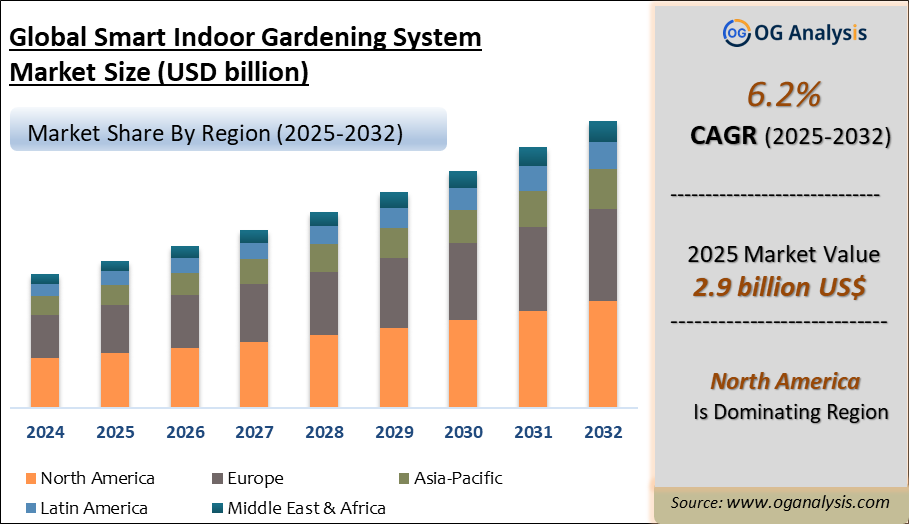
"Global Smart Indoor Gardening System Market is valued at USD 2.9 billion in 2025. Further, the market is expected to grow at a CAGR of 6.2% to reach USD 4.9 billion by 2034."
The Smart Indoor Gardening System market is rapidly gaining momentum as consumers seek ways to grow fresh, pesticide-free produce indoors year-round. These systems combine automated hydroponics or aeroponics with sensors, LED lighting, and app integration to manage water levels, nutrient dosing, and lighting schedules. They appeal to urban dwellers, apartment owners, hobbyists, and even schools and offices, offering convenience, self-sufficiency, and education. The shift toward sustainability, food security concerns, and heightened interest in wellness trends are all driving adoption. At-home gardening is becoming more accessible through subscription-based seed pods, modular kitchen units, and community-focused smart farms.
On the technology front, manufacturers are innovating with AI-powered growth algorithms, remote monitoring through smartphones, and modular design for scalability. Integration with voice assistants and cloud platforms enables real-time alerts and predictive maintenance, while gamification and personalized coaching encourage better plant care. Beyond kitchens, these systems are entering office spaces, restaurants, and retail environments with customizable lighting spectrums to suit aesthetic needs. Challenges include balancing upfront costs, ease of use, and yield expectations. Still, the market outlook is bullish, with expansion fueled by urbanization, education initiatives in STEM, and eco-conscious consumerism. Increasing hardware-widget integration and service-driven models (e.g., lease + seed-refill subscriptions) continue to enhance market viability and user engagement.
Key Takeaways
-
Smart indoor gardening systems automate plant care—including lighting, watering, nutrient delivery, and climate control—making home gardening accessible for busy urban consumers and novices.
-
AI-driven analytics and machine-learning algorithms optimize growing conditions by adapting light spectra, watering frequency, and nutrient profiles to plant type and growth stage.
-
Modular and stackable designs support scalability—from countertop herb kits to multi-tier vertical units—allowing users to expand their garden footprint over time.
-
Voice-assistant and smartphone app integration enable remote monitoring, real-time alerts, and control, enhancing user convenience and reducing plant-care errors.
-
Subscription models offering seed pods, nutrient packs, and filter replacements are gaining popularity, creating recurring revenue streams and simplifying system upkeep.
-
Gamified features—like growth tracking, achievements, and community sharing—motivate users, particularly younger consumers, to remain engaged and improve plant outcomes.
-
Sensor and IoT advancements allow real-time monitoring of moisture, pH, temperature, and light intensity, supporting predictive maintenance and preventative troubleshooting.
-
Applications are expanding beyond home kitchens to office environments, restaurants, and retail spaces, where both aesthetics and functionality are required.
-
Sustainability and self-sufficiency trends are driving demand, especially among eco-conscious consumers wanting locally grown, chemical-free produce year-round.
-
Partnerships between system manufacturers, seed suppliers, and educational institutions are promoting STEM learning and urban agriculture awareness, fueling innovation and mainstream adoption.
North America Smart Indoor Gardening System market Analysis
The North American market for smart indoor gardening systems is booming, driven by urbanization, consumer interest in self-sufficiency, and rising consciousness around food quality and sustainability. Adoption is high in urban apartments, homes, and educational institutions, where users value turnkey solutions that integrate hydroponics, LED lighting, and IoT-based monitoring. Attractive avenues for companies include modular, app-connected systems with data-driven plant care, nutrition tracking, and climate automation. Growth is reinforced by partnerships between tech players and retailers, while challenges remain in consumer education, system affordability, and overcoming hardware durability concerns. Continued focus on intuitive interfaces and subscription-based nutrient and seed services is likely to fuel market expansion.
Asia Pacific Smart Indoor Gardening System Market Analysis
The Asia Pacific region is rapidly emerging as a dynamic market, fueled by increasing disposable incomes, high-density living, and growing awareness of food safety. Markets in Japan, South Korea, China, and Southeast Asia are embracing compact, space-saving smart garden solutions tailored to local cuisines and kitchens. Opportunities exist for manufacturers to provide multilingual mobile apps, plant-specific recipe kits, and localized seed or nutrient bundles. Trends include vertical tower gardens, AI-enabled plant recognition, and partnerships with agriculture-tech startups. Key constraints include infrastructure reliability, limited consumer knowledge, and price sensitivity, which encourage companies to introduce cost-effective, easy-to-install plug-and-play systems.
Europe Smart Indoor Gardening System Market Analysis
Europe is witnessing steady growth in smart indoor gardening systems, led by eco-conscious countries like Germany, the Netherlands, and the Nordics. Demand is driven by consumer interest in locally grown organic produce, sustainable living, and smart-home integration. The market favors minimalist design, low-power LED systems, and app compatibility with wider home automation ecosystems. Companies can capitalize on opportunities such as certified-organic seed kits, energy-efficient systems with heat recovery, and smart sensors optimized for native herbs and vegetables. Trends include Bluetooth-enabled reminders, urban community garden deployment, and vertical micro-farm kits. However, high product standards, EU regulations around electronics and pesticide-free claims, and competition from traditional hydroponic setups present notable challenges for vendors.
Market Scope
| Parameter | Detail |
| Base Year | 2024 |
| Estimated Year | 2025 |
| Forecast Period | 2026-2032 |
| Market Size-Units | USD billion |
| Market Splits Covered | By Type, By Technology |
| Countries Covered | North America (USA, Canada, Mexico) |
| Analysis Covered | Latest Trends, Driving Factors, Challenges, Trade Analysis, Price Analysis, Supply-Chain Analysis, Competitive Landscape, Company Strategies |
| Customization | 10% free customization (up to 10 analyst hours) to modify segments, geographies, and companies analyzed |
| Post-Sale Support | 4 analyst hours, available up to 4 weeks |
| Delivery Format | The Latest Updated PDF and Excel Data file |
Market Segmentation
By Type
- Floor Garden
- Wall Garden
By Technology
- Self-Watering
- Smart Sensing
- Smart Pest Management
- Other Technologies
By End Use
- Residential
- Commercial
By Geography
- North America (USA, Canada, Mexico)
- Europe (Germany, UK, France, Spain, Italy, Rest of Europe)
- Asia-Pacific (China, India, Japan, Australia, Vietnam, Rest of APAC)
- The Middle East and Africa (Middle East, Africa)
- South and Central America (Brazil, Argentina, Rest of SCA)
Key Market Players
- Robert Bosch GmbH
- Plenty Unlimited Inc.
- AeroFarms
- Gardyn Inc.
- BSH Hausgerate GmbH
- BrightFarms Inc.
- Click & Grow LLC
- CityCrop Automated Indoor Farming Ltd
- IGWorks Inc.
- Living Greens Farm Inc.
- Bowery Farming Inc.
- Agrilution Systems GmbH
- AVA Technologies Inc.
- Plantui Smart Garden LLP
- Gotham Greens LLC
- Homecrop
- EDN Inc.
- Grow Smart Greens
- Rise Gardens Inc.
- Nutritower Inc.
- Urban Cultivator
- Greenjoy Production Inc.
- Root Farm Ltd.
- VegeBox
- Greenery Unlimited
- AquaSprouts Inc.
- Ingarden Inc.
- Farmshelf Corporation
- idoo
- Lettuce Grow.
Recent Developments
July 2025 – A premium fogponics-based indoor gardening system hit the market. It delivers nutrient-rich mist directly to plant roots, offers app-guided care, and boasts strong yields—but caution is advised for small indoor spaces due to potential air-quality concerns.
May 2025 – A top vertical hydroponics brand offered a Memorial Day sale on its AI-assisted indoor systems. These units support up to 30 plants, automate watering and lighting via sensors and AI, and feature sleek modern aesthetics.
January 2025 – A major electronics company unveiled a stylish lamp-integrated indoor garden at CES. It supports around 20 plants, uses dual-mode lighting for day and night, and integrates with a smart-home app for remote control.
FAQ's
The Smart Indoor Gardening System Market is estimated to reach USD 4.9 billion by 2034.
The Global Smart Indoor Gardening System Market is expected to grow at a Compound Annual Growth Rate (CAGR) of 6.2% during the forecast period from 2025 to 2034.
The Global Smart Indoor Gardening System Market is estimated to generate USD 2.9 billion in revenue in 2025.
Didn’t find what you’re looking for? TALK TO OUR ANALYST TEAM
Need something within your budget? NO WORRIES! WE GOT YOU COVERED!


