Smart Plug Market Analysis and Outlook Report: Industry Size, Share, Growth Trends, and Forecast (2026-2034)

Published On: Jan, 2026
|
Pages: 155

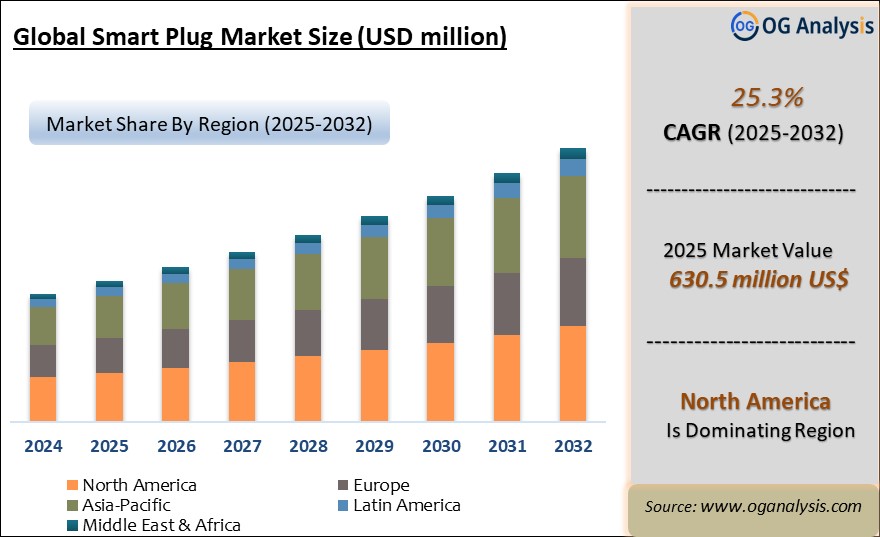
""The Global Smart Plug Market valued at $ 503.2 Million in 2024, is expected to grow by 25.3% CAGR to reach market size worth $ 4,900.9 Million by 2034.""

The Smart Plug Market has experienced significant growth as consumers increasingly adopt smart home technology and IoT solutions. These devices, which allow users to remotely control, schedule, and monitor electrical appliances through mobile apps or voice assistants, have become essential for modern households seeking energy efficiency and convenience. In 2024, the smart plug industry continued to evolve, driven by rising energy costs, the proliferation of smart speakers, and growing awareness about sustainable living. Major advancements in device integration and user-friendly interfaces have made smart plugs more accessible to a broader range of consumers.

Looking ahead to 2025, the Smart Plug Market is expected to witness accelerated growth as connectivity technologies such as Wi-Fi 6, 5G, and Zigbee enhance product performance and reliability. Moreover, as global energy efficiency regulations tighten and consumer demand for eco-friendly solutions rises, smart plugs will play a pivotal role in reducing household energy consumption. Companies are also exploring AI-based energy monitoring capabilities and enhanced compatibility with smart ecosystems, further boosting the attractiveness of smart plugs for both residential and commercial applications.
The Global Smart Plug Market Analysis Report will provide a comprehensive assessment of business dynamics, offering detailed insights into how companies can navigate the evolving landscape to maximize their market potential through 2034. This analysis will be crucial for stakeholders aiming to align with the latest industry trends and capitalize on emerging market opportunities.

North America is the leading region in the smart plug market, fueled by high smart home adoption rates, strong consumer spending on connected devices, and the presence of major IoT technology providers.
The residential segment dominates the market, powered by rising demand for energy-efficient solutions, increased awareness of home automation, and the growing popularity of voice-controlled smart ecosystems.
Global Smart Plug Market Analysis 2025-2032: Industry Size, Share, Growth Trends, Competition and Forecast Report

Smart Plug Market Strategy, Price Trends, Drivers, Challenges and Opportunities to 2034

In terms of market strategy, price trends, drivers, challenges, and opportunities from2025 to 2034, Smart Plug market players are directing investments toward acquiring new technologies, securing raw materials through efficient procurement and inventory management, enhancing product portfolios, and leveraging capabilities to sustain growth amidst challenging conditions. Regional-specific strategies are being emphasized due to highly varying economic and social challenges across countries.

Factors such as global economic slowdown, the impact of geopolitical tensions, delayed growth in specific regions, and the risks of stagflation necessitate a vigilant and forward-looking approach among Smart Plug industry players. Adaptations in supply chain dynamics and the growing emphasis on cleaner and sustainable practices further drive strategic shifts within companies.

The market study delivers a comprehensive overview of current trends and developments in the Smart Plug industry, complemented by detailed descriptive and prescriptive analyses for insights into the market landscape until 2034.

North America Smart Plug Market Analysis

The North American Smart Plug market experienced significant advancements in 2024, driven by heightened consumer focus on sustainability, technological integration, and personalized offerings across various segments. Growth was propelled by the rise in demand for innovative packaging solutions, eco-friendly products, and digital transformation in retail and service sectors. Companies leveraged advanced technologies such as AI, IoT, and data analytics to enhance customer engagement, optimize supply chains, and develop targeted marketing strategies. From 2025, the market is anticipated to witness robust expansion, underpinned by increasing adoption of subscription-based services, heightened awareness of eco-conscious consumption, and innovations in packaging and delivery methods. A competitive landscape characterized by continuous product differentiation, strategic mergers and acquisitions, and the influx of startups is reshaping market dynamics, with key players investing in digitalization and sustainability to secure market share.

Europe Smart Plug Market Outlook

The European Smart Plug market in 2024 demonstrated strong momentum, underpinned by regulatory emphasis on sustainable practices and consumer preferences for high-quality, eco-friendly, and customizable products. Rising interest in cultural and experiential offerings, coupled with advancements in e-commerce and digital solutions, bolstered market growth. The region's focus on circular economy principles encouraged investments in recyclable and biodegradable packaging solutions. Moving into 2025, growth is expected to be driven by the increasing prevalence of innovative retail models, AI-driven personalization, and a surge in demand for wellness-related consumer products. The competitive landscape is marked by robust participation from regional leaders and multinational firms, adopting strategies such as partnerships and green initiatives to meet regulatory and consumer demands, positioning Europe as a hub of innovation and sustainable growth.

Asia-Pacific Smart Plug Market Forecast

The Asia-Pacific Smart Plug market witnessed dynamic growth in 2024, fueled by rapid urbanization, digital adoption, and evolving consumer preferences for convenience and premium products. Emerging markets played a pivotal role, with increasing disposable income and a young, tech-savvy population driving demand for connected home devices, innovative retail solutions, and functional packaging. Anticipated growth from 2025 stems from an expanding middle class, escalating e-commerce penetration, and strong demand for personalized and health-focused products. Companies are capitalizing on regional trends by localizing offerings and investing in digital infrastructure. The competitive landscape is intensifying, with global players entering the market and local firms leveraging cultural insights and price advantages to capture market share, ensuring a vibrant, fast-paced ecosystem.

Middle East, Africa, Latin America Smart Plug Market Overview

The Middle East, Africa, Latin America Smart Plug market showcased steady development in 2024, supported by advancements in retail automation, growing awareness of sustainable practices, and increasing preference for convenience-driven solutions. Markets in the Middle East, Africa, and South America demonstrated rising adoption of digital payment solutions, recyclable packaging, and smart home innovations, catering to evolving consumer demands. From 2025, the market is poised for substantial growth, fueled by infrastructure development, the rise of digital platforms, and increasing focus on affordable, quality products. The competitive landscape is characterized by regional players innovating in product design and packaging, while international companies expand through localized strategies and strategic partnerships, ensuring that the RoW remains a critical contributor to global market dynamics.

Smart Plug Market Dynamics and Future Analytics

The research analyses the Smart Plug parent market, derived market, intermediaries’ market, raw material market, and substitute market are all evaluated to better prospect the Smart Plug market outlook. Geopolitical analysis, demographic analysis, and Porter’s five forces analysis are prudently assessed to estimate the best Smart Plug market projections.

Recent deals and developments are considered for their potential impact on Smart Plug's future business. Other metrics analyzed include the Threat of New Entrants, Threat of New Substitutes, Product Differentiation, Degree of Competition, Number of Suppliers, Distribution Channel, Capital Needed, Entry Barriers, Govt. Regulations, Beneficial Alternative, and Cost of Substitute in Smart Plug market.

Smart Plug trade and price analysis helps comprehend Smart Plug's international market scenario with top exporters/suppliers and top importers/customer information. The data and analysis assist our clients in planning procurement, identifying potential vendors/clients to associate with, understanding Smart Plug price trends and patterns, and exploring new Smart Plug sales channels. The research will be updated to the latest month to include the impact of the latest developments such as the Russia-Ukraine war on the Smart Plug market.

Market Scope

Parameter

Detail

Base Year

2024

Estimated Year

2025

Forecast Period

2026-2032

Market Size-Units

USD million

Market Splits Covered

By Product, By Application, By end user

Countries Covered

North America (USA, Canada, Mexico)
Europe (Germany, UK, France, Spain, Italy, Rest of Europe)
Asia-Pacific (China, India, Japan, Australia, Rest of APAC)
The Middle East and Africa (Middle East, Africa)
South and Central America (Brazil, Argentina, Rest of SCA)

Analysis Covered

Latest Trends, Driving Factors, Challenges, Trade Analysis, Price Analysis, Supply-Chain Analysis, Competitive Landscape, Company Strategies

Customization

10% free customization (up to 10 analyst hours) to modify segments, geographies, and companies analyzed

Post-Sale Support

4 analyst hours, available up to 4 weeks

Delivery Format

The Latest Updated PDF and Excel Data file

Segmentation

By Product

  • Wi-Fi
  • Bluetooth

By End user

  • Commercial
  • Household
  • Industrial

By Geography
- North America (USA, Canada, Mexico)
- Europe (Germany, UK, France, Spain, Italy, Rest of Europe)
- Asia-Pacific (China, India, Japan, Australia, Vietnam, Rest of APAC)
- The Middle East and Africa (Middle East, Africa)
- South and Central America (Brazil, Argentina, Rest of SCA)

Key Market Players

  • Lenovo Group Limited

  • Panasonic Corporation

  • TP-Link Technologies Co., Ltd.

  • Xiaomi Inc.

  • D-Link Corporation

  • Ankuoo Electronics Inc.

  • EDIMAX Technology Co. Ltd.

  • Leviton Manufacturing Co., Inc.

  • SDI Technologies, Inc.

  • Broad-link Technology Inc.

Recent Developments

Jan 2026 – TP-Link (Tapo): TP-Link introduced an AI assistant for its smart home app experience, designed to let users create routines and control connected devices (including smart plugs) using natural-language commands. The update targets easier automation setup and simpler day-to-day control.

Sep 2025 – Legrand (radiant®): Legrand expanded its Matter-enabled lineup with new Wi-Fi, Matter-compatible smart power products in the radiant ecosystem, including smart receptacle/plug offerings. The launch focuses on simpler setup across major smart home platforms.

Jul 2025 – Belkin (Wemo): Belkin announced it will end technical support for most Wemo smart home products, impacting cloud/app-based functions used by many Wemo plugs (remote control, voice integrations). The move pushes users toward local-control ecosystems (where supported) or replacement upgrades.

Apr 2025 – Eve Systems (Eve Energy): Eve announced a firmware update enabling Matter energy reporting on the Eve Energy smart plug, extending cross-platform power/consumption visibility. It also broadened platform support and improved app-level energy insights.

Feb 2025 – Meross: Meross launched a new Smart Wi-Fi Outdoor Plug (dual-outlet) with Matter compatibility and power monitoring, aimed at outdoor appliances and lighting. The release emphasizes ecosystem interoperability and usage tracking for energy-aware automations.

Apr 2025 – Meross: Meross rolled out a Matter firmware upgrade path for select smart plug models (reported as updates enabling newer Matter capabilities). The update supports broader compatibility improvements and feature alignment with newer Matter versions.

Who can benefit from this research
The research would help top management/strategy formulators/business/product development/sales managers and investors in this market in the following ways
1. The report provides 2024 Smart Plug market sales data at the global, regional, and key country levels with a detailed outlook to 2034 allowing companies to calculate their market share and analyze prospects, uncover new markets, and plan market entry strategy.

2. The research includes the Smart Plug market split into different types and applications. This segmentation helps managers plan their products and budgets based on the future growth rates of each segment

3. The Smart Plug market study helps stakeholders understand the breadth and stance of the market giving them information on key drivers, restraints, challenges, and growth opportunities of the market and mitigating risks

4. This report would help top management understand competition better with a detailed SWOT analysis and key strategies of their competitors, and plan their position in the business

5. The study assists investors in analyzing Smart Plug business prospects by region, key countries, and top companies' information to channel their investments.

Available Customizations
The standard syndicate report is designed to serve the common interests of Smart Plug Market players across the value chain and include selective data and analysis from entire research findings as per the scope and price of the publication.
However, to precisely match the specific research requirements of individual clients, we offer several customization options to include the data and analysis of interest in the final deliverable.
Some of the customization requests are as mentioned below –
Segmentation of choice – Our clients can seek customization to modify/add a market division for types/applications/end-uses/processes of their choice.
Smart Plug Pricing and Margins Across the Supply Chain, Smart Plug Price Analysis / International Trade Data / Import-Export Analysis,
Supply Chain Analysis, Supply – Demand Gap Analysis, PESTLE Analysis, Macro-Economic Analysis, and other Smart Plug market analytics
Processing and manufacturing requirements, Patent Analysis, Technology Trends, and Product Innovations
Further, the client can seek customization to break down geographies as per their requirements for specific countries/country groups such as South East Asia, Central Asia, Emerging and Developing Asia, Western Europe, Eastern Europe, Benelux, Emerging and Developing Europe, Nordic countries, North Africa, Sub-Saharan Africa, Caribbean, The Middle East and North Africa (MENA), Gulf Cooperation Council (GCC) or any other.
Capital Requirements, Income Projections, Profit Forecasts, and other parameters to prepare a detailed project report to present to Banks/Investment Agencies.
Customization of up to 10% of the content can be done without any additional charges.

Note: Latest developments will be updated in the report and delivered within 2 to 3 working days

You can purchase individual sections of this report. Explore pricing options for specific sections.

FAQ's

The Global Smart Plug Market is estimated to generate USD 624.2 Million in revenue in 2025

The Global Smart Plug Market is expected to grow at a Compound Annual Growth Rate (CAGR) of 25.3% during the forecast period from 2025 to 2034.

The Smart Plug Market is estimated to reach USD 4,900.9 Million by 2034.

License

Didn’t find what you’re looking for? TALK TO OUR ANALYST TEAM

Need something within your budget? NO WORRIES! WE GOT YOU COVERED!

Related Products

5G Devices Market Analysis and Outlook Report: Industry Size, Share, Growth Trends, and Forecast (2026-2034)

The 5G Devices Market is gaining strong commercial relevance as consumers, enterprises, telecom operators, and industrial users transition toward faster, lower-latency, and more connected digital ecosystems. The market includes smartphones, tablets, laptops, fixed wireless access devices, routers, modules, gateways, wearables, and other connected endpoints designed to operate on 5G networks. Demand is being supported by expanding network coverage, rising mobile data consumption, cloud-based applications, connected vehicles, industrial automation, telemedicine, smart homes, and immersive digital experiences. Competitive intensity remains high as leading device manufacturers, chipset providers, telecom operators, and component suppliers focus on performance differentiation, affordability, battery efficiency, AI integration, and ecosystem-based product strategies. Companies are strengthening their positions through product launches, localized manufacturing, carrier partnerships, premium device innovation, and expansion into enterprise and industrial 5G use cases. However, pricing pressure, semiconductor supply constraints, uneven network availability, regulatory compliance, trade restrictions, and slower replacement cycles continue to shape market execution. Key Takeaways 5G smartphones remain the largest product category, supported by premium device launches, mid-range affordability, and growing replacement demand across developed and emerging markets. Fixed wireless access devices, routers, and customer premises equipment are becoming important growth areas as telecom operators use 5G to expand broadband access. Enterprise adoption is increasing across manufacturing, logistics, healthcare, energy, retail, and transportation, where 5G devices enable real-time monitoring, automation, and connected operations. Device makers are focusing on AI-enabled features, improved battery life, enhanced cameras, faster processors, foldable designs, and stronger integration with connected ecosystems. Regional growth patterns vary significantly, with mature markets driven by premium replacement cycles and emerging markets supported by affordable 5G device penetration. Supply chain resilience has become a strategic priority, encouraging companies to diversify manufacturing, strengthen component sourcing, and reduce exposure to geopolitical disruptions. Regulatory factors such as spectrum policy, data security requirements, localization rules, and import controls are influencing product availability and regional market strategies. Price competition, slower consumer upgrades, network coverage gaps, and margin pressure remain key challenges despite strong long-term demand for connected 5G-enabled devices.

Published:Jul-2026

Artificial Intelligence (Ai) In Energy And Power Market Analysis and Outlook Report: Industry Size, Share, Growth Trends, and Forecast (2026-2034)

The Artificial Intelligence (AI) in Energy and Power Market is gaining strong strategic importance as utilities, power producers, grid operators, renewable energy developers, and energy service providers increasingly use digital intelligence to improve reliability, efficiency, forecasting, automation, and asset performance. AI is being deployed across power generation, transmission, distribution, energy trading, grid balancing, renewable integration, predictive maintenance, demand response, outage management, and customer energy analytics. As power systems become more complex due to renewable energy growth, electrification, distributed energy resources, electric vehicles, and rising electricity demand from data centers, AI-based platforms are becoming essential for real-time decision-making and operational optimization. These solutions help energy companies analyze large volumes of equipment, weather, grid, consumption, and market data to improve forecasting accuracy, reduce downtime, optimize dispatch, and strengthen grid resilience. Market growth is supported by the modernization of aging grid infrastructure, increasing renewable power penetration, rising pressure to reduce operational costs, and the need for more flexible and intelligent power systems. AI enables utilities to shift from reactive operations to predictive and automated management by identifying faults, forecasting demand, optimizing battery storage, detecting anomalies, and supporting faster restoration during outages. Competitive dynamics are shaped by collaboration between energy companies, industrial automation providers, cloud platforms, software vendors, AI specialists, and equipment manufacturers. However, the market also faces challenges such as high implementation costs, data quality limitations, cybersecurity risks, integration complexity, regulatory uncertainty, and shortage of skilled AI-energy professionals. Despite these barriers, AI is expected to become a core enabler of the future energy ecosystem as the power sector moves toward cleaner, smarter, more distributed, and more resilient infrastructure. Regional Analysis North AmericaArtificial Intelligence (AI) in Energy and Power Market North America holds a leading position in the Artificial Intelligence (AI) in Energy and Power Market, supported by advanced utility infrastructure, strong cloud and AI ecosystem development, rising data center electricity demand, and high investment in grid modernization. The United States is the key contributor, with utilities adopting AI for predictive maintenance, outage detection, demand forecasting, grid automation, renewable integration, and energy trading. The region is also seeing growing use of AI to manage grid stress created by electrification, extreme weather, and large-scale digital infrastructure growth. Opportunities remain strong in smart grids, distributed energy resource management, battery optimization, and AI-enabled reliability planning. EuropeArtificial Intelligence (AI) in Energy and Power Market Europe is a highly active market for AI in energy and power, driven by decarbonization targets, renewable energy expansion, smart grid deployment, and strict energy efficiency requirements. Countries across the region are using AI to improve wind and solar forecasting, balance power supply, manage demand-side flexibility, and support grid stability as renewable penetration increases. The European market benefits from strong regulatory support for digitalization, sustainability reporting, and energy system modernization. Demand is also rising from utilities, industrial energy users, and energy aggregators seeking intelligent tools for asset optimization, carbon reduction, and grid congestion management. However, data privacy, regulatory complexity, and integration with legacy infrastructure remain key challenges. Asia-PacificArtificial Intelligence (AI) in Energy and Power Market Asia-Pacific is one of the fastest-growing regions in the Artificial Intelligence (AI) in Energy and Power Market, supported by rapid electricity demand growth, urbanization, industrial expansion, renewable capacity additions, and large-scale smart grid investment. China, India, Japan, South Korea, Australia, and Southeast Asian markets are increasingly adopting AI for load forecasting, renewable energy prediction, grid automation, asset monitoring, and demand response. The region’s strong growth in solar, wind, electric vehicles, and data centers is increasing the need for intelligent power management. Opportunities are significant in distribution automation, microgrids, energy storage optimization, and AI-based power planning, although uneven grid maturity and digital infrastructure gaps remain restraints. Middle East & AfricaArtificial Intelligence (AI) in Energy and Power Market The Middle East & Africa market is gaining momentum as countries invest in energy diversification, smart utilities, renewable power projects, and digital transformation of power infrastructure. Gulf countries are leading adoption, using AI to optimize solar generation, improve grid reliability, manage energy demand, and support national sustainability goals. AI is also becoming relevant in oil and gas-linked power systems, utility asset management, and large-scale infrastructure planning. In Africa, adoption remains at an earlier stage but is supported by the need for grid reliability, mini-grid management, loss reduction, and renewable integration. Growth opportunities exist in smart metering, predictive maintenance, energy access, and AI-enabled grid resilience. South & Central AmericaArtificial Intelligence (AI) in Energy and Power Market South & Central America is developing steadily in the Artificial Intelligence (AI) in Energy and Power Market, driven by renewable energy growth, grid reliability needs, hydropower management, and modernization of transmission and distribution networks. Brazil, Chile, Colombia, and Mexico are key markets where utilities are exploring AI for grid monitoring, fault detection, asset performance management, energy forecasting, and operational efficiency. AI can play an important role in managing weather-sensitive power generation, transmission constraints, and remote infrastructure. Market growth is supported by digital utility programs and renewable integration, while challenges include budget limitations, regulatory variation, cybersecurity readiness, and uneven technology adoption across smaller utilities. Key Insights AI-enabled grid optimization is becoming a major market trend: Power utilities are increasingly using AI to improve grid monitoring, congestion management, voltage control, outage prediction, and real-time load balancing. As electricity networks become more decentralized and variable, AI helps operators manage distributed energy resources, renewable intermittency, and peak demand more efficiently. This trend is especially important for utilities facing pressure to improve reliability while integrating solar, wind, storage, and electric vehicle charging infrastructure. Predictive maintenance is driving adoption across generation and transmission assets: Energy companies are using AI to monitor turbines, transformers, substations, transmission lines, inverters, and grid equipment to predict failures before they occur. By analyzing sensor data, operating history, vibration patterns, thermal images, and asset performance indicators, AI can reduce unplanned downtime and extend equipment life. This is a strong value proposition for utilities, renewable operators, and industrial power users because asset failures can create high repair costs, service interruptions, and regulatory penalties. Renewable energy forecasting is strengthening the role of AI in power markets: Solar and wind generation depend heavily on weather conditions, making accurate forecasting essential for grid stability and energy trading. AI models can analyze weather data, satellite imagery, historical production patterns, and grid demand signals to improve renewable output prediction. This helps grid operators schedule backup power, optimize storage dispatch, and reduce curtailment. As renewable penetration increases, AI-based forecasting is becoming a critical tool for balancing clean energy supply with real-time electricity demand. Demand response and energy management are emerging as high-growth applications: AI is enabling utilities and energy service providers to predict consumption patterns, manage peak loads, and automate demand-side flexibility. Smart meters, connected buildings, industrial control systems, and distributed energy platforms generate large volumes of data that AI can use to recommend or automate energy-saving actions. This supports lower energy costs, better grid stability, and improved customer participation in flexible power programs. The opportunity is especially strong in commercial buildings, industrial facilities, data centers, and smart cities. Rising electricity demand from digital infrastructure is increasing the need for intelligent power planning: Growth in cloud computing, AI data centers, electrification, and advanced manufacturing is increasing pressure on electricity networks. AI tools are being used to forecast load growth, optimize grid investments, manage interconnection queues, and support better planning for transmission and distribution upgrades. This is becoming a key driver for power companies that need to improve capacity planning while avoiding costly overbuilding or reliability risks. Energy trading and market optimization are becoming more data-driven: AI is increasingly used in electricity trading, price forecasting, renewable bidding, battery arbitrage, and portfolio optimization. Power producers and traders use AI to assess demand patterns, weather volatility, market prices, grid constraints, and generation availability. This improves commercial decision-making and helps companies capture value in increasingly dynamic power markets. The trend is particularly relevant as renewable and storage assets create more complex market participation strategies. Cybersecurity and operational risk remain major challenges: As AI becomes more integrated with grid operations, utilities face higher exposure to cyber threats, data manipulation, model errors, and system vulnerabilities. AI-powered energy platforms require secure data flows, strong governance, resilient architecture, and clear human oversight. Any failure in critical energy infrastructure can have serious operational and public safety consequences, making trust, explainability, and cybersecurity central to market adoption. Data quality and system integration limitations can slow implementation: Many utilities operate legacy systems with fragmented data, inconsistent asset records, and siloed operational platforms. AI models require reliable, high-quality, real-time data to deliver accurate insights. Integration with SCADA, ADMS, EMS, DERMS, smart meters, asset management systems, and enterprise platforms can be complex and expensive. This makes implementation more difficult for smaller utilities and companies with limited digital maturity. Report Scope Parameter Artificial Intelligence (Ai) In Energy And Power Market Detail Base Year 2025 Estimated Year 2026 Forecast Period 2026-2034 Market Size-Units USD billion Market Splits Covered By Technology, By Application, By End-User Countries Covered North America (USA, Canada, Mexico) Europe (Germany, UK, France, Spain, Italy, Rest of Europe) Asia-Pacific (China, India, Japan, Australia, Rest of APAC) The Middle East and Africa (Middle East, Africa) South and Central America (Brazil, Argentina, Rest of SCA) Analysis Covered Latest Trends, Driving Factors, Challenges, Trade Analysis, Price Analysis, Supply-Chain Analysis, Competitive Landscape, Company Strategies Customization 10% free customization (up to 10 analyst hours) to modify segments, geographies, and companies analyzed Post-Sale Support 4 analyst hours, available up to 4 weeks Delivery Format The Latest Updated PDF and Excel Data file

Published:Jul-2026

Machine Vision System Market Analysis and Outlook Report: Industry Size, Share, Growth Trends, and Forecast (2026-2034)

The machine vision system market is a high-growth segment of the industrial automation, quality control, and smart manufacturing ecosystem, focused on technologies that enable machines to capture, process, analyze, and interpret visual information for inspection, measurement, identification, guidance, and process control. Machine vision systems are widely used across automotive, electronics, semiconductors, pharmaceuticals, food and beverages, packaging, logistics, metals, plastics, medical devices, and general manufacturing industries. Key applications include defect detection, barcode and label verification, dimensional measurement, robotic guidance, surface inspection, assembly verification, sorting, counting, and traceability. Demand is being driven by increasing automation, rising quality expectations, labor efficiency needs, high-speed production environments, and growing adoption of Industry 4.0 practices. Machine vision is becoming essential for manufacturers seeking consistent product quality, reduced rework, faster inspection, and data-driven production control. Recent trends in the machine vision system market include stronger adoption of artificial intelligence, deep learning-based inspection, 3D vision, hyperspectral imaging, smart cameras, embedded vision, and edge processing. Manufacturers are increasingly deploying machine vision solutions that can detect complex defects, support flexible production lines, and integrate with robotics, factory automation, and digital manufacturing platforms. Growth is further supported by electronics miniaturization, electric vehicle production, pharmaceutical serialization, food safety requirements, and warehouse automation. Competitive dynamics are shaped by camera manufacturers, vision software providers, sensor companies, industrial automation firms, lighting suppliers, system integrators, and robotics companies competing on accuracy, speed, ease of integration, software intelligence, reliability, and application expertise. At the same time, high implementation cost, lighting challenges, complex programming, data training requirements, and integration with legacy equipment continue to influence adoption. Key Insights Quality inspection remains the strongest application driver for machine vision systems, as manufacturers require fast, consistent, and non-contact inspection across high-speed production lines. Vision systems can detect defects, verify dimensions, identify missing components, and confirm assembly accuracy. This reduces human inspection variability, improves yield, and supports stricter quality standards across automotive, electronics, pharmaceuticals, packaging, and food production. Artificial intelligence and deep learning are reshaping machine vision by enabling systems to identify complex, variable, or subtle defects that traditional rule-based algorithms may miss. These technologies are especially valuable in surface inspection, cosmetic defect detection, food sorting, and electronics inspection. AI-enabled vision is expanding adoption where product variation and defect complexity require more adaptive inspection capability. 3D vision systems are gaining importance for applications that require depth perception, shape measurement, robotic guidance, bin picking, and volumetric inspection. These systems help improve automation accuracy in assembly, logistics, and industrial handling tasks. As robots become more widely deployed, 3D machine vision is becoming a key enabler of flexible and intelligent automation. Smart cameras and embedded vision are increasing market accessibility by combining imaging, processing, and software capabilities in compact devices. These solutions are easier to deploy in space-constrained environments and are well suited for distributed inspection points. Their adoption is growing among manufacturers seeking simpler integration, lower system complexity, and scalable inspection coverage. Automotive and electronics manufacturing remain major end-use sectors because they demand high precision, traceability, and inspection speed. Machine vision supports weld inspection, component placement, PCB inspection, battery inspection, connector verification, and surface quality checks. Growth in electric vehicles, semiconductors, and advanced electronics is strengthening demand for high-performance vision solutions. Food, beverage, and pharmaceutical applications are expanding as companies use machine vision for packaging verification, label inspection, contamination detection, fill-level inspection, serialization, and compliance support. These industries value systems that improve safety, consistency, and traceability. Regulatory and brand protection requirements are increasing the importance of reliable visual inspection. System integration expertise is a critical competitive factor because successful machine vision deployment depends on cameras, lighting, optics, software, positioning, and production line compatibility. Poor lighting or improper setup can reduce accuracy and reliability. Suppliers and integrators with deep application knowledge are better positioned to deliver dependable inspection performance. Future market growth will be driven by smart factories, robotics adoption, AI-based inspection, high-speed manufacturing, logistics automation, and increasing demand for zero-defect production. Opportunities will expand where machine vision can improve productivity, traceability, and process intelligence. Long-term competitiveness will depend on software capability, ease of use, integration flexibility, and measurable quality improvement. Regional Analysis North America Machine Vision System Market North America remains a leading machine vision system market, supported by strong automation adoption, advanced manufacturing infrastructure, robotics integration, and high demand for quality inspection across automotive, electronics, pharmaceuticals, food processing, and logistics sectors. Market dynamics are shaped by smart factory investments, labor efficiency needs, and growing use of AI-enabled inspection. Lucrative opportunities are strong in 3D vision, embedded vision, robotic guidance, and automated defect detection. The forecast remains favorable as manufacturers prioritize productivity and traceability, while latest developments focus on deep learning inspection, edge vision processing, and integration with industrial automation platforms. Asia Pacific Machine Vision System Market Asia Pacific is the fastest-growing machine vision system market, driven by large-scale electronics manufacturing, automotive production, semiconductor fabrication, industrial automation, and rising quality control requirements. Market dynamics are influenced by expanding factory automation, high-volume production environments, and demand for cost-effective inspection systems. Lucrative opportunities are visible in PCB inspection, EV battery inspection, robotics, packaging verification, and smart camera deployment. The forecast remains robust as regional manufacturers modernize production lines, while latest developments focus on AI-based vision, local system integration, and high-speed inspection for electronics and automotive applications. Europe Machine Vision System Market Europe represents a mature and innovation-led machine vision system market, supported by advanced automotive manufacturing, pharmaceutical production, industrial robotics, food safety requirements, and Industry 4.0 adoption. Market dynamics are shaped by demand for precision inspection, traceability, automation efficiency, and regulatory compliance across high-value manufacturing sectors. Lucrative opportunities are concentrated in 3D vision, hyperspectral imaging, robotic guidance, pharmaceutical serialization, and smart factory integration. The forecast remains constructive as manufacturers continue digital transformation, while latest developments center on AI-enabled inspection, sustainable production monitoring, and seamless integration with automation systems. Middle East & Africa Machine Vision System Market The Middle East & Africa machine vision system market is developing steadily, supported by industrial diversification, food and beverage processing, packaging automation, logistics modernization, and growing investment in smart manufacturing. Market dynamics are influenced by demand for improved production quality, automated inspection, and reduced manual dependency across emerging industrial sectors. Lucrative opportunities are emerging in packaging inspection, barcode verification, food quality control, warehouse automation, and industrial safety monitoring. The forecast remains positive as manufacturing and logistics capabilities expand, while latest developments focus on affordable vision systems, distributor support, and integration with automated production lines. South & Central America Machine Vision System Market South & Central America presents promising opportunities in the machine vision system market, supported by food processing, automotive assembly, packaging, pharmaceuticals, mining equipment manufacturing, and logistics automation. Market dynamics are shaped by increasing need for product quality, traceability, and production efficiency across regional industries. Lucrative opportunities are visible in label inspection, defect detection, robotic handling, sorting systems, and quality control for consumer goods manufacturing. The forecast remains encouraging as companies modernize production and adopt automation, while latest developments focus on cost-effective vision solutions, local integration services, and broader use of smart cameras in manufacturing environments. Market Scope Parameter Machine Vision System Market Detail Base Year 2025 Estimated Year 2026 Forecast Period 2026-2034 Market Size-Units USD billion Market Splits Covered By Product ,By Offering, By Deployment Type, By Application,By Deployment Type Countries Covered North America (USA, Canada, Mexico) Europe (Germany, UK, France, Spain, Italy, Rest of Europe) Asia-Pacific (China, India, Japan, Australia, Rest of APAC) The Middle East and Africa (Middle East, Africa) South and Central America (Brazil, Argentina, Rest of SCA) Analysis Covered Latest Trends, Driving Factors, Challenges, Trade Analysis, Price Analysis, Supply-Chain Analysis, Competitive Landscape, Company Strategies Customization 10% free customization (up to 10 analyst hours) to modify segments, geographies, and companies analyzed Post-Sale Support 4 analyst hours, available up to 4 weeks Delivery Format The Latest Updated PDF and Excel Data file

Published:Jun-2026