Software Defined Data Center Market Analysis and Outlook Report: Industry Size, Share, Growth Trends, and Forecast (2026-2034)

Published On: Mar, 2026
|
Pages: 150+

"The Software Defined Data Center Market was valued at $ 98.5 billion in 2026 and is projected to reach $ 396.64 billion by 2034, growing at a CAGR of 19.01%."

The Software Defined Data Center (SDDC) market encompasses architectures that virtualize and pool compute, storage, and networking resources and manage them through software-driven automation and policy. By abstracting infrastructure from hardware, SDDC enables IT teams to provision resources on demand, enforce consistent security and governance, and optimize utilization across private clouds, hybrid environments, and multi-site data centers. Core applications and end uses include private cloud modernization, hybrid cloud orchestration, virtual desktop infrastructure, enterprise application hosting, DevOps and CI/CD environments, database and analytics workloads, disaster recovery, and increasingly AI/ML pipelines that require flexible, scalable infrastructure. SDDC is implemented through combinations of server virtualization, software-defined networking (SDN), software-defined storage (SDS), hyperconverged infrastructure (HCI), container platforms, and centralized management layers that provide orchestration, telemetry, and policy-based control.

Market momentum is being driven by enterprise cloud operating model adoption, the need to reduce infrastructure complexity, and pressure to improve agility, resiliency, and cost transparency. Key trends include deeper automation and “infrastructure as code,” intent-based networking, greater use of Kubernetes and container-native virtualization, and expanded observability that unifies performance, security, and cost signals. Security is becoming more embedded through microsegmentation, zero-trust policies, and compliance automation, while edge and distributed cloud deployments are pushing SDDC capabilities into remote sites and branch locations. Growth drivers include data center modernization cycles, application modernization initiatives, demand for faster provisioning, and the economics of improved resource pooling and lifecycle management. Competitive dynamics span virtualization and cloud software leaders, networking vendors, HCI platform providers, open-source ecosystems, and systems integrators, with differentiation centered on operational simplicity, automation depth, interoperability, hybrid cloud integration, and licensing economics. Persistent challenges include skills gaps, migration complexity, vendor lock-in concerns, and aligning legacy applications with modern SDDC operational practices.

Key Market Insights

  • SDDC has evolved from “virtualization” to a full cloud operating model for on-prem and hybrid (historic → current → future). Early value came from server consolidation, while today the focus is end-to-end software control across compute, storage, and network. Future SDDC adoption will be judged by how well it delivers cloud-like self-service with governance. This pushes investment into orchestration, policy, and automation rather than raw virtualization alone. Platforms that simplify operations will keep winning share.

  • Hybrid cloud orchestration is the dominant enterprise use case. Most organizations run mixed estates and need consistent provisioning, security, and workload placement across on-prem, colocation, and public cloud. SDDC management layers increasingly act as the “control plane” that enforces policies across environments. Future growth will favor platforms that unify lifecycle management and cost visibility across hybrid footprints. Interoperability and API depth are critical buying criteria.

  • Automation and Infrastructure-as-Code are becoming non-negotiable capabilities. Enterprises want repeatable deployments, fewer manual changes, and faster environment creation for DevOps and CI/CD. Policy-driven provisioning reduces errors and improves auditability. Future differentiation will come from mature automation catalogs, workflow integration, and closed-loop remediation. Vendors that integrate with DevOps toolchains and GitOps practices gain advantage.

  • Software-defined networking and microsegmentation are reshaping security models. SDN enables intent-based policies, east-west traffic control, and granular segmentation across workloads. This supports zero-trust and reduces blast radius during incidents. Future SDDC deployments will increasingly embed security controls into provisioning workflows rather than bolt them on later. Security automation and compliance reporting will become core platform expectations.

  • HCI continues to be a major adoption pathway, especially for mid-market and remote sites. HCI simplifies procurement and operations by integrating compute and storage with centralized management. It is particularly attractive for VDI, ROBO (remote office/branch office), and standardized edge deployments. Future HCI evolution will emphasize better networking integration, GPU support, and automated upgrades. Simplicity and predictable operations will remain key drivers.

  • Containers and Kubernetes are reshaping SDDC design and management priorities. Enterprises want consistent infrastructure for both VMs and containers, driving “VMs + Kubernetes” convergence and container-native storage/networking. Future platforms will need strong support for mixed workloads and smooth migration paths. Organizations will prefer unified operations, observability, and security across both paradigms. Tooling that reduces fragmentation will win.

  • Observability is moving from monitoring to full-stack operational intelligence. SDDC buyers demand unified visibility across performance, capacity, security posture, and cost drivers. Telemetry and analytics help prevent outages, optimize utilization, and improve planning. Future differentiation will come from actionable insights, anomaly detection, and automated capacity governance. Strong observability reduces operational overhead and improves service reliability.

  • AI/ML and GPU-enabled workloads are influencing infrastructure choices. While not all AI runs on private infrastructure, many enterprises require on-prem or hybrid environments for data locality, latency, or governance. This increases demand for flexible resource pools, faster provisioning, and better performance isolation. Future SDDC stacks will integrate GPU scheduling, high-speed networking, and storage throughput optimization. Platforms that support AI operations alongside traditional workloads will gain traction.

  • Licensing economics and vendor lock-in concerns are driving evaluation rigor. Organizations are scrutinizing subscription models, core-based licensing, and bundled feature pricing. Openness—APIs, ecosystem support, and multi-vendor hardware compatibility—matters more as enterprises seek bargaining power and flexibility. Future market shifts may favor platforms that balance innovation with predictable cost structures. Transparent pricing and migration options will influence renewals.

  • Skills gaps and migration complexity remain the biggest adoption friction points. Moving from legacy architectures to SDDC requires redesigning processes, retraining teams, and modernizing governance. Many projects stall due to operational change management rather than technology limitations. Future growth will increasingly depend on strong partner ecosystems, reference architectures, and managed services. Vendors that package implementation accelerators and best-practice playbooks will see faster adoption.

Global end-user Internet data volume (ZB), 2018–2024

Figure: Global end-user Internet data volume increased from an estimated 1.9 zettabytes in 2018 to around 7.5 zettabytes in 2024e, reflecting the rapid expansion of digital applications, cloud services, and data-intensive workloads worldwide. As enterprises, hyperscalers, and service providers handle growing volumes of data across fixed and mobile broadband networks, demand intensifies for scalable, automated, and software-driven infrastructure architectures. OG Analysis estimates, derived from ITU Internet data indicators and global digital infrastructure studies, illustrate how sustained growth in Internet data volumes reinforces long-term adoption of software-defined networking, storage virtualization, and orchestration platforms within modern software defined data centers.
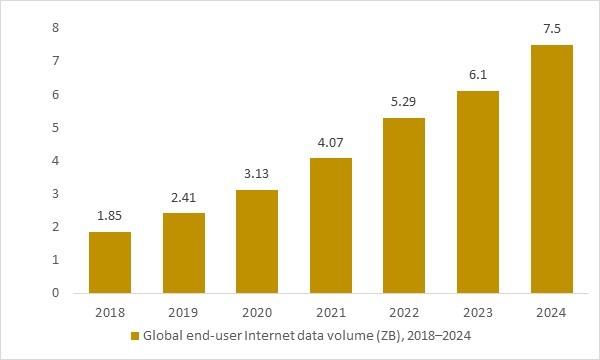
Global Internet data volume growth, 2018–2024, supporting software-defined networking and data center automation.

  • Global end-user Internet data volume expanded sharply from about 1.9 zettabytes in 2018 to an estimated 7.5 zettabytes in 2024e, highlighting the accelerating scale of digital workloads worldwide. This surge reflects rising adoption of cloud computing, data-intensive applications, and always-on connectivity across enterprises and consumers. Managing such growth efficiently requires highly virtualized, automated, and policy-driven infrastructure rather than rigid hardware-centric data centers. As a result, software defined data center architectures are increasingly adopted to deliver scalability, flexibility, and cost optimization in modern digital environments.

Regional Insights

North America Software Defined Data Center Market

The region leads in SDDC adoption due to early cloud operating model maturity, strong enterprise IT budgets, and large hyperscale and colocation ecosystems that influence architecture standards. Hybrid cloud modernization remains a primary driver as enterprises balance on-prem control with public cloud agility, accelerating demand for unified orchestration, automation, and policy-based governance. Security-driven deployments—microsegmentation, zero-trust networking, and compliance automation—are key priorities, especially in regulated industries such as financial services and healthcare. AI/ML and data-intensive workloads are influencing refresh cycles, increasing interest in GPU-enabled clusters, high-speed networking, and software-defined storage performance. Vendor competition is intense, with enterprises scrutinizing licensing economics and seeking flexible migration paths. Managed services and systems integrators play a strong role in large-scale transformations and operational change management.

Europe Software Defined Data Center Market

Europe’s market is shaped by data sovereignty expectations and stringent compliance requirements, reinforcing demand for private and hybrid SDDC architectures with strong governance and auditable controls. Many organizations prioritize interoperability and multi-vendor architectures to avoid lock-in and to align with complex procurement environments across countries and sectors. Modernization often focuses on consolidating fragmented legacy estates while improving energy efficiency and operational resilience through automation and better capacity management. Cloud adoption continues to expand, but deployment decisions frequently emphasize residency, risk controls, and standardized operating models across multiple geographies. Containers and Kubernetes adoption is strong, driving convergence strategies that unify VM and container operations under common policy and observability. Partner ecosystems are critical, with local integrators helping translate platform capabilities into compliant reference architectures and repeatable deployments.

Asia-Pacific Software Defined Data Center Market

Asia-Pacific shows rapid growth in SDDC as digital transformation accelerates across banking, telecom, manufacturing, and public sector modernization programs, though maturity varies widely by country. Hybrid cloud is a dominant theme, with enterprises building private cloud foundations while leveraging public cloud for elasticity, pushing demand for consistent orchestration and automation. High adoption of e-commerce and mobile services increases emphasis on scalable, resilient platforms with strong observability and faster provisioning for DevOps. Many deployments are cost- and skills-sensitive, making HCI a popular pathway for simplified operations, particularly in mid-market and distributed enterprise footprints. Edge and remote-site deployments are expanding, increasing the need for centralized policy management and lifecycle automation across multiple locations. Vendors that provide strong local support, flexible deployment models, and rapid implementation frameworks tend to gain share.

Middle East & Africa Software Defined Data Center Market

Growth is concentrated in major hubs where government-led digitization, smart city initiatives, and new data center builds are expanding demand for modern private and hybrid cloud capabilities. Many organizations prioritize greenfield SDDC deployments, often pairing them with managed services due to skills constraints and the need for faster time-to-value. Security and compliance are becoming more prominent as critical sectors modernize, driving interest in microsegmentation, identity-based policy, and automated patching and upgrades. Colocation expansion and regional cloud availability influence hybrid strategies, with enterprises seeking consistent controls across on-prem and hosted environments. HCI adoption is strong for rapid deployment in enterprises and for standardized footprints in distributed operations. Competitive advantage often comes from vendor ecosystems that combine platform, implementation, and ongoing operations support.

South & Central America Software Defined Data Center Market

The market is driven by enterprise modernization, increased reliance on digital channels, and the need to improve resiliency and agility while managing constrained IT budgets. HCI and software-defined storage are attractive entry points because they simplify operations and reduce procurement complexity, especially for mid-sized organizations. Hybrid cloud architectures are expanding, but adoption often emphasizes pragmatic integration with legacy systems and incremental migration rather than full redesign. Skills gaps and limited operational bandwidth increase reliance on partners for implementation, automation setup, and managed operations. Security and uptime requirements are rising, encouraging investment in centralized policy controls, backup/DR automation, and improved observability. Vendors that offer predictable licensing, flexible deployment, and strong partner networks tend to perform best in competitive evaluations.

Report Scope

Parameter

Software Defined Data Centre market Detail

Base Year

2025

Estimated Year

2026

Forecast Period

2027-2034

Market Size-Units

USD billion

Market Splits Covered

By Product, By Application, By End User and By Technology

Countries Covered

North America (USA, Canada, Mexico)
Europe (Germany, UK, France, Spain, Italy, Rest of Europe)
Asia-Pacific (China, India, Japan, Australia, Rest of APAC)
The Middle East and Africa (Middle East, Africa)
South and Central America (Brazil, Argentina, Rest of SCA)

Analysis Covered

Latest Trends, Driving Factors, Challenges, Trade Analysis, Price Analysis, Supply-Chain Analysis, Competitive Landscape, Company Strategies

Customization

10% free customization (up to 10 analyst hours) to modify segments, geographies, and companies analyzed

Post-Sale Support

4 analyst hours, available up to 4 weeks

Delivery Format

The Latest Updated PDF and Excel Data file

Software Defined Data Center Market Segments Covered In The Report

By Type
- Software Defined Computing (SDC)
- Software-Defined Storage (SDS)
- Software-Defined Data Center Networking (SDDCN)
- Automation and Orchestration

By Component
- Hardware
- Software
- Services

By Organization Size
- Small And Medium-Sized Enterprises (SMEs)
- Large enterprises

By Vertical
- Banking
- Financial Services And Insurance (BFSI)
- Information Technology (IT) And Telecom
- Government And Defense
- Healthcare
- Education
- Retail
- Manufacturing
- Others Verticals

By Geography
- North America (USA, Canada, Mexico)
- Europe (Germany, UK, France, Spain, Italy, Rest of Europe)
- Asia-Pacific (China, India, Japan, Australia, Vietnam, Rest of APAC)
- The Middle East and Africa (Middle East, Africa)
- South and Central America (Brazil, Argentina, Rest of SCA)

Key Market Players

VMware Inc., Microsoft Corporation, Hewlett Packard Enterprise Company, Dell Technologies Inc., Oracle Corporation, Cisco Systems Inc., Citrix Systems Inc., International Business Machines Corporation, SAP SE, Hitachi Ltd., Fujitsu Ltd., NEC Corporation, Juniper Networks Inc., Western Digital Corporation, Nutanix, Red Hat Inc., Huawei Technologies Co. Ltd., Lenovo Group Limited, NetApp Inc., Pure Storage Inc., Tintri Inc., DataCore Software, Scale Computing, Pivot, StratoScale, Coho Data Inc., Maxta Inc., Hedvig Inc., Diamanti Inc., Robin Systems Inc.

Recent Industry Developments

August 2025 – Apollo acquired a majority stake in Stream Data Centers to capitalize on the growing demand for AI-driven digital infrastructure. This move expands Apollo’s capacity to develop high-performance data center campuses tailored to hyperscaler requirements.

June 2025 – Cisco and NTT Data partnered to launch AI-powered software-defined infrastructure services, aimed at modernizing enterprise IT and data center architectures with enhanced automation and cost efficiency.

April 2025 – Dell Technologies introduced disaggregated, software-defined infrastructure innovations designed for AI-ready data centers—featuring shared compute, storage, and networking pools managed through software-driven automation.

June 2025 – Broadcom unveiled the Jericho 4 Ethernet fabric router, optimized to interconnect over one million processors across multiple data centers, meeting the growing bandwidth and low-latency demands of distributed AI workloads.

You can purchase individual sections of this report. Explore pricing options for specific sections.

FAQ's

The Global Software Defined Data Center Market is estimated to generate $98.5 billion in revenue in 2026.

The Global Software Defined Data Center Market is expected to grow at a Compound Annual Growth Rate (CAGR) of 19.01% during the forecast period from 2026 to 2034.

The Software Defined Data Center Market is estimated to reach $ 396.64 billion by 2034.

License

Didn’t find what you’re looking for? TALK TO OUR ANALYST TEAM

Need something within your budget? NO WORRIES! WE GOT YOU COVERED!

Related Products

Machine Vision System Market Analysis and Outlook Report: Industry Size, Share, Growth Trends, and Forecast (2026-2034)

The machine vision system market is a high-growth segment of the industrial automation, quality control, and smart manufacturing ecosystem, focused on technologies that enable machines to capture, process, analyze, and interpret visual information for inspection, measurement, identification, guidance, and process control. Machine vision systems are widely used across automotive, electronics, semiconductors, pharmaceuticals, food and beverages, packaging, logistics, metals, plastics, medical devices, and general manufacturing industries. Key applications include defect detection, barcode and label verification, dimensional measurement, robotic guidance, surface inspection, assembly verification, sorting, counting, and traceability. Demand is being driven by increasing automation, rising quality expectations, labor efficiency needs, high-speed production environments, and growing adoption of Industry 4.0 practices. Machine vision is becoming essential for manufacturers seeking consistent product quality, reduced rework, faster inspection, and data-driven production control. Recent trends in the machine vision system market include stronger adoption of artificial intelligence, deep learning-based inspection, 3D vision, hyperspectral imaging, smart cameras, embedded vision, and edge processing. Manufacturers are increasingly deploying machine vision solutions that can detect complex defects, support flexible production lines, and integrate with robotics, factory automation, and digital manufacturing platforms. Growth is further supported by electronics miniaturization, electric vehicle production, pharmaceutical serialization, food safety requirements, and warehouse automation. Competitive dynamics are shaped by camera manufacturers, vision software providers, sensor companies, industrial automation firms, lighting suppliers, system integrators, and robotics companies competing on accuracy, speed, ease of integration, software intelligence, reliability, and application expertise. At the same time, high implementation cost, lighting challenges, complex programming, data training requirements, and integration with legacy equipment continue to influence adoption. Key Insights Quality inspection remains the strongest application driver for machine vision systems, as manufacturers require fast, consistent, and non-contact inspection across high-speed production lines. Vision systems can detect defects, verify dimensions, identify missing components, and confirm assembly accuracy. This reduces human inspection variability, improves yield, and supports stricter quality standards across automotive, electronics, pharmaceuticals, packaging, and food production. Artificial intelligence and deep learning are reshaping machine vision by enabling systems to identify complex, variable, or subtle defects that traditional rule-based algorithms may miss. These technologies are especially valuable in surface inspection, cosmetic defect detection, food sorting, and electronics inspection. AI-enabled vision is expanding adoption where product variation and defect complexity require more adaptive inspection capability. 3D vision systems are gaining importance for applications that require depth perception, shape measurement, robotic guidance, bin picking, and volumetric inspection. These systems help improve automation accuracy in assembly, logistics, and industrial handling tasks. As robots become more widely deployed, 3D machine vision is becoming a key enabler of flexible and intelligent automation. Smart cameras and embedded vision are increasing market accessibility by combining imaging, processing, and software capabilities in compact devices. These solutions are easier to deploy in space-constrained environments and are well suited for distributed inspection points. Their adoption is growing among manufacturers seeking simpler integration, lower system complexity, and scalable inspection coverage. Automotive and electronics manufacturing remain major end-use sectors because they demand high precision, traceability, and inspection speed. Machine vision supports weld inspection, component placement, PCB inspection, battery inspection, connector verification, and surface quality checks. Growth in electric vehicles, semiconductors, and advanced electronics is strengthening demand for high-performance vision solutions. Food, beverage, and pharmaceutical applications are expanding as companies use machine vision for packaging verification, label inspection, contamination detection, fill-level inspection, serialization, and compliance support. These industries value systems that improve safety, consistency, and traceability. Regulatory and brand protection requirements are increasing the importance of reliable visual inspection. System integration expertise is a critical competitive factor because successful machine vision deployment depends on cameras, lighting, optics, software, positioning, and production line compatibility. Poor lighting or improper setup can reduce accuracy and reliability. Suppliers and integrators with deep application knowledge are better positioned to deliver dependable inspection performance. Future market growth will be driven by smart factories, robotics adoption, AI-based inspection, high-speed manufacturing, logistics automation, and increasing demand for zero-defect production. Opportunities will expand where machine vision can improve productivity, traceability, and process intelligence. Long-term competitiveness will depend on software capability, ease of use, integration flexibility, and measurable quality improvement. Regional Analysis North America Machine Vision System Market North America remains a leading machine vision system market, supported by strong automation adoption, advanced manufacturing infrastructure, robotics integration, and high demand for quality inspection across automotive, electronics, pharmaceuticals, food processing, and logistics sectors. Market dynamics are shaped by smart factory investments, labor efficiency needs, and growing use of AI-enabled inspection. Lucrative opportunities are strong in 3D vision, embedded vision, robotic guidance, and automated defect detection. The forecast remains favorable as manufacturers prioritize productivity and traceability, while latest developments focus on deep learning inspection, edge vision processing, and integration with industrial automation platforms. Asia Pacific Machine Vision System Market Asia Pacific is the fastest-growing machine vision system market, driven by large-scale electronics manufacturing, automotive production, semiconductor fabrication, industrial automation, and rising quality control requirements. Market dynamics are influenced by expanding factory automation, high-volume production environments, and demand for cost-effective inspection systems. Lucrative opportunities are visible in PCB inspection, EV battery inspection, robotics, packaging verification, and smart camera deployment. The forecast remains robust as regional manufacturers modernize production lines, while latest developments focus on AI-based vision, local system integration, and high-speed inspection for electronics and automotive applications. Europe Machine Vision System Market Europe represents a mature and innovation-led machine vision system market, supported by advanced automotive manufacturing, pharmaceutical production, industrial robotics, food safety requirements, and Industry 4.0 adoption. Market dynamics are shaped by demand for precision inspection, traceability, automation efficiency, and regulatory compliance across high-value manufacturing sectors. Lucrative opportunities are concentrated in 3D vision, hyperspectral imaging, robotic guidance, pharmaceutical serialization, and smart factory integration. The forecast remains constructive as manufacturers continue digital transformation, while latest developments center on AI-enabled inspection, sustainable production monitoring, and seamless integration with automation systems. Middle East & Africa Machine Vision System Market The Middle East & Africa machine vision system market is developing steadily, supported by industrial diversification, food and beverage processing, packaging automation, logistics modernization, and growing investment in smart manufacturing. Market dynamics are influenced by demand for improved production quality, automated inspection, and reduced manual dependency across emerging industrial sectors. Lucrative opportunities are emerging in packaging inspection, barcode verification, food quality control, warehouse automation, and industrial safety monitoring. The forecast remains positive as manufacturing and logistics capabilities expand, while latest developments focus on affordable vision systems, distributor support, and integration with automated production lines. South & Central America Machine Vision System Market South & Central America presents promising opportunities in the machine vision system market, supported by food processing, automotive assembly, packaging, pharmaceuticals, mining equipment manufacturing, and logistics automation. Market dynamics are shaped by increasing need for product quality, traceability, and production efficiency across regional industries. Lucrative opportunities are visible in label inspection, defect detection, robotic handling, sorting systems, and quality control for consumer goods manufacturing. The forecast remains encouraging as companies modernize production and adopt automation, while latest developments focus on cost-effective vision solutions, local integration services, and broader use of smart cameras in manufacturing environments. Market Scope Parameter Machine Vision System Market Detail Base Year 2025 Estimated Year 2026 Forecast Period 2026-2034 Market Size-Units USD billion Market Splits Covered By Product ,By Offering, By Deployment Type, By Application,By Deployment Type Countries Covered North America (USA, Canada, Mexico) Europe (Germany, UK, France, Spain, Italy, Rest of Europe) Asia-Pacific (China, India, Japan, Australia, Rest of APAC) The Middle East and Africa (Middle East, Africa) South and Central America (Brazil, Argentina, Rest of SCA) Analysis Covered Latest Trends, Driving Factors, Challenges, Trade Analysis, Price Analysis, Supply-Chain Analysis, Competitive Landscape, Company Strategies Customization 10% free customization (up to 10 analyst hours) to modify segments, geographies, and companies analyzed Post-Sale Support 4 analyst hours, available up to 4 weeks Delivery Format The Latest Updated PDF and Excel Data file

Published:Jun-2026

Data Center Asset Management Market Analysis and Outlook Report: Industry Size, Share, Growth Trends, and Forecast (2026-2034)

The data center asset management market is a strategic segment of the data center infrastructure management and enterprise IT operations ecosystem, focused on tracking, monitoring, optimizing, and managing physical and digital assets across data center environments. These solutions are used to manage servers, storage systems, networking equipment, racks, power distribution units, cooling systems, cables, software assets, spare parts, and lifecycle documentation across enterprise, colocation, hyperscale, cloud, telecom, and government data centers. Key applications include asset tracking, inventory management, capacity planning, lifecycle management, compliance monitoring, maintenance scheduling, energy optimization, and operational visibility. Demand is being driven by rapid data center expansion, increasing infrastructure complexity, cloud workload growth, AI-driven compute demand, and the need to reduce downtime while improving asset utilization and operational control. Recent trends in the data center asset management market include growing adoption of real-time monitoring, RFID and barcode-based tracking, digital twins, automated discovery tools, AI-enabled analytics, and integration with DCIM, ITSM, and enterprise resource planning platforms. Operators are increasingly seeking centralized visibility across distributed facilities to support capacity decisions, sustainability goals, maintenance planning, and regulatory compliance. Growth is further supported by edge data center deployment, hybrid IT architectures, hardware refresh cycles, and rising focus on energy efficiency and uptime assurance. Competitive dynamics are shaped by DCIM vendors, IT asset management providers, data center software companies, infrastructure monitoring firms, cloud management platforms, and managed service providers competing on integration capability, analytics depth, automation, scalability, security, and ease of deployment. At the same time, legacy systems, data accuracy issues, integration complexity, cybersecurity concerns, and high implementation effort continue to influence adoption. Key Insights Asset visibility remains the strongest demand driver for the data center asset management market, as operators need accurate information on servers, storage, networking hardware, racks, cables, power assets, and cooling infrastructure. Without reliable asset visibility, capacity planning and maintenance become inefficient. Real-time asset intelligence helps reduce downtime, improve utilization, and support better operational decision-making across complex facilities. Capacity planning is becoming more important as data centers face increasing demand from cloud computing, artificial intelligence, high-performance computing, and enterprise digital workloads. Asset management platforms help operators understand available space, power, cooling, and equipment utilization. This enables better expansion planning, workload placement, and infrastructure investment decisions, especially in high-density environments. Lifecycle management is a key application area because data center assets require structured tracking from procurement and installation through maintenance, upgrades, relocation, and retirement. Proper lifecycle visibility helps reduce stranded assets, improve refresh planning, and support compliance with internal IT governance. This is especially valuable for large enterprises and colocation providers managing multi-site infrastructure. Integration with DCIM, ITSM, and enterprise systems is reshaping market expectations, as operators seek unified operational workflows rather than standalone asset databases. Connected platforms improve incident response, change management, procurement planning, and service delivery. Vendors that support seamless integration with existing infrastructure and software ecosystems are better positioned for enterprise adoption. Automation and AI-enabled analytics are strengthening the value of asset management by reducing manual tracking errors and enabling predictive insights. Automated discovery, anomaly detection, and intelligent reporting help improve accuracy and operational efficiency. As data center environments become larger and more dynamic, automation is becoming essential for maintaining reliable asset data. Sustainability and energy efficiency goals are influencing adoption, as asset management systems help identify underutilized equipment, optimize capacity, and support better power and cooling decisions. Improved asset intelligence can contribute to reduced waste, lower energy consumption, and more effective equipment lifecycle planning. This aligns asset management with broader data center sustainability strategies. Edge and distributed data center growth is creating demand for asset management solutions that can provide centralized visibility across multiple smaller facilities. Operators need to manage equipment, maintenance, security, and capacity across geographically dispersed sites. Cloud-based platforms and remote monitoring capabilities are becoming increasingly important for distributed infrastructure management. Future market growth will be shaped by hyperscale expansion, AI infrastructure demand, hybrid IT complexity, sustainability pressure, and stronger need for operational resilience. Opportunities will increase where solutions deliver accurate data, automation, integration, and actionable analytics. Long-term competitiveness will depend on scalability, cybersecurity, interoperability, and ability to support high-density and distributed data center environments. Regional Analysis North America Data Center Asset Management Market North America remains a leading data center asset management market, supported by hyperscale data center expansion, cloud infrastructure growth, AI workload demand, and strong enterprise adoption of digital infrastructure management tools. Market dynamics are shaped by the need for real-time asset visibility, capacity optimization, uptime assurance, and lifecycle tracking across large and distributed facilities. Lucrative opportunities are strong in DCIM-integrated asset platforms, automated discovery, AI-enabled analytics, and sustainability-focused asset optimization. The forecast remains favorable as operators modernize high-density infrastructure, while latest developments focus on digital twins, intelligent monitoring, and cloud-based asset management systems. Asia Pacific Data Center Asset Management Market Asia Pacific is the fastest-growing data center asset management market, driven by rapid cloud adoption, digital economy expansion, edge data center deployment, and increasing investment in hyperscale and colocation infrastructure. Market dynamics are influenced by growing demand for scalable asset tracking, energy-efficient operations, and centralized management across multi-site facilities. Lucrative opportunities are visible in automated inventory systems, RFID-based tracking, DCIM integration, and capacity planning tools. The forecast remains robust as regional data center construction accelerates, while latest developments focus on smart facility operations, remote monitoring, and asset management solutions tailored to high-growth digital infrastructure markets. Europe Data Center Asset Management Market Europe represents a mature and regulation-focused data center asset management market, supported by strong demand for cloud services, enterprise digitization, sustainability requirements, and data protection-driven infrastructure planning. Market dynamics are shaped by energy efficiency targets, lifecycle visibility, asset utilization improvement, and compliance requirements across colocation, enterprise, and hyperscale data centers. Lucrative opportunities are concentrated in sustainability-linked asset analytics, automated documentation, digital twin platforms, and integrated DCIM solutions. The forecast remains constructive as operators prioritize efficiency and transparency, while latest developments center on greener data center operations, asset lifecycle optimization, and secure multi-site infrastructure management. Middle East & Africa Data Center Asset Management Market The Middle East & Africa data center asset management market is developing steadily, supported by cloud region expansion, digital government initiatives, telecom modernization, and growing investment in enterprise and colocation data centers. Market dynamics are influenced by the need for better infrastructure visibility, uptime protection, capacity planning, and remote management across newly built and distributed facilities. Lucrative opportunities are emerging in cloud-based asset tracking, facility monitoring, lifecycle management, and DCIM-linked platforms. The forecast remains positive as regional digital infrastructure expands, while latest developments focus on hyperscale partnerships, smart facility management, and stronger operational control across mission-critical environments. South & Central America Data Center Asset Management Market South & Central America presents promising growth opportunities in the data center asset management market, supported by increasing cloud adoption, enterprise IT modernization, telecom infrastructure expansion, and growing colocation demand. Market dynamics are shaped by the need to manage physical IT assets more efficiently, improve utilization, reduce downtime, and support distributed infrastructure growth. Lucrative opportunities are visible in inventory automation, asset lifecycle tracking, remote monitoring, and integrated infrastructure management platforms. The forecast remains encouraging as digital services expand, while latest developments focus on regional data center upgrades, cloud connectivity growth, and improved operational visibility across enterprise and colocation facilities. Market Scope Parameter Data Center Asset Management Market Detail Base Year 2025 Estimated Year 2026 Forecast Period 2026-2034 Market Size-Units USD billion Market Splits Covered By Component, By Deployment, By Application, By End-user Countries Covered North America (USA, Canada, Mexico) Europe (Germany, UK, France, Spain, Italy, Rest of Europe) Asia-Pacific (China, India, Japan, Australia, Rest of APAC) The Middle East and Africa (Middle East, Africa) South and Central America (Brazil, Argentina, Rest of SCA) Analysis Covered Latest Trends, Driving Factors, Challenges, Trade Analysis, Price Analysis, Supply-Chain Analysis, Competitive Landscape, Company Strategies Customization 10% free customization (up to 10 analyst hours) to modify segments, geographies, and companies analyzed Post-Sale Support 4 analyst hours, available up to 4 weeks Delivery Format The Latest Updated PDF and Excel Data file

Published:Jun-2026

Hydrophone Market Analysis and Outlook Report: Industry Size, Share, Growth Trends, and Forecast (2026-2034)

The Hydrophone market is a specialized but steadily expanding segment within underwater sensing and acoustic instrumentation, built around devices designed to detect, record, and interpret sound in aquatic environments. Demand is centered on naval and maritime surveillance, sonar systems, passive acoustic monitoring, marine mammal detection, oceanographic research, offshore energy operations, subsea inspection, and integration with autonomous underwater platforms. The market’s importance continues to rise because underwater acoustics remains one of the most effective methods for sensing activity, mapping soundscapes, and monitoring both biological and man-made noise below the surface. One of the clearest industry shifts is the broadening of hydrophone use from defense and research into environmental compliance, offshore wind monitoring, and long-duration autonomous deployments. This is expanding the category from a niche hardware market into a broader ecosystem that includes arrays, moored systems, towed platforms, hull-mounted solutions, and data-driven monitoring platforms. Piezoelectric designs remain widely used across laboratory, industrial, and marine applications, while ruggedization, miniaturization, and longer-duration deployment capability are becoming increasingly important in product selection. From a competitive standpoint, the market is shaped by specialist acoustic sensor manufacturers, marine instrumentation companies, defense contractors, and integrated subsea-system providers competing through sensitivity, depth tolerance, frequency range, array design, signal clarity, and compatibility with autonomous and real-time monitoring platforms. The strongest demand drivers include rising naval focus on underwater domain awareness, increasing use of passive acoustic monitoring in marine conservation and offshore energy development, and broader deployment of autonomous underwater vehicles, gliders, and other unmanned systems that rely on compact acoustic payloads. Another important trend is the move toward multi-hydrophone and array-based architectures that improve coverage, localization, and mission flexibility compared with single-sensor deployment. Overall, the market outlook remains favorable as end users seek better underwater intelligence, stronger environmental monitoring capability, and more scalable acoustic sensing platforms across defense, science, and commercial marine operations. The industry is increasingly moving toward solution-based offerings where sensing hardware, deployment architecture, and data interpretation are combined into more complete underwater acoustic systems. Key Market Insights Defense and underwater surveillance remain the strongest historic foundation of demand. Hydrophones continue to hold strategic importance in passive listening, anti-submarine operations, and long-range underwater detection systems. Their value lies in enabling persistent acoustic awareness in environments where visual or radio-based sensing is limited. This gives the market a durable foundation tied to naval modernization and maritime security priorities. Array-based deployments are especially important where wider detection coverage and better target tracking are required. Defense-led demand is expected to remain one of the most commercially important pillars of the market. Passive acoustic monitoring is becoming a major commercial growth engine. Hydrophones are increasingly used to detect marine mammals, fish sounds, ambient ocean noise, and anthropogenic sound sources. This is broadening demand beyond military and research settings into conservation, compliance, and long-term soundscape monitoring. The shift is commercially significant because it supports recurring deployment, data collection, and program-based procurement. It also strengthens demand for moored systems, archival recorders, and data-enabled acoustic platforms. Environmental monitoring is likely to remain one of the fastest-expanding application areas. Offshore wind and marine infrastructure monitoring are creating new opportunity layers. Acoustic monitoring is becoming more relevant in offshore energy projects where developers need to observe protected species and underwater noise conditions. Hydrophone systems are being incorporated into passive listening programs tied to construction and operational activity. This increases the market’s exposure to environmental compliance and project-monitoring budgets. It also encourages demand for real-time and array-based systems that can operate in active offshore environments. Offshore energy-linked monitoring is expected to become an increasingly attractive commercial niche. Autonomous underwater vehicles are reshaping product design priorities. As autonomous underwater vehicles, gliders, and other unmanned systems become more important in defense, science, and commercial marine work, hydrophones must become more compact, efficient, and integration-friendly. This is pushing the market toward lighter payloads, modular sensor configurations, and better compatibility with autonomous missions. Towed and embedded acoustic arrays are also becoming more relevant in these platforms. The result is a stronger link between hydrophone demand and the expansion of unmanned marine robotics. Suppliers aligned with autonomous-platform integration are likely to gain a strategic advantage. Piezoelectric technology remains highly important across core applications. Piezoelectric hydrophones continue to be widely used because they offer dependable sensitivity across a broad range of underwater measurement needs. Their relevance spans laboratory testing, industrial measurements, marine monitoring, and general underwater acoustics. This gives the market a stable technical base even as new packaging, electronics, and array formats evolve. While innovation continues around integration and deployment, core sensing performance remains central to buyer choice. Established piezoelectric platforms are therefore likely to remain commercially significant. Array-based systems are gaining importance over single-sensor deployment. Multi-hydrophone configurations improve localization, coverage, and the ability to distinguish different acoustic sources in complex underwater environments. This is especially valuable in surveillance, marine mammal monitoring, offshore construction mitigation, and advanced research programs. Arrays also support more sophisticated analytics and better situational awareness than isolated sensors. As end users seek broader acoustic intelligence, demand is moving toward system-level solutions rather than standalone devices alone. This trend should continue to strengthen the value of integrated acoustic platforms. Marine research and ocean observing remain a stable and influential demand segment. Hydrophones are widely used in soundscape studies, species monitoring, ocean-noise characterization, and long-duration observation programs. Their role in fixed and mobile observing platforms makes them important to scientific and public-sector monitoring efforts. This segment may not always drive the largest volumes, but it supports consistent demand and long-term program visibility. It also reinforces the importance of data quality, archival capability, and deployment endurance. Scientific monitoring will continue to underpin the market’s broader credibility and application diversity. Signal processing and data handling are becoming stronger competitive differentiators. Buyers increasingly value not only the sensing element, but also how well the acoustic data can be filtered, analyzed, transmitted, and turned into actionable insight. This is raising the importance of integrated electronics, software capability, and mission-ready acoustic systems. The market is therefore moving beyond hardware-only competition toward platform performance and data usefulness. Vendors that can pair high-quality sensing with clearer interpretation and real-time usability are likely to stand out. Software-enabled acoustic intelligence will shape future competitive positioning. Durability and environmental tolerance remain central purchasing criteria. Underwater applications expose sensors to pressure, corrosion, fouling, vibration, and long deployment cycles, making rugged design commercially essential. This is particularly important in offshore operations, defense, and permanent or semi-permanent monitoring systems. Buyers often prioritize reliability and service life as much as sensitivity and frequency response. The ability to perform consistently in harsh marine conditions supports repeat procurement and long-term supplier relationships. Robust construction will remain one of the most important product-level differentiators. Future growth will favor integrated marine-acoustics solution providers. The market is shifting from simple sensor procurement toward broader solutions that combine hydrophones, arrays, deployment systems, autonomous platforms, and data workflows. Customers increasingly want acoustic capability that fits into a complete surveillance, monitoring, or research mission architecture. This favors companies that can deliver platform compatibility, system integration, and operational support rather than only standalone components. As applications expand across defense, offshore energy, and environmental monitoring, solution depth will matter more. Long-term leadership is likely to favor suppliers that combine sensor performance with deployable, mission-ready acoustic systems. Regional Insights North AmericaHydrophone market North America remains a commercially important market, supported by naval surveillance requirements, offshore energy activity, marine mammal monitoring, and a strong installed base of ocean observation programs. A major market dynamic is the shift from stand-alone sensing toward passive acoustic monitoring networks tied to offshore wind permitting, underwater noise measurement, and broader maritime domain awareness. The strongest opportunities for companies are in array-based systems, real-time monitoring platforms, rugged moored deployments, and software-linked acoustic analytics for defense and environmental compliance. Recent regional developments indicate stronger movement toward standardized project-level acoustic monitoring, which favors suppliers able to provide calibrated, deployable, and regulator-ready solutions. The outlook remains positive, with growth likely to come from long-duration monitoring, integrated data services, and mission-ready systems rather than basic sensor sales alone. Asia PacificHydrophone market Asia Pacific is expected to remain the strongest growth engine, driven by expanding naval modernization, autonomous underwater systems, offshore infrastructure, and marine research investment across major regional economies. The market is highly diverse, with some countries emphasizing defense and underwater communication while others are expanding environmental monitoring, marine park acoustics, and broader ocean observation capability. The most attractive opportunities lie in compact hydrophone arrays, autonomous-underwater-vehicle-compatible payloads, passive acoustic monitoring systems, and multi-role platforms that support both security and environmental applications. Recent developments across the region point to more advanced and application-specific underwater sensing capabilities. The forecast is strongly positive, especially for companies that can combine durability, miniaturization, and system integration capability across defense, science, and commercial marine use cases. EuropeHydrophone market Europe offers a high-value but regulation- and project-driven opportunity profile, with demand shaped by offshore wind, marine conservation programs, subsea infrastructure, and a mature underwater noise monitoring environment. One of the clearest market dynamics is the move toward multipurpose acoustic systems that can support environmental compliance, soundscape assessment, and wider maritime monitoring from the same deployment architecture. Lucrative opportunities are strongest in passive acoustic monitoring for offshore wind, real-time underwater noise platforms, and integrated array solutions that support both project development and long-term operational compliance. Recent activity across the regional marine monitoring ecosystem shows growing interest in embedding acoustic sensing into offshore infrastructure and combining real-time data with noise-management workflows. The forecast is steadily positive, with the best gains likely for suppliers offering high-reliability systems tailored to offshore renewables, marine protection requirements, and advanced acoustic analytics. Middle East & AfricaHydrophone market Middle East & Africa is a smaller but increasingly strategic region, where demand is being supported by port expansion, shipping-noise awareness, reef and cetacean monitoring, and the gradual build-out of regional marine science capability. The main market dynamic is the widening use of passive acoustics in areas that historically relied more heavily on conventional marine observation, particularly where coastal development and biodiversity protection need to be balanced more carefully. The best opportunities for companies are in durable monitoring systems for harsh marine environments, project-based acoustic deployments, and sensor platforms suited to port, reef, and protected-area applications. Recent developments in regional marine programs suggest stronger institutional momentum behind underwater noise management and acoustic baseline building across developing maritime zones. The forecast is moderately positive, with the strongest upside in early-stage programs that need equipment, deployment support, and long-term monitoring capability. South & Central AmericaHydrophone market South & Central America presents a selective but increasingly attractive opportunity profile, supported by offshore energy activity, biodiversity monitoring, and growing interest in regional soundscape assessment. The market is being shaped by the need to understand shipping, offshore industrial, and marine mammal acoustic conditions in complex coastal and deepwater environments, which is raising the value of flexible and long-duration passive monitoring systems. The most promising opportunities lie in ocean soundscape projects, glider-based monitoring, offshore industry compliance work, and hydrophone deployments linked to marine science and conservation programs. Recent developments across the region indicate movement toward more sophisticated, platform-based hydrophone use rather than isolated measurement campaigns. The forecast is positive, especially for suppliers able to support mobile monitoring, distributed sensing, and data-rich environmental applications across offshore and scientific use cases. Market Scope Parameter Hydrophone Market Detail Base Year 2025 Estimated Year 2026 Forecast Period 2026-2034 Market Size-Units USD billion Market Splits Covered By Type, By Frequency Range, By Technology, By Application Countries Covered North America (USA, Canada, Mexico) Europe (Germany, UK, France, Spain, Italy, Rest of Europe) Asia-Pacific (China, India, Japan, Australia, Rest of APAC) The Middle East and Africa (Middle East, Africa) South and Central America (Brazil, Argentina, Rest of SCA) Analysis Covered Latest Trends, Driving Factors, Challenges, Trade Analysis, Price Analysis, Supply-Chain Analysis, Competitive Landscape, Company Strategies Customization 10% free customization (up to 10 analyst hours) to modify segments, geographies, and companies analyzed Post-Sale Support 4 analyst hours, available up to 4 weeks Delivery Format The Latest Updated PDF and Excel Data file

Published:Mar-2026