"The Strawberries Market is valued at $ 14.3 billion in 2025. Further, the market is expected to grow at a CAGR of 3.2% to reach $ 19.1 billion by 2034."
The strawberries market continues to evolve globally, driven by rising consumer demand for fresh produce, health benefits, and versatile culinary uses. Strawberries are valued for their rich nutrient profile, including vitamins, antioxidants, and dietary fiber, making them a popular choice across fresh consumption, processed foods, beverages, and confectionery. Retail and foodservice channels leverage packaging innovations—such as pre-washed clamshells and snack packs—to enhance convenience and reduce waste. Meanwhile, controlled-environment agriculture (greenhouses and vertical farms) and precision growing techniques have improved yield, quality, and seasonality. Sustainability efforts, including reduced pesticide use, water-efficient irrigation, and eco-friendly packaging, are increasingly important as farmers and brands respond to consumer and regulatory pressures.
Industry-wide growth is shaped by expansion into emerging markets, product innovation, and retail partnerships. Breeding advances have introduced disease-resistant and flavor-enhanced varieties, enabling extended shelf life and adaptation to diverse climates. Value-added products—like berry blends, purees, frozen berries, and ready-to-eat snacks—foster market diversification. Digital tools, AI-based crop monitoring, and supply chain analytics improve forecasting and post-harvest handling, reducing spoilage. Seasonal promotions, branded berries, and farm-to-table traceability enhance consumer trust. Export demand remains strong, with production hubs in North America, Europe, and Asia supplying global markets. Looking ahead, demand for clean-label, local, and nutritionally optimized strawberries is expected to drive continued market development.
Key Takeaways
-
Controlled‑environment systems—greenhouses, tunnel farming, vertical racks—enable off‑season production, better pest control, and uniform fruit quality, supporting year‑round availability and reducing dependency on field-grown cycles.
-
Breeding and varietal innovation produce strawberries with improved shelf life, firmness, flavor, and disease resistance, enhancing supply consistency and enabling expansion into new geographies and climates.
-
Growing demand for convenience favors value‑added formats—washed, cut, frozen, pureed, and blended berries—reducing consumer preparation time while preserving nutritional and sensory attributes.
-
Sustainability practices, such as drip irrigation, integrated pest management, and recyclable packaging, are being adopted to satisfy environmental standards and attract eco‑conscious consumers.
-
Digital farming tools—soil sensors, drones, AI–driven yield prediction—are improving farm planning, optimized resource use, and reduced wastage, boosting farm profitability and supply reliability.
-
E‑commerce and direct‑to‑consumer channel growth enable subscription box models, same‑day delivery of fresh berries, and strong branding opportunities based on provenance and freshness.
-
Functional positioning of strawberries as “nutrient‑dense superfoods” stimulates use in health-focused product launches, dietary supplements, and marketing campaigns targeting wellness‑oriented shoppers.
-
Export and trade volume growth is supported by coordination between major production regions, improved cold‑chain logistics, and regulatory harmonization, promoting international availability.
-
Collaborative programs between growers, retailers, and research institutes are accelerating disease control, sustainable practices, and plant breeding, reinforcing sector resilience.
-
Promotional campaigns—branded berries, festivals, recipe tie‑ins, in‑store sampling—support consumption occasions and consumer engagement, supporting incremental demand across seasons.
Global strawberry production, 2018–2024 (million tonnes)
Figure: Global strawberry production increased from around 8.5 million tonnes in 2018 to an estimated 10.7 million tonnes in 2024. As fresh consumption rises and food processors expand use in frozen, puree, concentrate, bakery and dairy applications, this growing fruit base directly supports demand growth in the strawberries market. OG Analysis estimates, aligned with FAOSTAT agricultural data, demonstrate how rising crop output enables investment in cold chain infrastructure, product innovation and new value-added formats worldwide.
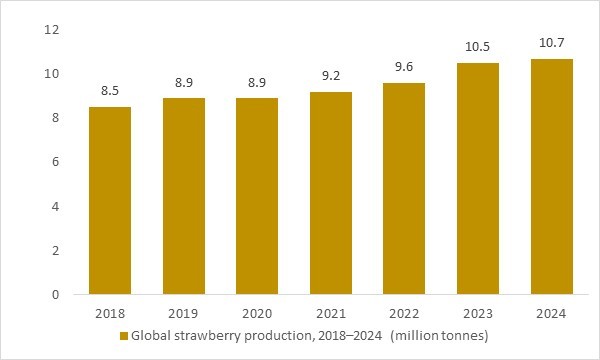
Global strawberry production has risen from an estimated 8.5 million tonnes in 2018 to around 10.7 million tonnes in 2024 (OG Analysis estimate), reflecting strong growth in fresh and processed demand. FAO-aligned statistics show that world strawberry output surpassed 10 million tonnes by 2023, with China alone contributing roughly 40% of global volume and the US, Mexico, Turkey and Spain forming the next tier of large producers. This expansion of the primary crop base underpins capacity growth in both the fresh strawberry trade and downstream uses such as frozen strawberries, jams, bakery fillings and dairy applications.
Report Scope
| Parameter | Strawberries Market scope Detail |
| Base Year | 2024 |
| Estimated Year | 2025 |
| Forecast Period | 2026-2032 |
| Market Size-Units | USD billion |
| Market Splits Covered | By Product, By Application, By End User and By Technology |
| Countries Covered | North America (USA, Canada, Mexico) |
| Analysis Covered | Latest Trends, Driving Factors, Challenges, Trade Analysis, Price Analysis, Supply-Chain Analysis, Competitive Landscape, Company Strategies |
| Customization | 10% free customization (up to 10 analyst hours) to modify segments, geographies, and companies analyzed |
| Post-Sale Support | 4 analyst hours, available up to 4 weeks |
| Delivery Format | The Latest Updated PDF and Excel Data file |
Market Segmentation
By Type
- June Bearing Strawberry
- Ever Bearing Strawberry
- Day Neutral Strawberry
By Category
- Organic
- Conventional
By Sales Channel
- Supermarkets Or Hyper Markets
- Convenience Stores
- Independent Retailers
- Online Sales
By Application
- Food And Beverage
- Cosmetics And Personal Care
- Other
By Geography
- North America (USA, Canada, Mexico)
- Europe (Germany, UK, France, Spain, Italy, Rest of Europe)
- Asia-Pacific (China, India, Japan, Australia, Vietnam, Rest of APAC)
- The Middle East and Africa (Middle East, Africa)
- South and Central America (Brazil, Argentina, Rest of SCA)
Key Market Players
- Hershey Foods Corporation
- Dole PLC
- J.M. Smucker Company
- Del Monte Pacific Limited
- Ocean Spray Cranberries Inc.
- Seneca Foods Corporation
- Hero AG
- Keelings Ltd.
- Welch Foods Inc
- Monin Inc.
- Driscoll’s Inc.
- Andros Groupe
- R. Torre And Company Inc.
- Mirak Group Inc.
- Berry Gardens Ltd.
- Stonewall Kitchen LLC
- Wilkin And Sons Ltd.
- Naturipe Farms LLC
- BelOrta cvba
- Goknur Gida Sanayi ve Ticaret Anonim Sirketi
- Mrs. Miller's Homemade Jams LLC
- ST. DALFOUR INTERNATIONAL INCORPORATED
Recent Developments
July 18, 2025 – UK growers reported a “bumper year” with 9,000 tonnes more strawberries than last year, thanks to optimal spring weather—boosting season length and fruit size, though harvesting faced labor shortages.
June 30, 2025 – Malling Centenary continues to dominate at Wimbledon, supplied daily by Hugh Lowe Farms, but emerging varieties like Fandango, Karima, and Florice are gaining ground due to greater sweetness and shelf life.
June 27, 2025 – British strawberries were hailed the “biggest and sweetest in decades” following a record‐sunny spring, with exceptional sugar accumulation credited to warm days and cool nights.
FAQ's
The Global Strawberries Market is expected to grow at a Compound Annual Growth Rate (CAGR) of 3.2% during the forecast period from 2025 to 2034.
The Strawberries Market is estimated to reach USD 19.1 billion by 2034.
The Global Strawberries Market is estimated to generate USD 14.3 billion in revenue in 2025.
Didn’t find what you’re looking for? TALK TO OUR ANALYST TEAM
Need something within your budget? NO WORRIES! WE GOT YOU COVERED!


