Aircraft Door Market Outlook 2026–2034: Lightweight Design Trends, Growth Drivers, Leading Companies, and Future Opportunities
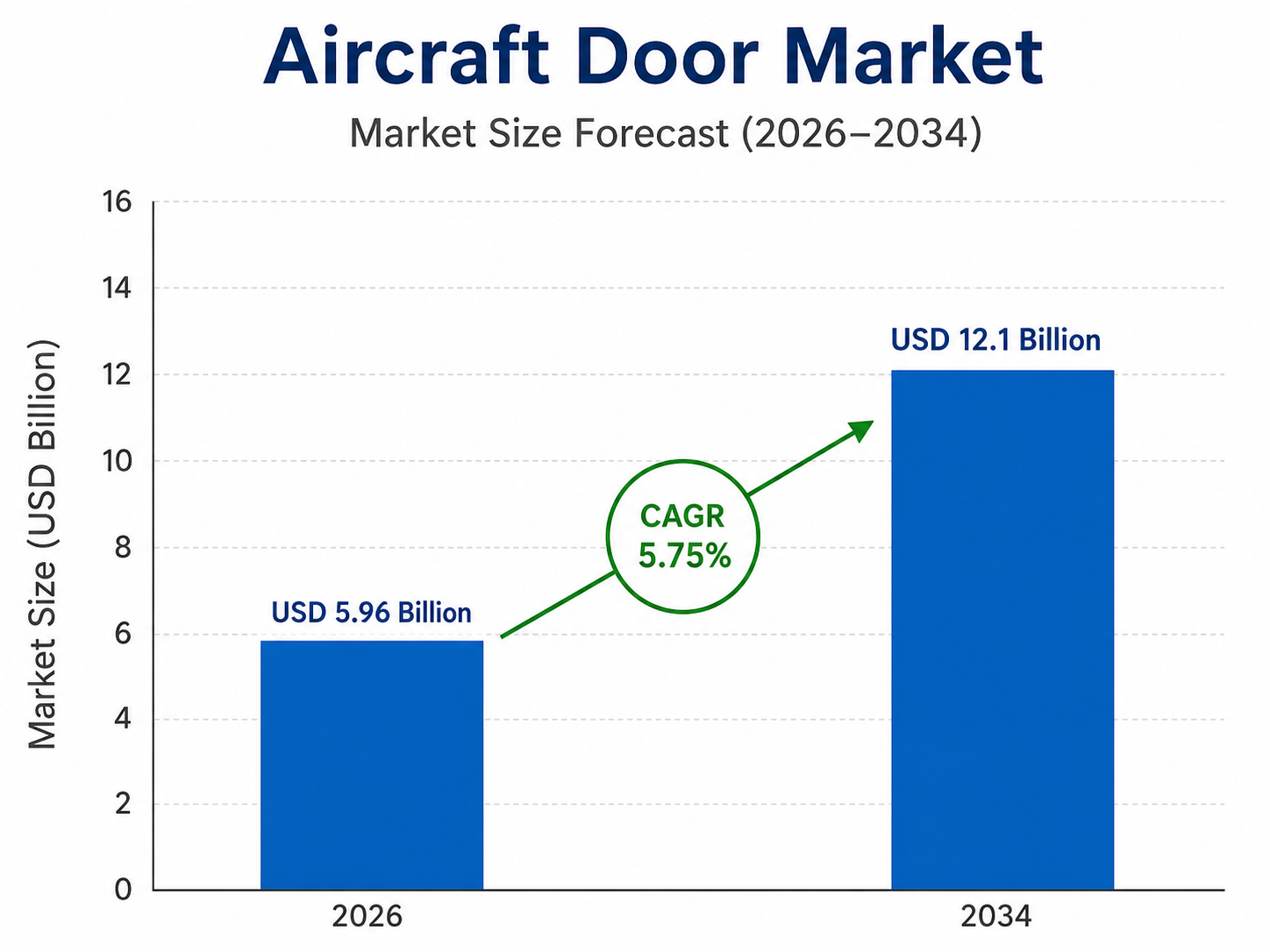
The Aircraft Door Market is estimated to be valued at $ 5.96 billion in 2026 and is projected to reach $ 12.1 billion by 2034, expanding at a CAGR of 5.75% from 2026 to 2034.
Aircraft doors include passenger doors, cargo doors, emergency exits, service doors, landing gear doors, access panels, and crew doors used across commercial aircraft, regional aircraft, business jets, helicopters, military aircraft, and cargo aircraft. These systems are designed to ensure passenger safety, cabin pressurization, structural integrity, emergency evacuation, aerodynamic performance, and secure cargo handling. Market growth is supported by rising aircraft production, fleet modernization, air passenger traffic recovery, defense aircraft procurement, and increasing use of lightweight composite and advanced metallic structures. Manufacturers are focusing on weight reduction, automated locking systems, improved sealing, smart sensors, durability, lower maintenance requirements, and compliance with strict aviation safety standards.
1. What is the latest trend in the Aircraft Door Market?
The latest trend is the development of lightweight, sensor-enabled, and maintenance-friendly aircraft door systems.
Manufacturers are using composite materials, titanium alloys, advanced seals, and improved actuation systems to reduce aircraft weight.
Smart monitoring features are being explored to detect door status, pressure integrity, locking condition, and maintenance needs.
These improvements support fuel efficiency, operational safety, and lower lifecycle maintenance costs.
2. What are the key challenges in the Aircraft Door Market?
Key challenges include strict certification requirements, high engineering complexity, long development cycles, and aircraft production delays.
Aircraft doors must meet demanding safety, pressurization, evacuation, structural, and environmental performance standards.
Supply-chain constraints in aerospace materials, actuators, seals, and precision components can delay deliveries.
Manufacturers must also balance weight reduction with durability, safety, manufacturability, and maintenance accessibility.
3. What is the major driving factor for the Aircraft Door Market?
The major driving factor is rising aircraft production and fleet replacement across commercial, cargo, regional, and defense aviation.
Airlines are modernizing fleets with more fuel-efficient aircraft, creating demand for lightweight and reliable door systems.
Growing air travel, cargo transportation, and defense modernization are supporting new aircraft deliveries.
Aircraft door replacement, repair, and maintenance also create steady aftermarket demand.
4. What is the major segment in the Aircraft Door Market and why?
Passenger doors represent a major segment because they are critical for boarding, emergency evacuation, cabin pressurization, and flight safety.
Every commercial aircraft requires multiple passenger and emergency doors designed to meet strict certification standards.
Demand is closely linked to narrow-body and wide-body aircraft production volumes.
Cargo doors are also important due to the growth of air freight, freighter conversion, and e-commerce logistics.
5. Which application or end-user is driving more demand?
Commercial aviation is driving the highest demand due to aircraft deliveries, airline fleet expansion, and replacement of aging aircraft.
Narrow-body aircraft generate strong demand because they account for large delivery volumes across global airline fleets.
Cargo aircraft, business jets, and military aircraft also contribute through specialized door designs and mission-specific requirements.
MRO providers support demand through inspection, repair, replacement, seal maintenance, and actuator servicing.
6. Which region offers the highest growth potential and why?
Asia Pacific offers strong growth potential due to rising air passenger traffic, airline fleet expansion, and growing aircraft procurement.
China, India, Southeast Asia, and Japan are important demand centers for commercial aircraft and aviation infrastructure.
North America remains a leading established market due to strong aerospace manufacturing, defense programs, and MRO activity.
Europe is also significant due to Airbus production, aerospace suppliers, and advanced aircraft component engineering.
7. What strategies are major companies adopting in the market?
Major companies are focusing on lightweight structures, composite materials, automated actuation, digital monitoring, and integrated door modules.
They are strengthening partnerships with aircraft OEMs, tier-one suppliers, and MRO networks to secure long-term programs.
Manufacturers are improving production efficiency, certification support, and aftermarket service capabilities.
Companies are also investing in supply-chain resilience and advanced manufacturing to meet aircraft delivery schedules.
8. What are the leading companies in the Aircraft Door Market?
Leading companies include Airbus Atlantic, Boeing, Safran, Collins Aerospace, Latecoere, Spirit AeroSystems, Daher, Saab, GKN Aerospace, Mitsubishi Heavy Industries, Aernnova, Triumph Group, and Elbit Systems.
These companies compete through engineering capability, certification expertise, lightweight design, reliability, production scale, and OEM relationships.
Established aerospace suppliers benefit from long-term aircraft programs and aftermarket service opportunities.
Specialized suppliers compete through custom door assemblies, actuation systems, seals, latches, and structural components.
9. Why are aircraft doors strategically important for aircraft manufacturers and airlines?
Aircraft doors are strategically important because they directly affect safety, pressurization, passenger flow, cargo loading, and aircraft availability.
Reliable door systems help reduce maintenance disruptions, ground delays, and operational risk.
For aircraft manufacturers, door design influences structural weight, aerodynamic performance, production efficiency, and certification timelines.
For airlines, durable and low-maintenance doors support higher aircraft utilization and lower lifecycle costs.
10. What is the future outlook for the Aircraft Door Market?
The market outlook remains positive as aircraft production, fleet modernization, defense procurement, and air cargo demand continue to grow.
Future growth will be supported by lightweight materials, smart monitoring, improved sealing systems, and modular door assemblies.
Aftermarket demand will remain important as airlines focus on safety inspections, maintenance reliability, and aircraft life extension.
Companies offering certified, lightweight, reliable, and OEM-integrated aircraft door solutions are expected to gain market share.
Browse Related Reports
https://www.oganalysis.com/industry-reports/air-cargo-market
https://www.oganalysis.com/industry-reports/passenger-air-transport-market
https://www.oganalysis.com/industry-reports/passenger-chartered-air-transport-market
https://www.oganalysis.com/industry-reports/commercial-aircraft-landing-gear-market
https://www.oganalysis.com/industry-reports/air-transport-market
