Aircraft Lightning Protection Systems Market Outlook 2026–2034: Lightweight Composite Protection, Aviation Safety Demand, Growth Drivers, Leading Companies, and Future Opportunities
The Aircraft Lightning Protection Systems Market is estimated to be valued at $ 3.4 billion in 2026 and is projected to reach $ 4.4 billion by 2034, expanding at a CAGR of 3.2% from 2026 to 2034.
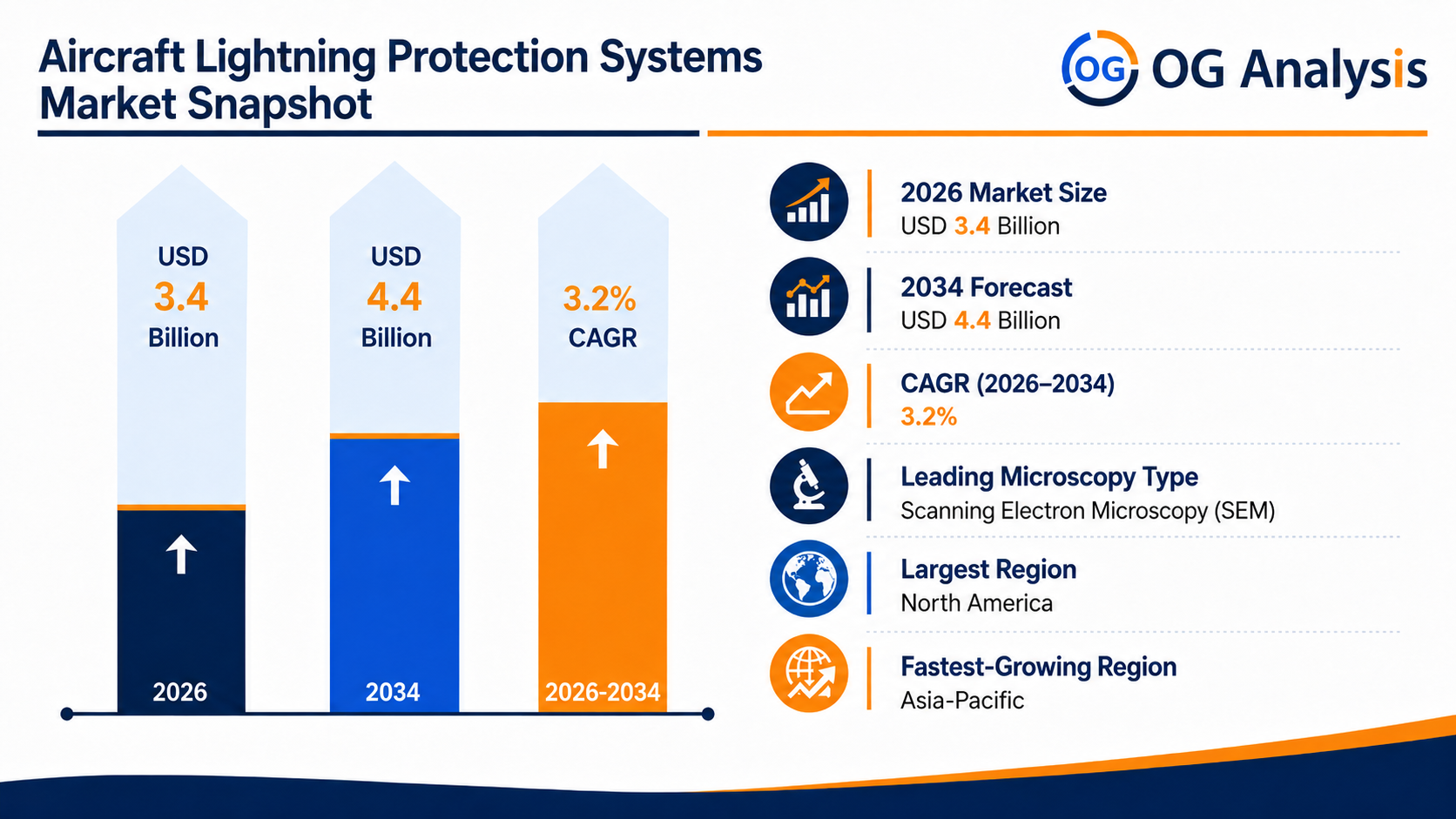
Aircraft lightning protection systems are designed to protect aircraft structures, fuel systems, avionics, antennas, radomes, composite surfaces, wiring, and electronic components from lightning strike damage, electrical arcing, thermal stress, and electromagnetic interference. Market growth is supported by rising aircraft production, growing use of composite materials, increasing electrification of aircraft systems, higher avionics complexity, and strict aviation safety certification requirements. Modern aircraft require integrated protection solutions across external surfaces, fuel tanks, control systems, communication equipment, and critical electronics. Demand is also expanding across commercial aircraft, business jets, military aircraft, helicopters, UAVs, and emerging electric and hybrid-electric aircraft platforms.
Get Your Free Sample Report for In-Depth Market Insights :
https://www.oganalysis.com/industry-reports/global-aircraft-lightning-protection-systems-market
1. What is the latest trend in the Aircraft Lightning Protection Systems Market?
The latest trend is the development of lightweight lightning strike protection solutions for composite aircraft structures.
As aircraft manufacturers use more carbon fiber composites, protection systems must provide conductivity without adding excessive weight.
Conductive meshes, expanded metal foils, embedded films, diverter strips, and advanced coatings are gaining importance.
More-electric aircraft, UAVs, and advanced avionics are also increasing demand for electromagnetic protection and surge-suppression technologies.
2. What are the key challenges in the Aircraft Lightning Protection Systems Market?
Key challenges include high certification complexity, weight constraints, material compatibility, installation precision, and long aircraft qualification cycles.
Lightning protection systems must perform reliably without affecting aerodynamics, fuel safety, structural integrity, or signal performance.
Composite structures are more vulnerable to lightning damage than traditional metallic airframes, requiring specialized protection designs.
Manufacturers must also manage cost pressure, supply-chain reliability, and compliance with strict aerospace safety standards.
3. What is the major driving factor for the Aircraft Lightning Protection Systems Market?
The major driving factor is the growing need to protect modern aircraft from direct and indirect lightning effects.
Aircraft operate in weather conditions where lightning exposure can damage structures, antennas, radomes, avionics, and electrical systems.
Rising use of advanced electronics, fly-by-wire systems, sensors, communication systems, and composite materials increases protection requirements.
This makes lightning protection a critical part of aircraft design, certification, maintenance, and safety assurance.
4. What is the major segment in the Aircraft Lightning Protection Systems Market and why?
Lightning protection materials for aircraft structures represent a major segment because they are essential for composite airframes, wings, fuselage sections, nacelles, and radomes.
Conductive meshes and metallic foils help dissipate lightning current across aircraft surfaces and reduce localized thermal damage.
Static discharge wicks and diverter strips are also important because they help manage electrical charge and protect sensitive external components.
Surge protection devices remain critical for avionics, wiring, sensors, and communication systems.
5. Which application or end-user is driving more demand?
Commercial aircraft manufacturers and airlines are major demand drivers due to large fleet sizes, aircraft deliveries, maintenance cycles, and safety requirements.
Military aircraft programs also generate strong demand because mission systems, radar, antennas, and electronic warfare equipment require robust protection.
Business jets, helicopters, UAVs, and eVTOL platforms are emerging users of lightweight protection systems.
Maintenance, repair, and overhaul providers also support demand through inspections, replacements, and lightning-damage repairs.
6. Which region offers the highest growth potential and why?
North America remains a leading region due to strong commercial aircraft production, defense aviation programs, aerospace suppliers, and advanced certification capabilities.
Europe is supported by major aircraft manufacturing, helicopter production, and strong aerospace material innovation.
Asia Pacific offers strong growth potential due to rising aircraft deliveries, expanding airline fleets, regional manufacturing, and defense modernization.
The Middle East also supports demand through large airline fleets, aircraft maintenance activity, and aviation infrastructure expansion.
7. What strategies are major companies adopting in the market?
Major companies are focusing on lightweight materials, composite-compatible protection systems, advanced surge protection, and integrated aircraft safety solutions.
They are improving conductive meshes, lightning diverters, static discharge products, and transient voltage protection components.
Partnerships with aircraft OEMs, defense contractors, MRO providers, and material suppliers are becoming important for qualification and adoption.
Companies are also investing in testing, certification support, customized design, and application-specific protection systems.
8. What are the leading companies in the Aircraft Lightning Protection Systems Market?
Leading companies include Honeywell International, Parker Hannifin, Cobham, Dayton-Granger, Dexmet Corporation, TE Connectivity, Microchip Technology, Saab, L3Harris Technologies, Astroseal Products Manufacturing, Amphenol Aerospace, and Conductive Composites.
These companies compete through aerospace certification experience, product reliability, lightweight material capability, testing expertise, OEM relationships, and global support networks.
Dayton-Granger highlights lightning protection solutions for aircraft, radomes, antennas, and onboard electronic equipment, while market coverage also identifies Dayton-Granger, Dexmet, TE Connectivity, Honeywell, Saab, Cobham, and L3 Technologies among major participants.
9. Why are aircraft lightning protection systems strategically important for aviation?
Aircraft lightning protection systems are strategically important because they help preserve aircraft safety, operational reliability, and regulatory compliance.
They protect passengers, crew, structures, fuel systems, flight controls, communication equipment, antennas, and avionics from lightning-related risks.
Reliable protection reduces aircraft downtime, repair cost, inspection burden, and potential mission disruption.
For aircraft OEMs, lightning protection is essential for certification, airworthiness, and long-term fleet performance.
10. What is the future outlook for the Aircraft Lightning Protection Systems Market?
The market outlook remains positive as aircraft become lighter, more electric, more connected, and more dependent on advanced electronic systems.
Future growth will be supported by composite airframes, UAVs, electric aircraft, advanced avionics, lightning testing, and high-performance protection materials.
Commercial aviation, defense modernization, business aviation, and MRO activity will continue to support demand.
Companies offering lightweight, certifiable, integrated, and application-specific lightning protection solutions are expected to gain market share.
Browse Related Reports
https://www.oganalysis.com/industry-reports/commercial-helicopters-market
https://www.oganalysis.com/industry-reports/passenger-aircrafts-market
https://www.oganalysis.com/industry-reports/military-drone-uav-market
https://www.oganalysis.com/industry-reports/aircraft-sensors-market
https://www.oganalysis.com/industry-reports/electric-aircraft-market
Stay Connected With Us
