Antivirus Software Market Outlook 2026–2034: Endpoint Protection Demand, AI-Based Threat Detection, Growth Drivers, Leading Companies, and Future Opportunities
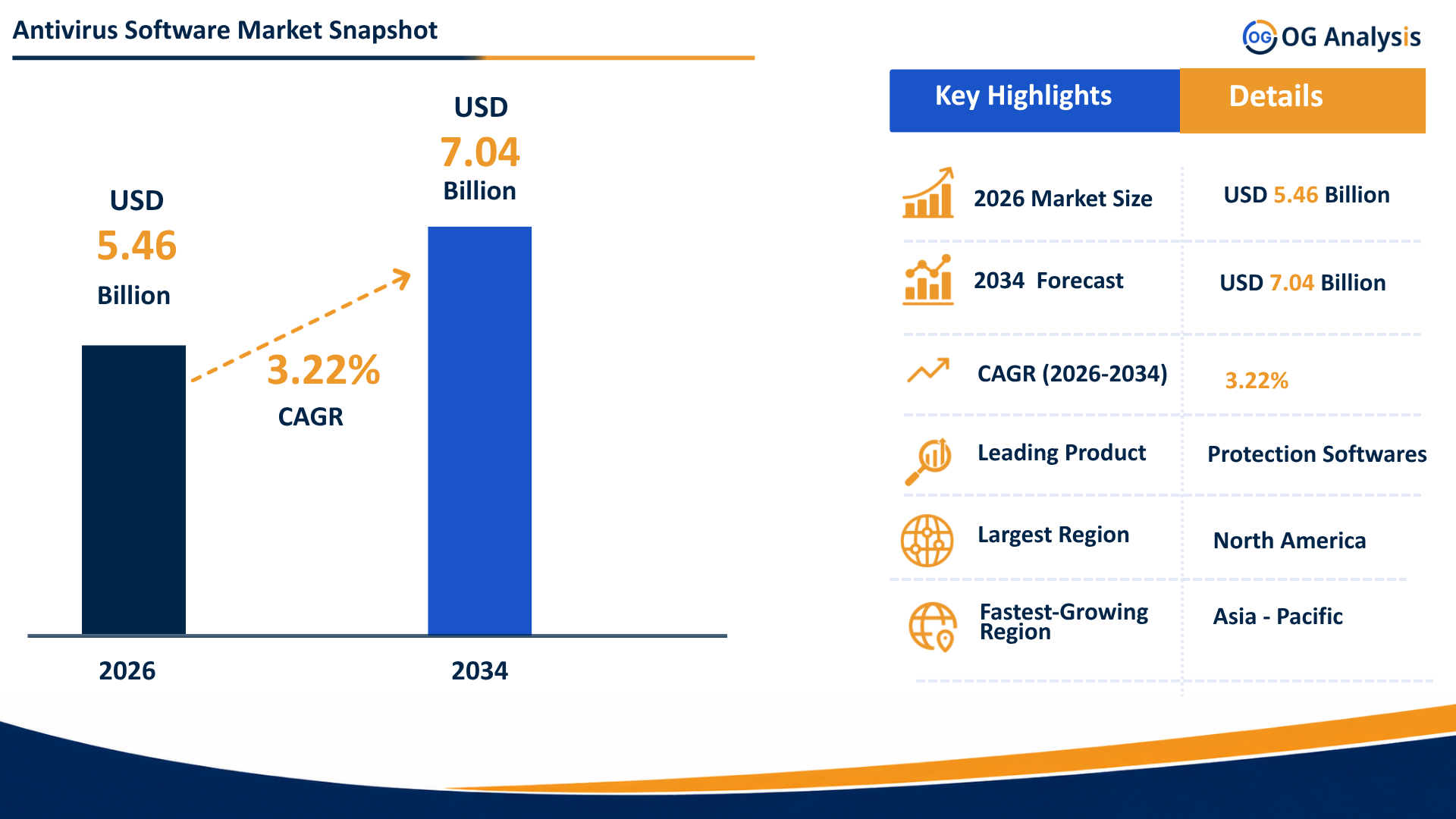
The Antivirus Software Market is estimated to be valued at 5.46 billion in 2026 and is projected to reach 7.04 billion by 2034, expanding at a CAGR of 3.22% from 2026 to 2034.
Antivirus software includes security tools designed to detect, block, quarantine, and remove malware, viruses, ransomware, spyware, trojans, worms, phishing threats, malicious websites, and suspicious files across computers, smartphones, tablets, servers, and enterprise endpoints. The market includes standalone antivirus products, internet security suites, endpoint protection platforms, mobile security applications, cloud-based antivirus tools, and business-grade cybersecurity solutions. Market growth is supported by rising cyberattacks, ransomware incidents, remote work, cloud usage, digital payments, mobile-device adoption, and expanding enterprise IT networks. Consumer users need antivirus tools for personal devices, identity protection, online banking, parental controls, and privacy protection, while enterprises require endpoint protection, threat intelligence, centralized management, policy control, and incident-response support. Built-in security tools such as Microsoft Defender remain widely used, while third-party vendors compete through advanced malware detection, VPN bundles, password managers, dark web monitoring, cloud scanning, AI-based threat detection, and managed security services.
Get the Complete Analysis :
https://www.oganalysis.com/industry-reports/antivirus-software-market
Get Your Free Sample Report for In-Depth Market Insights :
https://www.oganalysis.com/industry-reports/antivirus-software-market/free-sample
1. What is the latest trend in the Antivirus Software Market?
The latest trend is the shift from traditional signature-based antivirus toward AI-enabled endpoint protection, cloud-based scanning, behavioral analytics, and integrated cybersecurity suites.
Vendors are adding ransomware rollback, phishing protection, identity monitoring, VPN, password management, dark web alerts, and privacy tools to improve customer value.
Enterprise buyers are increasingly looking beyond basic antivirus toward endpoint detection and response, extended detection and response, and managed detection and response services.
Built-in protection tools and operating-system security features are also influencing the market by reducing dependence on basic standalone antivirus products.
2. What are the key challenges in the Antivirus Software Market?
Key challenges include intense price competition, free built-in security tools, false positives, performance concerns, malware evasion techniques, and customer fatigue from bundled subscriptions.
Antivirus vendors must continuously update detection engines because cybercriminals use obfuscation, fileless malware, social engineering, and polymorphic attacks to avoid detection.
Enterprise customers also require strong integration with SIEM, EDR, cloud security, identity systems, and compliance workflows.
Consumer users may avoid paid antivirus when they believe built-in operating-system protection is sufficient for everyday browsing and device use.
3. What is the major driving factor for the Antivirus Software Market?
The major driving factor is the rising frequency and complexity of malware, ransomware, phishing, and endpoint-based cyber threats.
As individuals and organizations rely more on connected devices, online payments, cloud platforms, and remote access, endpoint protection becomes increasingly important.
Antivirus software helps protect users from malicious downloads, infected attachments, unsafe websites, credential theft, and unauthorized system changes.
Enterprise demand is also supported by compliance needs, hybrid work, bring-your-own-device policies, and the need to protect distributed workforces.
4. What is the major segment in the Antivirus Software Market and why?
Enterprise endpoint security is a major segment because organizations require centralized protection across laptops, desktops, servers, mobile devices, and cloud-connected endpoints.
Business users need policy management, threat visibility, ransomware protection, patch awareness, incident reporting, and integration with broader security operations.
Consumer antivirus also remains important because households use security suites for PCs, mobile devices, online banking, privacy, and identity protection.
Cloud-based antivirus and mobile security are growing as users shift toward remote work, smartphones, tablets, and cloud-first digital activity.
5. Which application or end-user is driving more demand?
Corporate users, small and medium businesses, government agencies, educational institutions, healthcare organizations, financial services firms, and individual consumers are driving demand.
Enterprises use antivirus and endpoint protection to secure employees, branch offices, servers, remote devices, and business-critical applications.
Consumers use antivirus software for malware protection, safe browsing, parental control, identity monitoring, device optimization, and privacy support.
Mobile security demand is increasing as smartphones become the primary device for banking, shopping, communication, and work access.
6. Which region offers the highest growth potential and why?
North America remains a leading market due to high cybersecurity spending, large enterprise IT infrastructure, mature software adoption, and strong presence of major security vendors.
Asia Pacific offers strong growth potential due to rapid digitalization, expanding SME technology adoption, smartphone penetration, cloud migration, and increasing cyberattack exposure.
Europe is supported by strict data protection rules, enterprise compliance needs, and demand for endpoint security across public and private organizations.
Emerging markets are also gaining traction as businesses adopt digital payments, online services, and cloud applications that require endpoint protection.
7. What strategies are major companies adopting in the market?
Major companies are focusing on AI-based malware detection, cloud threat intelligence, ransomware protection, phishing defense, identity protection, and integrated security suites.
Enterprise-focused vendors are expanding into EDR, XDR, MDR, zero-trust endpoint security, vulnerability management, and security operations services.
Consumer-focused vendors are bundling antivirus with VPN, password managers, device cleanup, privacy protection, and dark web monitoring to improve subscription retention.
Strategic acquisitions are also shaping the market, including Sophos’ Secureworks acquisition to strengthen MDR and XDR capabilities.
8. What are the leading companies in the Antivirus Software Market?
Leading companies include Microsoft, NortonLifeLock/Gen Digital, McAfee, Bitdefender, ESET, Trend Micro, Avast, AVG, Kaspersky, Malwarebytes, Sophos, Fortinet, F-Secure, G DATA, Quick Heal, AhnLab, Panda Security, Webroot, Comodo, and Tencent.
These companies compete through detection accuracy, threat intelligence, endpoint performance, pricing, brand trust, device coverage, cloud protection, and enterprise-management capabilities.
AV-Comparatives’ 2026 IT security survey lists ESET, Bitdefender, Kaspersky, Microsoft Defender, Avast, Norton, McAfee, Malwarebytes, AVG, Avira, F-Secure, and G Data among commonly used anti-malware manufacturers among survey participants.
Large vendors benefit from brand recognition and installed bases, while specialized cybersecurity providers compete through enterprise-grade endpoint protection and managed security services.
9. Why is antivirus software strategically important for users and organizations?
Antivirus software is strategically important because endpoints are one of the most common entry points for malware, ransomware, phishing, and unauthorized access.
For consumers, antivirus tools protect personal files, financial data, passwords, browsing activity, and connected devices.
For organizations, endpoint protection helps reduce breach risk, maintain business continuity, support compliance, and protect distributed workforces.
As threats become more sophisticated, antivirus software is evolving into a broader endpoint security layer within modern cybersecurity architecture.
10. What is the future outlook for the Antivirus Software Market?
The market outlook remains positive as cyber threats continue to evolve and endpoint protection remains essential for consumers, businesses, and public-sector organizations.
Future growth will be supported by AI-powered detection, cloud-based security, endpoint detection and response, ransomware defense, mobile protection, identity monitoring, and managed security services.
Traditional antivirus will continue to be absorbed into broader cybersecurity suites as customers demand integrated protection across devices, identities, networks, and cloud applications.
Companies offering strong detection performance, low system impact, easy management, privacy features, and enterprise-grade response capabilities are expected to gain market share.
Browse Related Reports
https://www.oganalysis.com/industry-reports/remote-working-software-market
https://www.oganalysis.com/industry-reports/cloud-computing-market
https://www.oganalysis.com/industry-reports/thin-client-market
https://www.oganalysis.com/industry-reports/firewall-as-a-service-market
https://www.oganalysis.com/industry-reports/cybersecurity-market
