Aromatic Chemicals Market Growth Outlook 2026–2034: Trends, Applications, Leading Companies, and Regional Opportunities
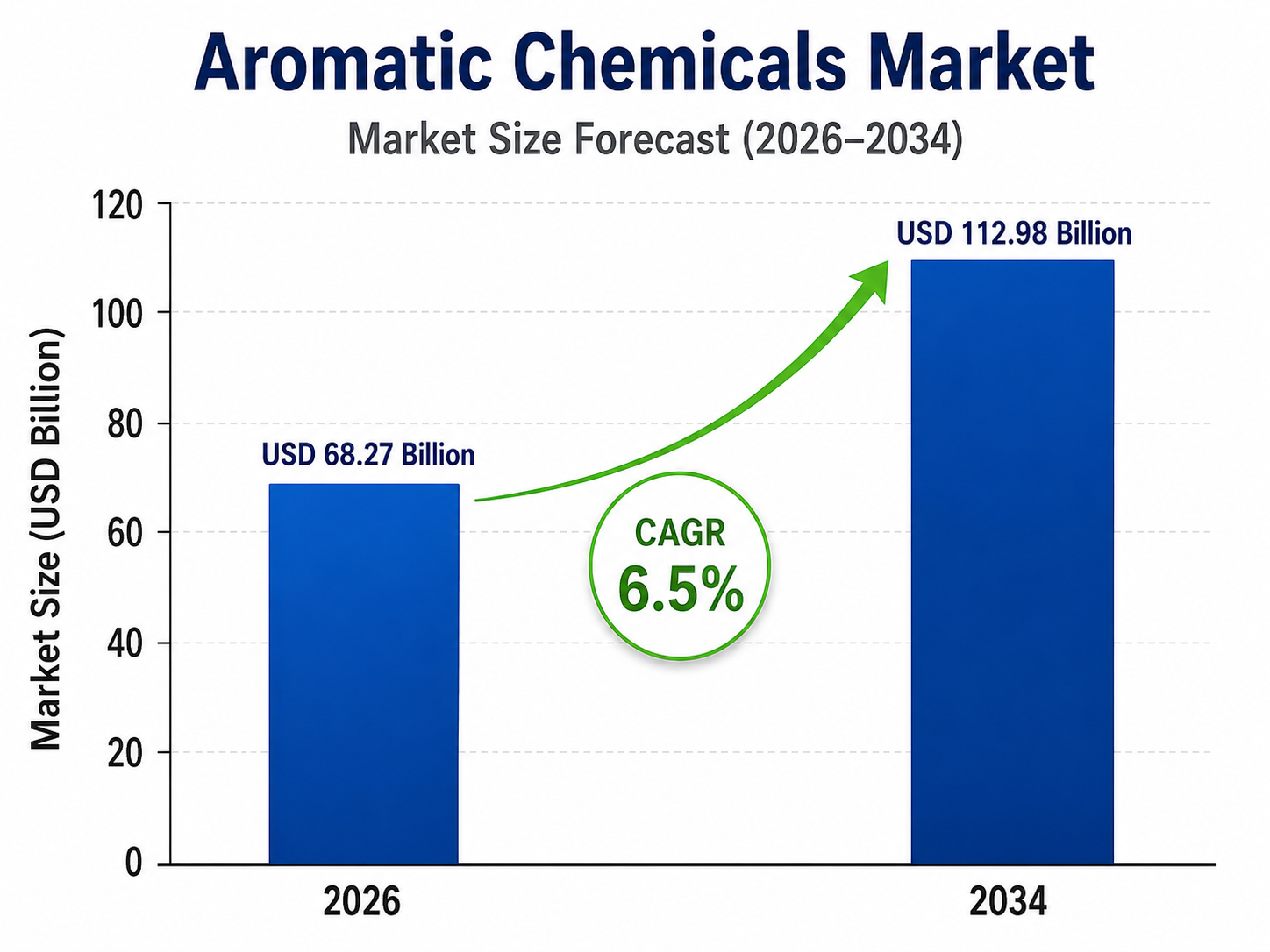
The Aromatic Chemicals Market is estimated to be valued at $ 68.27 billion in 2026 and is projected to reach $ 112.98 billion by 2034, expanding at a CAGR of 6.5% from 2026 to 2034.
Aromatic chemicals are fragrance and flavor compounds used to provide scent, cosmetics, soaps, taste, and sensory enhancement across perfumes, personal care products, detergents, household cleaners, food and beverages, and various industrial formulations. The market is Growing rapidly as consumer brands increasingly focus on premium fragrances, long-lasting scent profiles, natural-inspired ingredients, and Customized product experiences.
Market growth is driven by increasing consumption of personal care products, iincreasing demand for home care solutions, rising disposable incomes, and the broader application of aroma compounds in wellness, hygiene, and lifestyle products. As brands increasingly compete through sensory innovation, aromatic chemicals are emerging as a strategic component for enhancing formulation performance, strengthening product identity, influencing consumer preferences, and supporting premium product positioning.
1. What is the latest trend in the Aromatic Chemicals Market?
The latest trend is the growing shift toward sustainable, bio-based, natural-identical, and traceable aromatic ingredients.
Fragrance and flavor houses are increasingly using green chemistry, biotechnology, and upcycled raw materials to meet brand sustainability goals.
AI-assisted formulation and digital scent design are also emerging as tools for faster product development.
This trend is helping companies balance performance, cost, regulatory compliance, and consumer demand for cleaner ingredients.
2. What are the key challenges in the Aromatic Chemicals Market?
Key challenges include raw material price volatility, regulatory pressure, allergen labeling requirements, supply chain disruption, and environmental concerns.
Natural aromatic ingredients can face availability issues due to crop cycles, climate impact, and geographic sourcing concentration.
Synthetic ingredients also face scrutiny related to safety, biodegradability, and changing consumer perception.
Companies must continuously reformulate products to meet evolving compliance, sustainability, and brand requirements.
3. What is the major driving factor for the Aromatic Chemicals Market?
The major driving factor is rising demand from personal care, fine fragrance, cosmetics, home care, and hygiene products.
Consumers increasingly prefer products with distinctive, long-lasting, premium, and mood-enhancing scent profiles.
Growth in urban lifestyles, grooming routines, household cleaning, and premium consumer goods is strengthening demand.
Aromatic chemicals help brands create product differentiation, emotional appeal, and repeat purchase behavior.
4. What is the major segment in the Aromatic Chemicals Market and why?
Synthetic aromatic chemicals represent a major segment because they offer consistent quality, scalable production, cost efficiency, and stable fragrance performance.
They are widely used in soaps, detergents, cosmetics, perfumes, air fresheners, and household products.
Synthetic compounds also allow formulators to create unique scent profiles that may be difficult or expensive to obtain naturally.
However, natural and bio-based aroma chemicals are gaining faster attention due to sustainability and clean-label preferences.
5. Which application or end-user is driving more demand?
Personal care, cosmetics, fine fragrances, soaps, detergents, and household care products are driving strong demand.
These applications require aromatic chemicals for scent identity, product freshness, masking of base odors, and consumer appeal.
Premium perfumes, deodorants, shampoos, body care, laundry care, and surface cleaners remain key demand areas.
Food and beverage flavor applications also contribute steadily, especially in processed foods, beverages, confectionery, and bakery products.
6. Which region offers the highest growth potential and why?
Asia Pacific offers strong growth potential due to rising disposable income, urbanization, expanding middle-class consumption, and growing personal care demand.
China, India, Japan, South Korea, and Southeast Asian countries are important markets for fragrances, cosmetics, detergents, and packaged foods.
The region also benefits from expanding chemical manufacturing capacity and strong demand from local consumer brands.
Europe and North America remain mature markets driven by premium fragrance innovation, sustainability, and regulatory-quality formulations.
7. What strategies are major companies adopting in the Aromatic Chemicals Market?
Major companies are focusing on sustainable sourcing, biotechnology-based production, green chemistry, portfolio expansion, and customer-specific fragrance solutions.
They are investing in R&D to develop high-performance, long-lasting, biodegradable, and allergen-conscious aroma compounds.
Partnerships with personal care, home care, food, and fragrance brands are helping suppliers co-create differentiated formulations.
Companies are also strengthening backward integration and supply chain resilience to secure key raw materials.
8. What are the leading companies in the Aromatic Chemicals Market?
Leading companies include Givaudan, dsm-firmenich, Symrise, International Flavors & Fragrances, BASF, Takasago, MANE, Robertet, Kao Corporation, Privi Speciality Chemicals, Eternis Fine Chemicals, Bell Flavors & Fragrances, Bedoukian Research, Sensient Technologies, and T. Hasegawa.
These companies compete through ingredient innovation, global formulation expertise, regulatory support, sensory science, and customer partnerships.
Large players benefit from broad portfolios across fragrance, flavor, natural, synthetic, and specialty aroma compounds.
Specialized manufacturers are gaining opportunities through niche molecules, sustainable ingredients, and regional supply advantages.
9. Why are aromatic chemicals strategically important for consumer product brands?
Aromatic chemicals are strategically important because fragrance and flavor strongly influence consumer perception, product identity, and brand recall.
They help brands create emotional differentiation in crowded categories such as personal care, home care, cosmetics, and packaged foods.
A well-designed scent profile can improve premium positioning, customer loyalty, and repeat purchases.
For manufacturers, aroma innovation is a key tool for product launches, reformulation, and market segmentation.
10. What is the future outlook for the Aromatic Chemicals Market?
The market outlook remains positive as demand grows for premium personal care, fine fragrances, home care, packaged foods, and wellness-oriented products.
Future growth will be supported by sustainable aroma molecules, biotechnology, natural-identical compounds, and advanced formulation technologies.
Regulatory compliance, supply security, and clean-label preferences will shape product development and sourcing strategies.
Companies offering scalable, sustainable, high-performance, and brand-specific aromatic solutions are expected to gain competitive advantage.
Browse Related Report
https://www.oganalysis.com/industry-reports/mixed-fertilizer-market
https://www.oganalysis.com/industry-reports/biphenyl-diphenyl-ether-market
https://www.oganalysis.com/industry-reports/dust-control-agents-market
https://www.oganalysis.com/industry-reports/plastics-processing-aid-market
https://www.oganalysis.com/industry-reports/micronized-zeolites-market
