Automotive Robotics Market: Growth Trends Shaping the Automotive Industry
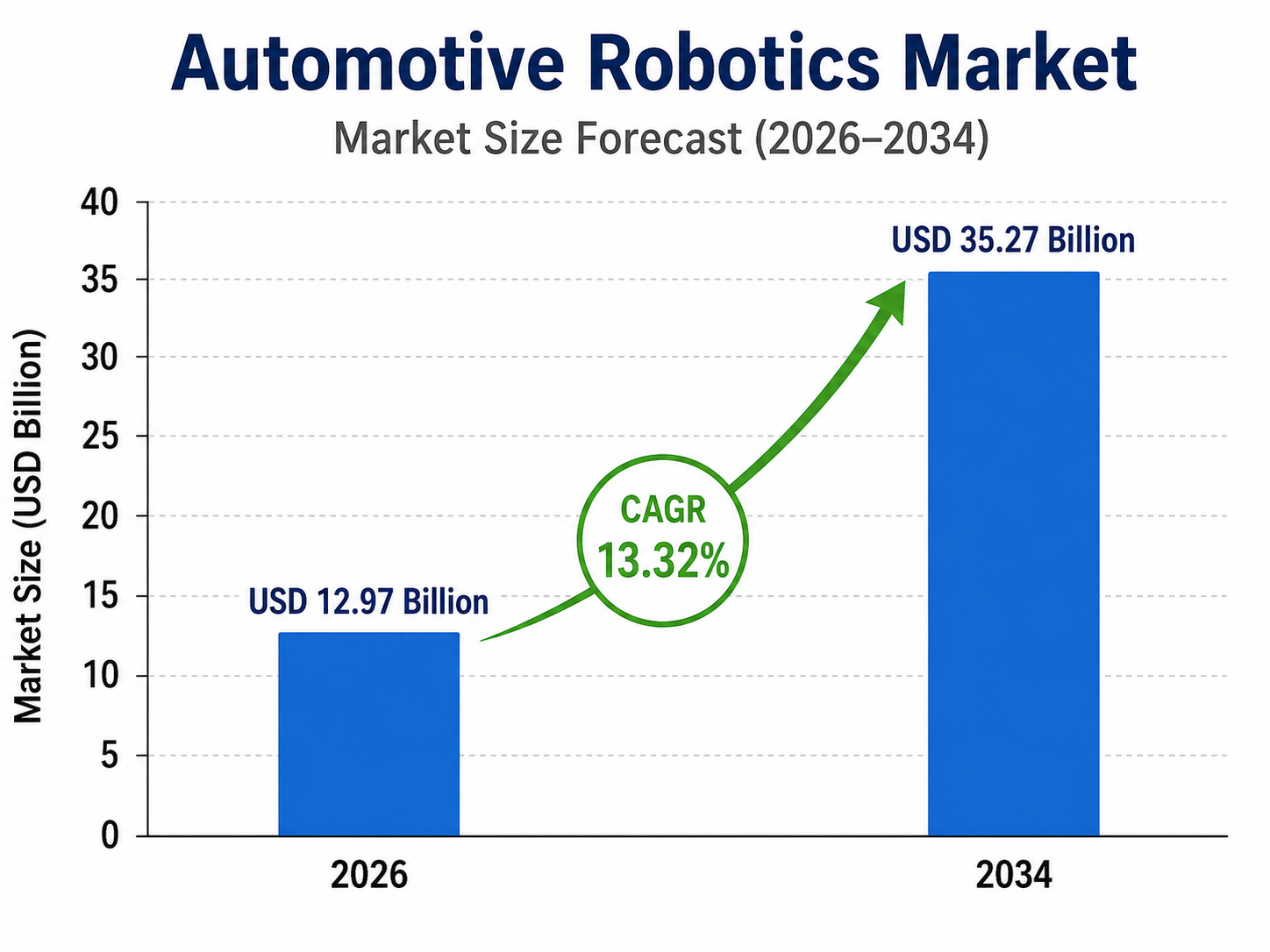
The Automotive Robotics Market is estimated to be valued at USD 12.97 billion in 2026 and is projected to reach USD 35.27 billion by 2034, expanding at a CAGR of 13.32% from 2026 to 2034.
Automotive robotics involves the deployment of industrial robots, collaborative robots (cobots), robotic arms, automated welding and painting systems, assembly robots, material handling robots, and inspection robots to automate and optimize vehicle manufacturing processes.These systems support body-in-white production, welding, painting, powertrain assembly, battery manufacturing, component handling, quality inspection, and final assembly. Growth in the market is fueled by the increasing complexity of vehicle manufacturing, the expansion of electric vehicle production, labor shortages, automation initiatives, safety requirements, and the need for higher precision and productivity.
As automakers shift toward flexible, software-enabled, and highly automated production lines, robotics is becoming a core investment area for OEMs, Tier-1 suppliers, battery manufacturers, and automotive component producers.
1. What is the latest trend in the Automotive Robotics Market?
The latest trend is the integration of AI, machine vision, collaborative robots, and smart automation into automotive production lines.
Robots are increasingly being used for flexible manufacturing, EV battery assembly, precision welding, automated inspection, and adaptive material handling.
Automakers are moving from fixed automation toward intelligent robotic systems that can support multiple models and production changes.
This trend is helping manufacturers improve speed, quality, safety, and scalability across modern vehicle plants.
2. What are the key challenges in the Automotive Robotics Market?
Key challenges include high initial investment, integration complexity, skilled labor shortage, maintenance requirements, and difficulty in retrofitting older production lines.
Automotive robots must meet strict standards for precision, uptime, safety, repeatability, and compatibility with existing manufacturing systems.
Small and mid-sized suppliers may find adoption difficult due to cost, programming expertise, and long payback periods.
Cybersecurity and software reliability are also becoming more important as robotic systems become increasingly connected.
3. What is the major driving factor for the Automotive Robotics Market?
The major driving factor is the rising need for automation, productivity improvement, and consistent manufacturing quality in vehicle production.
Robots help automakers reduce cycle time, minimize human error, improve workplace safety, and support high-volume production with better repeatability.
Growth is further supported by electric vehicle expansion, labor shortages, and increasing complexity in automotive assembly.
Manufacturers are adopting robotics to improve cost efficiency while meeting stricter quality and delivery requirements.
4. What is the major segment in the Automotive Robotics Market and why?
Articulated robots represent a major segment because they offer high flexibility, multi-axis movement, precision, and suitability for complex automotive tasks.
They are widely used in welding, painting, material handling, assembly, machine tending, and component positioning.
Their ability to perform repetitive and high-accuracy operations makes them essential in automotive production lines.
As vehicle platforms become more complex, demand for flexible and programmable articulated robots continues to increase.
5. Which application or end-user is driving more demand?
Welding, painting, material handling, assembly, and inspection applications are driving strong demand for automotive robotics.
Vehicle OEMs, Tier-1 suppliers, EV manufacturers, battery producers, and component manufacturers are key end users.
Welding remains a highly important application because automotive body structures require speed, accuracy, and consistency.
EV production is also creating new demand for robotics in battery packs, power electronics, lightweight materials, and modular assembly.
6. Which region offers the highest growth potential and why?
Asia Pacific offers strong growth potential due to large automotive production volumes, expanding EV manufacturing, industrial automation investments, and strong robotics supply chains.
China, Japan, South Korea, and India are key markets supported by vehicle manufacturing, electronics ecosystems, and smart factory initiatives.
The region benefits from high demand for cost-efficient production and rapid adoption of automation across automotive plants.
Europe and North America also remain important due to advanced vehicle manufacturing, labor cost pressures, and EV capacity expansion.
7. What strategies are major companies adopting in the Automotive Robotics Market?
Major companies are focusing on AI-enabled robots, collaborative automation, machine vision, software integration, predictive maintenance, and flexible manufacturing solutions.
They are expanding robot portfolios for welding, painting, assembly, battery production, quality inspection, and smart factory applications.
Partnerships with automakers, system integrators, software firms, and automation specialists are becoming increasingly important.
Companies are also investing in easier programming, remote monitoring, energy-efficient robots, and modular robotic cells.
8. What are the key companies in the Automotive Robotics Market?
Leading companies include ABB, FANUC, KUKA, Yaskawa Electric, Kawasaki Heavy Industries, DENSO, Mitsubishi Electric, Comau, Stäubli, Universal Robots, Nachi-Fujikoshi, Omron, Epson Robots, Dürr, and Rockwell Automation.
These companies compete through robot performance, payload capacity, precision, application expertise, software platforms, and service networks.
Their leadership is supported by strong automotive customer relationships and proven deployment in global manufacturing plants.
Companies with complete automation ecosystems, integration support, and EV-ready robotic solutions are gaining competitive advantage.
9. Why is automotive robotics strategically important for OEMs and suppliers?
Automotive robotics helps OEMs and suppliers improve production efficiency, quality consistency, worker safety, and manufacturing flexibility.
It enables companies to handle complex vehicle designs, shorter model cycles, and rising demand for customized production.
Robotics also supports EV transition by automating battery assembly, lightweight material handling, and precision component manufacturing.
For top management, robotics is a strategic lever for cost control, capacity expansion, and long-term competitiveness.
10. What is the future outlook for the Automotive Robotics Market?
The market outlook remains strong as automakers increase investments in smart factories, EV plants, flexible automation, and AI-powered manufacturing.
Future growth will be supported by collaborative robots, machine vision, digital twins, predictive analytics, and autonomous mobile robots.
Robotics adoption is expected to expand beyond traditional welding and painting into inspection, logistics, battery assembly, and final assembly.
Companies that offer scalable, intelligent, and application-specific robotic solutions are expected to benefit most from future demand.
Browse Related Report
https://www.oganalysis.com/industry-reports/automotive-emission-analyzer-market
https://www.oganalysis.com/industry-reports/automotive-infotainment-market
https://www.oganalysis.com/industry-reports/automotive-voice-recognition-system-market
https://www.oganalysis.com/industry-reports/automotive-smart-key-market
https://www.oganalysis.com/industry-reports/3d-printing-automotive-market
