Automotive Speaker Market Outlook 2026–2034: Premium Audio Trends, EV Demand, Leading Companies, and Growth Opportunities
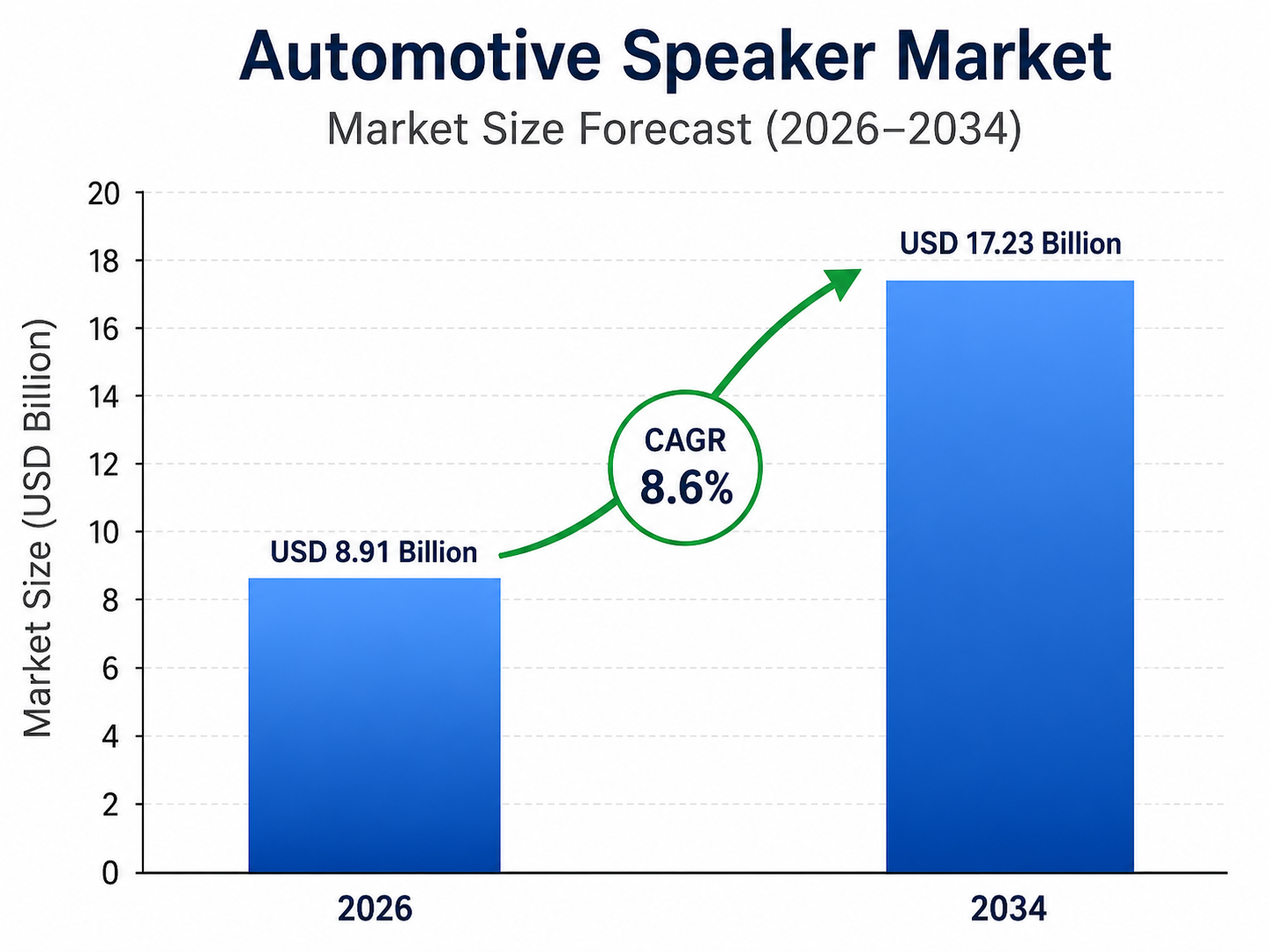
The Automotive Speaker Market is estimated to be valued at $ 8.91 billion in 2026 and is projected to reach $ 17.23 billion by 2034, expanding at a CAGR of 8.6% from 2026 to 2034.
Automotive speakers include woofers, subwoofers, tweeters, mid-range units, coaxial speakers, and component systems installed in passenger and commercial vehicles. They support music playback, navigation instructions, hands-free communication, active noise control, warning sounds, and immersive infotainment experiences. Market growth is being driven by rising demand for premium in-car audio, connected digital cockpits, electric vehicles, and factory-installed branded sound systems. Automakers are increasing speaker counts and integrating amplifiers, digital signal processing, headrest speakers, and spatial-audio technologies. As vehicle interiors become more software-defined and entertainment-focused, speaker performance is becoming an important product-differentiation and passenger-experience factor.
1. What is the latest trend in the Automotive Speaker Market?
The latest trend is the adoption of immersive spatial audio, personalized sound zones, and headrest- or seat-integrated speakers.
Automakers are combining multi-speaker layouts with digital signal processing, active noise cancellation, and software-defined sound tuning.
Electric vehicles are accelerating this trend because their quieter cabins make audio quality more noticeable.
Over-the-air sound-profile updates and AI-assisted acoustic optimization are also emerging.
2. What are the key challenges in the Automotive Speaker Market?
Key challenges include limited cabin space, vehicle weight targets, acoustic variation, vibration exposure, and pressure to control system costs.
Speakers must deliver consistent sound despite differences in cabin materials, seating positions, road noise, and vehicle architecture.
Premium systems also require complex amplifiers, wiring, software, and extensive acoustic tuning.
Commodity pricing and long automotive qualification cycles can place additional pressure on supplier margins.
3. What is the major driving factor for the Automotive Speaker Market?
The major driving factor is increasing consumer demand for premium entertainment, connectivity, and personalized in-vehicle experiences.
Audio quality is becoming an important purchase consideration as vehicles incorporate larger displays, streaming services, and digital cockpits.
Automakers use branded sound systems to differentiate trims and create profitable optional packages.
Growth in electric and luxury vehicles is further increasing demand for advanced speaker configurations.
4. What is the major segment in the Automotive Speaker Market and why?
Passenger vehicles represent the major vehicle segment because they account for the largest share of global vehicle production and audio-system installations.
Consumers increasingly expect high-quality speakers even in entry- and mid-range cars, not only in luxury models.
SUVs, premium cars, and electric vehicles often use higher speaker counts and more advanced component systems.
Rising private vehicle ownership and infotainment adoption continue to support segment demand.
5. Which application or end-user is driving more demand?
Original equipment manufacturers are driving significant demand through factory-installed speaker systems across multiple vehicle price categories.
Premium and luxury vehicle brands use branded audio systems, subwoofers, amplifiers, and immersive configurations to enhance differentiation.
Electric vehicles are another important demand area because quiet cabins support more detailed and personalized sound reproduction.
The aftermarket remains relevant for consumers upgrading output, bass performance, or overall sound quality.
6. Which region offers the highest growth potential and why?
Asia Pacific offers strong growth potential due to large vehicle production, expanding EV sales, rising incomes, and growing demand for connected infotainment.
China, Japan, South Korea, and India support extensive automotive manufacturing and electronics supply chains.
Consumers are increasingly demanding premium features in compact, mid-range, and electric vehicles.
North America and Europe remain important markets for luxury audio, branded systems, and advanced cabin technologies.
7. What strategies are major companies adopting in the market?
Major companies are focusing on OEM partnerships, branded audio programs, lightweight speaker materials, and software-based acoustic tuning.
They are developing modular speaker platforms that can be adapted across multiple vehicle models and trim levels.
Investment is increasing in spatial audio, active noise control, personal sound zones, and headrest-integrated solutions.
Companies are also expanding engineering centers near major automotive production hubs.
8. What are the leading companies in the Automotive Speaker Market?
Leading companies include Harman International, Bose, Panasonic, Alps Alpine, Pioneer, Sony, JVC Kenwood, FORVIA Clarion, Premium Sound Solutions, Focal, and Elettromedia.
These companies compete through sound quality, acoustic engineering, OEM relationships, product reliability, and brand recognition.
Large suppliers benefit from integrated speakers, amplifiers, software, microphones, and infotainment capabilities.
Specialist audio brands compete through premium tuning, distinctive sound signatures, and high-performance components.
9. Why are automotive speakers strategically important for vehicle manufacturers?
Automotive speakers influence perceived vehicle quality, passenger comfort, brand identity, and the overall digital-cockpit experience.
They support entertainment, calls, navigation, driver alerts, active noise management, and external acoustic-warning functions.
Premium audio packages can create incremental revenue and strengthen differentiation between vehicle trims.
For electric vehicles, sound design is becoming an important part of the brand and ownership experience.
10. What is the future outlook for the Automotive Speaker Market?
The market outlook remains positive as vehicles evolve into connected, entertainment-rich, and software-defined mobility spaces.
Future systems will increasingly combine immersive audio, personalized listening zones, active noise control, and intelligent acoustic processing.
Lightweight materials and fewer high-performance speakers may help reduce system weight while maintaining sound quality.
Suppliers offering scalable hardware, advanced software, and strong OEM integration capabilities are expected to gain market share.
Browse related Reports
https://www.oganalysis.com/industry-reports/automotive-emission-analyzer-market
https://www.oganalysis.com/industry-reports/automotive-infotainment-market
https://www.oganalysis.com/industry-reports/automotive-voice-recognition-system-market
https://www.oganalysis.com/industry-reports/automotive-smart-key-market
https://www.oganalysis.com/industry-reports/3d-printing-automotive-market
