Building the Future: Exploring the Global Automotive IoT Market
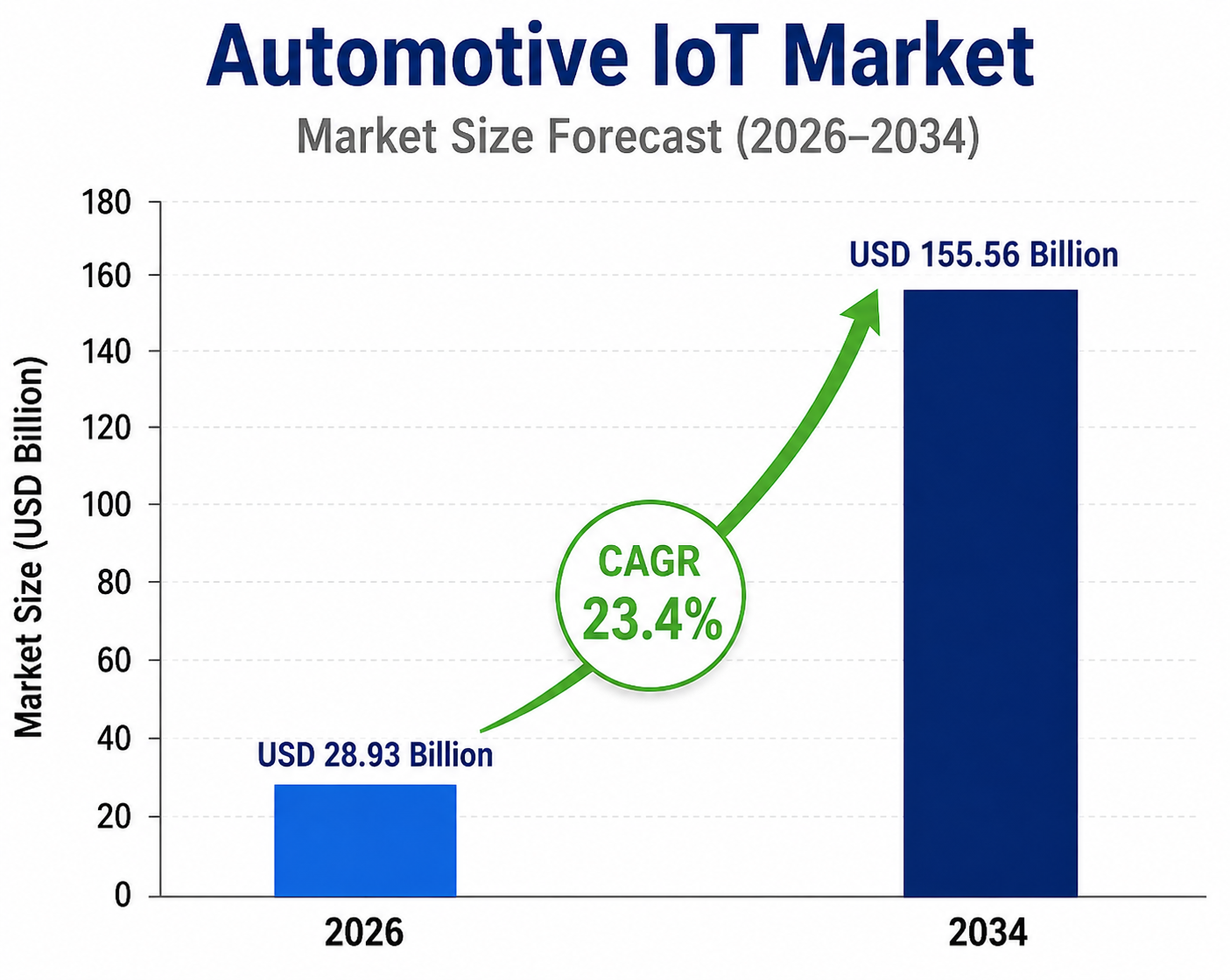
The Automotive IoT Market is estimated to be valued at $ 28.93 billion in 2026 and is projected to reach $ 155.56 billion by 2034, expanding at a CAGR of 23.4 % from 2026 to 2034. Connected sensors, embedded software, telematics devices, cloud platforms, communication modules, and data analytics technologies are implemented into vehicles and mobility ecosystems through Automotive IoT. These technologies support connected cars, fleet tracking, predictive maintenance, infotainment ,vehicle diagnostics, ADAS support, usage-based insurance, over-the-air updates, and real-time vehicle-to-everything communication.
Market growth is spurred by Increasing preference for connected vehicles, software-defined mobility, smart transportation systems, vehicle safety, electrification, and digital customer experiences. The shift from hardware-centric vehicles to data-driven mobility platforms is positioning Automotive IoT as a key strategic focus for OEMs, Tier-1 suppliers, semiconductor manufacturers, telecom operators, fleet owners, and technology providers.
1. What is the latest trend in the Automotive IoT Market?
A key trend in the Automotive IoT market is the transition toward software-defined vehicles (SDVs), where vehicle performance, safety features, infotainment systems, and user experiences are increasingly controlled through software and connectivity. Automakers are integrating IoT technologies with artificial intelligence (AI), 5G, edge computing, cybersecurity solutions, over-the-air (OTA) updates, digital cockpits, and vehicle-to-everything (V2X) communication. This evolution is transforming vehicles from traditional mechanical products into connected digital platforms. Furthermore, it is unlocking new revenue streams through subscription-based services, remote feature upgrades, data analytics, and personalized mobility solutions.
2. What are the key challenges in the Automotive IoT Market?
Key challenges include cybersecurity risks, data privacy concerns, interoperability issues, high development costs, regulatory complexity, and dependence on reliable network connectivity.
Automotive IoT systems must meet strict safety, reliability, latency, and data protection requirements as vehicles become more connected and software-dependent.
Fragmented technology standards across OEMs, suppliers, telecom networks, and software platforms can slow implementation.
Consumer concerns around data ownership, vehicle hacking, and recurring digital service costs also remain important barriers.
3. What is the major driving factor for the Automotive IoT Market?
The major driving factor is rising demand for connected, intelligent, safer, and more personalized mobility experiences.
Automotive IoT helps OEMs and fleet operators improve vehicle performance, reduce downtime, enable remote diagnostics, enhance safety, optimize routes, and create recurring digital revenue.
Growth is further supported by electric vehicle adoption, smart transportation systems, and advanced driver assistance technologies.
As mobility becomes more data-driven, real-time vehicle intelligence is becoming essential for both passenger and commercial vehicles.
4. What is the major segment in the Automotive IoT Market and why?
Connectivity hardware and telematics solutions represent a major segment because they form the foundation for vehicle communication, tracking, diagnostics, and data exchange.
Embedded connectivity modules, sensors, gateways, and control units enable fleet monitoring, infotainment, safety alerts, remote software updates, and predictive maintenance.
This segment is critical because most Automotive IoT applications depend on reliable connectivity and continuous data transmission.
Rising connected car adoption, commercial fleet digitization, and OEM telematics programs continue to strengthen demand.
5. Which application or end-user is driving more demand?
Fleet management, connected car services, infotainment, and vehicle diagnostics are driving strong demand for Automotive IoT solutions.
Commercial fleets, logistics operators, ride-hailing platforms, leasing companies, and OEM-connected vehicle programs require real-time visibility, safety, maintenance, and operating efficiency.
Fleet operators are adopting IoT to reduce fuel costs, monitor driver behavior, improve asset utilization, and minimize vehicle downtime.
Passenger vehicle users are also increasing demand through navigation, entertainment, remote access, safety alerts, and connected ownership services.
6. Which region offers the highest growth potential and why?
Asia Pacific offers strong growth potential due to large vehicle production, expanding EV adoption, smart city investments, rising connected car demand, and strong electronics manufacturing capacity.
China, Japan, South Korea, and India are key markets as automakers and technology suppliers accelerate connected mobility, infotainment, telematics, and intelligent transportation deployments.
The region benefits from high consumer acceptance of digital vehicle features and strong government support for smart mobility infrastructure.
Growth in logistics, ride-hailing, e-commerce delivery, and urban transport systems is also supporting Automotive IoT deployment.
7. What strategies are major companies adopting in the Automotive IoT Market?
Major companies are focusing on partnerships, software platforms, semiconductor innovation, cloud integration, cybersecurity, and over-the-air update capabilities.
OEMs, Tier-1 suppliers, telecom operators, and technology companies are collaborating to build connected vehicle ecosystems and monetize vehicle data.
Companies are also investing in scalable IoT platforms that support multiple vehicle models, regions, and service applications.
Strategic acquisitions, joint ventures, and alliances are helping players strengthen capabilities in AI, 5G, edge computing, and vehicle cybersecurity.
8. What are the leading companies in the Automotive IoT Market?
Leading companies include Robert Bosch, Continental, Denso, Harman, Qualcomm, NXP Semiconductors, Texas Instruments, Intel, Microsoft, IBM, Verizon, Thales, Aptiv, Valeo, LG Electronics, and Cisco.
These companies compete across connectivity modules, automotive chips, telematics platforms, cloud services, cybersecurity, infotainment systems, ADAS, and software-defined vehicle solutions.
Their leadership is supported by strong R&D capabilities, established OEM relationships, and broad connected mobility portfolios.
Companies with integrated hardware, software, cloud, and data security capabilities are gaining strategic advantage.
9. Why is Automotive IoT strategically important for automakers and suppliers?
Automotive IoT allows automakers to move beyond one-time vehicle sales toward recurring digital services, connected subscriptions, predictive maintenance, and data-driven customer engagement.
For suppliers, it creates opportunities in sensors, chips, connectivity platforms, vehicle software, cybersecurity, cloud integration, and intelligent mobility infrastructure.
It also helps OEMs improve product differentiation, strengthen customer loyalty, and generate revenue across the vehicle lifecycle.
As competition shifts toward connected experiences, Automotive IoT is becoming central to long-term mobility strategy and brand positioning.
10. What is the future outlook for the Automotive IoT Market?
The market outlook remains strong as vehicles become more connected, electric, autonomous-ready, and software-defined.
Growth will be supported by 5G adoption, smart mobility platforms, EV ecosystems, digital cockpits, fleet digitization, ADAS expansion, and real-time vehicle intelligence.
Future opportunities will emerge from vehicle-to-everything communication, autonomous mobility, usage-based insurance, remote diagnostics, and connected charging networks.
Companies that combine secure connectivity, scalable software, advanced analytics, and strong automotive partnerships are expected to gain a competitive edge.
Browse Related Reports
https://www.oganalysis.com/industry-reports/automotive-emission-analyzer-market
https://www.oganalysis.com/industry-reports/automotive-infotainment-market
https://www.oganalysis.com/industry-reports/automotive-voice-recognition-system-market
https://www.oganalysis.com/industry-reports/automotive-smart-key-market
https://www.oganalysis.com/industry-reports/automotive-remote-diagnostic-market
