Car Subscription Market Outlook 2026–2034: Flexible Mobility Trends, Growth Drivers, Leading Companies, and Future Opportunities
The Car Subscription Market is expected to grow from $ 11.2 billion in 2026 to $ 70 billion by 2034, registering a CAGR of 25.7%.
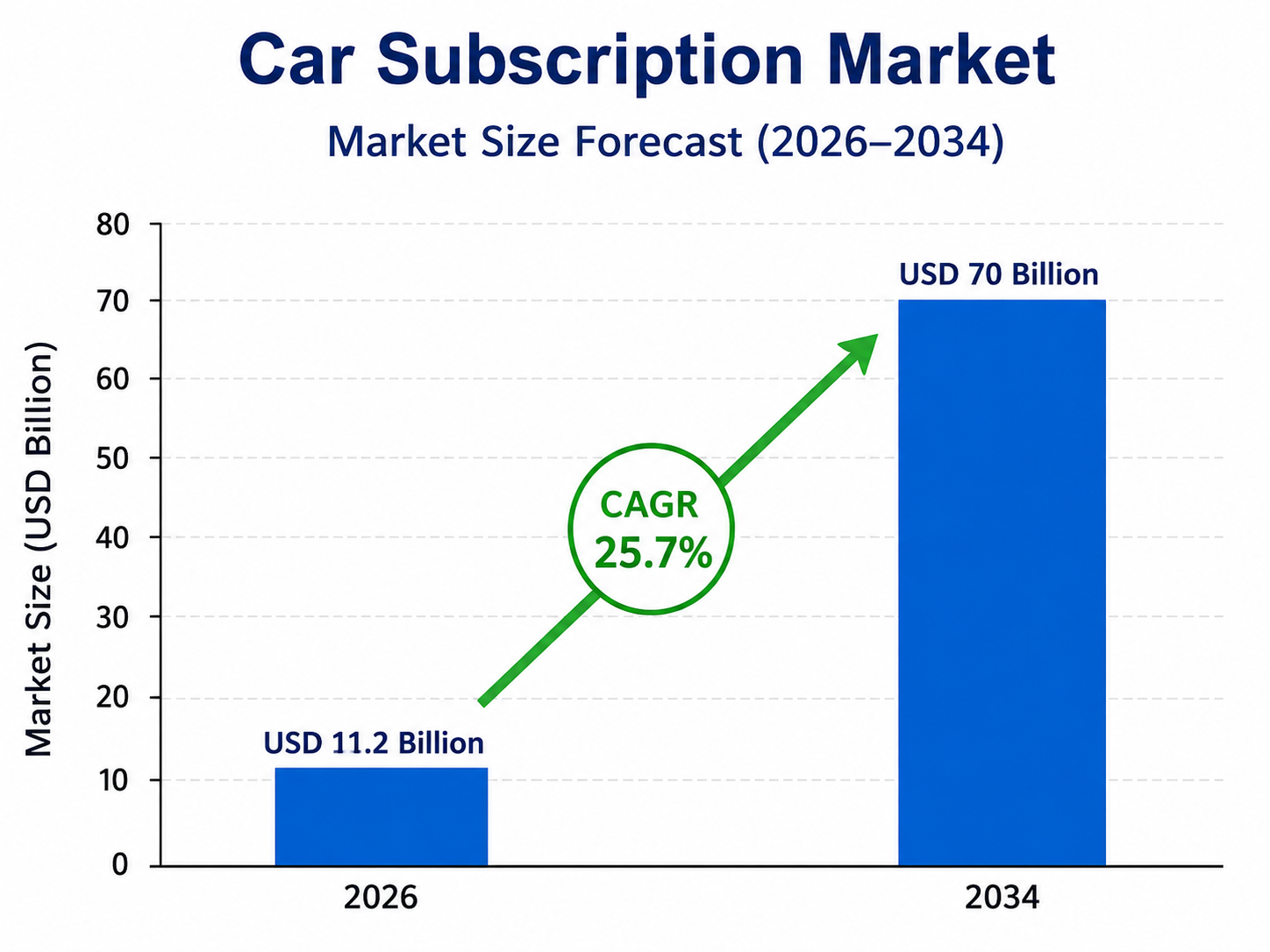
During the forecast period. Car subscription services provide customers with flexible access to vehicles through a monthly subscription that typically covers insurance, maintenance, roadside assistance, registration, and, in many cases, the option to switch between different vehicle models. Positioned between traditional vehicle ownership, leasing, car rental, and mobility-as-a-service, this model offers greater convenience and flexibility while creating recurring revenue opportunities for service providers. Market growth is being driven by changing consumer preferences, increasing urban mobility needs, rising vehicle ownership costs, the expansion of digital booking platforms, and growing demand for flexible access to electric and premium vehicles. Automakers, dealerships, rental companies, fintech firms, and mobility service providers are increasingly adopting subscription-based business models to improve fleet utilization, strengthen customer loyalty, and maximize revenue throughout the vehicle lifecycle. Continued advancements in digital platforms, connected vehicle technologies, and personalized subscription plans are expected to further accelerate market growth over the forecast period.
1. What is the latest trend in the Car Subscription Market?
The latest trend is the rise of flexible, app-based car subscription platforms that allow users to select, upgrade, or switch vehicles with limited long-term commitment.
EV subscription bundles are gaining attention because they reduce consumer concerns around depreciation, maintenance, and charging transition risks.
OEMs and dealers are also using subscriptions to build recurring revenue streams and retain customers before purchase decisions.
Digital onboarding, integrated insurance, and transparent monthly pricing are becoming key service differentiators.
2. What are the key challenges in the Car Subscription Market?
Key challenges include high vehicle acquisition costs, depreciation risk, insurance complexity, fleet utilization pressure, and uncertain consumer willingness to pay.
Providers must balance flexible contract terms with the need to recover vehicle, maintenance, financing, and operating costs.
Residual-value management is especially important for premium and electric vehicles.
Customer confusion between subscription, leasing, rental, and feature-based car subscriptions can also affect adoption.
3. What is the major driving factor for the Car Subscription Market?
The major driving factor is rising demand for flexible vehicle access without the long-term financial burden of ownership or leasing.
Consumers increasingly prefer bundled monthly plans that include maintenance, insurance, and service support.
Urban professionals, temporary residents, expatriates, and younger consumers are key groups seeking flexibility.
Rising vehicle prices and changing mobility habits are further supporting subscription-based access models.
4. What is the major segment in the Car Subscription Market and why?
Passenger cars represent the major segment because most subscription demand comes from individuals and households seeking flexible personal mobility.
Compact cars, SUVs, premium vehicles, and electric cars are commonly offered through monthly subscription plans.
Passenger-car subscriptions appeal to users who want access without large down payments, resale concerns, or long-term ownership obligations.
Premium and EV categories are gaining momentum because subscriptions reduce upfront cost barriers.
5. Which application or end-user is driving more demand?
Individual consumers, urban professionals, corporate employees, expatriates, and businesses with temporary mobility needs are driving strong demand.
Corporate users are adopting subscriptions for flexible employee mobility, project-based travel, and short-term executive vehicle access.
Consumers use subscriptions to test brands, experience EVs, avoid ownership risk, or access vehicles for specific lifestyle needs.
Demand is strongest where users value convenience, bundled services, and contract flexibility.
6. Which region offers the highest growth potential and why?
Asia Pacific offers strong growth potential due to rising urbanization, large young consumer populations, digital adoption, and expanding mobility platforms.
India, China, Japan, South Korea, and Southeast Asia are seeing interest in flexible mobility, EV access, and app-based vehicle services.
North America remains important due to strong auto retail, rental, leasing, and digital platform ecosystems.
Europe also offers opportunities through subscription adoption among premium brands, corporate users, and urban mobility customers.
7. What strategies are major companies adopting in the market?
Major companies are focusing on digital platforms, bundled pricing, flexible contract terms, EV subscriptions, and dealer-network integration.
OEMs are using subscriptions to support brand trial, customer retention, and recurring revenue beyond vehicle sales.
Rental and leasing companies are improving fleet utilization by offering monthly access plans and business mobility packages.
Partnerships with insurers, financing companies, maintenance providers, and dealerships are central to scalable operations.
8. What are the leading companies in the Car Subscription Market?
Leading companies include Volkswagen, Toyota, BMW, Mercedes-Benz, Volvo Cars, Porsche, Jaguar Land Rover, Hyundai, Nissan, Hertz, Sixt, Cox Automotive, Clutch, FINN, Wagonex, Carvolution, Onto, Zoomcar, Myles, and Flexcar.
These companies compete through vehicle availability, brand strength, pricing transparency, insurance inclusion, digital experience, and contract flexibility.
OEM-backed services benefit from direct access to new vehicles and brand-loyal customers.
Independent platforms compete through multi-brand choice, simplified subscription plans, and faster digital onboarding.
9. Why is car subscription strategically important for automakers and mobility providers?
Car subscription is strategically important because it allows automakers and mobility providers to capture recurring revenue from vehicle access rather than relying only on one-time sales.
It helps OEMs introduce customers to new models, electric vehicles, and premium features before purchase or lease conversion.
For fleet operators, subscriptions improve asset utilization and create new channels for remarketing vehicles.
For dealers, the model can support customer acquisition, service revenue, and long-term relationship management.
10. What is the future outlook for the Car Subscription Market?
The market outlook remains positive as consumers seek more flexible, digital, and lower-commitment mobility options.
Future growth will be supported by EV adoption, app-based vehicle access, corporate mobility programs, and bundled ownership alternatives.
Success will depend on managing depreciation, insurance, fleet utilization, pricing, and customer retention effectively.
Companies offering transparent pricing, strong vehicle choice, reliable service, and scalable fleet economics are expected to gain market share.
Browse Related Reports:
https://www.oganalysis.com/industry-reports/ebike-drive-unit-market
https://www.oganalysis.com/industry-reports/automotive-emission-analyzer-market
https://www.oganalysis.com/industry-reports/automobile-front-caliper-market
https://www.oganalysis.com/industry-reports/smart-washing-machine-market
https://www.oganalysis.com/industry-reports/pharmaceutical-logistics-market
