Cholesterol Test Market Outlook 2026–2034: Preventive Cardiac Screening, Point-of-Care Diagnostics, Growth Drivers, Leading Companies, and Future Opportunities
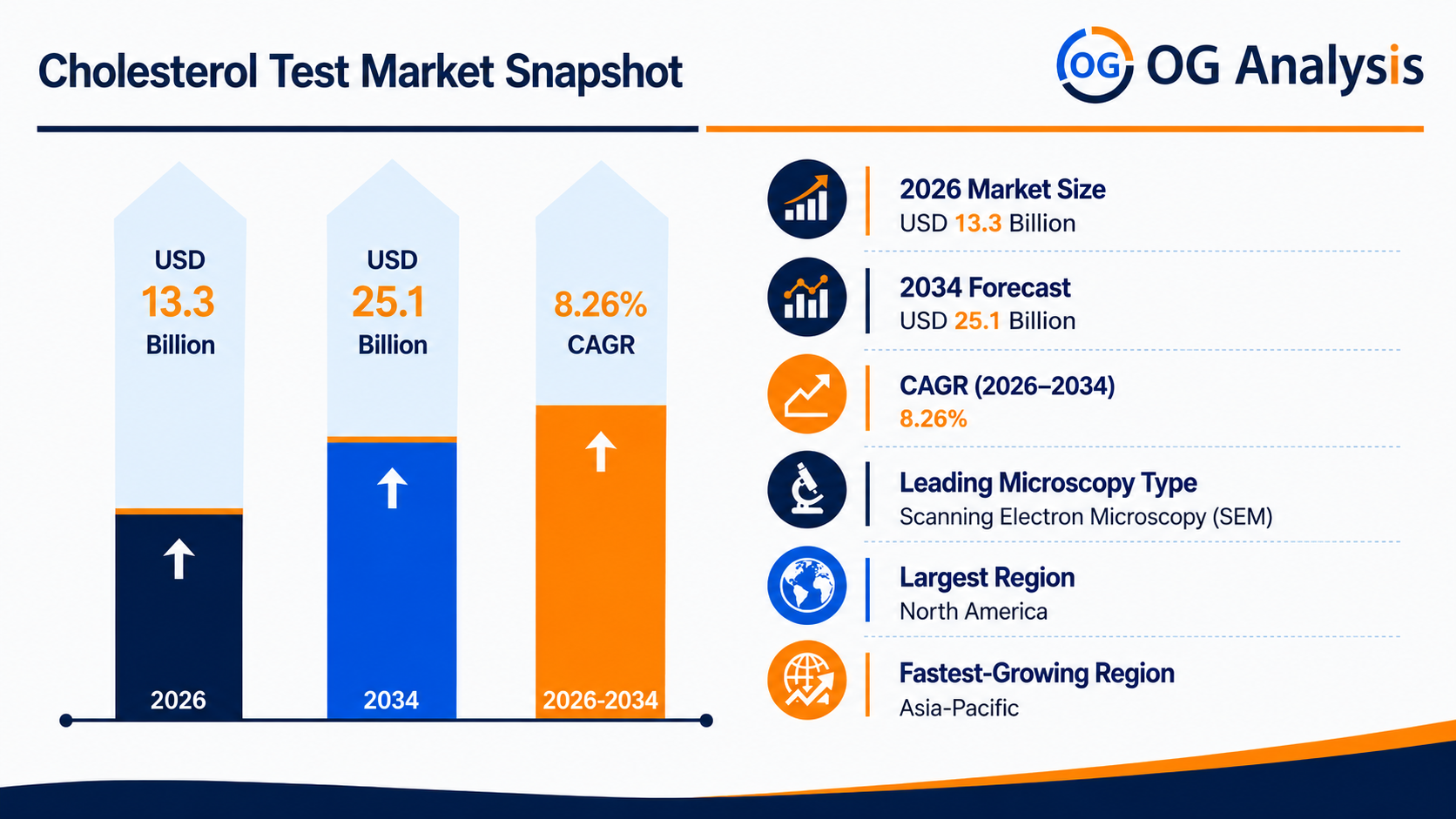
The Cholesterol Test Market was valued at $ 13.3 billion in 2026 and is projected to reach $ 25.1 billion by 2034, growing at a CAGR of 8.26%.
Cholesterol testing includes laboratory-based lipid profile analyzers, point-of-care testing devices, home cholesterol monitoring kits, test strips, reagents, and consumables used to measure total cholesterol, LDL cholesterol, HDL cholesterol, triglycerides, and comprehensive lipid panels. The market is expanding due to the increasing prevalence of cardiovascular diseases, diabetes, obesity, hypertension, and lifestyle-related disorders. Rising awareness of preventive healthcare, routine wellness screening, and early cardiovascular risk assessment is driving demand across hospitals, diagnostic laboratories, clinics, pharmacies, and home healthcare settings. Manufacturers are focusing on rapid testing technologies, portable analyzers, digital connectivity, automated laboratory systems, and AI-supported diagnostic workflows to improve testing efficiency and patient outcomes.
Get Your Free Sample Report for In-Depth Market Insights :
https://www.oganalysis.com/industry-reports/cholesterol-test-market/free-sample
1. What is the latest trend in the Cholesterol Test Market?
The latest trend is the growing adoption of point-of-care and home-based cholesterol testing solutions.
Healthcare providers are increasingly using rapid lipid analyzers to support immediate clinical decision-making and preventive screening.
Digital connectivity, smartphone integration, and cloud-based reporting are improving patient monitoring and follow-up.
Interest is also increasing in advanced lipid markers alongside conventional cholesterol testing.
2. What are the key challenges in the Cholesterol Test Market?
Key challenges include testing cost, reimbursement differences, limited awareness in developing regions, and variability in patient compliance with routine screening.
Healthcare providers must ensure testing accuracy, quality control, standardization, and regulatory compliance across laboratory and point-of-care settings.
Limited access to advanced diagnostic infrastructure can also restrict adoption in resource-constrained healthcare systems.
Competition from bundled diagnostic panels and pricing pressure on consumables may affect profitability.
3. What is the major driving factor for the Cholesterol Test Market?
The major driving factor is the rising global burden of cardiovascular disease and dyslipidemia.
Healthcare systems increasingly emphasize preventive screening and early detection to reduce long-term treatment costs and improve patient outcomes.
Routine health checkups, aging populations, and lifestyle-related disorders are expanding testing volumes.
Growing physician awareness and public health initiatives continue to strengthen demand.
4. What is the major segment in the Cholesterol Test Market and why?
Laboratory-based lipid profile testing represents a major segment because it provides comprehensive and highly accurate cholesterol assessment.
Hospitals and diagnostic laboratories rely on automated analyzers for high-throughput testing and standardized reporting.
These systems support routine preventive screening, chronic disease management, and cardiovascular risk evaluation.
Point-of-care testing is also expanding rapidly due to convenience and faster clinical decision-making.
5. Which application or end-user is driving more demand?
Hospitals, diagnostic laboratories, and primary care clinics are driving the highest demand due to increasing preventive health screening programs.
Cardiology clinics, diabetes management centers, occupational health programs, and wellness initiatives also contribute significantly.
Retail pharmacies and home healthcare are emerging channels as consumers seek convenient self-monitoring solutions.
Population-wide cardiovascular screening programs continue to increase testing frequency.
6. Which region offers the highest growth potential and why?
North America remains a leading market due to advanced healthcare infrastructure, preventive screening programs, and high awareness of cardiovascular risk.
The region benefits from widespread laboratory automation, reimbursement support, and adoption of point-of-care diagnostics.
Asia Pacific offers the strongest growth potential because of expanding healthcare access, rising chronic disease prevalence, and increasing diagnostic investment.
Europe also maintains strong demand through national screening initiatives and preventive healthcare policies.
7. What strategies are major companies adopting in the market?
Major companies are focusing on rapid diagnostics, laboratory automation, digital health integration, and portable testing platforms.
Manufacturers are investing in improved analytical accuracy, user-friendly devices, cloud connectivity, and workflow efficiency.
Strategic collaborations with hospitals, laboratories, pharmacies, and healthcare providers are expanding market reach.
Companies are also strengthening reagent portfolios and recurring consumable revenue through installed diagnostic systems.
8. What are the leading companies in the Cholesterol Test Market?
Leading companies include Abbott Laboratories, F. Hoffmann-La Roche, Siemens Healthineers, Danaher Corporation, Beckman Coulter, Thermo Fisher Scientific, bioMérieux, PTS Diagnostics, EKF Diagnostics, Nova Biomedical, SD Biosensor, Sinocare, Menarini Group, QuidelOrtho, and Trinity Biotech.
These companies compete through diagnostic accuracy, product innovation, automation capability, point-of-care solutions, and global distribution networks.
Large diagnostic manufacturers benefit from extensive laboratory instrument portfolios and established healthcare partnerships.
Specialized point-of-care companies continue to strengthen their position through portable lipid testing technologies.
9. Why are cholesterol tests strategically important for healthcare providers?
Cholesterol tests are strategically important because they enable early detection of cardiovascular risk and support timely clinical intervention.
Routine lipid testing helps physicians monitor treatment effectiveness, assess disease progression, and personalize patient care.
Healthcare systems use cholesterol testing to reduce long-term cardiovascular complications through preventive management.
The tests also support public health screening programs and chronic disease management initiatives.
10. What is the future outlook for the Cholesterol Test Market?
The market outlook remains highly positive as preventive healthcare, cardiovascular screening, and personalized medicine continue to expand.
Future growth will be driven by point-of-care diagnostics, home testing, digital health integration, and broader access to lipid monitoring.
Advances in rapid diagnostics, automation, and AI-assisted interpretation are expected to improve testing efficiency and accessibility.
Companies offering accurate, connected, cost-effective, and patient-friendly cholesterol testing solutions are expected to gain market share.
Browse Related Reports
https://www.oganalysis.com/industry-reports/cholesterol-assay-kits-market
https://www.oganalysis.com/industry-reports/iot-medical-devices-market
https://www.oganalysis.com/industry-reports/lab-supplies-market
https://www.oganalysis.com/industry-reports/hospital-information-system-market
https://www.oganalysis.com/industry-reports/angioplasty-balloons-market
Stay Connected With Us
