Coal Mining Market Outlook 2026–2034: Automation Trends, Energy Demand, Leading Companies, and Future Opportunities
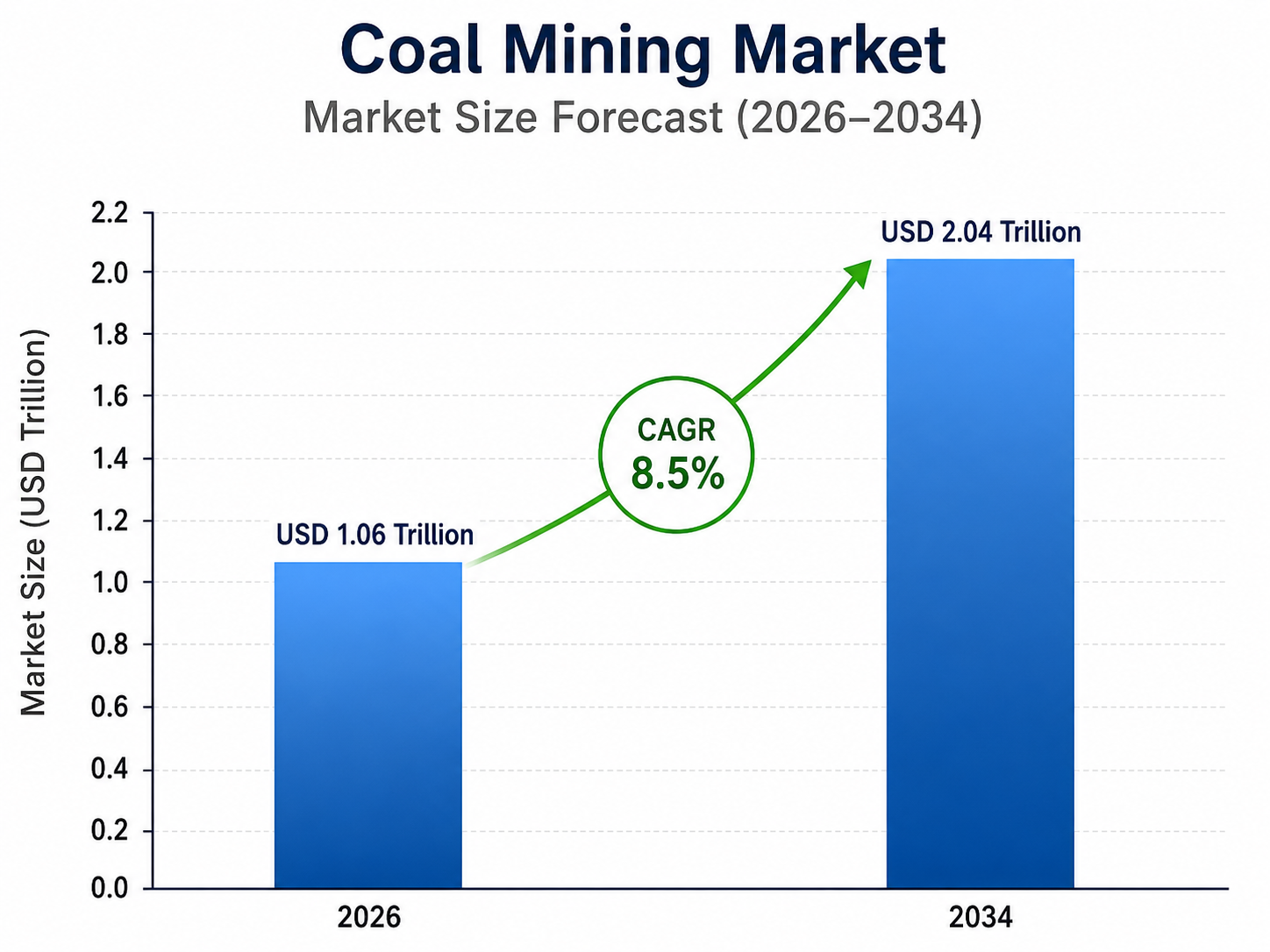
The Coal Mining Market is estimated to be valued at $ 1.06 trillion in 2026 and is projected to reach $ 2.04 trillion by 2034, expanding at a CAGR of 8.5% from 2026 to 2034.
Coal mining includes the extraction, processing, transportation, and sale of thermal coal, metallurgical coal, lignite, and other coal grades through surface and underground operations. The industry supplies fuel for electricity generation and industrial heat, while metallurgical coal remains important for conventional steelmaking. Market performance is influenced by power demand, steel production, commodity prices, government policy, transport infrastructure, environmental regulations, and energy-transition investment. Mining companies are increasingly adopting autonomous equipment, digital mine planning, methane monitoring, predictive maintenance, and lower-emission operating practices to improve productivity, safety, and asset reliability.
1. What is the latest trend in the Coal Mining Market?
The latest trend is the growing use of autonomous haulage, remotely operated equipment, drones, digital twins, and AI-based mine planning.
Mining companies are integrating real-time geological, equipment, safety, and production data into centralized operating centers.
Methane capture, fleet electrification, and renewable power at mine sites are also receiving greater investment.
These technologies are helping operators improve productivity while reducing safety risks and operating emissions.
2. What are the key challenges in the Coal Mining Market?
Key challenges include decarbonization policies, permitting delays, volatile coal prices, methane emissions, mine safety, and rehabilitation liabilities.
Operators also face rising labor, fuel, explosives, transportation, and equipment-maintenance costs.
Access to project finance and insurance is becoming more difficult for some thermal-coal developments.
Long-term demand uncertainty is encouraging companies to prioritize low-cost and high-quality reserves.
3. What is the major driving factor for the Coal Mining Market?
The major driving factor is continued demand for affordable and reliable energy across coal-dependent economies.
Coal remains important for baseload electricity, industrial heat, cement production, chemicals, and steel manufacturing.
Rapid electricity-demand growth and energy-security concerns are sustaining domestic production in several Asian countries.
Metallurgical coal demand is additionally supported by expanding steel capacity in emerging economies.
4. What is the major segment in the Coal Mining Market and why?
Surface mining represents a major production segment because it generally offers higher productivity, lower unit costs, and easier use of large-scale equipment.
It is widely used where coal seams are relatively close to the surface and deposits are extensive.
Large excavators, draglines, trucks, conveyors, and autonomous haulage systems support high-volume output.
Underground mining remains important for deeper reserves and premium metallurgical coal deposits.
5. Which application or end-user is driving more demand?
Power generation remains the largest end-use sector because coal continues to supply a substantial share of electricity in several major economies.
Steel producers represent another strategically important customer group through their use of metallurgical and coking coal.
Cement, chemicals, paper, and other energy-intensive industries also contribute to demand.
Future demand growth is expected to be increasingly concentrated in Asia and industrial applications.
6. Which region offers the highest growth potential and why?
Asia Pacific represents the largest and most strategically important region due to extensive coal reserves, power demand, steel production, and industrial growth.
China, India, Indonesia, and Australia are major producers, consumers, or exporters within the global coal supply chain.
India offers notable long-term potential through electricity growth, infrastructure development, and expanding steel capacity.
Australia and Indonesia remain important suppliers to the seaborne thermal and metallurgical coal markets.
7. What strategies are major companies adopting in the market?
Major companies are focusing on automation, cost reduction, portfolio optimization, mine-life extension, and export-infrastructure efficiency.
Several miners are prioritizing higher-quality metallurgical and lower-impurity coal products with stronger long-term demand prospects.
Methane management, land rehabilitation, water recycling, and renewable power are becoming more important operational priorities.
Acquisitions, mergers, asset divestments, and geographic diversification are also reshaping the competitive landscape.
8. What are the leading companies in the Coal Mining Market?
Leading companies include China Shenhua Energy, Coal India, Glencore, Peabody Energy, Core Natural Resources, Whitehaven Coal, Yancoal Australia, Banpu, Exxaro Resources, Thungela Resources, and SUEK.
These companies compete through reserve quality, production cost, logistics access, export capacity, and customer relationships.
Large state-supported producers benefit from domestic scale and long-term utility demand.
Export-oriented miners compete through coal quality, port access, operational efficiency, and geographic market reach.
9. Why is coal mining strategically important for energy and industrial companies?
Coal mining supports electricity security, steel production, industrial heat, employment, exports, and government revenue in several economies.
Metallurgical coal remains particularly important where commercial low-carbon steel alternatives are not yet available at sufficient scale.
For utilities and industrial buyers, supply reliability and delivered cost remain central procurement considerations.
For mining companies, disciplined capital allocation is essential amid changing policy and demand conditions.
10. What is the future outlook for the Coal Mining Market?
The market outlook is expected to remain stable but regionally uneven as renewable energy expands and coal demand shifts toward Asia.
Thermal-coal growth will face increasing pressure from decarbonization, while metallurgical coal may remain comparatively resilient.
Automation, consolidation, methane reduction, and high-quality reserve development will shape competitive performance.
Companies with low-cost assets, efficient logistics, strong balance sheets, and diversified customer exposure are likely to remain better positioned.
Browse Related Reports
https://www.oganalysis.com/industry-reports/surface-mining-market
https://www.oganalysis.com/industry-reports/metallurgical-coal-market
https://www.oganalysis.com/industry-reports/autonomous-haulage-systems-ahs-market
https://www.oganalysis.com/industry-reports/modular-mining-systems-market
https://www.oganalysis.com/industry-reports/bentonite-clay-market
