Communication Based Train Control Market Outlook 2026–2034: Metro Automation, Moving-Block Signalling, Growth Drivers, Leading Companies, and Future Opportunities
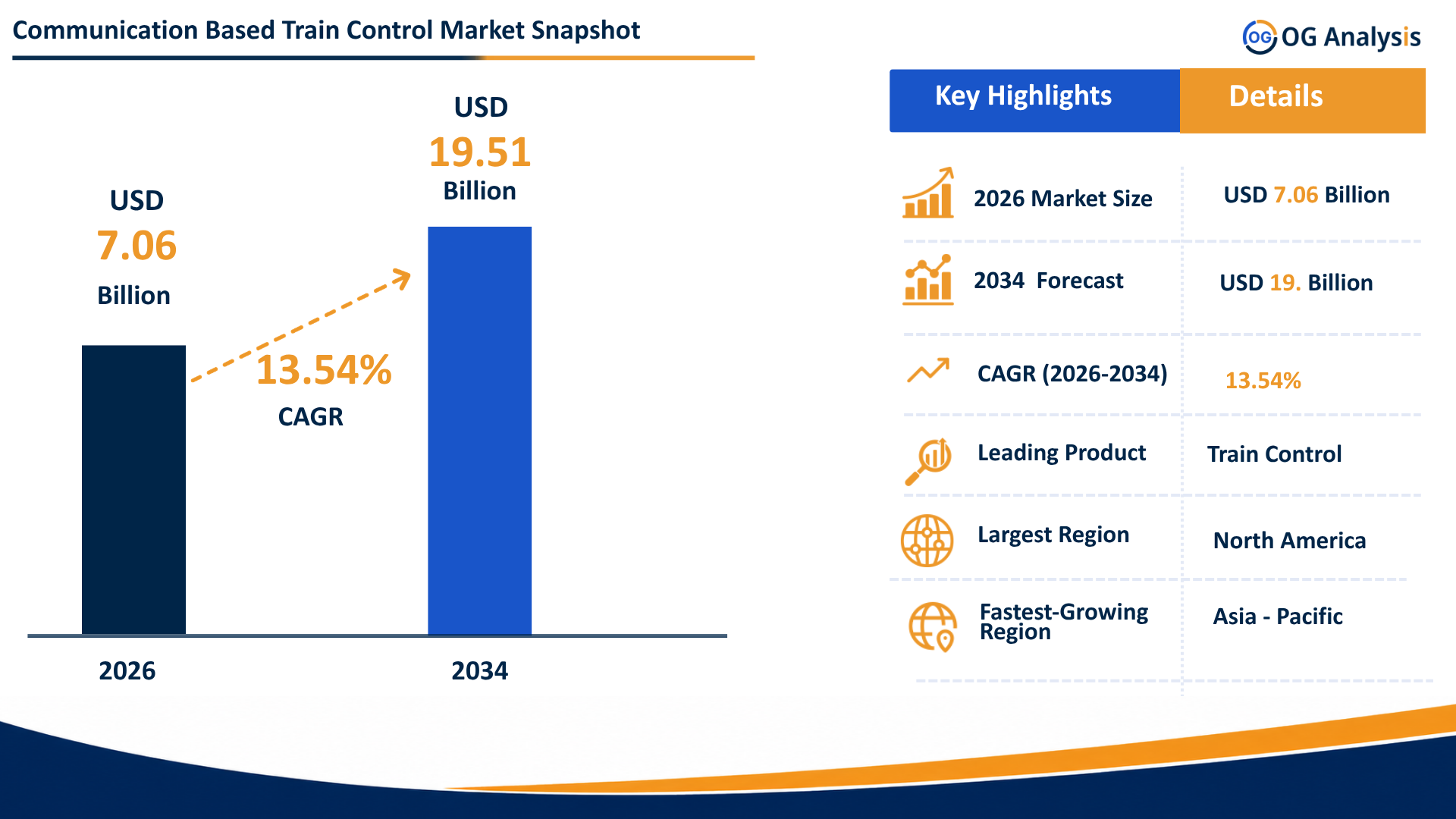
The Communication Based Train Control Market is estimated to be valued at $ 7.06 billion in 2026 and is projected to reach $19.51 billion by 2034, expanding at a CAGR of 13.54% from 2026 to 2034.
Communication Based Train Control, or CBTC, is an advanced railway signalling and train control system that uses continuous data communication between trains and trackside/control-center equipment to improve train separation, safety, punctuality, and network capacity. Market growth is supported by urban rail expansion, metro automation, high passenger density, smart city investments, replacement of legacy signalling systems, and rising demand for safer and more frequent train operations. CBTC systems support functions such as automatic train protection, automatic train operation, automatic train supervision, moving-block control, real-time train tracking, and centralized traffic management. Demand is strongest across metro and light rail networks where operators need shorter headways, better capacity utilization, higher service reliability, and driverless or semi-automated train operations. Siemens describes CBTC as a solution for greater automation in public transport, while Hitachi highlights CBTC use in driverless and unattended train operations.
Get the Complete Analysis :
https://www.oganalysis.com/industry-reports/communication-based-train-control-market
Get Your Free Sample Report for In-Depth Market Insights :
https://www.oganalysis.com/industry-reports/communication-based-train-control-market/free-sample
1. What is the latest trend in the Communication Based Train Control Market?
The latest trend is the shift toward fully automated, driverless, and digitally connected metro signalling systems.
Transit authorities are adopting CBTC to increase train frequency, reduce headways, improve punctuality, and support safer operations.
Integration of CBTC with 5G, AI-enabled traffic management, cloud-based diagnostics, and predictive maintenance is gaining attention.
Modernization of existing metro lines is also becoming a major trend as cities replace fixed-block signalling with advanced moving-block control.
2. What are the key challenges in the Communication Based Train Control Market?
Key challenges include high installation cost, complex integration with legacy rail infrastructure, long project timelines, and operational disruption during upgrades.
CBTC deployment requires reliable train-to-ground communication, cybersecurity protection, precise system testing, and safety certification.
Retrofitting older metro lines can be difficult due to tunnel constraints, mixed rolling stock, service continuity requirements, and signaling compatibility issues.
Transit agencies also face budget pressure, procurement delays, and the need for skilled technical teams to operate and maintain advanced systems.
3. What is the major driving factor for the Communication Based Train Control Market?
The major driving factor is the need to increase urban rail capacity without building entirely new lines.
CBTC enables trains to run closer together while maintaining safe separation, helping operators improve throughput on congested metro networks.
Rapid urbanization, rising public transit ridership, traffic congestion, and smart city development are strengthening demand for advanced rail signalling.
Rail operators also adopt CBTC to improve safety, reduce delays, optimize energy use, and support automated train operation.
4. What is the major segment in the Communication Based Train Control Market and why?
The metro rail segment is the major application segment because CBTC is widely used in high-frequency urban transit systems.
Metro operators need short headways, continuous train monitoring, automatic control, and high service reliability during peak passenger periods.
Automatic train protection and automatic train operation are major system functions because they directly support safety and operational efficiency.
Moving-block CBTC systems are gaining strong preference because they enable dynamic train spacing and better line capacity compared with conventional fixed-block signalling.
5. Which application or end-user is driving more demand?
Urban metro operators, light rail systems, transit authorities, railway infrastructure agencies, and smart city transport planners are driving strong demand.
New metro projects require CBTC from the design stage, while existing systems adopt CBTC during modernization and capacity-upgrade programs.
Airport rail links, automated people movers, and high-density commuter corridors are also important end-use areas.
Demand is strongest where cities need safer, faster, more frequent, and more energy-efficient public transport services.
6. Which region offers the highest growth potential and why?
Asia Pacific offers the highest growth potential due to rapid metro expansion, urbanization, rail infrastructure investment, and high passenger volumes.
China, India, Japan, South Korea, Singapore, Indonesia, Thailand, and other Asian markets are investing in metro automation and signalling upgrades.
Europe remains important due to mature rail systems, modernization of urban transit networks, and strong signalling technology suppliers.
North America is supported by metro modernization, aging signalling replacement, and investment in advanced train control systems.
7. What strategies are major companies adopting in the market?
Major companies are focusing on digital signalling platforms, driverless train operation, 5G-enabled train communication, cybersecurity, and predictive maintenance.
They are strengthening partnerships with metro operators, rail infrastructure authorities, rolling stock manufacturers, and system integrators.
Suppliers are also developing modular CBTC platforms that can support new lines, brownfield upgrades, and different grades of automation.
Companies are investing in software-based signalling, automated supervision, remote diagnostics, and lifecycle service contracts to improve long-term customer value.
8. What are the leading companies in the Communication Based Train Control Market?
Leading companies include Siemens Mobility, Alstom, Hitachi Rail, Thales, Toshiba Infrastructure Systems, Mitsubishi Electric, CRRC, Nippon Signal, CAF Signalling, Wabtec, Stadler Rail, Indra, Nokia, Ericsson, Cisco, Belden, and ZTE.
These companies compete through signalling reliability, safety certification, automation capability, project execution, cybersecurity, communications technology, and long-term service support.
Siemens offers Trainguard MT for CBTC-based automatic train control, while Hitachi has been investing in next-generation CBTC and 5G-enabled digital signalling.
Vendors with proven metro references, strong software capability, and integration experience are better positioned for large urban rail contracts.
9. Why is Communication Based Train Control strategically important for rail operators?
CBTC is strategically important because it allows rail operators to increase capacity, improve safety, and reduce service delays on existing infrastructure.
It supports closer train spacing, automated operation, better traffic supervision, and more reliable passenger service.
For city governments, CBTC helps improve public transport efficiency and reduce pressure on road networks.
For rail operators, it supports long-term modernization, lower operational risk, improved asset utilization, and readiness for driverless train operations.
10. What is the future outlook for the Communication Based Train Control Market?
The market outlook remains positive as cities continue investing in metro expansion, rail automation, and signalling modernization.
Future growth will be supported by moving-block CBTC, driverless metro systems, 5G communications, AI-enabled traffic supervision, cybersecurity upgrades, and cloud-based diagnostics.
Demand will continue across new metro lines, legacy signalling replacement, airport rail systems, automated people movers, and high-capacity urban transit corridors.
Companies offering safe, interoperable, scalable, cybersecurity-ready, and automation-focused CBTC solutions are expected to gain market share
Browse Related Reports
https://www.oganalysis.com/industry-reports/railway-system-market
https://www.oganalysis.com/industry-reports/passenger-rail-transport-market
https://www.oganalysis.com/industry-reports/railway-infrastructure-maintenance-services-market
https://www.oganalysis.com/industry-reports/smart-transportation-market
https://www.oganalysis.com/industry-reports/railway-management-system-market
