Cyclic Olefin Copolymers Market Outlook 2026–2034: Medical Packaging Demand, Optical Polymer Innovation, Growth Drivers, Leading Companies, and Future Opportunities
The Cyclic Olefin Copolymers Market is estimated to be valued at $ 1,118 million in 2026 and is projected to reach $ 1,761 million by 2034, expanding at a CAGR of 5.6% from 2026 to 2034.
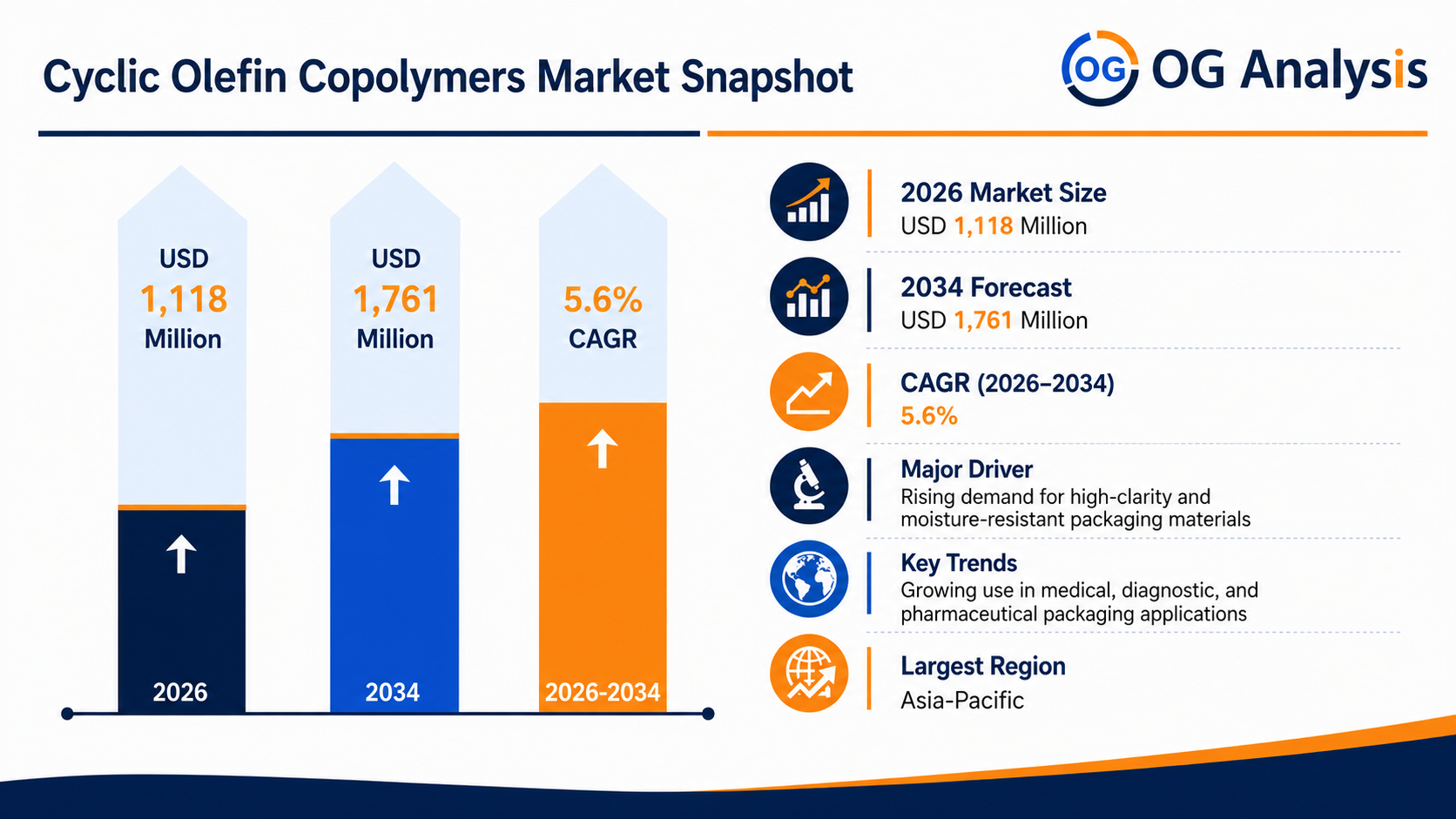
Cyclic olefin copolymers are high-performance thermoplastic materials known for optical clarity, low moisture absorption, chemical resistance, high purity, dimensional stability, low extractables, and strong barrier properties. These characteristics make COC materials suitable for pharmaceutical packaging, diagnostic consumables, medical devices, optical lenses, displays, microfluidics, labware, electronics, and specialty film applications.Market growth is supported by rising demand for advanced healthcare packaging, biologics, diagnostic testing, wearable medical devices, precision optics, and high-performance polymer films. COC materials are increasingly used where traditional plastics or glass face limitations related to breakage, weight, moisture sensitivity, optical performance, or contamination risk. Adoption is also supported by miniaturization in diagnostics, growth in prefilled drug delivery formats, and demand for transparent, chemically stable, and clean materials in regulated industries.
Get Your Free Sample Report for In-Depth Market Insights :
https://www.oganalysis.com/industry-reports/cyclic-olefin-copolymers-market
1. What is the latest trend in the Cyclic Olefin Copolymers Market?
The latest trend is increasing use of COC in pharmaceutical packaging, diagnostic devices, microfluidic chips, and high-clarity optical components.
Manufacturers are focusing on materials with low extractables, strong dimensional stability, high transparency, and compatibility with sensitive drugs and biological samples.
Demand is also growing for COC films used in blister packaging, barrier packaging, and specialty healthcare applications.
Optics, electronics, and semiconductor-related components are adding new growth opportunities due to the material’s purity and optical performance.
2. What are the key challenges in the Cyclic Olefin Copolymers Market?
Key challenges include high material cost, limited supplier base, processing complexity, and long qualification cycles in medical and pharmaceutical applications.
COC often competes with glass, polypropylene, polyethylene, polycarbonate, PMMA, and other specialty polymers depending on performance requirements.
Manufacturers must manage strict regulatory, sterilization, biocompatibility, and quality-control standards for healthcare applications.
Supply security and grade availability are also important concerns because the market is relatively concentrated among a small number of producers.
3. What is the major driving factor for the Cyclic Olefin Copolymers Market?
The major driving factor is rising demand for high-performance materials in medical, pharmaceutical, and diagnostic applications.
COC offers excellent clarity, low moisture absorption, chemical resistance, and low contamination risk, making it suitable for sensitive healthcare products.
Growth in biologics, point-of-care diagnostics, lab-on-chip systems, and prefilled drug delivery formats is supporting adoption.
The material is also gaining preference where lightweight, break-resistant alternatives to glass are required.
4. What is the major segment in the Cyclic Olefin Copolymers Market and why?
Healthcare and pharmaceutical packaging is a major segment because COC provides strong performance in drug-contact and diagnostic applications.
Its low extractables, high transparency, moisture barrier properties, and sterilization compatibility make it suitable for vials, syringes, cartridges, blister films, and labware.
Diagnostic consumables and microfluidic devices are also important because they require optical clarity and precise molded structures.
Optical and electronics applications remain significant due to COC’s low birefringence and dimensional stability.
5. Which application or end-user is driving more demand?
Pharmaceutical companies, medical device manufacturers, diagnostic companies, optical component producers, and electronics manufacturers are driving demand.
Healthcare users require clean, stable, transparent, and chemically resistant materials for regulated packaging and device components.
Diagnostic companies use COC in cartridges, microplates, microfluidic devices, and point-of-care testing platforms.
Electronics and optics users value COC for lenses, sensors, displays, optical films, and precision molded parts.
6. Which region offers the highest growth potential and why?
Asia Pacific offers strong growth potential due to expanding healthcare manufacturing, electronics production, optical component demand, and pharmaceutical packaging activity.
Japan remains important because several leading COC/COP material producers and technology developers are based there.
China, South Korea, India, and Southeast Asia are attractive due to medical device manufacturing, diagnostics growth, and electronics supply chains.
North America and Europe remain key markets because of advanced pharmaceutical, diagnostics, and specialty packaging industries.
7. What strategies are major companies adopting in the market?
Major companies are focusing on high-purity grades, medical-grade materials, improved barrier films, optical-grade polymers, and application-specific COC solutions.
They are strengthening partnerships with pharmaceutical packaging firms, diagnostic device makers, optics manufacturers, and film converters.
Capacity expansion, technical support, grade customization, and regulatory documentation are becoming important competitive tools.
Companies are also targeting high-value applications where COC can replace glass or improve performance over conventional plastics.
8. What are the leading companies in the Cyclic Olefin Copolymers Market?
Leading companies include TOPAS Advanced Polymers, ZEON Corporation, Mitsui Chemicals, JSR Corporation, Polyplastics, Sumitomo Bakelite, Borealis, Polysciences, and China Petrochemical Development Corporation.
These companies compete through product purity, optical performance, processing support, regulatory documentation, supply reliability, and application-specific grades.
Japanese and European suppliers hold strong positions due to established technology platforms and specialty polymer expertise.
Producers with medical-grade portfolios and long-term qualification support are better positioned in regulated healthcare applications.
9. Why are cyclic olefin copolymers strategically important for healthcare and electronics industries?
Cyclic olefin copolymers are strategically important because they combine glass-like clarity with the processing advantages of thermoplastics.
They support safer, lighter, and more design-flexible alternatives for medical packaging, diagnostics, optical devices, and precision components.
Their low moisture absorption and chemical stability help protect sensitive drugs, reagents, and electronic or optical systems.
For manufacturers, COC can improve product reliability, reduce breakage risk, and enable advanced miniaturized device designs.
10. What is the future outlook for the Cyclic Olefin Copolymers Market?
The market outlook remains positive as demand expands across healthcare packaging, diagnostics, microfluidics, optics, and electronics.
Future growth will be supported by biologics, point-of-care testing, precision drug delivery, sustainable high-barrier packaging, and advanced optical components.
Competition will remain focused on material purity, regulatory support, supply security, processing performance, and cost optimization.
Companies offering reliable medical-grade materials, specialty films, and optical-grade COC solutions are expected to gain market share.
Browse Related Reports
https://www.oganalysis.com/industry-reports/spinon-glass-sog-market
https://www.oganalysis.com/industry-reports/insulated-shipping-packaging-market
https://www.oganalysis.com/industry-reports/active-pharmaceutical-ingredients-api-market
https://www.oganalysis.com/industry-reports/nanomedicine-market
https://www.oganalysis.com/industry-reports/lab-supplies-market
Stay Connected With Us
