Dendritic Cell Cancer Vaccine Market Outlook 2026–2034: Personalized Immunotherapy Trends, Growth Drivers, Leading Companies, and Future Opportunities
The Dendritic Cell Cancer Vaccine Market is expected to grow from $ 3.54 billion in 2026 to $ 7.28 billion by 2034, registering a CAGR of 9.39%
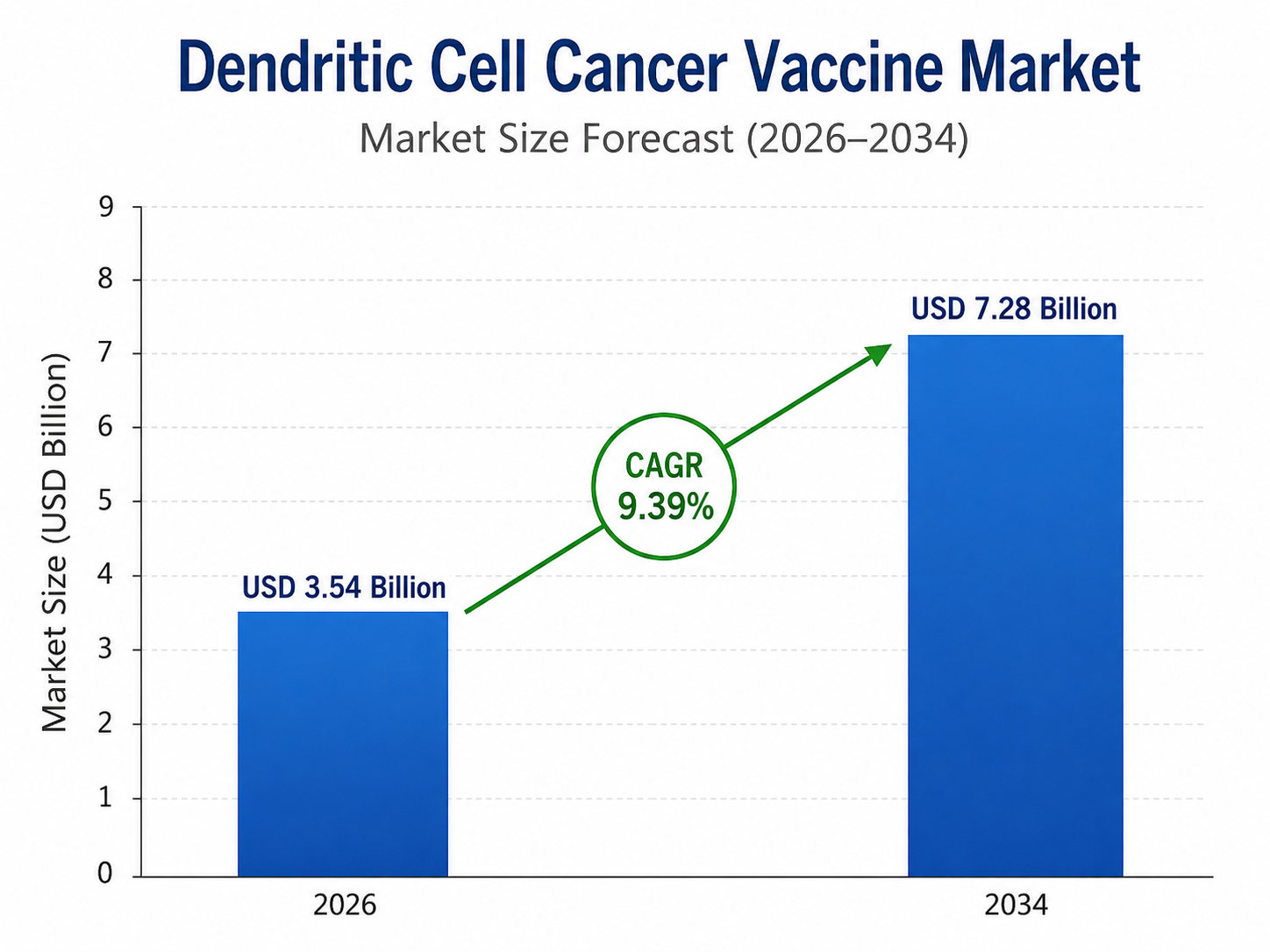
During the forecast period. The market is driven by the growing adoption of personalized cancer immunotherapies that harness the body's immune system to recognize and target tumor cells. Dendritic cell cancer vaccines are developed by collecting a patient's immune cells, activating or differentiating dendritic cells in a controlled laboratory setting, loading them with tumor-specific or tumor-associated antigens, and re-administering them to stimulate a targeted T-cell immune response against cancer. Market growth is being supported by the rising global burden of cancer, increasing demand for precision oncology, advancements in cell processing and manufacturing technologies, and expanding clinical research on combination immunotherapy approaches. Despite challenges related to high manufacturing costs, complex production workflows, logistical requirements, and variable patient responses, continued investment in personalized medicine, cell-based therapies, and innovative immuno-oncology platforms is expected to create significant opportunities for market growth over the forecast period.
1. What is the latest trend in the Dendritic Cell Cancer Vaccine Market?
The latest trend is the development of personalized dendritic cell vaccines using patient-specific tumor antigens, neoantigens, and tumor lysates.
Companies and research centers are combining dendritic cell vaccines with checkpoint inhibitors, chemotherapy, radiation, and targeted therapies.
Automation, closed-system manufacturing, and improved antigen-loading techniques are also gaining importance.
These advances aim to improve immune activation, treatment consistency, and commercial scalability.
2. What are the key challenges in the Dendritic Cell Cancer Vaccine Market?
Key challenges include high manufacturing cost, individualized production, complex logistics, long preparation time, and variable patient response.
Autologous vaccines require patient-specific cell collection, processing, quality control, and cold-chain coordination.
Clinical efficacy has been inconsistent across cancer types and trial designs, limiting broad adoption.
Regulatory approval, reimbursement, and physician confidence remain important commercialization barriers.
3. What is the major driving factor for the Dendritic Cell Cancer Vaccine Market?
The major driving factor is rising demand for personalized cancer immunotherapies that can generate targeted anti-tumor immune responses.
Dendritic cells play a central role in antigen presentation and T-cell activation, making them attractive for therapeutic vaccine development.
Increasing cancer burden and unmet need in difficult-to-treat solid tumors are supporting clinical research.
Advances in genomics, tumor profiling, and cell-processing technologies are further strengthening market potential.
4. What is the major segment in the Dendritic Cell Cancer Vaccine Market and why?
Autologous dendritic cell vaccines represent a major segment because most current approaches use the patient’s own immune cells.
Autologous manufacturing reduces immune compatibility concerns and enables patient-specific antigen presentation.
This model is especially relevant in personalized oncology, where tumor-specific antigens vary across patients.
However, allogeneic and off-the-shelf approaches are being explored to improve scalability and cost efficiency.
5. Which application or end-user is driving more demand?
Prostate cancer, glioblastoma, melanoma, ovarian cancer, and other solid tumor indications are important demand areas.
Specialized cancer centers, academic hospitals, oncology clinics, and cell-therapy research institutions are key end users.
Demand is strongest where conventional treatments offer limited durability or where immune-based therapies are being actively tested.
Clinical-trial settings currently account for a significant share of market activity.
6. Which region offers the highest growth potential and why?
North America remains a leading market due to advanced oncology infrastructure, active cell-therapy research, and availability of approved immunotherapies.
The United States has strong clinical trial activity, specialized cancer centers, and established reimbursement pathways for selected therapies.
Asia Pacific offers strong growth potential due to rising cancer burden, expanding biotech investment, and growing cell-therapy capacity.
Europe is also important due to cancer-vaccine research, academic collaborations, and advanced regulatory frameworks.
7. What strategies are major companies adopting in the market?
Major companies are focusing on clinical validation, manufacturing optimization, regulatory filings, combination therapy trials, and platform expansion.
They are investing in closed-system cell processing, antigen-selection technologies, cryopreservation, and scalable production workflows.
Partnerships with hospitals, cancer centers, research institutions, and contract manufacturers are becoming increasingly important.
Companies are also targeting orphan and high-unmet-need cancers where differentiated survival benefits may support approval.
8. What are the leading companies in the Dendritic Cell Cancer Vaccine Market?
Leading companies and ecosystem participants include Dendreon, Northwest Biotherapeutics, Mendus, ImmunoCellular Therapeutics, Diakonos Oncology, Argos Therapeutics, Batu Biologics, and other oncology cell-therapy developers.
Dendreon is associated with PROVENGE, while Northwest Biotherapeutics is developing DCVax platform products.
Competition is shaped by clinical evidence, manufacturing reliability, regulatory progress, and access to oncology treatment networks.
Companies with scalable platforms and strong cancer-center partnerships are better positioned for commercialization.
9. Why are dendritic cell cancer vaccines strategically important for oncology care?
Dendritic cell cancer vaccines are strategically important because they aim to train the immune system to recognize and attack cancer more specifically.
They may complement surgery, chemotherapy, radiation, targeted therapy, and checkpoint inhibition in selected cancers.
For oncology providers, they offer a personalized treatment pathway for patients with limited standard options.
For developers, the segment represents a high-value intersection of cancer vaccines, cell therapy, and precision medicine.
10. What is the future outlook for the Dendritic Cell Cancer Vaccine Market?
The market outlook remains positive, although commercial success will depend on stronger clinical evidence, scalable manufacturing, and reimbursement acceptance.
Future growth will be supported by neoantigen discovery, AI-based antigen selection, automated cell processing, and combination immunotherapy.
Glioblastoma, prostate cancer, melanoma, and other solid tumors are expected to remain key development areas.
Companies that can demonstrate durable outcomes, simplify logistics, and reduce production costs are expected to gain market relevance.
Browse Related Reports:
https://www.oganalysis.com/industry-reports/rabies-diagnostics-market
https://www.oganalysis.com/industry-reports/fetal-bovine-serum-market
https://www.oganalysis.com/industry-reports/porcine-vaccines-market
https://www.oganalysis.com/industry-reports/hyperpigmentation-disorders-treatment-market
https://www.oganalysis.com/industry-reports/generic-injectables-market
