Digitally Printed Wallpaper Market Outlook 2026–2034: Custom Wall Décor Trends, Digital Printing Innovation, Growth Drivers, Leading Companies, and Future Opportunities
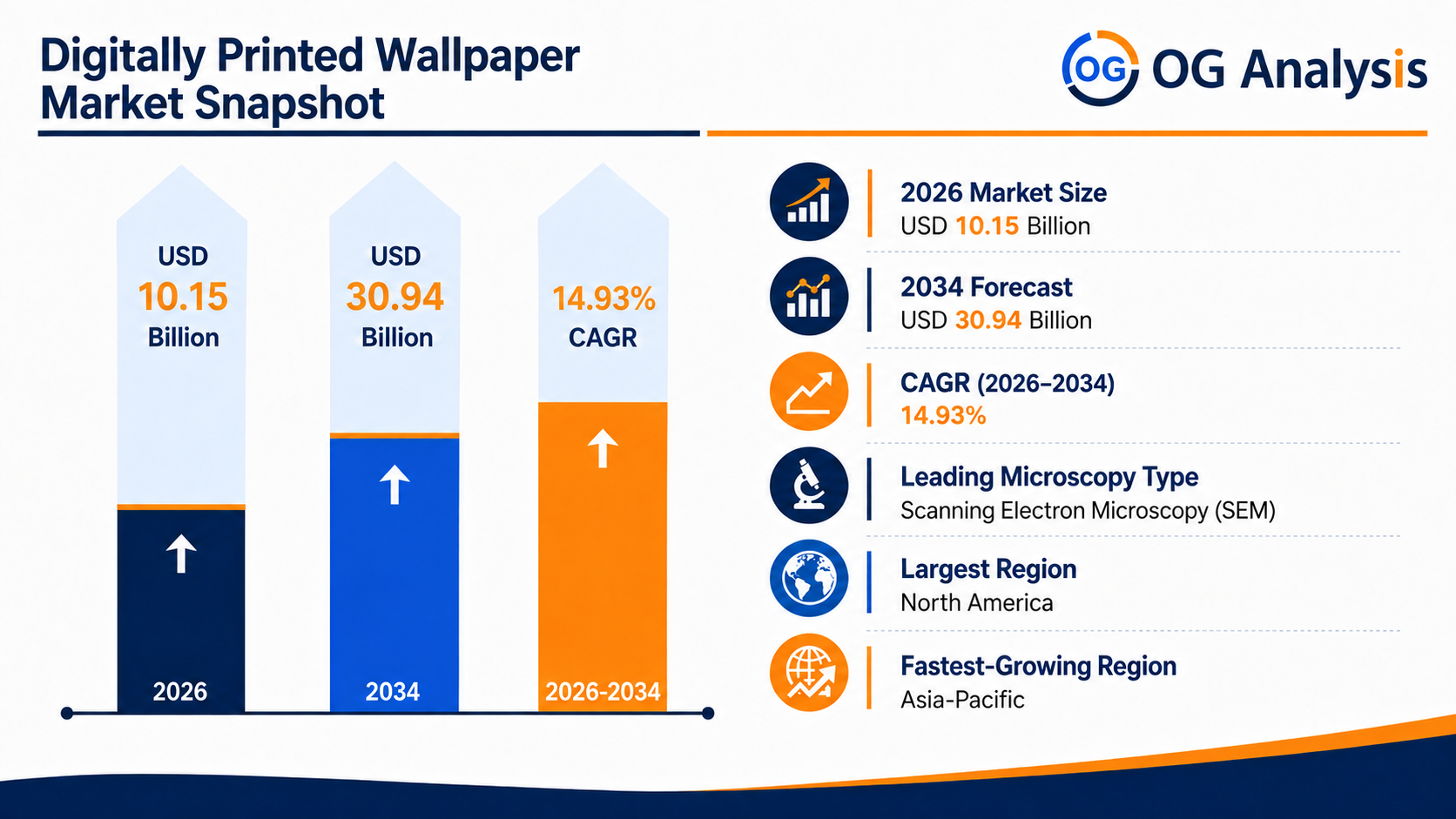
The Digitally Printed Wallpaper Market is estimated to be valued at $ 10.15 billion in 2026 and is projected to reach $ 30.94 billion by 2034, expanding at a CAGR of 14.93% from 2026 to 2034.
Digitally printed wallpaper refers to wallcoverings produced using digital printing technologies such as inkjet, UV printing, latex printing, and eco-solvent printing on substrates including paper, vinyl, non-woven materials, textiles, canvas, and specialty films. These wallpapers are widely used in residential interiors, commercial spaces, hospitality, retail, offices, healthcare facilities, education buildings, and entertainment venues. Market growth is supported by rising demand for personalized interiors, custom murals, premium home décor, short-run printing, faster design turnaround, and on-demand production. Digital printing allows brands, designers, architects, and consumers to create unique wallcoverings without the high setup cost associated with traditional printing methods. The market is also benefiting from e-commerce wallpaper platforms, removable peel-and-stick products, sustainable inks, textured finishes, and growing demand for large-format decorative graphics in commercial interiors.
Get Your Free Sample Report for In-Depth Market Insights :
https://www.oganalysis.com/industry-reports/digitally-printed-wallpaper-market
1. What is the latest trend in the Digitally Printed Wallpaper Market?
The latest trend is the rise of customized mural wallpapers, peel-and-stick wallcoverings, and large-scale artistic prints for residential and commercial interiors.
Consumers are moving toward personalized designs, bold patterns, botanical themes, scenic murals, abstract art, and premium textured finishes.
Digital printing enables fast design changes, short production runs, and room-specific customization.
Sustainable substrates, low-VOC inks, and removable wallpapers are also gaining attention among modern buyers.
2. What are the key challenges in the Digitally Printed Wallpaper Market?
Key challenges include raw material price volatility, print durability concerns, color consistency, installation quality, and competition from paint and traditional wallpapers.
Manufacturers must manage substrate compatibility, ink adhesion, washability, scratch resistance, and fading performance.
Premium digitally printed wallpaper can be costlier than mass-produced wallpaper, limiting adoption in price-sensitive markets.
Improper wall preparation, moisture exposure, and installation errors can also affect product performance and customer satisfaction.
3. What is the major driving factor for the Digitally Printed Wallpaper Market?
The major driving factor is rising demand for customized, aesthetic, and premium interior decoration solutions.
Consumers, interior designers, hotels, offices, and retail brands increasingly want personalized wall designs that reflect identity, lifestyle, and brand experience.
Digital printing reduces minimum order requirements and supports rapid production of unique designs.
Growth in home renovation, online décor shopping, commercial refurbishment, and experiential retail is further supporting demand.
4. What is the major segment in the Digitally Printed Wallpaper Market and why?
Non-woven and vinyl-based digitally printed wallpapers are major segments because they offer durability, print clarity, dimensional stability, and easier installation.
Vinyl wallpapers are widely used in commercial and high-traffic interiors because of their cleanability and resistance to wear.
Non-woven wallpapers are preferred in residential applications due to easier handling, premium finish, and improved wall application.
Peel-and-stick removable wallpaper is also growing due to demand from renters, DIY consumers, and temporary décor applications.
5. Which application or end-user is driving more demand?
Residential interiors and commercial décor are the leading demand areas.
Homeowners use digitally printed wallpaper for bedrooms, living rooms, children’s rooms, feature walls, kitchens, and home offices.
Hotels, restaurants, retail stores, offices, hospitals, schools, and entertainment venues use printed wallpapers to create branded and immersive spaces.
Interior designers, architects, and online customization platforms are important demand influencers in this market.
6. Which region offers the highest growth potential and why?
Asia Pacific offers strong growth potential due to urbanization, rising disposable income, expanding real estate development, and growing interest in premium interiors.
China, India, Japan, South Korea, Australia, and Southeast Asia are attractive markets for residential décor and commercial interior upgrades.
North America remains important due to strong DIY décor culture, e-commerce wallpaper sales, and demand for customized murals.
Europe is supported by design-led interiors, sustainable materials, premium wallcoverings, and strong renovation activity.
7. What strategies are major companies adopting in the market?
Major companies are focusing on customized design libraries, online ordering platforms, faster printing, sustainable inks, and premium substrate options.
They are expanding peel-and-stick collections, mural wallpapers, textured products, washable finishes, and designer collaborations.
Printer and material suppliers are improving print quality, ink performance, color management, and production efficiency.
Wallpaper brands are also using digital visualization tools, sample programs, and direct-to-consumer channels to improve customer conversion.
8. What are the leading companies in the Digitally Printed Wallpaper Market?
Leading companies include A.S. Création Tapeten, Graham & Brown, York Wallcoverings, Tapetenfabrik Gebr. Rasch, Muraspec, Flavor Paper, Spoonflower, Wall&decò, Rebel Walls, Photowall, Grandeco Wallfashion Group, and MuralsWallpaper.
Key printing technology suppliers include HP, Canon, Epson, Mimaki, Roland DG, Durst, Ricoh, and Xeikon.
Wallpaper companies compete through design range, substrate quality, customization, brand partnerships, and online distribution.
Printer technology suppliers compete through print speed, color accuracy, ink systems, substrate compatibility, and large-format production capability.
9. Why is digitally printed wallpaper strategically important for interior décor and commercial branding?
Digitally printed wallpaper is strategically important because it allows interiors to be customized quickly and cost-effectively.
It helps homeowners and designers create feature walls, murals, branded spaces, and themed environments without long production cycles.
For commercial users, it supports brand storytelling across hotels, offices, retail stores, restaurants, and event spaces.
For manufacturers, digital printing reduces inventory risk and enables flexible on-demand design production.
10. What is the future outlook for the Digitally Printed Wallpaper Market?
The market outlook remains positive as interior décor shifts toward personalization, premium aesthetics, fast customization, and sustainable materials.
Future growth will be supported by digital murals, peel-and-stick products, washable wallcoverings, eco-friendly inks, and online customization tools.
Commercial interiors will continue to adopt printed wallpapers for branding, ambience, and experiential design.
Companies offering strong design libraries, reliable print quality, sustainable substrates, and easy installation solutions are expected to gain market share.
Browse Related Reports
Stay Connected With Us
