Dried Banana Market Outlook 2026–2034: Healthy Snacking Trends, Shelf-Stable Fruit Demand, Growth Drivers, Leading Companies, and Future Opportunities
The Dried Banana Market is estimated to be valued at $ 1.3 billion in 2026 and is projected to reach $ 2.0 billion by 2034, expanding at a CAGR of 5.7% from 2026 to 2034.
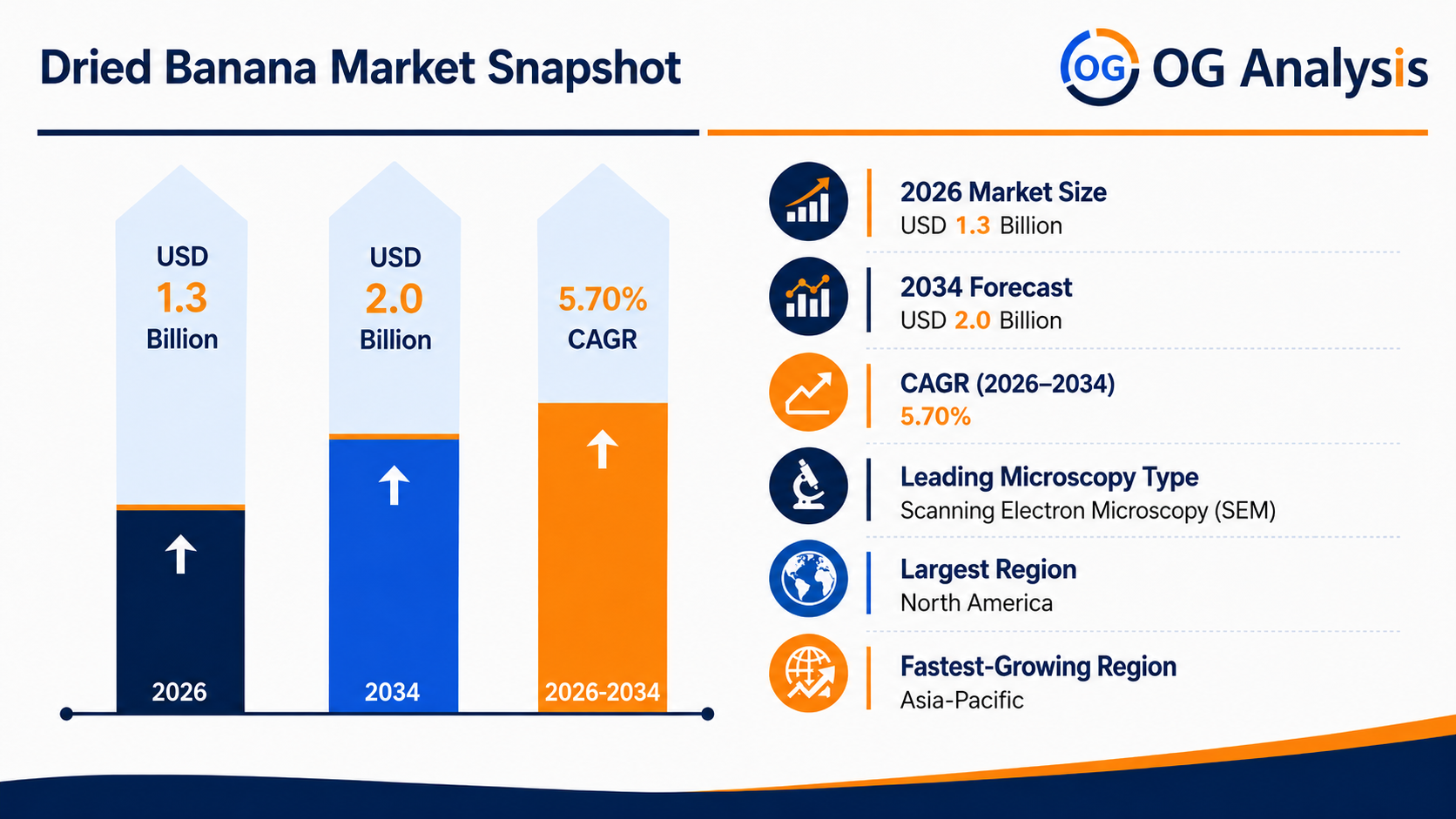
Dried banana products include banana chips, dehydrated banana slices, freeze-dried banana, banana flakes, banana powder, and value-added banana snacks used across retail snacking, bakery, breakfast cereals, confectionery, infant food, desserts, trail mixes, smoothies, and foodservice applications. Market growth is supported by rising demand for fruit-based snacks, plant-based diets, clean-label foods, convenient nutrition, and shelf-stable tropical fruit products. Dried bananas offer natural sweetness, portability, longer shelf life, and versatility across packaged food formulations. Product innovation is focused on baked banana chips, freeze-dried fruit inclusions, organic dried banana, low-sugar formats, flavored chips, resealable packaging, and premium snack mixes.
Get Your Free Sample Report for In-Depth Market Insights :
https://www.oganalysis.com/industry-reports/dried-banana-market
1. What is the latest trend in the Dried Banana Market?
The latest trend is the rising demand for healthier fruit-based snacks, including baked banana chips, freeze-dried banana pieces, and organic dried banana products.
Consumers are looking for convenient snacks with natural fruit positioning, better ingredients, and reduced reliance on artificial additives.
Premium and specialty dried banana products are gaining attention across retail and online channels.
Food manufacturers are also using dried banana as an inclusion in cereals, snack bars, bakery mixes, desserts, and trail mixes.
2. What are the key challenges in the Dried Banana Market?
Key challenges include raw banana price volatility, seasonal supply variation, moisture control, shelf-life stability, and quality consistency.
Manufacturers must manage browning, texture, oil absorption in fried chips, sugar content, packaging performance, and microbial safety.
Premium dried banana products can face price pressure compared with conventional snacks and fresh fruit.
Exporters also need to comply with food safety, labeling, pesticide residue, and quality standards in international markets.
3. What is the major driving factor for the Dried Banana Market?
The major driving factor is growing consumer preference for convenient, shelf-stable, and fruit-based snack products.
Dried bananas are easy to store, transport, and consume, making them suitable for on-the-go snacking and lunchbox use.
Demand is also supported by plant-based diets, clean-label snacking, and the popularity of tropical fruit flavors.
Expansion of supermarkets, convenience stores, health food stores, and e-commerce platforms is further supporting market growth.
4. What is the major segment in the Dried Banana Market and why?
Banana chips represent a major segment because they are widely consumed as ready-to-eat snacks across retail, vending, foodservice, and online channels.
They are available in sweetened, salted, unsweetened, baked, fried, organic, and flavored formats.
Dried banana slices and freeze-dried banana are gaining popularity among health-conscious consumers and premium snack brands.
Banana powder and flakes are also important for bakery, infant food, beverages, cereals, and processed food applications.
5. Which application or end-user is driving more demand?
Retail snacking is the strongest demand area, supported by supermarkets, convenience stores, specialty food retailers, and online grocery platforms.
Food manufacturers use dried banana in breakfast cereals, granola, nutrition bars, bakery products, desserts, confectionery, and trail mixes.
Health-conscious consumers, children, athletes, travelers, and plant-based snack buyers are important end-user groups.
Foodservice and HoReCa channels also use dried banana in toppings, desserts, smoothies, and packaged meal solutions.
6. Which region offers the highest growth potential and why?
Asia Pacific offers strong growth potential due to large banana production, expanding food processing capacity, and rising packaged snack consumption.
The Philippines, India, Indonesia, Thailand, and Vietnam are important supply and consumption markets for dried banana products.
North America and Europe remain attractive due to demand for healthy snacks, tropical fruit imports, organic products, and premium dried fruit mixes.
Export opportunities are increasing as global retailers and food manufacturers source shelf-stable banana ingredients and snack products.
7. What strategies are major companies adopting in the market?
Major companies are focusing on organic products, baked chips, freeze-dried formats, flavored variants, clean-label ingredients, and resealable packaging.
They are improving drying technology, moisture control, texture, product consistency, and shelf-life performance.
Brands are also expanding through e-commerce, private-label partnerships, health food retailers, and export channels.
Sustainability, fair sourcing, farmer partnerships, and reduced food waste are becoming important brand-positioning strategies.
8. What are the leading companies in the Dried Banana Market?
Leading companies include Dole Food Company, Bare Snacks, Brother’s All Natural, Mavuno Harvest, Traina Foods, JBC Food Corporation, Golden Saba Bananas, Oishi Group, Senorita Foods, Paradise Fruits Solutions, Bergin Fruit and Nut Company, and local dried fruit processors across major banana-producing countries.
These companies compete through product quality, drying technology, flavor variety, sourcing reliability, organic certification, packaging, and retail distribution.
Private-label suppliers also play a major role in supplying dried banana chips, slices, and fruit mixes to supermarkets and international retailers.
9. Why is dried banana strategically important for food and snack companies?
Dried banana is strategically important because it combines natural sweetness, long shelf life, portability, and broad use across food categories.
It allows snack brands to participate in fruit-based, plant-based, and better-for-you snacking trends.
For food manufacturers, dried banana provides flavor, texture, nutrition positioning, and tropical fruit appeal in processed food formulations.
For banana-producing regions, dried banana also supports value addition, export earnings, and reduction of post-harvest losses.
10. What is the future outlook for the Dried Banana Market?
The market outlook remains positive as demand grows for natural snacks, dried fruits, tropical flavors, and convenient nutrition products.
Future growth will be supported by baked banana chips, freeze-dried banana, organic offerings, low-sugar formats, premium snack mixes, and online distribution.
Food processors are expected to expand usage in cereals, bakery, confectionery, bars, infant food, and functional snack applications.
Companies offering consistent quality, clean-label positioning, strong sourcing, attractive packaging, and differentiated flavors are expected to gain market share.
Browse Related Reports
https://www.oganalysis.com/industry-reports/food-traceability-market
https://www.oganalysis.com/industry-reports/flexible-paper-packaging-market
https://www.oganalysis.com/industry-reports/specialty-foods-market
https://www.oganalysis.com/industry-reports/fruit-and-nut-farming-market
https://www.oganalysis.com/industry-reports/bananas-market
Stay Connected With Us
