Egg Sorting Machine Market Outlook 2026–2034: Automated Grading Systems, Poultry Processing Modernization, Growth Drivers, Leading Companies, and Future Opportunities
The Egg Sorting Machine Market is estimated to be valued at 640.6 Million in 2026 and is projected to reach $ 1,101 Million by 2034, expanding at a CAGR of 7.0% from 2026 to 2034.
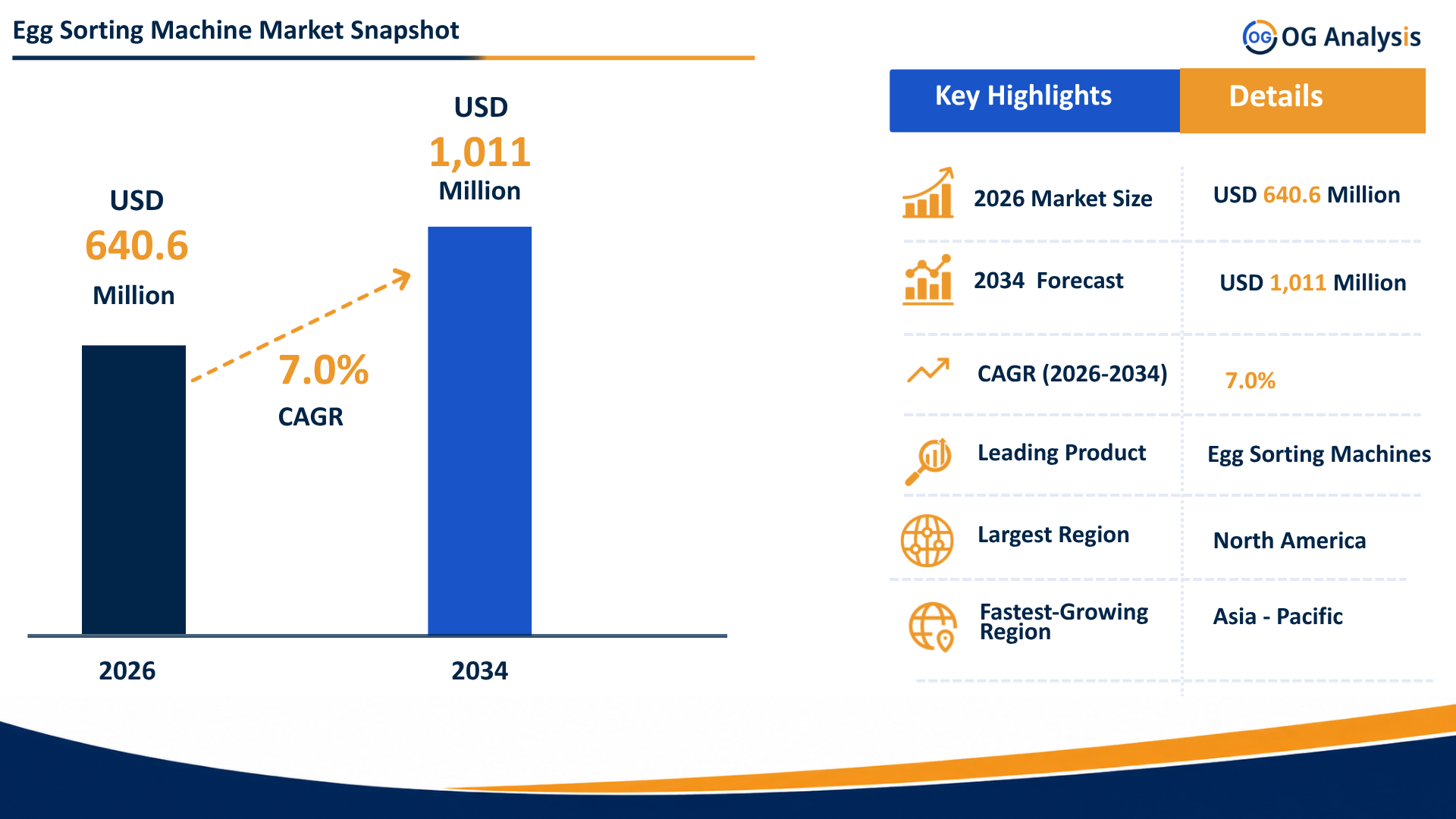
Egg sorting machines are automated systems used to inspect, grade, sort, count, transfer, and pack eggs based on weight, size, shell quality, cracks, dirt, shape, and other quality parameters. These machines are used across poultry farms, egg processing plants, hatcheries, packing centers, foodservice suppliers, and commercial egg producers. Market growth is supported by rising egg consumption, poultry farm modernization, labor-cost pressure, food safety requirements, and the need for consistent egg grading and packaging. Automated egg sorting machines improve operational efficiency, reduce manual handling, minimize breakage, improve traceability, and help producers meet retail and export quality standards. Product innovation is focused on higher sorting capacity, integrated washing and packing, vision-based inspection, crack detection, gentle egg handling, digital monitoring, and fully automated farm-to-packhouse workflows.
Get the Complete Analysis :
https://www.oganalysis.com/industry-reports/egg-sorting-machine-market
Get Your Free Sample Report for In-Depth Market Insights :
https://www.oganalysis.com/industry-reports/egg-sorting-machine-market/free-sample
1. What is the latest trend in the Egg Sorting Machine Market?
The latest trend is the adoption of automated, high-speed, and vision-enabled egg sorting systems.
Producers are using machines that combine weighing, grading, crack detection, dirt detection, orientation, counting, and packing in one integrated line.
Inline grading and packing systems are gaining attention because they reduce manual handling and improve productivity.
Digital controls, data tracking, farm automation, and food safety compliance features are becoming important purchasing factors.
2. What are the key challenges in the Egg Sorting Machine Market?
Key challenges include high capital cost, maintenance requirements, machine calibration, breakage risk, and the need for skilled operators.
Small and mid-sized poultry farms may delay adoption due to limited production scale or financing constraints.
Machines must handle eggs gently while maintaining high speed, accuracy, and hygiene standards.
Producers also evaluate spare parts availability, service support, cleaning requirements, and compatibility with existing farm layouts.
3. What is the major driving factor for the Egg Sorting Machine Market?
The major driving factor is the rising need for automated egg grading and packing in commercial poultry operations.
Manual sorting is time-consuming, labor-intensive, and less consistent when production volumes increase.
Egg sorting machines help producers improve grading accuracy, reduce handling losses, and meet retailer quality expectations.
Growth in organized poultry farming, egg exports, supermarkets, and packaged food supply chains is strengthening market demand.
4. What is the major segment in the Egg Sorting Machine Market and why?
Automatic egg sorting and grading machines represent a major segment because they offer higher capacity, better accuracy, and lower labor dependence.
These systems are widely used in commercial egg packing centers and large poultry farms where daily egg volumes are high.
Weight-based sorting remains important because egg size grading is a standard requirement in retail and foodservice channels.
Vision inspection and crack detection are gaining importance as producers focus on quality control and food safety.
5. Which application or end-user is driving more demand?
Commercial poultry farms, egg packing centers, hatcheries, egg processing plants, and foodservice suppliers are driving strong demand.
Large egg producers use sorting machines to manage high-volume grading, packing, and dispatch operations.
Retail suppliers require consistent egg sizes, clean shells, traceable batches, and standardized Egg packaging.
Hatcheries also use sorting systems to improve egg handling, selection, and operational efficiency.
6. Which region offers the highest growth potential and why?
Asia Pacific offers strong growth potential due to rising egg consumption, expanding poultry production, and modernization of farm infrastructure.
China, India, Japan, Southeast Asia, and Australia are important markets due to large poultry bases and increasing demand for automated egg handling.
North America and Europe remain mature markets with strong automation penetration and established egg grading standards.
Growth in emerging markets is supported by commercial poultry expansion, supermarket penetration, and food safety modernization.
7. What strategies are major companies adopting in the market?
Major companies are focusing on high-capacity sorting lines, integrated grading and packing systems, gentle handling technology, and digital machine controls.
They are improving crack detection, dirt detection, weighing accuracy, cleaning efficiency, and packing flexibility.
Suppliers are also offering modular machines suitable for small, medium, and large egg producers.
After-sales service, spare parts availability, installation support, and operator training are becoming important competitive strategies.
8. What are the leading companies in the Egg Sorting Machine Market?
Leading companies include MOBA, SANOVO Group, NABEL, Prinzen, Kyowa Machinery, Seyang, Plasson Do Brasil, ZENYER, Mintai, Sime-Tek, VÖLKER GmbH, Yamasa, EggTec, Guangxing Group, Damtech, ZOREL, and Riva Selegg.
These companies compete through sorting speed, grading accuracy, gentle handling, automation level, hygiene design, machine reliability, and service support.
Global suppliers with complete egg grading, packing, processing, and farm automation portfolios are better positioned among large poultry operators.
Regional manufacturers compete through cost-effective machines, local service networks, and customized solutions for small and medium farms.
9. Why are egg sorting machines strategically important for poultry producers?
Egg sorting machines are strategically important because they improve productivity, product consistency, and quality assurance in egg supply chains.
They reduce manual labor dependence and help minimize egg breakage during handling and packing.
For poultry producers, automated sorting supports better inventory control, traceability, packaging accuracy, and retailer compliance.
For large farms, these machines are essential for scaling operations while maintaining hygiene and grading standards.
10. What is the future outlook for the Egg Sorting Machine Market?
The market outlook remains positive as poultry farms continue shifting toward automation, food safety, and high-volume egg handling.
Future growth will be supported by automatic grading machines, inline packing systems, AI-based visual inspection, crack detection, and smart farm integration.
Demand will continue across commercial farms, hatcheries, egg processing plants, packing centers, and retail supply chains.
Companies offering reliable, hygienic, accurate, modular, and service-supported egg sorting systems are expected to gain market share.
Browse Related Reports
https://www.oganalysis.com/industry-reports/material-handling-equipment-market
https://www.oganalysis.com/industry-reports/agricultural-packaging-market
https://www.oganalysis.com/industry-reports/foreign-object-detection-system-market
https://www.oganalysis.com/industry-reports/agriculture-sensing-and-monitoring-devices-market
https://www.oganalysis.com/industry-reports/automated-feeding-systems-market
