Fertility Services Market Outlook 2026–2034: IVF Trends, Growth Drivers, Leading Companies, and Future Opportunities
The Fertility Services Market is expected to grow from $ 69.1 billion in 2026 to $ 180.9 billion by 2034, registering a CAGR of 12.79%.
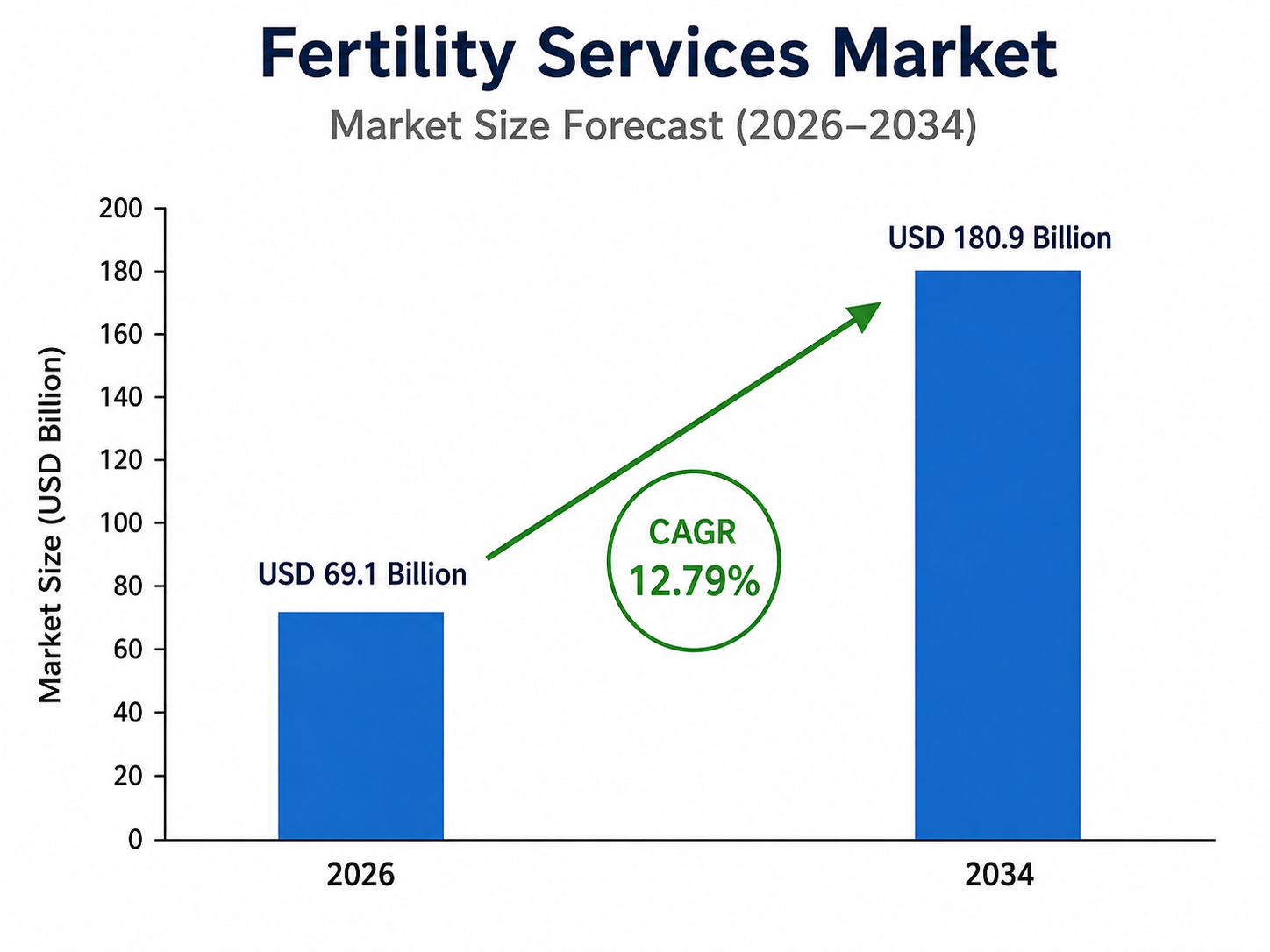
During the forecast period. The market includes a wide range of reproductive healthcare services, such as infertility diagnosis, in-vitro fertilization (IVF), intracytoplasmic sperm injection (ICSI), intrauterine insemination (IUI), fertility preservation, donor programs, surrogacy support, genetic testing, and reproductive counseling. These services are provided through fertility clinics, hospitals, reproductive medicine centers, egg and sperm banks, and specialized laboratory networks. Market growth is being driven by delayed parenthood, the increasing prevalence of infertility, greater awareness of reproductive health, evolving family structures, and improved access to assisted reproductive technologies. Rising adoption of employer-sponsored fertility benefits, medical tourism, elective egg freezing, and inclusive treatment options for same-sex couples and single parents is also contributing to market expansion. In addition, continuous advancements in AI-assisted embryo selection, preimplantation genetic testing, laboratory automation, digital patient management platforms, and personalized ovarian stimulation protocols are improving treatment outcomes and enhancing the overall patient experience.
1. What is the latest trend in the Fertility Services Market?
The latest trend is the integration of AI, time-lapse embryo imaging, genetic testing, and digital patient-management platforms into fertility treatment.
Clinics are using data-driven tools to support embryo assessment, stimulation planning, laboratory quality control, and treatment personalization.
Elective egg freezing and fertility preservation are also gaining adoption among younger consumers.
Employer-sponsored benefits and virtual fertility-navigation services are improving awareness and access.
2. What are the key challenges in the Fertility Services Market?
Key challenges include high treatment costs, limited insurance coverage, emotional burden, inconsistent success rates, and unequal geographic access.
Regulations governing donor gametes, embryo testing, surrogacy, and cross-border treatment differ significantly between countries.
Multiple treatment cycles may be required, increasing financial and psychological pressure on patients.
Clinics must also manage ethical concerns, laboratory quality, patient privacy, and transparent success-rate reporting.
3. What is the major driving factor for the Fertility Services Market?
The major driving factor is the rising number of individuals and couples seeking treatment for age-related and medical infertility.
Delayed marriage and parenthood, lifestyle changes, declining sperm quality, and reproductive disorders are expanding demand.
Greater awareness and reduced social stigma are encouraging earlier diagnosis and specialist consultation.
Improving treatment technology and expanding clinic networks are further supporting market growth.
4. What is the major segment in the Fertility Services Market and why?
In-vitro fertilization represents a major service segment because it addresses a broad range of female- and male-factor infertility conditions.
IVF can be combined with ICSI, donor eggs, frozen embryo transfer, genetic testing, and fertility-preservation programs.
Its relatively established clinical pathway and improving laboratory technology support strong patient adoption.
Higher service value per treatment cycle also makes IVF a major revenue contributor for fertility clinics.
5. Which application or end-user is driving more demand?
Specialized fertility clinics are driving the greatest demand because they provide integrated consultations, procedures, embryology, cryopreservation, and counseling.
Patients increasingly prefer dedicated centers with experienced specialists, advanced laboratories, and transparent treatment pathways.
Hospitals contribute through reproductive medicine departments and management of medically complex patients.
Egg banks, sperm banks, and genetic laboratories also support expanding donor and preservation services.
6. Which region offers the highest growth potential and why?
Asia Pacific offers strong growth potential due to its large patient population, delayed parenthood, improving healthcare access, and expanding clinic capacity.
China, India, Japan, South Korea, Australia, and Southeast Asia are increasing investment in assisted reproductive technologies.
Competitive treatment costs are also supporting fertility tourism in selected regional markets.
North America and Europe remain established markets with advanced laboratories and high adoption of fertility preservation.
7. What strategies are major companies adopting in the market?
Major companies are expanding clinic networks, acquiring regional providers, standardizing laboratory protocols, and investing in advanced embryology technology.
They are adding genetic testing, fertility preservation, donor programs, behavioral support, and financial-navigation services.
Digital consultations and employer partnerships are being used to improve patient acquisition and treatment continuity.
International expansion and medical-tourism programs are also strengthening geographic reach.
8. What are the leading companies in the Fertility Services Market?
Leading companies include IVI RMA Global, CCRM Fertility, Monash IVF Group, Virtus Health, CARE Fertility, Genea, Kindbody, The Prelude Network, Shady Grove Fertility, Boston IVF, Nova IVF Fertility, and Indira IVF.
These providers compete through clinic scale, laboratory quality, success outcomes, physician expertise, technology, and geographic coverage.
Large networks benefit from standardized protocols, centralized purchasing, brand recognition, and broader patient referral systems.
Regional clinics compete through affordability, personalized care, local access, and specialized treatment expertise.
9. Why are fertility services strategically important for healthcare providers?
Fertility services allow healthcare providers to participate in a growing specialty that combines diagnostics, procedures, laboratory services, and long-term patient engagement.
The segment creates opportunities across IVF, genetic testing, cryopreservation, donor services, pharmacy support, and reproductive counseling.
Integrated programs can improve patient retention and generate referrals across women’s health and urology services.
For investors, fertility services offer recurring demand and opportunities for scalable clinic-network development.
10. What is the future outlook for the Fertility Services Market?
The market outlook remains positive as infertility awareness, fertility preservation, and assisted reproductive technology adoption continue to expand.
Future growth will be supported by AI-assisted laboratories, automation, non-invasive embryo assessment, genetic testing, and personalized care pathways.
Affordability, insurance coverage, ethical governance, and transparent clinical outcomes will increasingly influence provider selection.
Companies offering accessible, evidence-based, technology-enabled, and emotionally supportive care are expected to gain market share.
Browse Related Reports:
https://www.oganalysis.com/industry-reports/onychomycosis-market
https://www.oganalysis.com/industry-reports/smart-inhalers-market
https://www.oganalysis.com/industry-reports/assisted-reproductive-technology-market
https://www.oganalysis.com/industry-reports/inhalation-anesthesia-market
https://www.oganalysis.com/industry-reports/vertebroplasty-and-kyphoplasty-market
