Greenhouse Horticulture Market Outlook 2026–2034: Controlled Environment Farming Trends, Smart Greenhouse Adoption, Growth Drivers, Leading Companies, and Future Opportunities
The Greenhouse Horticulture Market is estimated to be valued at $ 34.8 billion in 2026 and is projected to reach $ 86.6 billion by 2034, expanding at a CAGR of 12.1% from 2026 to 2034.
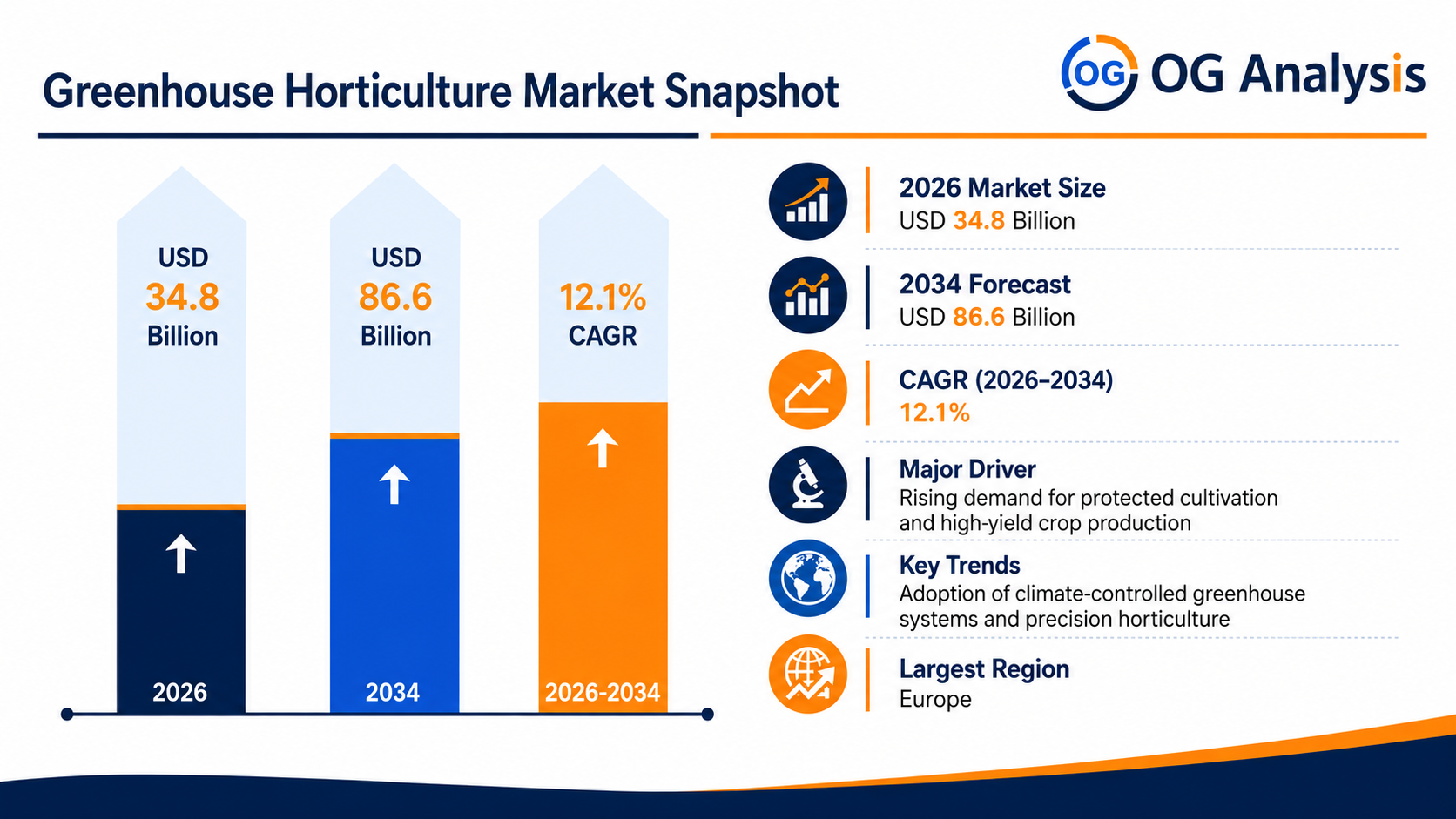
Greenhouse horticulture refers to the cultivation of fruits, vegetables, flowers, ornamentals, herbs, and nursery crops under protected structures where temperature, humidity, light, irrigation, nutrients, and pest exposure can be managed more efficiently than open-field farming. The market includes glass greenhouses, plastic greenhouses, hydroponic systems, climate-control systems, irrigation equipment, grow lights, sensors, automation platforms, and crop-management solutions.Market growth is supported by rising food demand, climate variability, water scarcity, urban farming, higher yield requirements, and consumer preference for fresh, locally available produce. Growers are adopting advanced greenhouse systems to improve productivity, reduce crop losses, extend growing seasons, and optimize resource use. Demand is especially strong across vegetables, tomatoes, cucumbers, peppers, leafy greens, floriculture, and high-value horticultural crops. Technology adoption is increasing through smart sensors, AI-enabled climate control, automated irrigation, fertigation, LED lighting, robotics, and data-driven crop monitoring.
1. What is the latest trend in the Greenhouse Horticulture Market?
The latest trend is the shift toward smart and automated greenhouse systems that use sensors, climate software, AI, and IoT-based monitoring.
Growers are using data-driven tools to control temperature, humidity, lighting, irrigation, carbon dioxide, and nutrient delivery.
Hydroponics, soilless cultivation, LED grow lights, and precision fertigation are gaining adoption in high-value crop production.
Sustainable greenhouse designs focused on energy efficiency, water recycling, and lower pesticide use are also becoming more important.
2. What are the key challenges in the Greenhouse Horticulture Market?
Key challenges include high capital investment, energy cost pressure, skilled labor shortages, and complex greenhouse operations.
Maintaining stable climate conditions requires advanced equipment, technical knowledge, and continuous monitoring.
Growers also face risks from crop disease, pest outbreaks, input-cost volatility, and power dependency.
In some regions, profitability can be affected by electricity prices, water availability, financing limitations, and market-price fluctuations.
3. What is the major driving factor for the Greenhouse Horticulture Market?
The major driving factor is the need for stable, high-yield, and resource-efficient food production under changing climate conditions.
Greenhouses help protect crops from extreme weather, pests, rainfall variability, and seasonal limitations.
They enable year-round production and can improve output per unit area compared with open-field cultivation.
Rising demand for fresh vegetables, fruits, flowers, and locally produced food is strengthening market expansion.
4. What is the major segment in the Greenhouse Horticulture Market and why?
Vegetable cultivation is a major segment because tomatoes, cucumbers, peppers, lettuce, leafy greens, and herbs are widely grown in greenhouse systems.
These crops benefit from controlled temperature, irrigation, fertigation, and pest management.
Greenhouse vegetables offer consistent quality, higher productivity, and better supply reliability for retailers and foodservice buyers.
Floriculture is also important, especially in regions with strong demand for ornamental plants, cut flowers, and nursery crops.
5. Which application or end-user is driving more demand?
Commercial growers are the leading demand drivers because they invest in large-scale greenhouse structures, climate systems, irrigation, lighting, and automation.
Retail supply chains, supermarkets, foodservice operators, exporters, and urban-farming companies are supporting demand for reliable year-round produce.
Floriculture producers and nursery operators are also important users of greenhouse horticulture technologies.
Demand is strongest where buyers require consistent quality, traceability, freshness, and predictable supply volumes.
6. Which region offers the highest growth potential and why?
Europe remains a leading region due to advanced greenhouse clusters, strong technology adoption, and mature horticulture systems in countries such as the Netherlands and Spain.
Asia Pacific offers strong growth potential due to food-security needs, urbanization, rising income levels, and government support for protected cultivation.
North America is growing through controlled-environment agriculture, high-value vegetable production, and local fresh-food demand.
The Middle East is also emerging due to water scarcity, food import dependence, and investment in climate-controlled farming.
7. What strategies are major companies adopting in the market?
Major companies are focusing on smart greenhouse design, energy-efficient climate control, hydroponic systems, LED lighting, and automation platforms.
They are integrating sensors, crop analytics, irrigation control, fertigation, and digital monitoring into complete greenhouse solutions.
Partnerships with growers, retailers, agri-tech firms, and research institutions are helping improve crop productivity and system performance.
Companies are also developing sustainable greenhouse models using water recycling, renewable energy, heat recovery, and low-input cultivation methods.
8. What are the leading companies in the Greenhouse Horticulture Market?
Leading companies include Dalsem, Certhon, Richel Group, Van der Hoeven Horticultural Projects, Netafim, Priva, Ridder, Hoogendoorn Growth Management, Signify, Heliospectra, Prospiant, Argus Control Systems, Top Greenhouses, and Rough Brothers.
These companies compete through greenhouse engineering, climate-control technology, irrigation systems, lighting solutions, automation software, and integrated project delivery.
Technology suppliers with complete greenhouse ecosystems are gaining preference among commercial growers.
Regional players compete through local project execution, crop-specific expertise, cost competitiveness, and after-sales support.
9. Why is greenhouse horticulture strategically important for food and agriculture?
Greenhouse horticulture is strategically important because it supports higher productivity, climate resilience, and efficient use of land and water.
It helps growers reduce exposure to weather shocks and improve crop quality, consistency, and harvest planning.
For food retailers, greenhouse production supports reliable supply of fresh vegetables, herbs, fruits, and flowers throughout the year.
For governments, it supports food security, domestic production, rural employment, and sustainable agriculture goals.
10. What is the future outlook for the Greenhouse Horticulture Market?
The market outlook remains positive as food systems shift toward climate-resilient, resource-efficient, and technology-enabled production.
Future growth will be supported by smart greenhouses, hydroponics, LED lighting, AI-based crop monitoring, robotics, and sustainable energy systems.
Demand for fresh local produce, reduced pesticide use, and year-round supply will continue to support commercial greenhouse investments.
Companies offering integrated, energy-efficient, and crop-specific greenhouse solutions are expected to gain market share.
Browse Related Reports
https://www.oganalysis.com/industry-reports/agricultural-packaging-market
https://www.oganalysis.com/industry-reports/rainwater-harvesting-system-market
https://www.oganalysis.com/industry-reports/biofertilizers-market
https://www.oganalysis.com/industry-reports/plant-growth-regulators-market
https://www.oganalysis.com/industry-reports/microgreens-market
Stay Connected With Us
