hERG Screening Market Outlook 2026–2034: Cardiac Safety Testing Trends, Growth Drivers, Leading Companies, and Future Opportunities
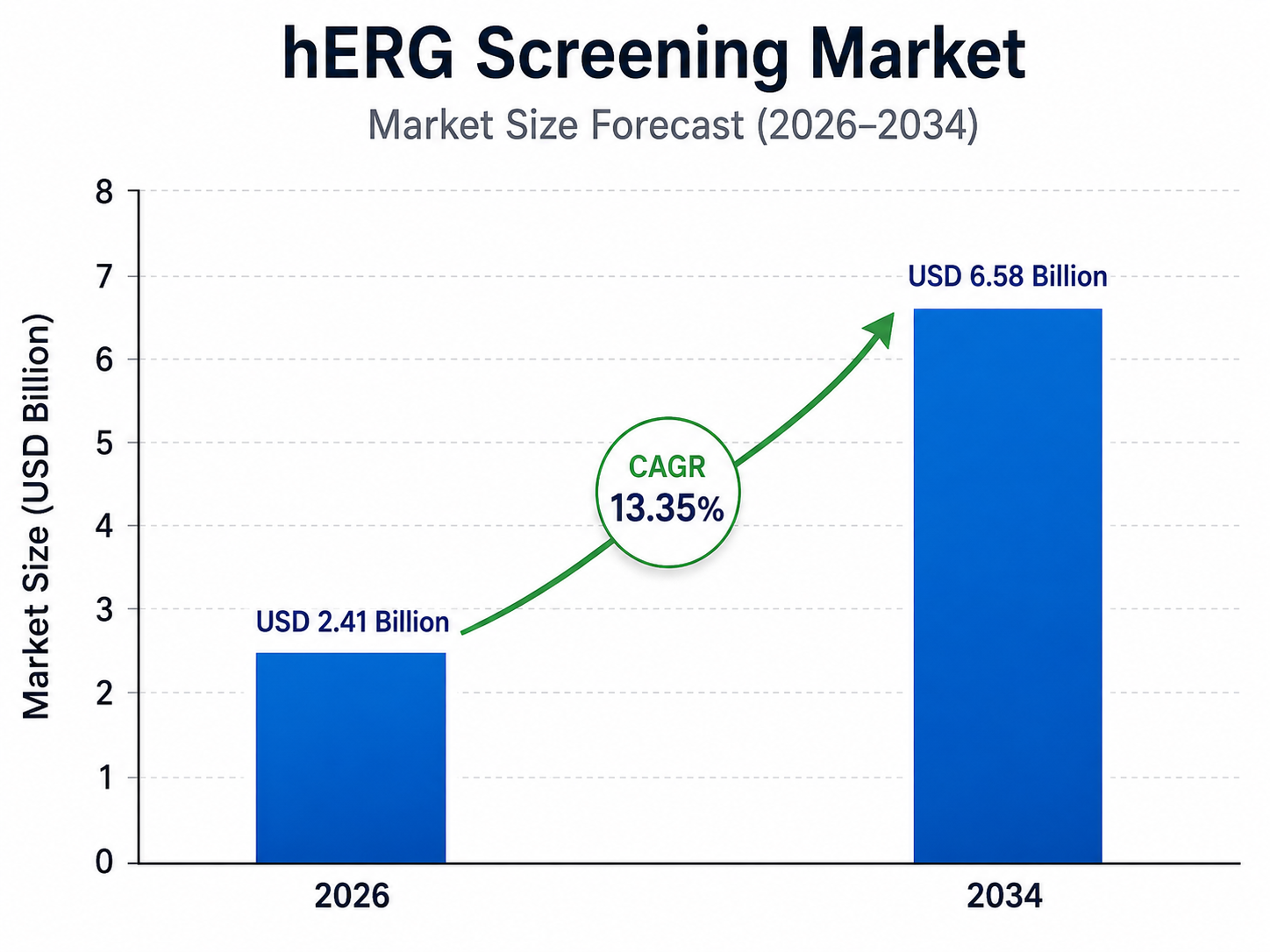
The hERG Screening Market is expected to grow from $ 2.41 billion in 2026 to $ 6.58 billion by 2034, registering a CAGR of 13.35%.
During the forecast period. hERG screening plays a critical role in drug development by evaluating whether drug candidates inhibit the human Ether-à-go-go-Related Gene (hERG) potassium channel, which is essential for maintaining normal cardiac electrical activity. Excessive inhibition of this channel can prolong the QT interval and increase the risk of potentially life-threatening ventricular arrhythmias, making early cardiac safety assessment a key step in the drug discovery process. The market includes a wide range of products and services, such as manual and automated patch-clamp assays, fluorescence-based assays, cell lines, reagents, analytical instruments, software solutions, and contract testing services. Market growth is being driven by increasing pharmaceutical and biotechnology research, stricter regulatory requirements for cardiac safety evaluation, rising investment in drug development, and the need to identify potentially unsafe compounds at earlier stages of development. Pharmaceutical companies, biotechnology firms, contract research organizations (CROs), and academic research institutions remain the primary end users, while advances in automation and integrated cardiac safety testing platforms continue to improve testing efficiency, consistency, and decision-making throughout the drug development pipeline.
1. What is the latest trend in the hERG Screening Market?
The latest trend is the adoption of high-throughput automated patch-clamp systems that screen larger compound libraries with improved speed and consistency.
Testing at physiological temperatures is also gaining attention because it can improve sensitivity for temperature-dependent channel inhibition.
Companies are integrating hERG assays with CiPA ion-channel panels and human stem-cell-derived cardiomyocyte models.
These approaches provide a broader assessment of proarrhythmic risk than isolated single-channel testing.
2. What are the key challenges in the hERG Screening Market?
Key challenges include assay variability, compound solubility, nonspecific binding, complex data interpretation, and differences between testing platforms.
Manual patch-clamp testing provides high-quality data but requires skilled electrophysiologists and has relatively low throughput.
Automated systems involve substantial equipment investment, validation, and laboratory-integration requirements.
Companies must also minimize false-positive results that could lead to the premature rejection of viable drug candidates.
3. What is the major driving factor for the hERG Screening Market?
The major driving factor is the need to identify cardiac-safety liabilities before drug candidates enter costly clinical development.
Early hERG testing helps researchers eliminate or optimize compounds associated with QT prolongation and potential arrhythmia risk.
Regulatory expectations for integrated nonclinical cardiac-safety assessment further support routine screening.
Rising pharmaceutical pipelines and pressure to reduce late-stage drug failure are strengthening demand.
4. What is the major segment in the hERG Screening Market and why?
Functional assays represent a major segment because they directly measure the effect of compounds on hERG potassium-channel activity.
Manual and automated patch-clamp techniques generate concentration-response and current-inhibition data for cardiac-risk assessment.
These assays are widely used during lead optimization, preclinical safety testing, and regulatory-support studies.
Their strong physiological relevance supports continued demand despite higher costs than biochemical binding assays.
5. Which application or end-user is driving more demand?
Pharmaceutical and biotechnology companies are driving the greatest demand because hERG evaluation is integrated across drug discovery and preclinical development.
Screening is used during hit identification, lead optimization, candidate selection, and investigational new drug-enabling studies.
Contract research organizations also account for substantial demand by providing specialist electrophysiology and GLP-compliant services.
Academic and research institutions contribute through ion-channel biology, disease modeling, and assay-development activities.
6. Which region offers the highest growth potential and why?
Asia Pacific offers strong growth potential due to expanding pharmaceutical research, growing biotechnology investment, and increased outsourcing of preclinical testing.
China, India, Japan, South Korea, and Singapore are strengthening drug-discovery and contract research capabilities.
North America remains the leading established market because of extensive pharmaceutical R&D and advanced safety-testing infrastructure.
Europe also benefits from strong regulatory science, CRO expertise, and established ion-channel research capabilities.
7. What strategies are major companies adopting in the hERG Screening Market?
Major companies are expanding automated patch-clamp capacity, GLP-compliant services, multichannel cardiac panels, and integrated cardiotoxicity testing.
They are developing assays with faster turnaround, greater throughput, improved temperature control, and more physiologically relevant data.
Partnerships with pharmaceutical developers and platform manufacturers support customized screening workflows.
Companies are also combining hERG results with computational models and cardiomyocyte assays to improve risk prediction.
8. What are the leading companies in the hERG Screening Market?
Leading participants include Charles River Laboratories, Eurofins Scientific, Evotec through Cyprotex, Thermo Fisher Scientific, Metrion Biosciences, Inotiv, Reaction Biology, Sophion Bioscience, Nanion Technologies, and Aurora Biomed.
Service providers compete through scientific expertise, GLP compliance, turnaround time, assay quality, and interpretation support.
Technology companies compete through automation, throughput, temperature control, software, and platform reliability.
Providers offering integrated ion-channel and cardiomyocyte testing hold a strong competitive position.
9. Why is hERG screening strategically important for drug developers?
hERG screening enables drug developers to identify cardiac risks before committing substantial resources to clinical trials.
Early detection allows medicinal chemists to modify molecular structures and improve the safety profile of lead compounds.
Reliable screening can reduce late-stage attrition, regulatory delays, restrictive product labeling, and development costs.
It therefore plays a central role in candidate selection, portfolio risk management, and patient safety.
10. What is the future outlook for the hERG Screening Market?
The market outlook remains positive as drug developers increase investment in predictive and integrated cardiac-safety assessment.
Future growth will be supported by automated electrophysiology, physiological-temperature assays, AI-supported analysis, and advanced computational modeling.
hERG testing will increasingly be combined with multichannel panels and human cardiomyocyte models rather than used as a standalone endpoint.
Companies offering scalable, validated, and regulatory-aligned screening solutions are expected to gain market share.
Browse Related Reports:
https://www.oganalysis.com/industry-reports/head-and-neck-cancer-diagnostics-market
https://www.oganalysis.com/industry-reports/internet-of-medical-things-iomt-market
https://www.oganalysis.com/industry-reports/digital-health-market
https://www.oganalysis.com/industry-reports/dental-practice-management-software-market
https://www.oganalysis.com/industry-reports/green-hospitals-market
