Hospital Gowns Market Outlook 2026–2034: Infection Control Trends, Growth Drivers, Leading Companies, and Future Opportunities
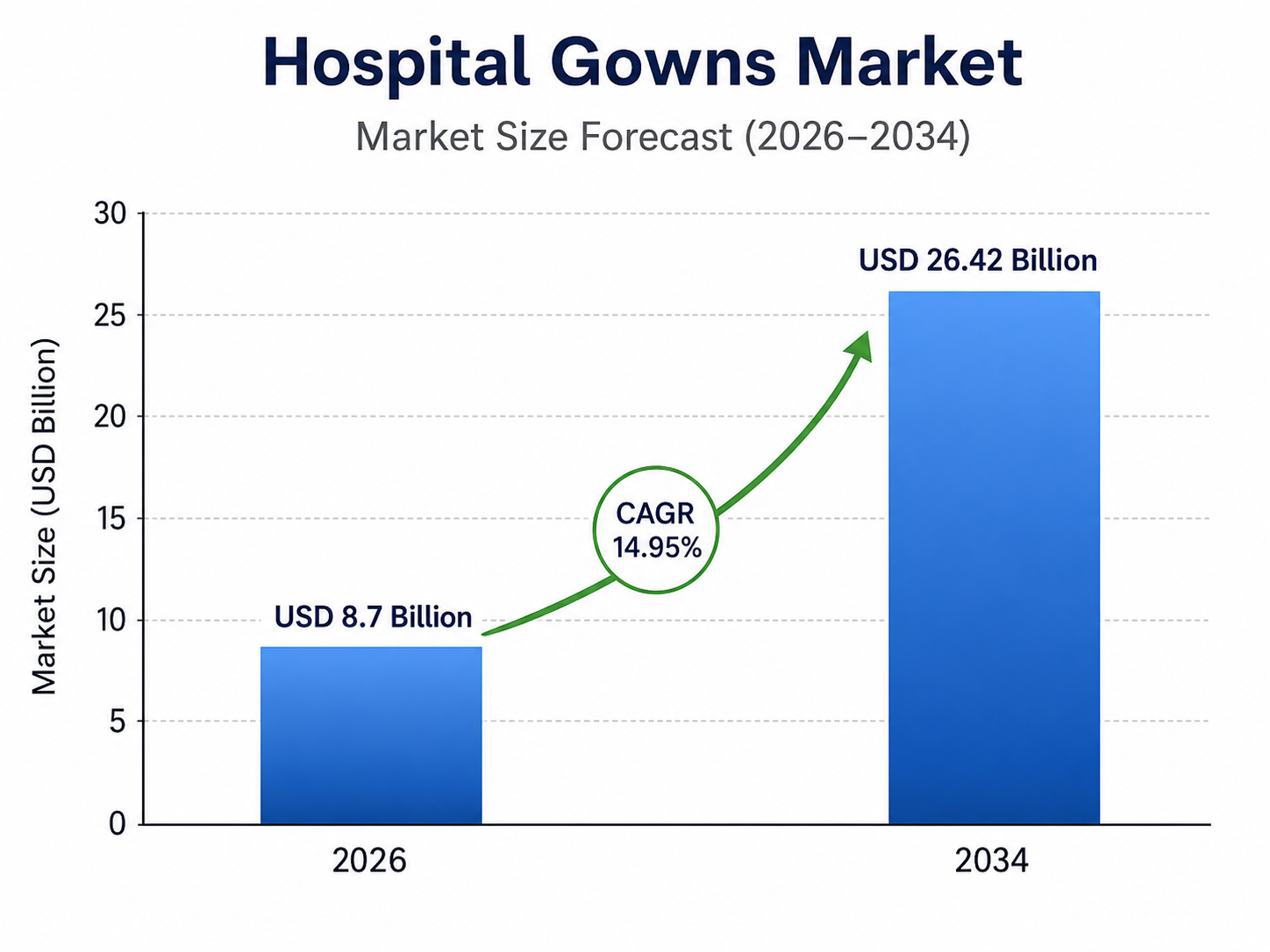
The Hospital Gowns Market is projected to grow from $ 8.7 billion in 2026 to $ 26.42 billion by 2034, registering a CAGR of 14.95%.
During the forecast period. Hospital gowns play a critical role in protecting both healthcare professionals and patients from fluids, microorganisms, and cross-contamination during medical procedures and routine care. These gowns include surgical, isolation, examination, and patient gowns, and are manufactured using either disposable nonwoven materials or reusable woven fabrics that offer different levels of protective performance. Market growth is being driven by increasing surgical procedures, rising hospital admissions, growing concerns about healthcare-associated infections, and the implementation of stricter infection prevention and control measures across healthcare facilities. Hospitals, ambulatory surgical centers, diagnostic laboratories, long-term care facilities, and emergency departments remain the primary end users. At the same time, manufacturers are focusing on developing gowns with enhanced comfort, breathability, fluid resistance, ergonomic fit, and sustainable materials while ensuring compliance with established safety and performance standards.
1. What is the latest trend in the Hospital Gowns Market?
The latest trend is the growing adoption of reusable, recyclable, and lower-waste hospital gowns as healthcare providers pursue sustainability targets.
Manufacturers are developing lightweight fabrics that combine fluid resistance, breathability, comfort, and repeated laundering performance.
Antimicrobial textiles, reinforced critical zones, and improved closure systems are also gaining attention.
Healthcare facilities are increasingly evaluating lifecycle cost and environmental impact alongside purchase price.
2. What are the key challenges in the Hospital Gowns Market?
Key challenges include raw material price volatility, supply-chain disruptions, regulatory compliance, inconsistent product quality, and medical-waste generation.
Manufacturers must balance barrier protection with comfort, breathability, mobility, and affordability.
Reusable gowns require reliable collection, laundering, inspection, and sterilization infrastructure.
Hospitals also face difficulties selecting appropriate protection levels for different procedures and exposure risks.
3. What is the major driving factor for the Hospital Gowns Market?
The major driving factor is the increasing emphasis on infection prevention and protection against healthcare-associated infections.
Hospital gowns help reduce exposure to blood, body fluids, microorganisms, and contaminated materials during patient care and surgical procedures.
Rising hospital admissions, surgical volumes, and chronic disease treatment are creating recurring demand.
Stricter occupational safety and infection-control policies further support market adoption.
4. What is the major segment in the Hospital Gowns Market and why?
Surgical gowns represent a major product segment because they are essential for maintaining sterile barriers during surgical and invasive procedures.
They provide higher fluid resistance and protection across critical zones exposed to blood and bodily fluids.
Growing surgical volumes and stricter operating-room infection-control standards sustain demand.
Advanced fabric, reinforced, and higher-barrier gowns also command greater value than basic patient gowns.
5. Which application or end-user is driving more demand?
Hospitals are the leading end users because they require gowns across operating rooms, emergency departments, intensive care units, isolation wards, and general patient care.
Ambulatory surgical centers also generate strong demand as outpatient procedure volumes increase.
Diagnostic laboratories and long-term care facilities use isolation and examination gowns for routine protection.
Demand is highest in facilities with large patient throughput and stringent infection-control requirements.
6. Which region offers the highest growth potential and why?
Asia Pacific offers strong growth potential due to expanding hospital capacity, increasing surgical procedures, and rising healthcare expenditure.
China, India, Japan, South Korea, and Southeast Asia are investing in healthcare infrastructure and infection-control supplies.
The region also benefits from a large textile and disposable medical-product manufacturing base.
North America remains an established market due to strict standards, high surgical volumes, and mature procurement systems.
7. What strategies are major companies adopting in the Hospital Gowns Market?
Major companies are focusing on sustainable materials, enhanced barrier protection, ergonomic design, and procedure-specific product portfolios.
They are expanding reusable gown programs, domestic manufacturing capacity, and long-term hospital supply agreements.
Manufacturers are also improving traceability, sterilization compatibility, packaging efficiency, and supply-chain resilience.
Partnerships with healthcare systems and group purchasing organizations support market access and recurring contracts.
8. What are the leading companies in the Hospital Gowns Market?
Leading companies include Medline Industries, Cardinal Health, 3M, Owens & Minor, Mölnlycke Health Care, Ansell, Standard Textile, Paul Hartmann, Lohmann & Rauscher, TIDI Products, Priontex, and Angelica.
These companies compete through barrier performance, product breadth, regulatory compliance, pricing, and distribution capabilities.
Large suppliers benefit from established hospital relationships and integrated infection-control portfolios.
Specialized textile providers compete through reusable systems, comfort, durability, and laundering support.
9. Why are hospital gowns strategically important for healthcare organizations?
Hospital gowns are strategically important because they protect patients and clinical staff while supporting infection-control and occupational-safety objectives.
Reliable gown availability helps hospitals maintain surgical schedules and respond to outbreaks or emergency demand.
Appropriate gown selection can reduce cross-contamination risk and improve staff confidence during patient care.
For procurement teams, gowns are also important to supply continuity, waste reduction, and lifecycle cost management.
10. What is the future outlook for the Hospital Gowns Market?
The market outlook remains positive as healthcare systems strengthen infection prevention, surgical capacity, and emergency preparedness.
Future growth will be supported by sustainable fabrics, reusable PPE programs, advanced barrier materials, and improved gown comfort.
Demand will increasingly shift toward products combining certified protection with lower environmental impact and dependable supply.
Companies offering compliant, cost-effective, comfortable, and sustainable gown solutions are expected to gain market share.
Browse Related Reports:
https://www.oganalysis.com/industry-reports/pediatric-catheters-market
https://www.oganalysis.com/industry-reports/transcatheter-embolization-and-occlusion-devices-market
https://www.oganalysis.com/industry-reports/minimally-invasive-surgery-devices-market
https://www.oganalysis.com/industry-reports/intraocular-lens-market
https://www.oganalysis.com/industry-reports/dental-bone-graft-substitutes-market
