Laser Processing Market Outlook 2026–2034: Precision Manufacturing Trends, Fiber Laser Adoption, Growth Drivers, Leading Companies, and Future Opportunities
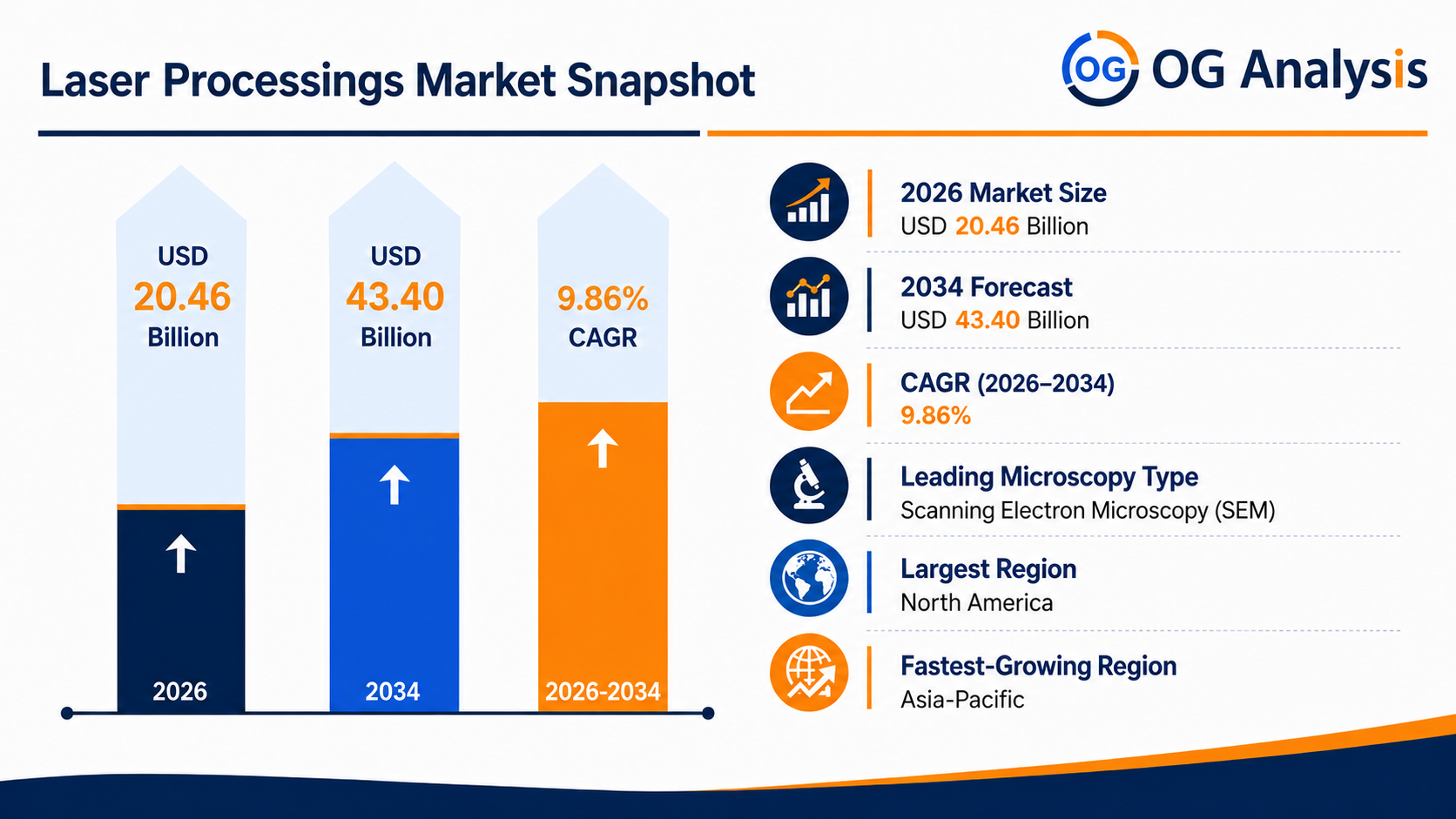
The Laser Processing Market is estimated to be valued at $ 20.46 billion in 2026 and is projected to reach $ 43.40 billion by 2034, expanding at a CAGR of 9.86% from 2026 to 2034.
Laser processing refers to the use of focused laser energy to cut, weld, drill, mark, engrave, clean, texture, harden, melt, or modify materials including metals, plastics, ceramics, glass, semiconductors, and composites. The technology is widely used across automotive, electronics, aerospace, medical devices, energy, machinery, packaging, defense, and precision manufacturing. Market growth is supported by rising demand for high-accuracy, non-contact, automated, and low-waste manufacturing processes. Laser systems enable faster cycle times, narrow heat-affected zones, clean processing, repeatable quality, and compatibility with complex part geometries. Fiber lasers, ultrafast lasers, CO₂ lasers, diode lasers, and solid-state lasers are increasingly used in industrial production lines. Adoption is also expanding through Industry 4.0, robotics integration, EV battery production, semiconductor packaging, and additive manufacturing applications.
Get Your Free Sample Report for In-Depth Market Insights :
https://www.oganalysis.com/industry-reports/laser-processings-market
1. What is the latest trend in the Laser Processing Market?
The latest trend is the increasing adoption of fiber lasers, ultrafast lasers, and AI-enabled laser processing systems for precision manufacturing.
Manufacturers are using lasers for high-speed cutting, welding, marking, micromachining, surface texturing, and additive manufacturing.
EV battery welding, semiconductor micro-processing, medical-device manufacturing, and lightweight material processing are emerging high-growth applications.
Robotic laser cells, real-time process monitoring, and automated quality inspection are also becoming important market trends.
2. What are the key challenges in the Laser Processing Market?
Key challenges include high capital cost, system-integration complexity, skilled operator requirements, and maintenance of optics, beam delivery, and cooling systems.
Laser processing performance depends on material type, reflectivity, thickness, surface condition, beam quality, and process parameters.
Safety requirements, fume extraction, energy consumption, and machine downtime can affect adoption decisions.
Small manufacturers may face barriers due to upfront investment and the need for technical expertise.
3. What is the major driving factor for the Laser Processing Market?
The major driving factor is rising demand for precise, automated, and efficient material processing across advanced manufacturing industries.
Lasers support clean, fast, repeatable, and non-contact processing, making them attractive for high-quality industrial production.
Automotive, electronics, aerospace, medical devices, and machinery manufacturers use lasers to improve productivity and reduce rework.
Growth in EVs, batteries, semiconductors, and miniaturized components is further strengthening demand.
4. What is the major segment in the Laser Processing Market and why?
Laser cutting is a major segment because it is widely used across sheet metal fabrication, automotive parts, machinery, electronics, and construction materials.
It offers high speed, precision, narrow kerf width, and flexibility for complex shapes and customized production.
Laser welding is also expanding rapidly due to EV battery packs, automotive structures, medical devices, and precision assemblies.
Laser marking and engraving remain important for product identification, traceability, branding, and regulatory compliance.
5. Which application or end-user is driving more demand?
Automotive, electronics, semiconductor, aerospace, medical device, metal fabrication, and industrial machinery sectors are driving strong demand.
EV manufacturers use laser welding and cutting for battery cells, busbars, battery trays, lightweight structures, and powertrain components.
Electronics and semiconductor users rely on laser processing for micro-drilling, wafer marking, trimming, cutting, and packaging applications.
Medical-device companies use lasers for precise cutting, welding, marking, and surface modification of small and complex components.
6. Which region offers the highest growth potential and why?
Asia Pacific offers the highest growth potential due to strong electronics manufacturing, semiconductor investment, automotive production, and industrial automation.
China, Japan, South Korea, Taiwan, and India are important markets for laser cutting, welding, marking, and micro-processing equipment.
North America remains important due to aerospace, defense, medical devices, EVs, and advanced manufacturing reshoring.
Europe is supported by automotive engineering, precision machinery, industrial automation, and strong laser technology suppliers.
7. What strategies are major companies adopting in the market?
Major companies are focusing on higher-power fiber lasers, ultrafast laser systems, automated workstations, robotic integration, and smart process monitoring.
They are improving beam quality, energy efficiency, processing speed, software control, and system reliability.
Partnerships with automation integrators, EV battery manufacturers, semiconductor companies, and machine-tool builders are becoming important.
Companies are also expanding service networks, application labs, and customized laser solutions for high-value industrial users.
8. What are the leading companies in the Laser Processing Market?
Leading companies include TRUMPF, Coherent, IPG Photonics, Han’s Laser, Amada, Bystronic, Lumentum, Jenoptik, Novanta, Prima Industrie, Mazak, Mitsubishi Electric, Panasonic, Laserline, nLIGHT, and Gravotech.
These companies compete through laser source performance, machine accuracy, automation capability, software integration, service support, and application expertise.
Fiber laser specialists are gaining from demand in cutting, welding, and marking, while machine-tool suppliers compete through complete processing systems.
Vendors with strong application engineering and global service networks are better positioned for industrial-scale adoption.
9. Why is laser processing strategically important for advanced manufacturing?
Laser processing is strategically important because it enables high-precision, flexible, and automated production with reduced mechanical contact and lower tooling needs.
It supports miniaturization, lightweighting, product traceability, cleaner joining, and high-quality surface modification.
For manufacturers, lasers help improve throughput, part quality, repeatability, and design flexibility.
For high-growth industries such as EVs, electronics, aerospace, and medical devices, laser processing is becoming a core production technology.
10. What is the future outlook for the Laser Processing Market?
The market outlook remains positive as manufacturing shifts toward automation, digitalization, precision engineering, and advanced materials.
Future growth will be supported by high-power fiber lasers, ultrafast lasers, AI-based process control, EV battery welding, semiconductor processing, and additive manufacturing.
Demand will continue to expand across automotive, electronics, medical devices, aerospace, energy, machinery, and industrial fabrication.
Companies offering reliable systems, strong software, application-specific solutions, and lifecycle service support are expected to gain market share.
Browse Related Reports
https://www.oganalysis.com/industry-reports/measuring-and-inspection-systems-for-plastic-market
https://www.oganalysis.com/industry-reports/vertical-cavity-surface-emitting-laser-market
https://www.oganalysis.com/industry-reports/aerospace-robotics-market
https://www.oganalysis.com/industry-reports/unpatterned-wafer-defect-inspection-system-market
https://www.oganalysis.com/industry-reports/industrial-gases-in-metals-and-metal-fabrication-market
Stay Connected With Us
