Medicine Checkweigher Market Outlook 2026–2034: Automation Trends, Regulatory Drivers, Leading Companies, and Future Opportunities
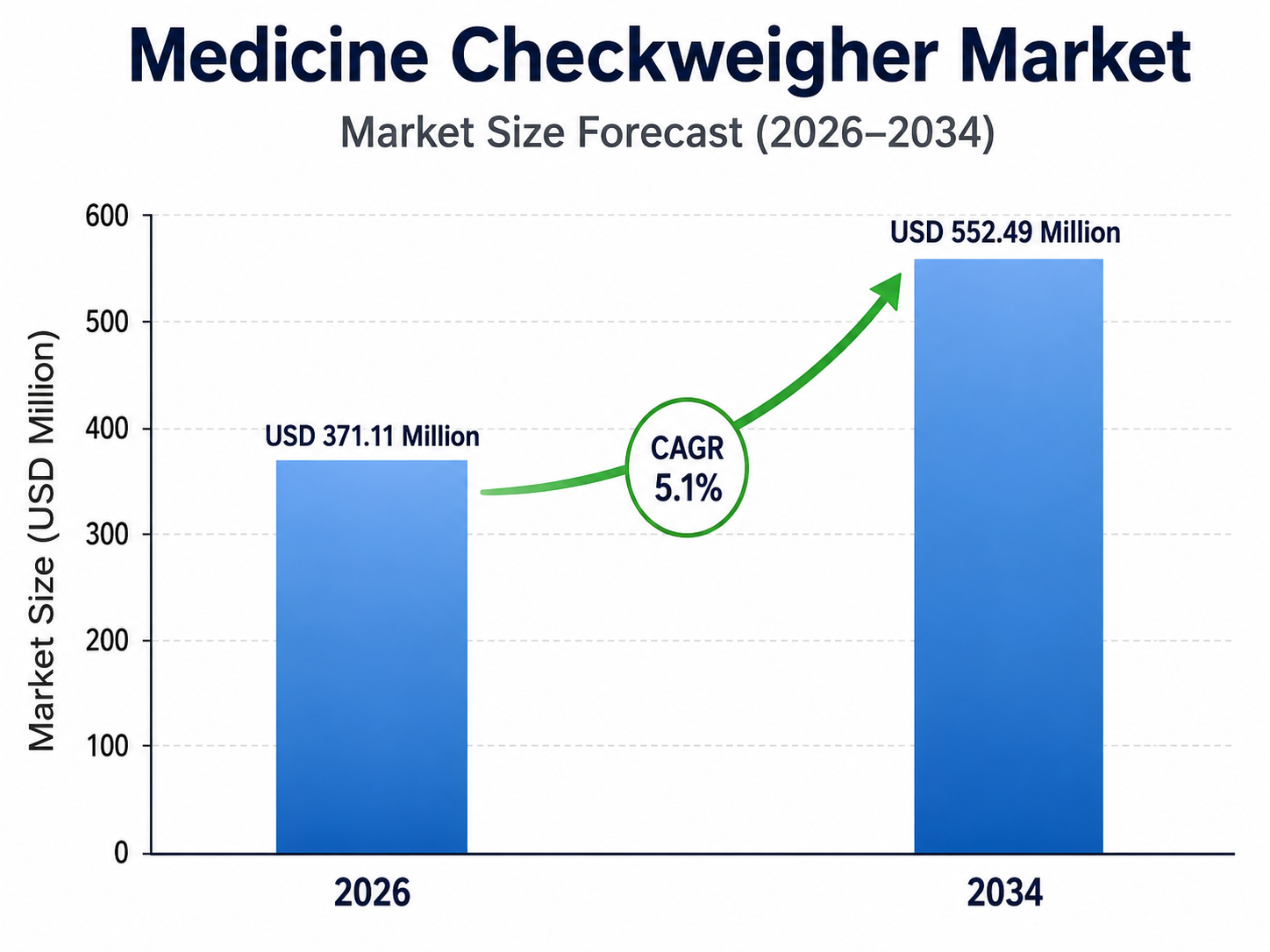
The Medicine Checkweigher Market is estimated to be valued at $ 371.11 Million in 2026 and is projected to reach $ 552.49 Million by 2034, expanding at a CAGR of 5.1%from 2026 to 2034.
Medicine checkweighers are automated systems used in pharmaceutical manufacturing to ensure that products such as tablets, capsules, bottles, blister packs, sachets, vials, tubes, cartons, and other packaged medicines meet the required weight standards. These systems quickly identify and remove underweight, overweight, incomplete, or incorrectly packed products, helping manufacturers maintain product quality and regulatory compliance.
The market for medicine checkweighers is growing due to stricter pharmaceutical quality regulations, increasing global medicine production, and greater adoption of automated packaging lines. Rising demand for serialization and product traceability is also driving market growth. To improve inspection accuracy and production efficiency, manufacturers are increasingly integrating checkweighers with vision inspection systems, metal detectors, X-ray inspection equipment, track-and-trace software, and centralized production management platforms.
1. What is the latest trend in the Medicine Checkweigher Market?
The latest trend is the integration of high-precision checkweighing with serialization, vision inspection, metal detection, and automated production-data management.
Manufacturers are adopting digital load cells, vibration compensation, servo-driven conveyors, and real-time performance analytics.
Compact systems designed for high-speed blister, bottle, vial, and carton lines are also gaining demand.
Remote monitoring and electronic audit trails are supporting smarter pharmaceutical quality-control operations.
2. What are the key challenges in the Medicine Checkweigher Market?
Key challenges include high equipment cost, difficult handling of lightweight packs, vibration interference, frequent format changes, and validation complexity.
Pharmaceutical lines require extremely high accuracy while operating at fast production speeds and rejecting products without damaging adjacent packs.
Machines must also comply with hygiene, data-integrity, electronic-record, and Good Manufacturing Practice requirements.
Smaller manufacturers may face barriers related to investment, technical expertise, and system integration.
3. What is the major driving factor for the Medicine Checkweigher Market?
The major driving factor is the need to ensure correct medicine quantity, complete packaging, and consistent product quality before market release.
Even minor weight deviations can indicate missing tablets, absent leaflets, incorrect fill volumes, or incomplete packaging components.
Stricter regulatory scrutiny and product-recall risks are encouraging manufacturers to automate 100% in-line weight verification.
Growth in generic drugs, contract manufacturing, and high-volume medicine production further supports demand.
4. What is the major segment in the Medicine Checkweigher Market and why?
Automatic dynamic checkweighers represent a major segment because they inspect every product without interrupting the packaging process.
These machines provide high throughput, automatic rejection, digital documentation, and direct integration with upstream and downstream equipment.
They are particularly valuable on continuous blister, bottle, sachet, vial, and carton packaging lines.
Their ability to combine speed, repeatability, and regulatory documentation supports widespread adoption.
5. Which application or end-user is driving more demand?
Pharmaceutical manufacturers are driving the strongest demand, followed by contract development and manufacturing organizations and nutraceutical producers.
Solid-dose medicines, including tablets and capsules packed in blisters or bottles, represent an important application area.
Liquid medicines, injectables, diagnostic products, and medical-device packs also require precise weight and component verification.
High-volume packaging facilities generate particularly strong demand for automated inspection systems.
6. Which region offers the highest growth potential and why?
Asia Pacific offers strong growth potential due to expanding pharmaceutical manufacturing, generic drug exports, contract production, and packaging automation.
China, India, Japan, South Korea, and Southeast Asia are investing in higher-quality and regulation-compliant manufacturing infrastructure.
Europe and North America remain major established markets because of stringent pharmaceutical standards and advanced production lines.
Regional demand is also supported by reshoring, capacity expansion, and greater focus on supply-chain quality.
7. What strategies are major companies adopting in the market?
Major companies are focusing on greater weighing accuracy, faster throughput, compact footprints, modular construction, and easier line integration.
They are combining checkweighers with metal detection, X-ray inspection, serialization, labeling, and vision-control systems.
Software upgrades, electronic batch records, remote diagnostics, and predictive maintenance are becoming key differentiators.
Companies are also expanding validation support, aftermarket services, and application-specific pharmaceutical configurations.
8. What are the leading companies in the Medicine Checkweigher Market?
Leading companies include Mettler-Toledo, Wipotec, Thermo Fisher Scientific, Minebea Intec, Anritsu, Ishida, Bizerba, Loma Systems, Sesotec, Techik, Yamato Scale, and regional inspection-equipment manufacturers.
These companies compete through weighing accuracy, line speed, regulatory compliance, product handling, software capability, and service support.
Established suppliers benefit from broad inspection portfolios and global technical networks.
Specialized manufacturers compete through customized, compact, and cost-effective pharmaceutical solutions.
9. Why are medicine checkweighers strategically important for pharmaceutical manufacturers?
Medicine checkweighers protect patients and brands by preventing incomplete, incorrectly filled, or noncompliant products from leaving the production line.
They help reduce recalls, rework, material waste, regulatory exposure, and manual inspection requirements.
Recorded weight data also supports batch documentation, process verification, and continuous production improvement.
For management teams, checkweighing is a critical investment in quality assurance and operational risk control.
10. What is the future outlook for the Medicine Checkweigher Market?
The market outlook remains positive as pharmaceutical production becomes more automated, connected, and compliance-focused.
Future systems will increasingly use intelligent rejection control, AI-supported analytics, automated format adjustment, and integrated inspection platforms.
Demand will expand across continuous manufacturing, personalized medicine, high-speed solid-dose packaging, and contract manufacturing facilities.
Companies offering accurate, validated, flexible, and digitally connected systems are expected to gain market share.
