Metal Recycling Market Outlook 2026–2034: Circular Economy Demand, Low-Carbon Metal Production, Leading Companies, and Future Opportunities
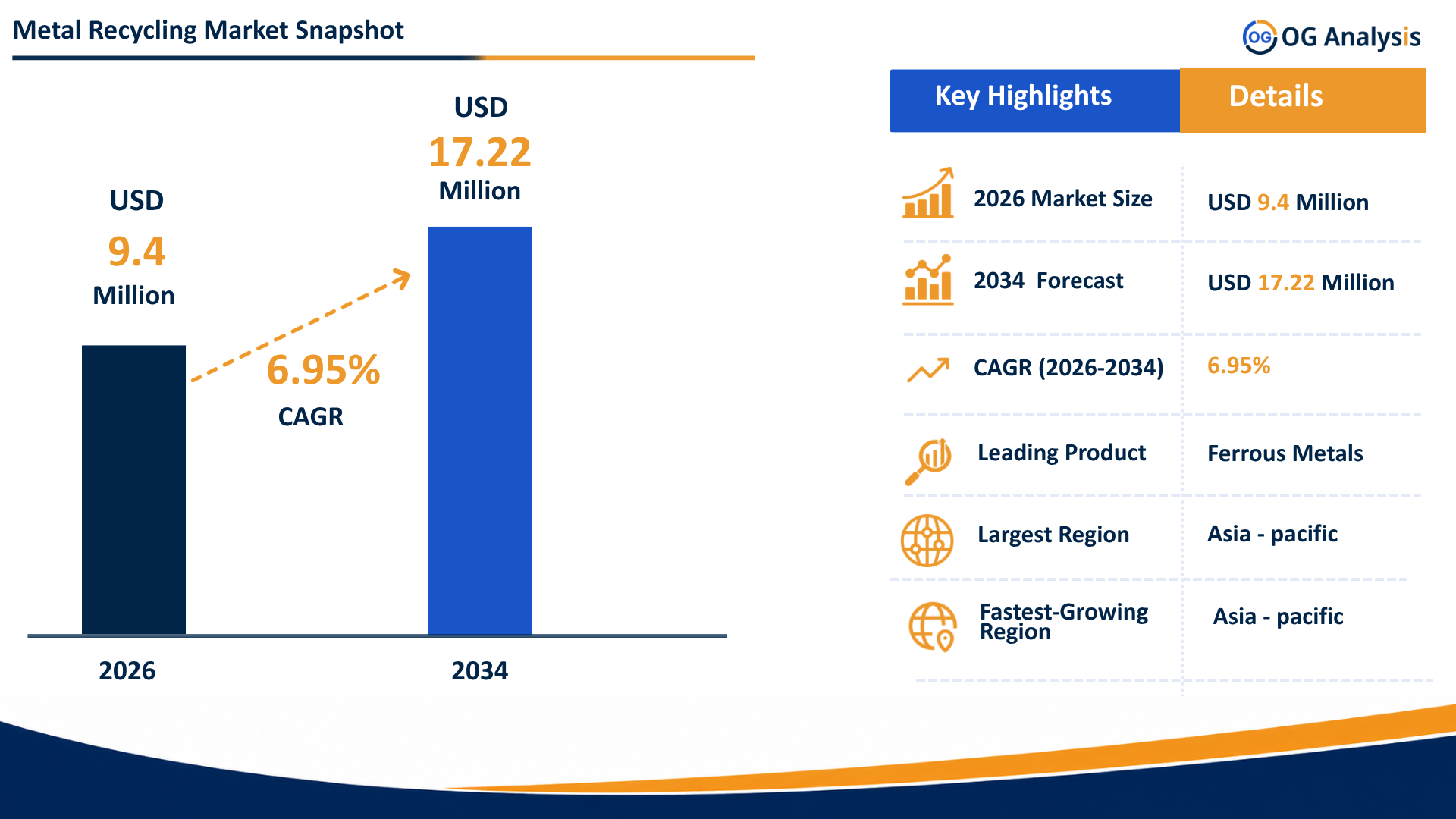
The Global Metal Recycling Market was valued at $9.4 billion in 2026 and is projected to reach $17.22 billion by 2034, growing at a CAGR of 6.95%.
Metal recycling covers the collection, sorting, processing, shredding, melting, and reuse of ferrous and non-ferrous metals such as steel, aluminum, copper, brass, zinc, lead, nickel, and precious metals. Demand is supported by rising scrap availability, circular economy initiatives, carbon reduction targets, infrastructure development, automotive manufacturing, electronics recycling, construction waste recovery, and growing use of secondary metals in industrial production.
Get the Complete Analysis :
https://www.oganalysis.com/industry-reports/metal-recycling-market
Get Your Free Sample Report for In-Depth Market Insights :
https://www.oganalysis.com/industry-reports/metal-recycling-market/free-sample
1. What is the latest trend in the Metal Recycling Market?
The latest trend is the adoption of AI-enabled sorting, automated scrap processing, sensor-based separation, and digital scrap traceability.
Recyclers are improving recovery rates, metal purity, and processing efficiency through advanced sorting and material identification technologies.
Closed-loop recycling is also gaining importance, especially in automotive, packaging, construction, and electronics industries.
Steelmakers and aluminum producers are increasingly using recycled inputs to reduce energy use and carbon emissions.
2. What are the key challenges in the Metal Recycling Market?
Key challenges include scrap price volatility, contamination, inconsistent scrap quality, informal collection systems, and high processing costs.
Recyclers must manage complex material streams from end-of-life vehicles, demolition waste, electronics, industrial scrap, and packaging waste.
Regulatory compliance, export restrictions, energy costs, and labor availability also affect profitability.
Maintaining high-purity recycled metals for automotive, aerospace, electrical, and packaging applications remains technically demanding.
3. What is the major driving factor for the Metal Recycling Market?
The major driving factor is the rising demand for sustainable, low-carbon, and cost-efficient raw materials across industries.
Recycled metals reduce dependence on primary ore extraction and support lower-emission manufacturing.
Demand is increasing from steel mills, aluminum producers, construction companies, automotive manufacturers, electronics recyclers, and packaging companies.
Circular economy policies and corporate sustainability targets are further strengthening recycled metal consumption.
4. What is the major segment in the Metal Recycling Market and why?
Ferrous metals represent the major category because steel and iron scrap are widely generated and reused across construction, automotive, machinery, and industrial manufacturing.
Steel recycling benefits from large scrap availability, established collection networks, and strong demand from electric arc furnace steel production.
Non-ferrous metals such as aluminum, copper, and brass are also high-value categories due to strong recovery economics.
Aluminum recycling is gaining strong attention because of its role in packaging, transport lightweighting, and low-carbon manufacturing.
5. Which application or end-user is driving more demand?
Construction, automotive, packaging, industrial machinery, electrical and electronics, and metal manufacturing are key demand drivers.
Construction and demolition activities generate large volumes of steel, copper, aluminum, and mixed metal scrap.
Automotive recycling supports recovery of steel, aluminum, copper wiring, batteries, catalytic materials, and other metal components.
Electronics recycling is expanding due to growing e-waste volumes and the need to recover copper, aluminum, precious metals, and critical materials.
6. Which region offers the highest growth potential and why?
Asia Pacific offers the highest growth potential due to rapid industrialization, infrastructure expansion, manufacturing growth, and rising scrap generation.
China, India, Japan, South Korea, and Southeast Asia are key markets for steel, aluminum, copper, and electronics recycling.
North America remains a mature market with strong scrap collection, steel recycling, and automotive recycling infrastructure.
Europe is supported by circular economy policies, carbon reduction goals, and strong demand for recycled metals in manufacturing.
7. What strategies are major companies adopting in the market?
Major companies are investing in advanced sorting technology, shredder capacity, scrap yards, digital trading platforms, and closed-loop recycling partnerships.
Recyclers are improving material recovery through automation, sensor-based sorting, and better contamination control.
Steel and aluminum producers are integrating scrap supply chains to secure high-quality recycled feedstock.
Companies are also expanding regional collection networks, downstream processing capacity, and sustainability-focused customer partnerships.
8. What are the leading companies in the Metal Recycling Market?
Leading companies include Nucor Corporation, Sims Limited, Commercial Metals Company, Aurubis AG, Novelis Inc., Steel Dynamics Inc., Radius Recycling, ArcelorMittal, Tata Steel, European Metal Recycling, Kuusakoski Group, Norsk Hydro, Gerdau, Dowa Holdings, American Iron & Metal, SA Recycling, OmniSource, Alter Trading, and ELG Haniel Group.
These companies compete through scrap sourcing strength, processing capacity, recycling technology, metal purity, logistics reach, and industrial customer relationships.
Nucor, Sims Limited, Commercial Metals Company, Aurubis, and Novelis are frequently identified among important companies in the recycled metal and scrap recycling industry.
Integrated steel and aluminum producers are increasingly strengthening recycled feedstock access to support low-carbon production.
9. Why is metal recycling strategically important?
Metal recycling is strategically important because it supports resource efficiency, lower emissions, reduced landfill waste, and raw material security.
It helps industries reduce reliance on mined ores while improving the availability of steel, aluminum, copper, and other industrial metals.
Recycling also supports circular supply chains across automotive, construction, packaging, electronics, and manufacturing industries.
As decarbonization pressure increases, recycled metals are becoming strategically valuable for producers and end-users.
10. What is the future outlook for the Metal Recycling Market?
The market outlook remains positive as industries increase recycled metal usage to reduce cost, emissions, and raw material supply risk.
Future growth will be supported by urban mining, e-waste recycling, electric vehicle recycling, battery material recovery, and circular manufacturing models.
AI-based sorting, cleaner scrap streams, closed-loop contracts, and stronger traceability will improve recycled metal quality and adoption.
Companies with strong collection networks, advanced processing assets, and sustainable metal supply capabilities are expected to gain market share.
Browse Related Reports
https://www.oganalysis.com/industry-reports/tire-recycling-downstream-products-market
https://www.oganalysis.com/industry-reports/hook-lifts-and-skip-loaders-market
https://www.oganalysis.com/industry-reports/collapsible-metal-tubes-market
https://www.oganalysis.com/industry-reports/industrial-garnet-market
https://www.oganalysis.com/industry-reports/heavy-construction-equipment-market
Stay Connected With Us
