Night Vision Devices Market Outlook 2026–2034: Technology Trends, Defense Demand, Leading Companies, and Growth Opportunities
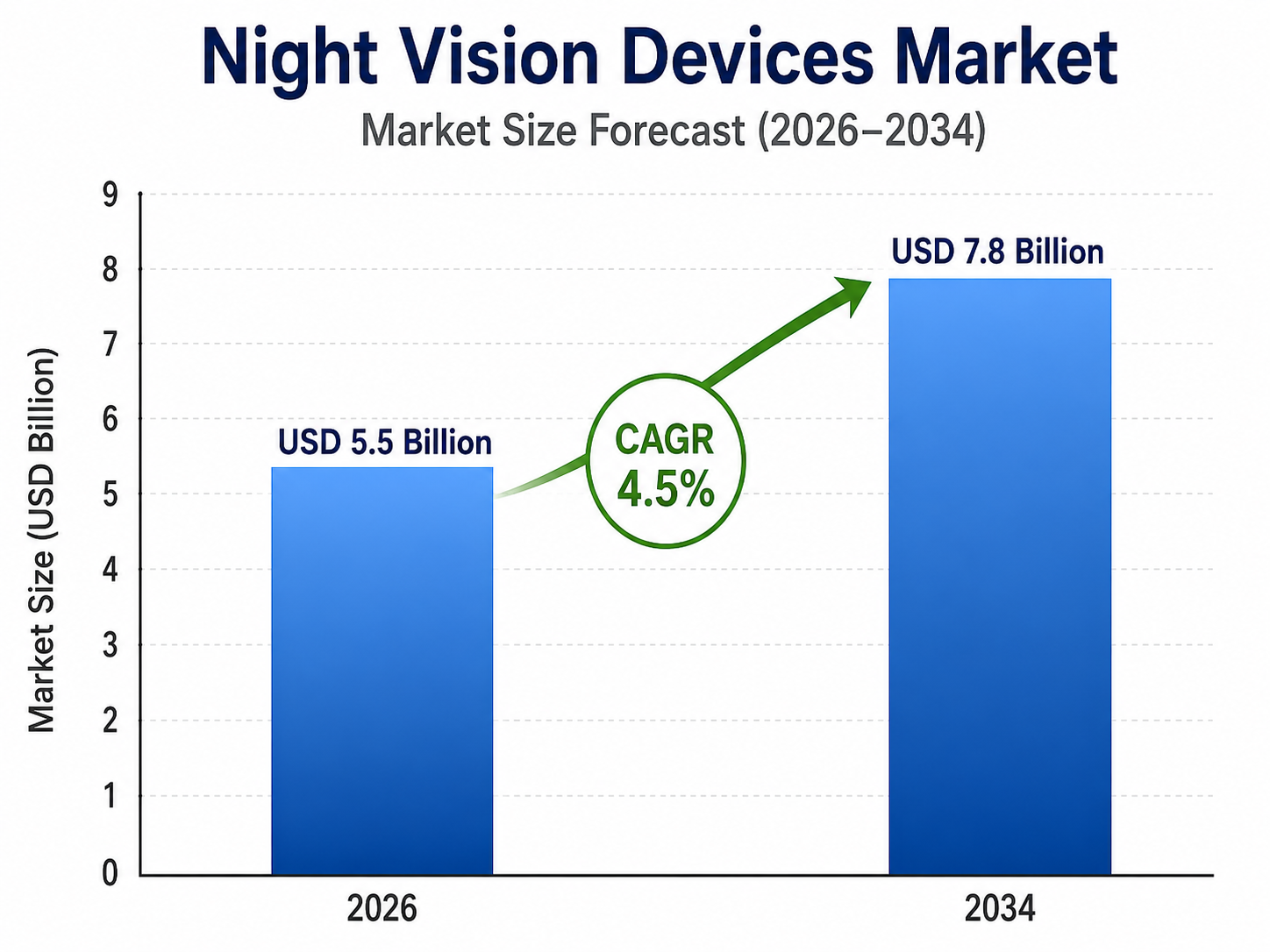
The Night Vision Devices Market is estimated to be valued at $ 5.5 billion in 2026 and is projected to reach $ 7.8 billion by 2034, expanding at a CAGR of 4.5% from 2026 to 2034.
Night vision devices use image intensification, infrared illumination, thermal imaging, digital sensors, or fused technologies to improve visibility in low-light and dark environments. Major products include goggles, binoculars, monoculars, weapon sights, cameras, and vehicle-mounted systems. Market growth is supported by defense modernization, border surveillance, law enforcement requirements, critical infrastructure protection, and increasing commercial use in wildlife observation, navigation, search and rescue, and security. Manufacturers are focusing on higher image resolution, lighter designs, longer battery life, improved detection range, and integration with digital networks.
1. What is the latest trend in the Night Vision Devices Market?
The latest trend is the integration of thermal imaging, image intensification, digital sensors, and AI-based image enhancement into fused night vision systems.
Manufacturers are developing color-capable displays, wider fields of view, augmented-reality overlays, and real-time target recognition.
Compact, helmet-mounted, and network-connected devices are also gaining importance.
These innovations improve situational awareness while reducing equipment weight and operator fatigue.
2. What are the key challenges in the Night Vision Devices Market?
Key challenges include high procurement costs, export restrictions, complex manufacturing, limited battery life, and strict military qualification requirements.
Advanced devices must perform reliably under fog, dust, smoke, rain, vibration, and extreme temperature conditions.
Weight, image distortion, restricted field of view, and user discomfort can affect long-duration operations.
Manufacturers must also balance imaging performance with affordability and production scalability.
3. What is the major driving factor for the Night Vision Devices Market?
The major driving factor is rising demand for enhanced nighttime surveillance, navigation, targeting, and operational safety.
Defense and law enforcement agencies are upgrading legacy equipment to improve effectiveness during low-light missions.
Border security, geopolitical tensions, and protection of critical infrastructure are strengthening procurement activity.
Commercial demand from security, hunting, wildlife monitoring, and rescue operations provides additional market support.
4. What is the major segment in the Night Vision Devices Market and why?
Night vision goggles represent a major product segment because they provide hands-free visibility for soldiers, pilots, special forces, and law enforcement personnel.
Goggles support navigation, surveillance, vehicle operation, target identification, and tactical movement in low-light conditions.
Binocular configurations provide improved depth perception and a more natural viewing experience.
Modernization programs are increasing demand for lighter, fused, and digitally enhanced goggles.
5. Which application or end-user is driving more demand?
Defense and military applications are driving the largest demand for night vision devices across land, aviation, naval, and unmanned platforms.
Law enforcement, border patrol, and homeland security agencies also use these systems for surveillance and tactical response.
Commercial security, wildlife research, search and rescue, and outdoor recreation contribute to broader market adoption.
Demand is particularly strong where uninterrupted nighttime visibility is mission-critical.
6. Which region offers the highest growth potential and why?
Asia Pacific offers strong growth potential due to defense modernization, border-security requirements, and rising procurement of surveillance equipment.
China, India, Japan, South Korea, and Australia are investing in advanced soldier systems, vehicles, sensors, and unmanned platforms.
North America remains a leading established market because of substantial military procurement and a strong technology supplier base.
Europe also generates demand through armed-forces modernization and security initiatives.
7. What strategies are major companies adopting in the market?
Major companies are focusing on sensor fusion, AI-enabled imaging, lighter equipment, improved battery performance, and higher-resolution displays.
They are investing in integrated soldier systems, weapon-mounted optics, vehicle solutions, and networked battlefield capabilities.
Long-term defense contracts, government partnerships, and product qualification programs are central to market positioning.
Companies are also expanding commercial portfolios and international distribution networks.
8. What are the leading companies in the Night Vision Devices Market?
Leading companies include L3Harris Technologies, Elbit Systems, Teledyne FLIR, Thales, BAE Systems, Photonis, ATN Corporation, Meprolight, Newcon Optik, Thermoteknix, and Night Vision Devices Inc.
These companies compete through image quality, detection range, durability, weight, system integration, and military certifications.
Large defense suppliers benefit from long-term government relationships and integrated electro-optical portfolios.
Specialized manufacturers compete through innovative optics, digital features, and application-specific products.
9. Why are night vision devices strategically important for defense and security organizations?
Night vision devices extend operational capability beyond daylight hours and improve mobility, surveillance, targeting, and personnel safety.
They help forces identify threats, navigate difficult terrain, and coordinate missions without visible illumination.
For border and infrastructure operators, these systems support continuous monitoring and faster incident response.
Night vision capability is therefore a critical element of modern situational awareness and force protection.
10. What is the future outlook for the Night Vision Devices Market?
The market outlook remains positive as defense agencies replace legacy systems and adopt connected, multi-sensor imaging platforms.
Future devices will increasingly combine thermal, low-light, digital, AI, mapping, and augmented-reality capabilities.
Miniaturization and cost reduction are expected to expand adoption across drones, vehicles, commercial security, and outdoor applications.
Companies offering lightweight, intelligent, interoperable, and affordable systems are likely to gain market share.
LinkedIn | Twitter
