Oncolytic Virus Therapy Market Outlook 2026–2034: HSV-Based Therapy Demand, Immuno-Oncology Innovation, Growth Drivers, Leading Companies, and Future Opportunities
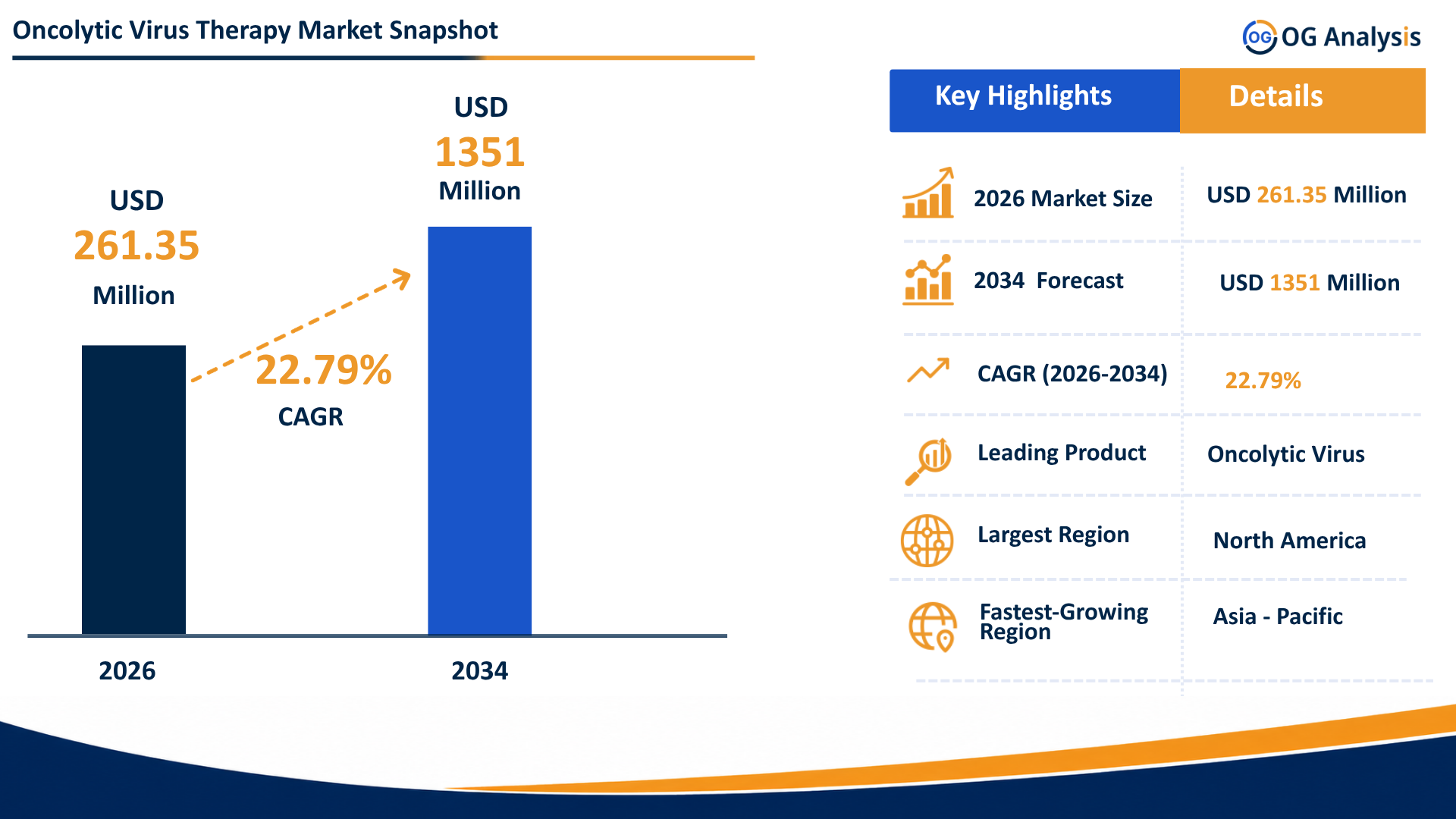
The Oncolytic Virus Therapy Market is estimated to be valued at $ 261.35 Million in 2026 and is projected to reach $1351 million by 2034, expanding at a CAGR of 22.79% from 2026 to 2034.
Oncolytic virus therapy is an emerging cancer treatment approach that uses naturally occurring or genetically engineered viruses to selectively infect, replicate within, and destroy cancer cells while also stimulating anti-tumor immune responses. These therapies are being developed across herpes simplex virus, adenovirus, vaccinia virus, reovirus, Newcastle disease virus, vesicular stomatitis virus, and other viral platforms. Market growth is supported by rising cancer prevalence, increasing immuno-oncology research, growing interest in combination therapies, and the clinical need for treatments that can activate localized and systemic immune responses. Oncolytic viruses are being studied in melanoma, glioblastoma, bladder cancer, head and neck cancer, colorectal cancer, lung cancer, breast cancer, pancreatic cancer, ovarian cancer, and other solid tumors. Adoption is shaped by regulatory approvals, intratumoral delivery feasibility, clinical-trial success, manufacturing complexity, biosafety requirements, and evidence of durable response.
Get the Complete Analysis :
https://www.oganalysis.com/industry-reports/oncolytic-virus-therapy-market
Get Your Free Sample Report for In-Depth Market Insights :
https://www.oganalysis.com/industry-reports/oncolytic-virus-therapy-market/free-sample
1. What is the latest trend in the Oncolytic Virus Therapy Market?
The latest trend is the development of next-generation oncolytic viruses designed to combine direct tumor cell killing with immune activation.
Companies are engineering viruses to express immune-stimulating molecules, improve tumor selectivity, and work better with checkpoint inhibitors.
Combination trials with PD-1/PD-L1 inhibitors, CTLA-4 inhibitors, chemotherapy, radiation, and cell therapies are gaining attention.
HSV-based, adenovirus-based, vaccinia-based, and reovirus-based platforms remain key areas of clinical development.
2. What are the key challenges in the Oncolytic Virus Therapy Market?
Key challenges include complex manufacturing, cold-chain requirements, biosafety controls, immune neutralization, delivery limitations, and variable tumor response.
Intratumoral administration can be difficult for deep or inaccessible tumors, while systemic delivery faces challenges from antiviral immunity and rapid clearance.
Clinical trials must demonstrate clear efficacy beyond existing immunotherapies, targeted therapies, and chemotherapy standards.
Regulatory review, patient selection, dosing schedules, viral shedding monitoring, and hospital handling protocols also add complexity.
3. What is the major driving factor for the Oncolytic Virus Therapy Market?
The major driving factor is the need for more effective immunotherapies for solid tumors that respond poorly to existing treatments.
Oncolytic viruses can destroy infected cancer cells and release tumor antigens that may help stimulate broader immune responses.
Their potential to convert “cold” tumors into more immune-responsive tumors is attracting strong research and clinical interest.
Rising oncology R&D investment, biomarker-driven development, and combination-treatment strategies are further supporting market growth.
4. What is the major segment in the Oncolytic Virus Therapy Market and why?
HSV-based oncolytic virus therapy is a major segment because it has the strongest commercial precedent through talimogene laherparepvec.
HSV platforms are attractive because they can be genetically engineered, delivered locally, and modified to express immune-stimulating payloads.
Adenovirus-based therapies are also important due to established vector engineering experience and regional commercialization history.
Vaccinia and reovirus platforms are gaining attention because of their potential use in systemic or combination immunotherapy settings.
5. Which application or end-user is driving more demand?
Melanoma remains a leading application because approved oncolytic virus therapy has established clinical use in selected melanoma patients.
Glioblastoma, bladder cancer, head and neck cancer, lung cancer, breast cancer, colorectal cancer, and pancreatic cancer are important pipeline areas.
Hospitals, cancer centers, specialty oncology clinics, academic research institutes, and biopharmaceutical companies are the main demand centers.
Demand is strongest in settings where local tumor injection, immunotherapy combinations, and clinical-trial access are feasible.
6. Which region offers the highest growth potential and why?
North America remains a leading region due to advanced oncology infrastructure, strong immunotherapy adoption, FDA-regulated biologics development, and a large base of clinical-stage companies.
The United States has strong activity in oncolytic virus research, cancer-center trials, and combination immunotherapy development.
Asia Pacific offers strong growth potential due to approvals and development activity in markets such as China and Japan, along with rising oncology investment.
Europe is supported by advanced cancer research networks, clinical trials, and adoption of innovative oncology therapies.
7. What strategies are major companies adopting in the market?
Major companies are focusing on engineered viral payloads, checkpoint inhibitor combinations, improved systemic delivery, intratumoral delivery optimization, and tumor-specific platform design.
They are developing viruses that express cytokines, immune co-stimulators, tumor antigens, or other immune-modulating genes.
Partnerships with cancer centers, immunotherapy companies, contract manufacturers, and clinical research organizations are becoming important.
Companies are also investing in scalable viral manufacturing, regulatory documentation, companion biomarker strategies, and expansion into multiple solid tumor indications.
8. What are the leading companies in the Oncolytic Virus Therapy Market?
Leading companies include Amgen, Replimune Group, CG Oncology, Candel Therapeutics, Genelux Corporation, Oncolytics Biotech, Calidi Biotherapeutics, ImmVira, Virogin Biotech, Transgene, TILT Biotherapeutics, SillaJen, Oncolys BioPharma, Daiichi Sankyo, Shanghai Sunway Biotech, and Takara Bio.
These companies compete through approved products, viral platform capability, clinical pipeline strength, tumor targeting, delivery route, immune payload design, manufacturing expertise, and regulatory progress.
Research and Markets identifies Amgen, Replimune, Genelux, Oncolys BioPharma, Oncolytics Biotech, and Candel Therapeutics among companies active in the oncolytic virus therapy market.
The Business Research Company also lists companies such as Amgen, Replimune, Genelux, Oncolytics Biotech, TILT Biotherapeutics, Transgene, Shanghai Sunway Biotech, Candel Therapeutics, CG Oncology, and others in this market.
9. Why is oncolytic virus therapy strategically important for oncology?
Oncolytic virus therapy is strategically important because it offers a differentiated immuno-oncology mechanism that combines tumor cell lysis with immune activation.
It may help address solid tumors where checkpoint inhibitors alone have limited response rates.
For oncology companies, oncolytic viruses create opportunities in combination regimens, localized therapy, immune payload delivery, and tumor microenvironment modulation.
For healthcare systems, successful therapies could expand treatment options for difficult-to-treat cancers and selected recurrent or refractory tumors.
10. What is the future outlook for the Oncolytic Virus Therapy Market?
The market outlook remains positive as immuno-oncology research expands and more engineered viral candidates progress through clinical trials.
Future growth will be supported by HSV-based therapies, adenovirus platforms, vaccinia-based vectors, reovirus programs, checkpoint inhibitor combinations, and improved delivery technologies.
Commercial adoption will depend on strong survival or response data, safety profile, manufacturing scalability, and reimbursement support.
Companies offering clinically differentiated, immune-activating, scalable, and combination-ready oncolytic virus therapies are expected to gain market share.
Browse Related Reports
https://www.oganalysis.com/industry-reports/urothelial-carcinoma-treatment-market
https://www.oganalysis.com/industry-reports/chemotherapy-market
https://www.oganalysis.com/industry-reports/cancertumor-profiling-market
https://www.oganalysis.com/industry-reports/dendritic-cell-cancer-vaccine-market
https://www.oganalysis.com/industry-reports/cancer-gene-therapy-marke
