Paper Pulp Moulding Machinery Market Outlook 2026–2034: Sustainable Packaging Demand, Automation Trends, Leading Companies, and Growth Opportunities
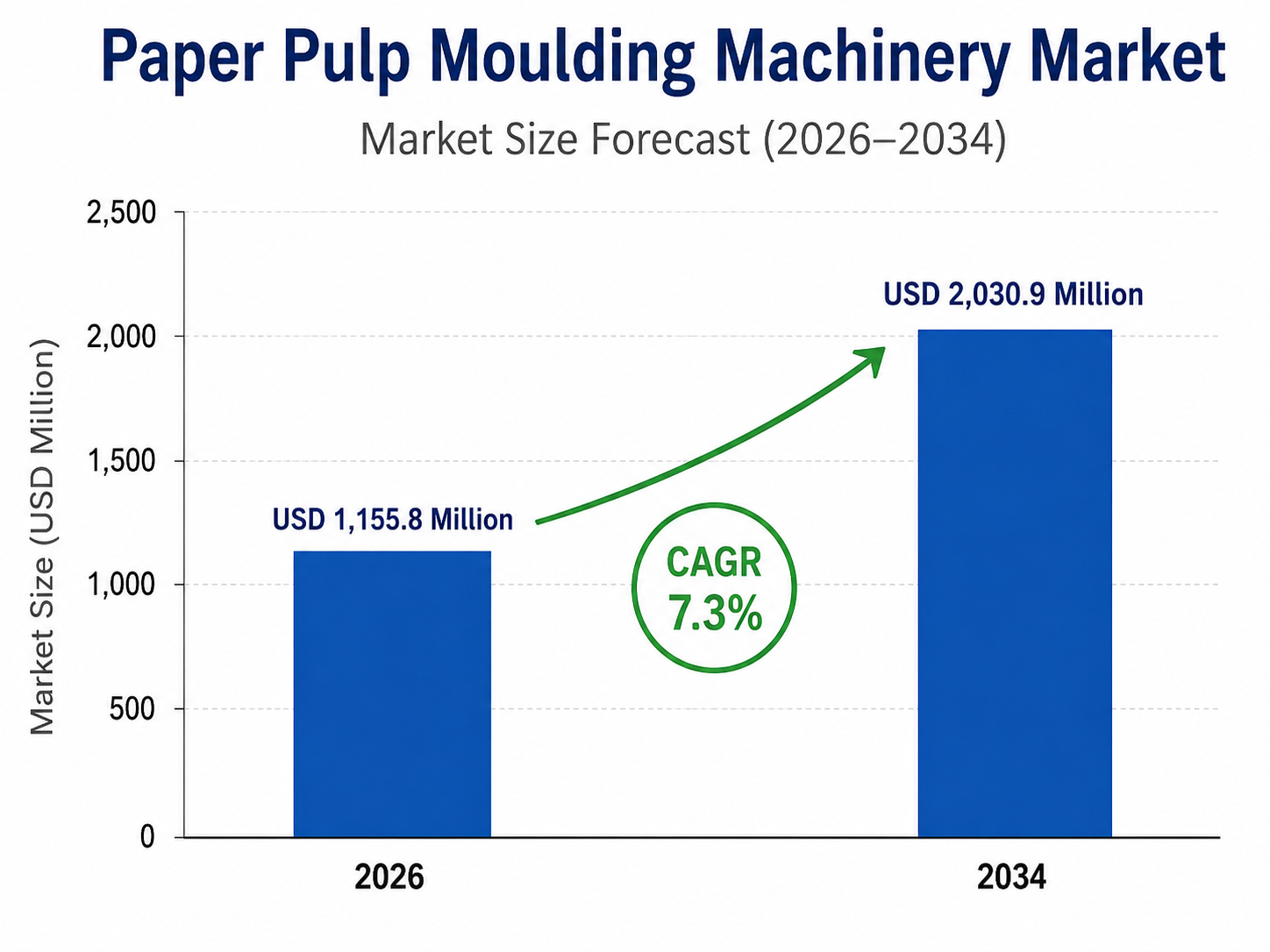
The Paper Pulp Moulding Machinery Market is estimated to be valued at $ 1155.8 million in 2026 and is projected to reach $ 2030.9 million by 2034, expanding at a CAGR of 7.3% from 2026 to 2034.
Paper pulp moulding machinery converts recycled paper, virgin pulp, bagasse, bamboo, wheat straw, and other natural fibers into molded packaging products through pulping, forming, pressing, drying, trimming, and finishing processes. The equipment is used to manufacture egg trays, fruit trays, cup carriers, food containers, tableware, medical trays, and protective packaging for electronics and industrial products. Market growth is supported by restrictions on single-use plastics, expanding sustainable packaging demand, circular-economy initiatives, and growing investment in automated manufacturing. Machinery suppliers are focusing on higher production speeds, energy-efficient drying, hot-press forming, robotic handling, digital controls, and turnkey production lines.
1. What is the latest trend in the Paper Pulp Moulding Machinery Market?
The latest trend is the adoption of fully automated thermoformed-fiber lines capable of producing smooth, detailed, and premium-quality packaging.
Manufacturers are integrating robotic handling, hot pressing, automatic trimming, vision inspection, and digital process controls.
Energy-efficient drying and closed-loop water systems are also gaining importance.
These developments allow molded fiber packaging to replace more complex plastic packaging formats.
2. What are the key challenges in the Paper Pulp Moulding Machinery Market?
Key challenges include high initial investment, significant drying-energy requirements, mold costs, and variations in raw-fiber quality.
Achieving consistent thickness, surface finish, strength, and dimensional accuracy requires precise pulp preparation and process control.
Production lines also need reliable water treatment, vacuum systems, drying equipment, and skilled maintenance support.
Smaller manufacturers may struggle to achieve sufficient production volumes for rapid investment recovery.
3. What is the major driving factor for the market?
The major driving factor is rising demand for recyclable, biodegradable, and plastic-free packaging across consumer and industrial applications.
Governments, retailers, food companies, and electronics brands are seeking lower-impact alternatives to expanded foam and single-use plastics.
Pulp molding enables manufacturers to use recycled paper and agricultural fibers in circular packaging systems.
Corporate sustainability targets and packaging regulations are accelerating machinery investment.
4. What is the major segment in the market and why?
Fully automatic pulp moulding machinery represents a major segment because it supports high output, consistent product quality, and reduced labor dependence.
These systems integrate forming, transfer, drying, hot pressing, trimming, counting, and stacking into continuous production.
They are preferred by large packaging manufacturers serving food, agriculture, electronics, and consumer-goods customers.
Automation also improves production traceability, safety, and material utilization.
5. Which application or end-user is driving more demand?
Food and beverage packaging is driving strong demand through egg cartons, drink carriers, food trays, plates, bowls, and takeaway containers.
Agricultural packaging, including fruit trays, seedling trays, and protective produce inserts, also represents an important application.
Electronics and appliance manufacturers increasingly use molded fiber for protective inserts and transit packaging.
Healthcare, cosmetics, and industrial products are creating additional demand for customized fiber packaging.
6. Which region offers the highest growth potential and why?
Asia Pacific offers strong growth potential due to its large packaging industry, manufacturing base, agricultural-fiber availability, and rising plastic-reduction initiatives.
China, India, Southeast Asia, and Japan are investing in food-service packaging, electronics protection, and export-oriented molded fiber production.
The region also has an expanding base of machinery manufacturers offering different capacity and automation levels.
Europe and North America remain attractive for premium thermoformed fiber and sustainable packaging conversion.
7. What strategies are major companies adopting in the market?
Major companies are focusing on turnkey plants, higher-capacity rotary machines, thermoforming technology, and energy-efficient drying systems.
They are developing modular lines that can process recycled paper, bagasse, bamboo, and other alternative fibers.
Remote diagnostics, PLC controls, automated mold changes, and predictive maintenance are becoming key differentiators.
Suppliers are also expanding installation, training, spare-parts, and lifecycle service capabilities.
8. What are the leading companies in the Paper Pulp Moulding Machinery Market?
Prominent companies include Huhtamaki Molded Fiber Technology, Brødrene Hartmann, EAMC, Inmaco, BeSure Technology, Parason, Beston Group, HGHY, and other regional machinery manufacturers.
These companies compete through output capacity, automation, product quality, energy consumption, mold expertise, and turnkey project execution.
European suppliers are strongly positioned in advanced and premium molded-fiber systems.
Asian manufacturers compete through broad equipment ranges, customization, scalability, and competitive pricing.
9. Why is paper pulp moulding machinery strategically important for packaging manufacturers?
Paper pulp moulding machinery enables packaging producers to enter fast-growing sustainable packaging categories and reduce dependence on petroleum-based materials.
Flexible molds allow manufacturers to serve food, agriculture, electronics, medical, and industrial customers using related production infrastructure.
Automation improves throughput, repeatability, hygiene, and product consistency while lowering manual handling.
For investors, the machinery provides access to a circular packaging market supported by regulatory and brand-level commitments.
10. What is the future outlook for the market?
The market outlook remains positive as companies increase adoption of molded fiber for food service, electronics, healthcare, and consumer packaging.
Future machinery will increasingly combine high-speed thermoforming, robotics, digital twins, automated quality inspection, and low-energy drying.
Agricultural residues and alternative fibers are expected to expand the available raw-material base.
Companies offering flexible, energy-efficient, turnkey, and globally supported systems are likely to gain market share.
Browse Related Reports
https://www.oganalysis.com/industry-reports/tractor-transmission-system-market
https://www.oganalysis.com/industry-reports/nonwoven-abrasives-market
https://www.oganalysis.com/industry-reports/printed-signage-market
https://www.oganalysis.com/industry-reports/industrial-fasteners-market
https://www.oganalysis.com/industry-reports/industrial-machinery-market-
