Robotic Vision Market Outlook 2026–2034: AI-Powered 3D Vision, Vision-Guided Robotics, Growth Drivers, Leading Companies, and Future Opportunities
The Robotic Vision Market is estimated to be valued at $ 3.66 billion in 2026 and is projected to reach $ 7.52 billion by 2034, expanding at a CAGR of 9.38% from 2026 to 2034.
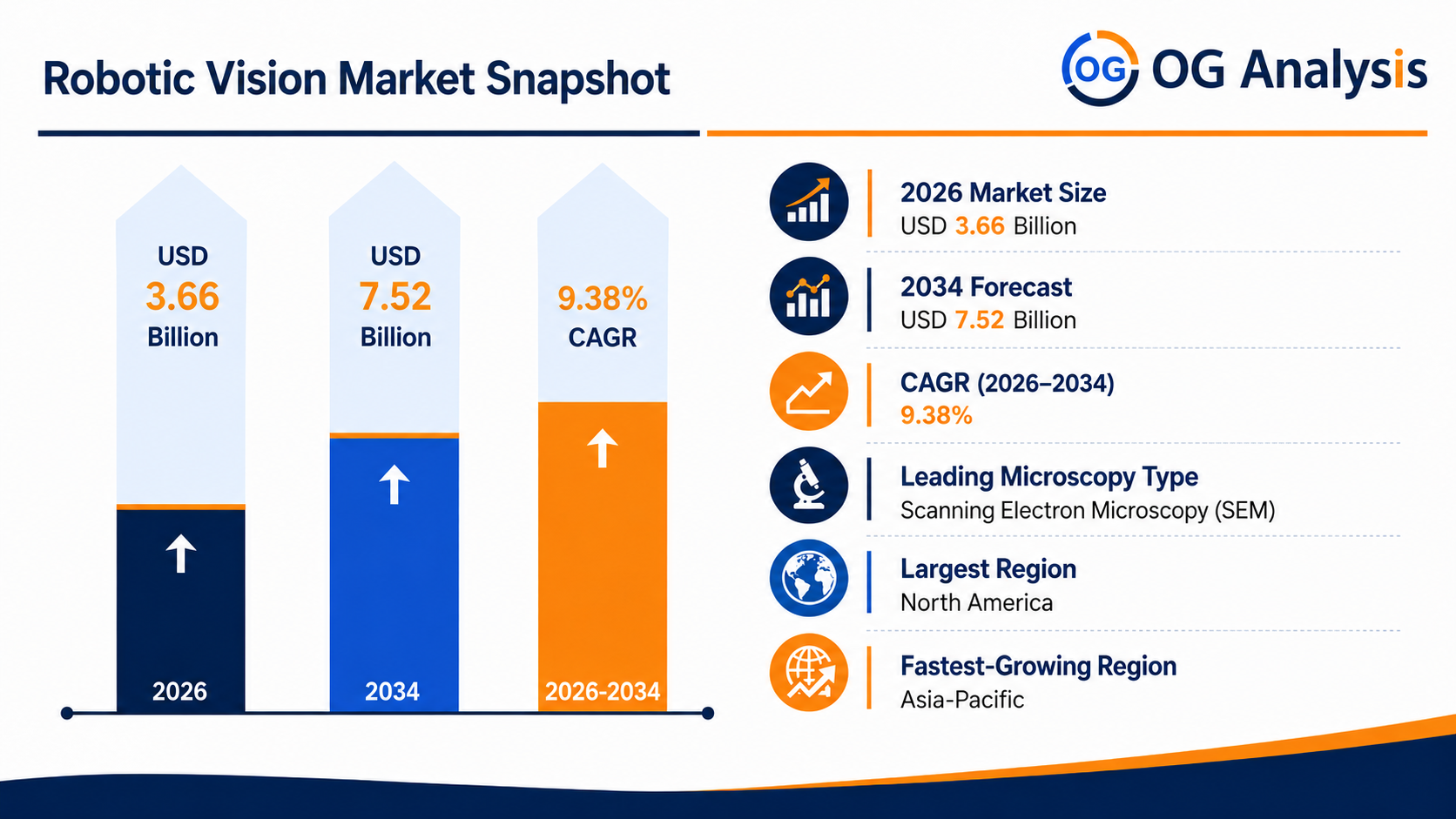
Robotic vision refers to camera, sensor, lighting, software, and AI-based perception systems that enable robots to detect, identify, locate, measure, inspect, and interact with objects in real-world environments. These systems are widely used in industrial robots, collaborative robots, autonomous mobile robots, warehouse robots, service robots, and inspection robots. Market growth is supported by rising factory automation, demand for flexible production, labor shortages, quality-control requirements, and adoption of AI-enabled robotics. Robotic vision allows robots to perform complex tasks such as pick-and-place, bin picking, assembly guidance, welding alignment, defect inspection, palletizing, packaging, sorting, navigation, and human-robot collaboration. Demand is especially strong across automotive, electronics, semiconductors, logistics, food and beverage, pharmaceuticals, metals, plastics, and general manufacturing.
Get Your Free Sample Report for In-Depth Market Insights :
https://www.oganalysis.com/industry-reports/robotic-vision-market
1. What is the latest trend in the Robotic Vision Market?
The latest trend is the adoption of AI-powered 3D vision systems that help robots understand object shape, depth, position, and orientation more accurately.
Deep learning is improving defect detection, object classification, random bin picking, and robotic guidance in complex production environments.
Vision-guided robots are increasingly being used in flexible manufacturing, warehouses, and collaborative workcells.
Edge vision processing, smart cameras, and integrated robot-vision software are also becoming important market trends.
2. What are the key challenges in the Robotic Vision Market?
Key challenges include high system integration cost, calibration complexity, lighting variation, occlusion, reflective surfaces, and limited performance in unstructured environments.
Robotic vision systems must be carefully matched with cameras, lenses, lighting, sensors, robot controllers, and software algorithms.
Small and medium manufacturers may face adoption barriers due to technical skills and return-on-investment concerns.
Data availability, model training, cybersecurity, and interoperability with existing automation systems are also important challenges.
3. What is the major driving factor for the Robotic Vision Market?
The major driving factor is the increasing need for flexible, accurate, and intelligent automation across manufacturing and logistics.
Traditional fixed automation struggles when product sizes, shapes, or positions change frequently.
Robotic vision enables robots to adapt to variation, identify parts, guide motion, inspect quality, and reduce dependence on manual handling.
This makes vision-enabled robotics highly valuable for productivity improvement, quality assurance, and labor optimization.
4. What is the major segment in the Robotic Vision Market and why?
3D robotic vision is becoming a major growth segment because it provides depth, height, shape, and orientation data needed for advanced automation.
It is especially useful in bin picking, palletizing, depalletizing, welding, assembly, inspection, and logistics applications.
2D vision remains widely used for barcode reading, alignment, presence detection, measurement, and simple pick-and-place tasks.
AI software and smart vision sensors are also gaining importance as robots require faster and more reliable decision-making.
5. Which application or end-user is driving more demand?
Automotive, electronics, logistics, food and beverage, pharmaceuticals, and semiconductor manufacturing are driving strong demand.
Automotive manufacturers use robotic vision for assembly, welding, painting, inspection, and component handling.
Electronics and semiconductor industries require precise vision systems for small-part alignment, inspection, and quality control.
Logistics and warehouse operators use robotic vision for sorting, picking, palletizing, navigation, and package recognition.
6. Which region offers the highest growth potential and why?
Asia Pacific offers the highest growth potential due to strong electronics manufacturing, automotive production, industrial robot adoption, and warehouse automation.
China, Japan, South Korea, Taiwan, and India are important markets due to large manufacturing bases and rising automation investment.
North America remains important due to advanced robotics adoption, reshoring, labor shortages, and logistics automation.
Europe is supported by Industry 4.0 initiatives, automotive automation, precision manufacturing, and strong machine vision suppliers.
7. What strategies are major companies adopting in the market?
Major companies are focusing on AI vision software, 3D cameras, smart sensors, robot-controller integration, and application-specific robotic guidance solutions.
They are improving accuracy, processing speed, ease of calibration, low-light performance, and compatibility with industrial robots and cobots.
Partnerships with robot manufacturers, system integrators, warehouse automation providers, and industrial software companies are becoming more important.
Companies are also expanding solutions for bin picking, inspection, autonomous navigation, depalletizing, and collaborative robotics.
8. What are the leading companies in the Robotic Vision Market?
Leading companies include Cognex, KEYENCE, Teledyne Technologies, Omron, Basler, SICK, Datalogic, FANUC, ABB, Yaskawa, KUKA, Mitsubishi Electric, Zivid, Photoneo, Zebra Technologies, and ISRA Vision.
These companies compete through camera quality, 2D/3D sensing capability, AI software, robot compatibility, inspection accuracy, integration support, and global service networks.
Vision specialists focus on cameras, sensors, lighting, software, and inspection tools, while robotics companies integrate vision into robot workcells.
Vendors with complete hardware, software, and robot-guidance ecosystems are better positioned for large-scale industrial adoption.
9. Why is robotic vision strategically important for automation industries?
Robotic vision is strategically important because it gives robots the ability to “see,” interpret, and respond to changing environments.
It improves flexibility, reduces the need for fixed fixtures, enhances quality inspection, and supports higher automation productivity.
For manufacturers, robotic vision helps reduce labor dependence, improve consistency, and enable mass customization.
For logistics and service robotics, vision is essential for navigation, object recognition, picking, sorting, and safe human-robot interaction.
10. What is the future outlook for the Robotic Vision Market?
The market outlook remains positive as industries move toward intelligent, flexible, and AI-enabled automation.
Future growth will be supported by 3D vision, deep learning, edge AI, smart cameras, autonomous robots, cobots, and integrated robot-perception software.
Demand will continue to expand in manufacturing, warehouses, electronics, automotive, healthcare, agriculture, and inspection applications.
Companies offering accurate vision systems, easy integration, scalable AI tools, and strong application support are expected to gain market share
Browse Related Reports
https://www.oganalysis.com/industry-reports/speed-sensor-market
https://www.oganalysis.com/industry-reports/precision-gearbox-machinery-market
https://www.oganalysis.com/industry-reports/foreign-object-detection-system-market
https://www.oganalysis.com/industry-reports/aerospace-robotics-market
https://www.oganalysis.com/industry-reports/robotics-market
Stay Connected With Us
