Satellite Technology Market Outlook 2026–2034: LEO Constellation Expansion, Direct-to-Device Connectivity, Leading Companies, and Future Opportunities
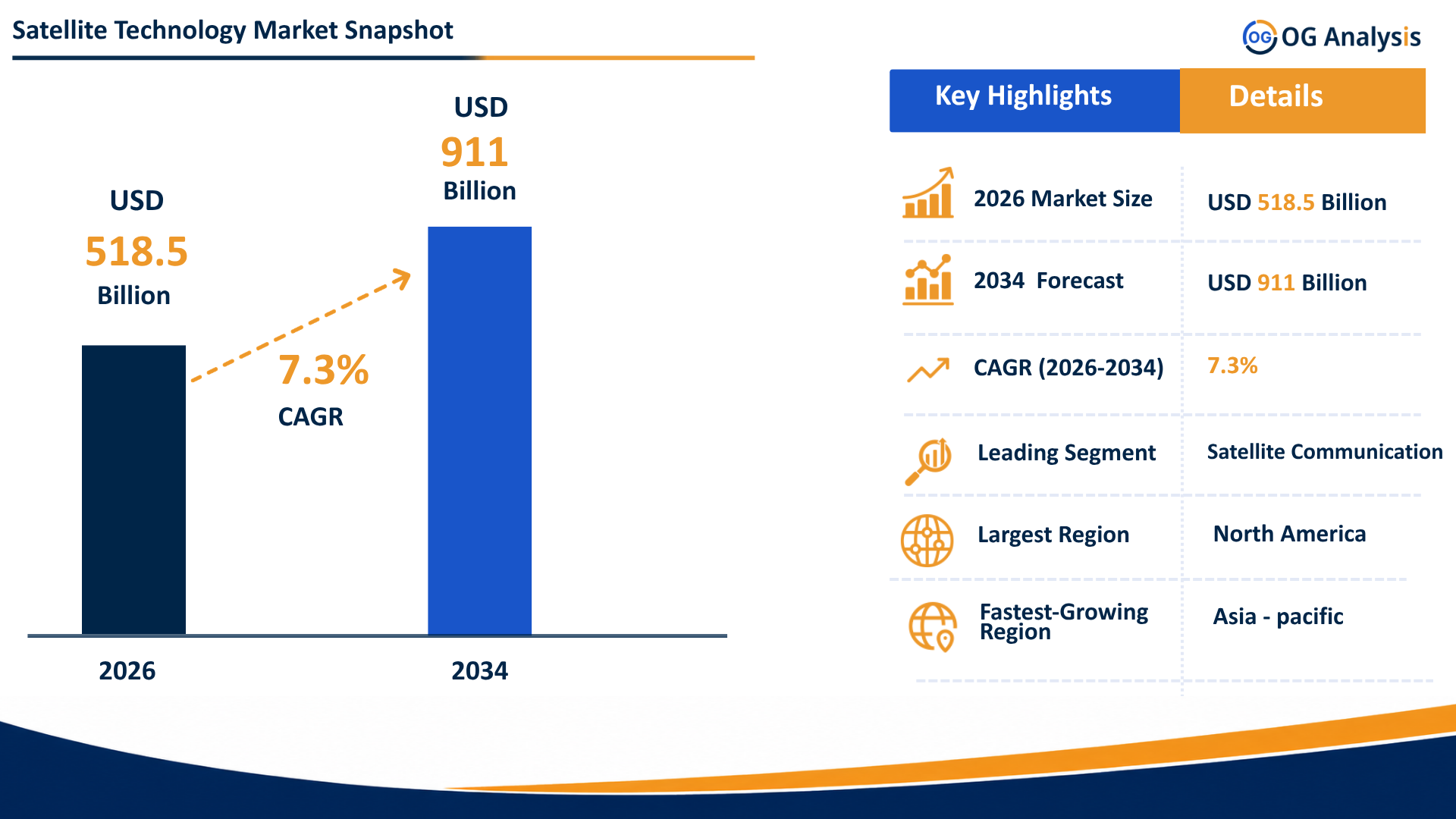
The Satellite Technology Market Size is valued at $ 518.5 billion in 2026. Worldwide sales of Satellite Technology Market are expected to grow at a significant CAGR of 7.3%, reaching $ 911 billion by the end of the forecast period in 2034.
Satellite technology covers satellite manufacturing, satellite payloads, launch systems, ground equipment, satellite communication, earth observation, navigation, remote sensing, defense surveillance, weather monitoring, broadband connectivity, IoT connectivity, and in-orbit services. Market growth is supported by rising demand for global broadband, direct-to-device connectivity, small satellite constellations, defense and intelligence applications, climate monitoring, commercial space services, and lower launch costs.
Get the Complete Analysis :
https://www.oganalysis.com/industry-reports/satellite-technology-market
Get Your Free Sample Report for In-Depth Market Insights :
https://www.oganalysis.com/industry-reports/satellite-technology-market/free-sample
1. What is the latest trend in the Satellite Technology Market?
The latest trend is the rapid deployment of low earth orbit satellite constellations for broadband, direct-to-device connectivity, earth observation, and IoT services.
Satellite operators are also investing in software-defined payloads, onboard AI processing, optical communications, inter-satellite links, and reusable launch systems.
NASA notes that small satellite technologies are advancing through improved materials, power systems, avionics, communications, autonomy, edge processing, and machine learning.
Amazon Leo, formerly Project Kuiper, began full-scale satellite constellation deployment in 2025, highlighting rising competition in LEO broadband networks.
2. What are the key challenges in the Satellite Technology Market?
Key challenges include high capital investment, launch delays, spectrum allocation, orbital congestion, space debris risk, cybersecurity threats, and regulatory approvals.
Satellite operators must manage manufacturing scale-up, ground station deployment, service reliability, latency, constellation replenishment, and orbital traffic coordination.
LEO networks require continuous satellite replacement, strong launch access, and large upfront investment before full commercial monetization.
Governments and operators are also facing increasing pressure to improve space sustainability, debris mitigation, and secure satellite communications.
3. What is the major driving factor for the Satellite Technology Market?
The major driving factor is rising demand for reliable global connectivity, broadband access, defense communications, earth observation, and real-time data services.
Satellites are critical for connecting remote regions, ships, aircraft, energy assets, defense users, disaster zones, and underserved rural communities.
Commercial operators are expanding LEO and MEO networks to reduce latency and improve broadband performance.
NASA’s commercial space communications initiative also reflects the growing shift toward using commercial satellite relay and communication services for space missions.
4. What is the major segment in the Satellite Technology Market and why?
Satellite communication is a major segment because it supports broadband internet, television broadcasting, mobile backhaul, maritime connectivity, aviation connectivity, defense networks, and emergency communications.
The segment benefits from rising demand for LEO broadband constellations, direct-to-device services, enterprise connectivity, and government communication networks.
Ground equipment is also a large revenue contributor because terminals, antennas, GNSS devices, gateways, and network equipment are required to access satellite services.
SIA reported that the satellite ground segment generated more than USD 155.3 billion in revenue in 2024, supported by GNSS and network equipment demand.
5. Which application or end-user is driving more demand?
Telecommunications, defense, government agencies, aviation, maritime, agriculture, energy, mining, logistics, media broadcasting, and environmental monitoring are driving demand.
Telecom operators are using satellites for backhaul, rural broadband, 5G non-terrestrial networks, and direct-to-device connectivity.
Defense and intelligence agencies are increasing use of satellites for surveillance, secure communication, navigation, missile warning, and battlefield awareness.
Earth observation demand is growing across climate monitoring, disaster management, agriculture analytics, urban planning, and infrastructure tracking.
6. Which region offers the highest growth potential and why?
North America remains the largest region due to strong satellite manufacturing, launch capability, defense spending, commercial space investment, and the presence of leading space technology companies.
The United States has a strong ecosystem covering satellite operators, launch providers, payload manufacturers, ground systems, defense contractors, and space-data companies.
Asia Pacific offers the highest growth potential due to rising space programs, expanding telecom demand, national satellite constellations, earth observation needs, and broadband coverage initiatives.
India, China, Japan, South Korea, Australia, and Southeast Asia are investing in satellite manufacturing, launch services, remote sensing, navigation, and space-based connectivity.
7. What strategies are major companies adopting in the market?
Major companies are focusing on LEO constellation deployment, reusable launch services, software-defined satellites, vertical integration, and strategic partnerships with telecom operators.
Satellite operators are expanding broadband capacity, multi-orbit networks, enterprise connectivity, government contracts, and direct-to-device services.
Manufacturers are investing in modular satellite platforms, high-throughput payloads, electric propulsion, onboard processing, and faster production cycles.
Companies are also forming partnerships with cloud providers, defense agencies, mobile network operators, and launch providers to strengthen commercial reach.
8. What are the leading companies in the Satellite Technology Market?
Leading companies include SpaceX, Boeing, Airbus Defence and Space, Lockheed Martin, Northrop Grumman, RTX, Thales Alenia Space, L3Harris Technologies, Viasat, SES, Eutelsat, Telesat, Maxar Technologies, Planet Labs, Iridium Communications, EchoStar, Amazon Leo, OHB SE, Mitsubishi Electric, and China Aerospace Science and Technology Corporation.
These companies compete through satellite manufacturing capability, launch access, constellation scale, payload technology, ground infrastructure, defense contracts, and service coverage.
SpaceX has expanded Starlink and direct-to-cell satellite capabilities, while Amazon Leo is deploying a competing LEO broadband network.
Traditional aerospace and defense companies remain important in large satellites, government payloads, secure communications, navigation, and earth observation missions.
9. Why is satellite technology strategically important?
Satellite technology is strategically important because it supports national security, global communications, navigation, weather forecasting, disaster response, and digital inclusion.
It enables connectivity in remote areas where terrestrial networks are difficult or uneconomic to deploy.
It also provides independent earth observation and intelligence capabilities for governments, enterprises, and environmental agencies.
As economies become more data-driven, satellite infrastructure is becoming a critical layer of communications, mobility, defense, climate intelligence, and emergency resilience.
10. What is the future outlook for the Satellite Technology Market?
The market outlook remains strong as satellite networks become more integrated with telecom, defense, cloud, mobility, and earth observation ecosystems.
Future growth will be supported by LEO and MEO constellations, direct-to-device connectivity, AI-enabled earth observation, software-defined satellites, and in-orbit servicing.
Satellite operators will focus on lowering latency, improving capacity, strengthening cybersecurity, and expanding affordable global coverage.
Companies with scalable satellite production, reusable launch access, advanced payloads, regulatory strength, and strong service partnerships are expected to gain market share.
Browse Related Reports
https://www.oganalysis.com/industry-reports/space-exploration-technologies-market
https://www.oganalysis.com/industry-reports/satellite-based-augmentation-systems-market
https://www.oganalysis.com/industry-reports/advanced-avionics-systems-market
https://www.oganalysis.com/industry-reports/military-phased-array-antenna-market
https://www.oganalysis.com/industry-reports/ammonium-perchlorate-market
Stay Connected With Us
