Semiconductor Gases Market Outlook 2026–2034: Electronic Special Gases Demand, Advanced Chip Manufacturing, Growth Drivers, Leading Companies, and Future Opportunities
The Semiconductor Gases Market is estimated to be valued at $ 9.63 billion in 2026 and is projected to reach $ 16.19 billion by 2034, expanding at a CAGR of 6.39% from 2026 to 2034.
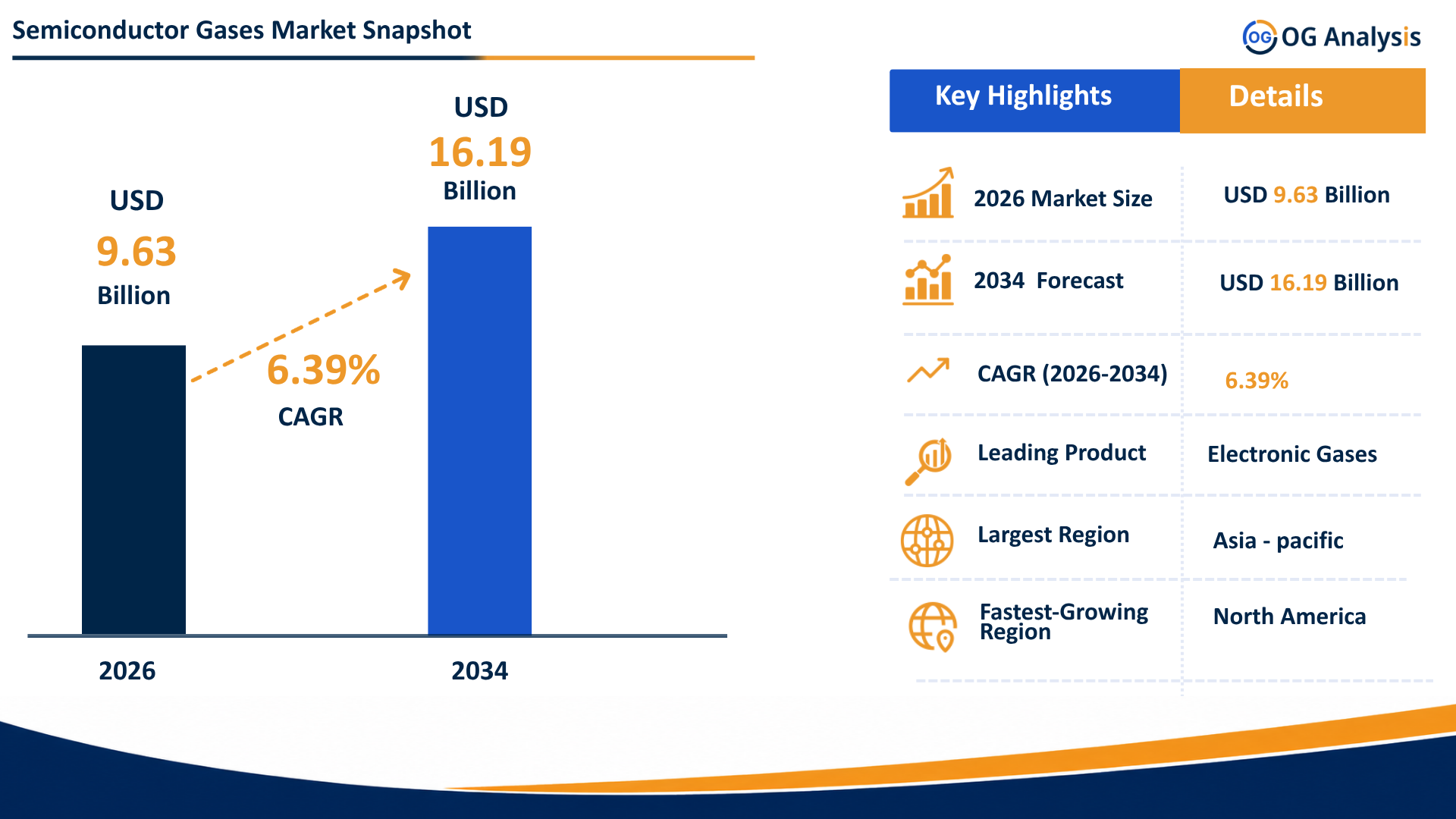
Semiconductor gases are ultra-high-purity gases used across wafer fabrication and chip manufacturing processes including deposition, etching, doping, oxidation, lithography, annealing, purging, and chamber cleaning. These gases include electronic special gases such as nitrogen trifluoride, silane, ammonia, fluorocarbons, and dopant gases, along with electronic bulk gases such as nitrogen, argon, helium, hydrogen, oxygen, and carbon dioxide. Market growth is supported by rising semiconductor demand from artificial intelligence, 5G, high-performance computing, electric vehicles, consumer electronics, industrial automation, and data centers. As chip architectures move toward smaller nodes, 3D NAND, FinFET, gate-all-around transistors, and advanced packaging, fabs require gases with higher purity, tighter contamination control, and precise process performance. Demand is also being shaped by new fab investments, localized supply-chain strategies, on-site gas generation, emission abatement, gas recycling, and low-global-warming-potential gas development.
Get the Complete Analysis :
https://www.oganalysis.com/industry-reports/semiconductor-gases-market
Get Your Free Sample Report for In-Depth Market Insights :
https://www.oganalysis.com/industry-reports/semiconductor-gases-market/free-sample
1. What is the latest trend in the Semiconductor Gases Market?
The latest trend is the rising demand for ultra-high-purity specialty gases used in advanced logic, memory, AI chips, and high-density semiconductor manufacturing.
Fabs are increasing the use of fluorinated gases, rare gases, silane, ammonia, hydrogen, and customized gas mixtures for etching, deposition, and chamber cleaning.
Gas suppliers are expanding on-site production, purification, delivery systems, and long-term supply agreements with semiconductor manufacturers.
Sustainability is also becoming important, with greater focus on gas recycling, abatement systems, and lower-emission alternatives.
2. What are the key challenges in the Semiconductor Gases Market?
Key challenges include high purity requirements, supply-chain volatility, rare gas shortages, safety risks, environmental regulation, and high cost of gas infrastructure.
Semiconductor fabs require uninterrupted gas supply because even minor contamination or delivery disruption can affect wafer yield and production output.
Fluorinated gases used in etching and chamber cleaning face regulatory pressure due to environmental and greenhouse-gas concerns.
Suppliers must manage purification, cylinder handling, bulk delivery, hazardous gas safety, abatement, and customer-specific qualification standards.
3. What is the major driving factor for the Semiconductor Gases Market?
The major driving factor is the expansion of semiconductor manufacturing capacity worldwide.
Rising demand for AI processors, memory chips, power semiconductors, EV electronics, smartphones, cloud infrastructure, and connected devices is increasing wafer fabrication activity.
Advanced chip production requires more complex gas chemistries and higher gas consumption across deposition, etching, doping, and cleaning steps.
Government incentives and regional fab investments are further strengthening demand for localized semiconductor gas supply chains.
4. What is the major segment in the Semiconductor Gases Market and why?
Electronic special gases are a major product segment because they are essential for precision semiconductor processing.
These gases are used in advanced etching, deposition, doping, cleaning, and thin-film formation where process control and purity directly affect chip performance.
Electronic bulk gases also remain important because nitrogen, argon, helium, oxygen, and hydrogen are used continuously for purging, carrier gas supply, oxidation, cooling, and process support.
Logic applications are especially important because advanced CPUs, GPUs, NPUs, and AI accelerators require high-performance fabrication processes.
5. Which application or end-user is driving more demand?
Foundries, integrated device manufacturers, memory producers, logic chip manufacturers, display makers, LED producers, and photovoltaic manufacturers are driving demand.
Wafer fabrication plants use semiconductor gases across nearly every major process stage, from deposition and etching to chamber cleaning and annealing.
Logic and memory chip manufacturers are major users because advanced devices require highly controlled thin films, selective etching, and contamination-free environments.
AI, high-performance computing, EV electronics, 5G, and data center demand are increasing gas consumption across leading-edge and mature-node fabs.
6. Which region offers the highest growth potential and why?
Asia Pacific remains the largest and highly attractive region due to its dominant semiconductor manufacturing base across Taiwan, South Korea, China, Japan, and Southeast Asia.
The region accounts for the majority of semiconductor gas demand because of large foundry, memory, display, and electronics manufacturing clusters.
North America is also gaining momentum due to new fab investments, CHIPS Act-supported manufacturing, and reshoring of semiconductor supply chains.
Europe is supported by semiconductor policy initiatives, automotive chip demand, power electronics, and investments in domestic chip production.
7. What strategies are major companies adopting in the market?
Major companies are focusing on capacity expansion, on-site gas supply systems, ultra-high-purity purification, long-term fab supply contracts, and advanced gas mixtures.
They are investing in local production near semiconductor clusters to reduce logistics risk and improve supply reliability.
Suppliers are also developing lower-GWP gases, recycling systems, abatement technologies, and process-specific formulations for advanced nodes.
Partnerships with foundries, IDMs, semiconductor equipment makers, and regional governments are becoming important competitive strategies.
8. What are the leading companies in the Semiconductor Gases Market?
Leading companies include Linde, Air Liquide, Air Products and Chemicals, Nippon Sanso Holdings, Merck KGaA, Entegris, Messer, SK Specialty, Kanto Denka Kogyo, Resonac, Taiyo Nippon Sanso, Solvay, Showa Denko Materials, Foosung, ADEKA, and Matheson Tri-Gas.
These companies compete through gas purity, product range, fab proximity, supply reliability, safety systems, analytical capability, purification technology, and long-term customer relationships.
Large industrial gas companies benefit from bulk gas infrastructure and on-site supply models, while specialty gas suppliers compete through advanced chemistries and process-specific materials.
Suppliers with strong presence near semiconductor manufacturing hubs are better positioned for long-term contracts and qualification-driven business.
9. Why are semiconductor gases strategically important for chip manufacturing?
Semiconductor gases are strategically important because they directly enable wafer processing, thin-film formation, pattern transfer, doping, cleaning, and yield control.
Chipmakers depend on gases with extremely high purity and consistent delivery to manufacture reliable, high-performance semiconductors.
Any gas contamination, shortage, or supply disruption can affect fab output, device quality, and production schedules.
For semiconductor supply chains, reliable gas sourcing is now a strategic priority alongside wafers, photoresists, chemicals, and equipment.
10. What is the future outlook for the Semiconductor Gases Market?
The market outlook remains positive as semiconductor manufacturing expands across AI, memory, logic, power electronics, EVs, data centers, and advanced packaging.
Future growth will be supported by electronic special gases, high-purity bulk gases, fluorinated gases, rare gases, gas recycling, low-emission alternatives, and on-site gas generation.
Advanced nodes, 3D chip structures, EUV lithography, and gate-all-around architectures will increase demand for process-specific gas solutions.
Companies offering reliable supply, ultra-high purity, strong safety systems, regional production, and sustainability-focused gas technologies are expected to gain market share.
Browse Related Reports
https://www.oganalysis.com/industry-reports/cmp-pads-market
https://www.oganalysis.com/industry-reports/spinon-glass-sog-market
https://www.oganalysis.com/industry-reports/semiconductor-liquid-filters-market
https://www.oganalysis.com/industry-reports/semiconductor-process-cleaning-agents-market
https://www.oganalysis.com/industry-reports/semiconductor-grade-silicon-market
