Weapons Sights Market Outlook 2026–2034: Advanced Electro-Optics, Thermal Sight Adoption, Defense Modernization, and Future Growth Opportunities
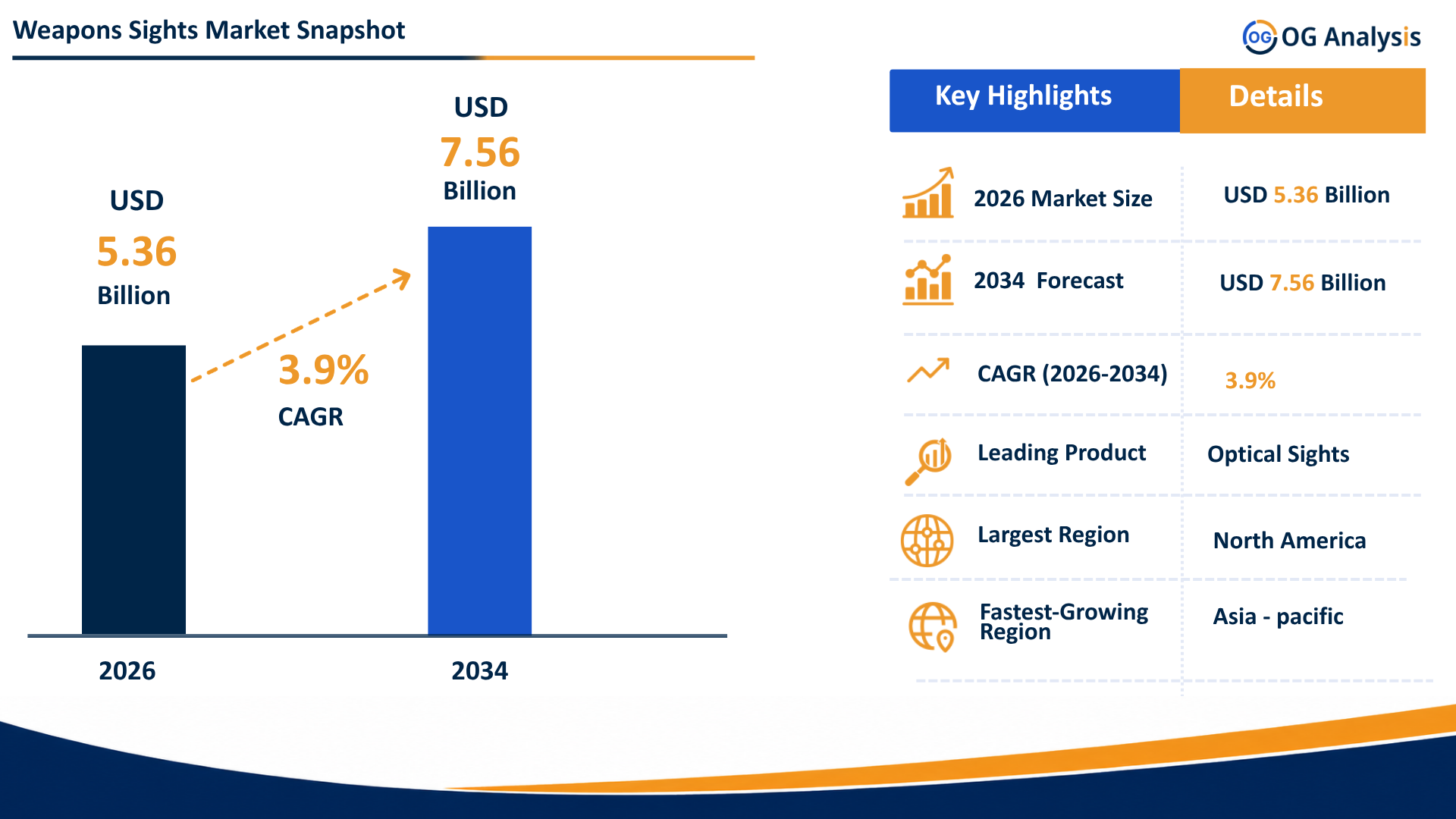
The Weapons Sights Market is estimated to be valued at $ 5.36 billion in 2026 and is projected to reach $ 7.56 billion by 2034, expanding at a CAGR of 3.9% from 2026 to 2034.
Weapons sights are aiming and target-acquisition devices mounted on firearms, rifles, pistols, shotguns, sniper systems, crew-served weapons, and tactical platforms to improve accuracy, visibility, and operational effectiveness. These systems include iron sights, optical scopes, red-dot sights, reflex sights, holographic sights, laser sights, thermal imaging sights, night-vision sights, magnifiers, and integrated digital sighting systems. Market growth is supported by military modernization, law-enforcement upgrades, rising demand for precision shooting, tactical training, hunting and sport shooting participation, and adoption of advanced electro-optics. Demand is shifting toward rugged, lightweight, low-power, multi-functional, and platform-compatible sighting systems. Product innovation is focused on thermal imaging, night vision, ballistic reticles, illuminated optics, wireless connectivity, rangefinding integration, compact red-dot optics, and digital fire-control features.
Get the Complete Analysis :
https://www.oganalysis.com/industry-reports/weapons-sights-market
Get Your Free Sample Report for In-Depth Market Insights :
https://www.oganalysis.com/industry-reports/weapons-sights-market/free-sample
1. What is the latest trend in the Weapons Sights Market?
The latest trend is the growing adoption of advanced electro-optical sights, including thermal, night-vision, holographic, red-dot, and digitally assisted sighting systems.
Users are demanding faster target acquisition, better low-light visibility, improved durability, and compact designs for rifles, pistols, and tactical platforms.
Multi-spectral sights that combine day optics, thermal imaging, and night capability are gaining attention in military and security applications.
Battery efficiency, solar-assisted power, rugged housings, and smart reticle systems are also becoming important product trends.
2. What are the key challenges in the Weapons Sights Market?
Key challenges include high product cost, export controls, defense procurement delays, regulatory restrictions, and strict performance qualification requirements.
Advanced sights must withstand recoil, shock, vibration, dust, moisture, temperature extremes, and rough field conditions.
Thermal and digital sights face challenges related to battery life, sensor cost, image clarity, software reliability, and miniaturization.
Manufacturers also compete against low-cost optics, counterfeit products, and price-sensitive aftermarket buyers.
3. What is the major driving factor for the Weapons Sights Market?
The major driving factor is rising demand for improved aiming accuracy, target visibility, and mission effectiveness across defense, law enforcement, and civilian shooting applications.
Military and security forces are upgrading sighting systems to improve performance in day, night, and adverse-weather environments.
Civilian demand is supported by hunting, sport shooting, personal defense, and recreational firearm accessories.
The shift from basic mechanical sights toward optical, electronic, and thermal systems is strengthening market expansion.
4. What is the major segment in the Weapons Sights Market and why?
Optical and red-dot/reflex sights are major product segments because they are widely used across rifles, carbines, pistols, and tactical firearms.
Red-dot and reflex sights support fast target acquisition at short to medium ranges, making them popular across military, law-enforcement, and commercial users.
Telescopic sights remain important for long-range shooting, hunting, sniper systems, and precision applications.
Thermal and night-vision sights are high-growth segments due to demand for low-light and all-weather visibility.
5. Which application or end-user is driving more demand?
Military and law-enforcement users are major demand drivers because they require rugged, certified, and mission-ready sighting systems.
Armed forces use advanced optics for infantry weapons, sniper rifles, machine guns, vehicle-mounted systems, and special operations platforms.
Law-enforcement agencies require sights for patrol rifles, tactical units, training, and low-light operations.
Commercial users, including hunters and sport shooters, also support strong demand for scopes, red-dot sights, and compact optics.
6. Which region offers the highest growth potential and why?
North America remains a leading market due to high defense spending, large civilian firearms accessories demand, and strong presence of optics manufacturers.
Asia Pacific offers strong growth potential due to defense modernization, border-security requirements, and rising procurement of advanced infantry equipment.
Europe is supported by military modernization, NATO defense spending, and demand for electro-optical systems.
The Middle East also presents opportunities due to security spending and demand for tactical and surveillance-oriented weapon optics.
7. What strategies are major companies adopting in the market?
Major companies are focusing on ruggedized designs, lightweight materials, advanced lens coatings, improved battery life, and compact sight architectures.
They are expanding product portfolios across red-dot sights, holographic sights, riflescopes, thermal sights, night-vision optics, and laser aiming systems.
Defense-focused suppliers are investing in integrated fire-control systems, rangefinding capability, ballistic computation, and multi-spectral imaging.
Companies are also strengthening military contracts, law-enforcement distribution, commercial retail channels, and aftermarket accessory ecosystems.
8. What are the leading companies in the Weapons Sights Market?
Leading companies include Trijicon, EOTECH, Aimpoint, Leupold & Stevens, SIG SAUER, Vortex Optics, Holosun, Meprolight, Steiner, Bushnell, Burris, Primary Arms, Crimson Trace, Nightforce Optics, Thales, Safran, Leonardo DRS, Teledyne FLIR, Elbit Systems, and L3Harris Technologies.
These companies compete through optical clarity, ruggedness, reticle technology, thermal imaging capability, brand reputation, military certification, battery performance, and platform compatibility.
Market sources commonly identify Trijicon, EOTECH, Aimpoint, Leupold & Stevens, SIG SAUER, Vortex Optics, Meprolight, and Holosun among major firearm and weapons sight participants.
9. Why are weapons sights strategically important for defense and security users?
Weapons sights are strategically important because they improve target acquisition, accuracy, visibility, and shooter confidence in demanding conditions.
They help military and law-enforcement users operate more effectively in low light, long range, moving-target, and high-stress environments.
For defense forces, advanced sights support infantry modernization and improve the effectiveness of existing weapon platforms.
For manufacturers, sights and optics create high-value aftermarket and upgrade opportunities beyond the base firearm platform.
10. What is the future outlook for the Weapons Sights Market?
The market outlook remains positive as defense modernization, tactical optics upgrades, law-enforcement procurement, and commercial shooting demand continue to expand.
Future growth will be supported by thermal sights, holographic sights, compact red-dot optics, digital fire-control systems, multi-spectral optics, and integrated rangefinding solutions.
Demand will continue across military, law enforcement, hunting, sport shooting, training academies, and private security applications.
Companies offering rugged, accurate, lightweight, power-efficient, and platform-compatible sighting systems are expected to gain market share.
Browse Related Reports
https://www.oganalysis.com/industry-reports/air-based-defense-equipment-market
https://www.oganalysis.com/industry-reports/drone-detection-and-jamming-system-market
https://www.oganalysis.com/industry-reports/military-satellite-market
https://www.oganalysis.com/industry-reports/radar-sensor-market
https://www.oganalysis.com/industry-reports/combat-drone-market
