Advanced Protective Gear And Armor Market Analysis and Outlook Report: Industry Size, Share, Growth Trends, and Forecast (2025-2032)

Published On: Mar, 2025
|
Pages: 163

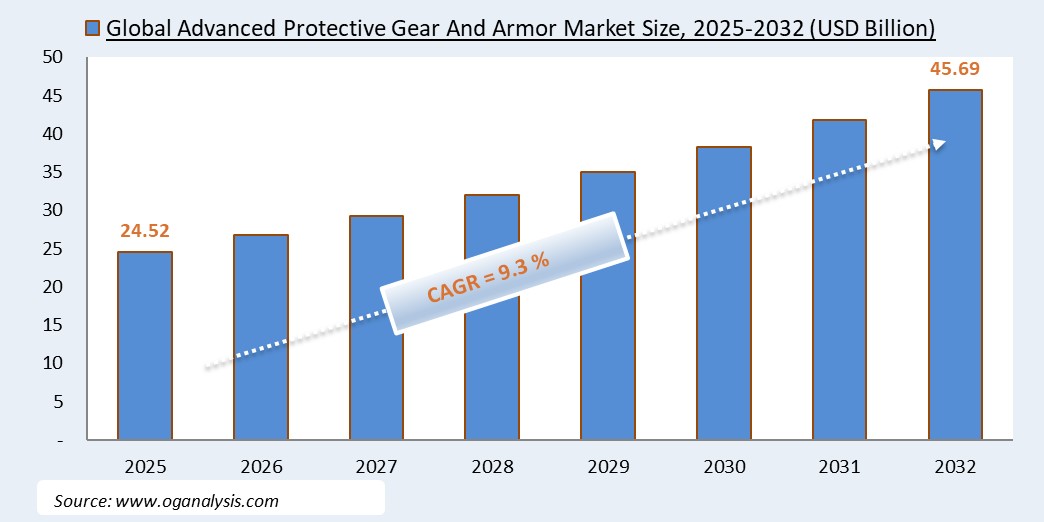
"The Global Advanced Protective Gear And Armor Market is valued at $ 24.52 Billion in 2025. Worldwide sales of Advanced Protective Gear And Armor Market are expected to grow at a significant CAGR of 9.3%, reaching $ 45.69 Billion by the end of the forecast period in 2032."

The global advanced protective gear and armor market is witnessing significant growth driven by rising security threats, increasing military modernization programs, and growing demand for protective solutions across defense, law enforcement, industrial, and civilian sectors. Advanced protective gear and armor include body armor, helmets, protective clothing, and ballistic-resistant equipment designed to provide enhanced protection against bullets, shrapnel, chemical agents, biological hazards, fire, and extreme environmental conditions. Defense forces worldwide are prioritizing the procurement of lightweight, high-strength armor systems that offer superior protection without compromising mobility and operational effectiveness. Additionally, the increasing frequency of military operations, peacekeeping missions, and counter-terrorism initiatives is driving the demand for advanced protective solutions to safeguard personnel in diverse combat and tactical environments.

The market is further supported by technological advancements in materials science, such as the development of aramid fibers, ultra-high-molecular-weight polyethylene (UHMWPE), ceramic composites, and nanotechnology-based coatings that enhance the durability, strength-to-weight ratio, and multi-threat protection capabilities of gear and armor systems. North America holds the largest market share owing to extensive defense budgets, continuous upgrades in soldier protection systems, and strong homeland security investments. Meanwhile, Asia Pacific is emerging as the fastest-growing region due to rising defense spending, border security concerns, and increasing procurement of advanced armor solutions in countries such as China, India, Japan, and South Korea. However, high production costs, stringent regulatory testing standards, and weight optimization challenges for multi-functional protection remain key market constraints. Leading companies are focusing on R&D to develop ergonomic, scalable, and integrated protective solutions for military, industrial, and emergency response applications globally. Overall, the advanced protective gear and armor market is expected to maintain steady growth as safety, survivability, and mission effectiveness remain top priorities across defense and critical infrastructure sectors worldwide.

Body armor is the largest product type segment in the advanced protective gear and armor market due to its extensive use among military personnel, law enforcement, and security forces globally. Its critical role in providing ballistic protection against bullets and shrapnel, combined with continuous advancements in lightweight and multi-threat resistant designs, drives its dominant market share in defense and security applications.

Aramid fibers are the largest material type segment as they offer high strength-to-weight ratios, excellent thermal stability, and superior impact resistance, making them ideal for manufacturing body armor, helmets, and protective clothing. Their widespread adoption in military and industrial protective solutions supports their market leadership over other material categories.
Global Advanced Protective Gear And Armor Market Analysis 2025-2032: Industry Size, Share, Growth Trends, Competition and Forecast Report

Key Insights

  • The advanced protective gear and armor market is driven by increasing military modernization programs and rising geopolitical tensions worldwide. Defense forces are prioritizing procurement of lightweight, high-strength protective solutions to ensure soldier safety and operational mobility during combat, peacekeeping, and counter-terrorism operations.

  • Body armor and ballistic protection systems remain the largest product segment due to their extensive use among military personnel, law enforcement officers, and security forces. Continuous improvements in ballistic resistance, weight reduction, and ergonomics are supporting their adoption in both developed and emerging defense markets.

  • North America dominates the global market owing to large defense budgets, regular troop deployment, and strong homeland security initiatives. The U.S. Department of Defense continues to invest in advanced soldier protection programs with enhanced survivability, multi-threat resistance, and integrated communication features.

  • Asia Pacific is the fastest-growing regional market driven by increasing defense spending, border security requirements, and modernization programs in China, India, Japan, and South Korea. These countries are investing in advanced protective gear to enhance troop protection and maintain regional security resilience.

  • Technological advancements in material science, such as aramid fibers, UHMWPE, ceramic composites, and nanotechnology-based coatings, are improving the strength-to-weight ratio, thermal resistance, and multi-functional protection capabilities of protective gear and armor systems globally.

  • Integration of sensors and smart technologies in protective gear is emerging as a key trend, enabling real-time health monitoring, environmental sensing, and threat detection for soldiers and first responders, thereby enhancing operational effectiveness and safety outcomes in critical missions.

  • The industrial segment is also witnessing steady demand for protective clothing and gear in hazardous work environments such as mining, oil and gas, chemical processing, and firefighting. Regulatory standards mandating workplace safety are driving investments in certified protective equipment for worker safety assurance.

  • High production costs and stringent testing and certification standards remain market challenges, especially for multi-functional armor solutions. Companies are focusing on cost optimization and design innovations to improve affordability while ensuring compliance with national and international protection standards.

  • Leading players including 3M, Honeywell, DuPont, BAE Systems, Point Blank Enterprises, and ArmorSource are investing in R&D to develop scalable, ergonomic, and integrated protective solutions tailored for military, industrial, and emergency response applications worldwide.

  • The market outlook remains positive as safety, survivability, and mission readiness continue to drive demand for advanced protective gear and armor. Defense and industrial sectors globally are expected to maintain stable procurement pipelines supported by continuous material innovation and safety regulations.

Global crude steel production, 2018–2024 (million tonnes)

Figure: Global crude steel production has risen from about 1.83 billion tonnes in 2018 to around 1.89 billion tonnes in 2024, sustaining the upstream supply base for armor plate and steel-intensive protective systems used across vehicle armor kits, ballistic doors/panels, protective barriers, and structural backings for composite/ceramic solutions. OG Analysis compilation, derived from worldsteel (World Steel Association) world crude steel output data, highlights how a broadly stable global steel production backdrop supports long-term availability of core steel inputs, while specialty plate rolling, heat treatment, and qualification capacity can still drive lead-time and cost volatility for advanced protective gear and armor programs.

Global crude steel production 2018–2024 (Mt) – upstream capacity indicator for armor plate and protective systems.

World totals are taken from the World Steel Association (worldsteel) time series for world crude steel production (2000–2024) published in World Steel in Figures 2025. The series is used here as a macro upstream capacity indicator relevant to steel-based armor and protective structures; it does not represent armor-grade steel output specifically, which depends on specialty plate capacity, alloying, heat-treatment, and qualification constraints.

Reort Scope

Parameter

Detail

Base Year

2024

Estimated Year

2025

Forecast Period

2026-2032

Market Size-Units

USD billion

Market Splits Covered

By Product Type, By Material type By End User

Countries Covered

North America (USA, Canada, Mexico)
Europe (Germany, UK, France, Spain, Italy, Rest of Europe)
Asia-Pacific (China, India, Japan, Australia, Rest of APAC)
The Middle East and Africa (Middle East, Africa)
South and Central America (Brazil, Argentina, Rest of SCA)

Analysis Covered

Latest Trends, Driving Factors, Challenges, Trade Analysis, Price Analysis, Supply-Chain Analysis, Competitive Landscape, Company Strategies

Customization

10% free customization (up to 10 analyst hours) to modify segments, geographies, and companies analyzed

Post-Sale Support

4 analyst hours, available up to 4 weeks

Delivery Format

The Latest Updated PDF and Excel Data file

 Segmentation

By Type

  • Personal armor (vests/soft armor, hard plates, helmets, shields)

  • Tactical protective gear (plate carriers, load-bearing, add-on protectors, ballistic eyewear/gloves)

  • Vehicle armor solutions (add-on kits, spall liners, underbody/blast kits, transparent armor)

  • Structural/infrastructure armor (ballistic doors, wall panels, partitions, ballistic glass)

  • CBRN protective gear

By Threat/Protection

  • Ballistic

  • Blast / fragmentation

  • Stab / slash / spike

  • Multi-threat (hybrid)

By Material

  • Aramid

  • UHMWPE

  • Ceramics (alumina, SiC, B4C)

  • Metals (steel, titanium, aluminum alloys)

  • Hybrid composites

By End User

  • Defense / military

  • Law enforcement

  • Homeland security / border protection

  • Private security / VIP protection

  • Critical infrastructure / industrial security

   By Geography 

  • North America (USA, Canada, Mexico)
  •  Europe (Germany, UK, France, Spain, Italy, Rest of Europe)
  • Asia-Pacific (China, India, Japan, Australia, Vietnam, Rest of APAC)
  • The Middle East and Africa (Middle East, Africa)
  • South and Central America (Brazil, Argentina, Rest of SCA)

Key companies

  • 3M Co.
  • Armorsource Llc
  • Avon Protection Plc
  • Bae Systems Plc
  • Dupont
  • Honeywell International Inc.
  • Kimberly Clark Professional
  • Msa Safety Inc.
  • Point Blank Enterprises Inc.

What You Receive

• Global Advanced Protective Gear And Armor market size and growth projections (CAGR), 2024- 2034
• Impact of recent changes in geopolitical, economic, and trade policies on the demand and supply chain of Advanced Protective Gear And Armor.
• Advanced Protective Gear And Armor market size, share, and outlook across 5 regions and 27 countries, 2025- 2034.
• Advanced Protective Gear And Armor market size, CAGR, and Market Share of key products, applications, and end-user verticals, 2025- 2034.
• Short and long-term Advanced Protective Gear And Armor market trends, drivers, restraints, and opportunities.
• Porter’s Five Forces analysis, Technological developments in the Advanced Protective Gear And Armor market, Advanced Protective Gear And Armor supply chain analysis.
• Advanced Protective Gear And Armor trade analysis, Advanced Protective Gear And Armor market price analysis, Advanced Protective Gear And Armor Value Chain Analysis.
• Profiles of 5 leading companies in the industry- overview, key strategies, financials, and products.
• Latest Advanced Protective Gear And Armor market news and developments.
The Advanced Protective Gear And Armor Market international scenario is well established in the report with separate chapters on North America Advanced Protective Gear And Armor Market, Europe Advanced Protective Gear And Armor Market, Asia-Pacific Advanced Protective Gear And Armor Market, Middle East and Africa Advanced Protective Gear And Armor Market, and South and Central America Advanced Protective Gear And Armor Markets. These sections further fragment the regional Advanced Protective Gear And Armor market by type, application, end-user, and country.

1. Table of Contents
1.1 List of Tables
1.2 List of Figures

2. Advanced Protective Gear And Armor Market Latest Trends, Drivers and Challenges, 2024 - 2032
2.1 Advanced Protective Gear And Armor Market Overview
2.2 Market Strategies of Leading Advanced Protective Gear And Armor Companies
2.3 Advanced Protective Gear And Armor Market Insights, 2024 - 2032
2.3.1 Leading Advanced Protective Gear And Armor Types, 2024 - 2032
2.3.2 Leading Advanced Protective Gear And Armor End-User industries, 2024 - 2032
2.3.3 Fast-Growing countries for Advanced Protective Gear And Armor sales, 2024 - 2032
2.4 Advanced Protective Gear And Armor Market Drivers and Restraints
2.4.1 Advanced Protective Gear And Armor Demand Drivers to 2032
2.4.2 Advanced Protective Gear And Armor Challenges to 2032
2.5 Advanced Protective Gear And Armor Market- Five Forces Analysis
2.5.1 Advanced Protective Gear And Armor Industry Attractiveness Index, 2024
2.5.2 Threat of New Entrants
2.5.3 Bargaining Power of Suppliers
2.5.4 Bargaining Power of Buyers
2.5.5 Intensity of Competitive Rivalry
2.5.6 Threat of Substitutes

3. Global Advanced Protective Gear And Armor Market Value, Market Share, and Forecast to 2032
3.1 Global Advanced Protective Gear And Armor Market Overview, 2024
3.2 Global Advanced Protective Gear And Armor Market Revenue and Forecast, 2024 - 2032 (US$ Million)

3.3 Global Advanced Protective Gear And Armor Market Size and Share Outlook By Product Type, 2024 - 2032
3.3.1 Body Armor
3.3.2 Helmets
3.3.3 Protective Clothing
3.3.4 Gloves
3.3.5 Face Shields & Eye Protection
3.3.6 Ballistic Shields

3.4 Global Advanced Protective Gear And Armor Market Size and Share Outlook By Material Type, 2024 - 2032
3.4.1 Aramid Fibers
3.4.2 Carbon Composites
3.4.3 Ceramic & Hybrid Materials
3.4.4 Metal Alloys
3.4.5 Nanomaterials

3.5 Global Advanced Protective Gear And Armor Market Size and Share Outlook By End-User, 2024 - 2032
3.5.1 Military & Defense
3.5.2 Law Enforcement
3.5.3 Firefighting & Emergency Services
3.5.4 Industrial Safety
3.5.5 Healthcare

3.6 Global Advanced Protective Gear And Armor Market Size and Share Outlook 0, 2024 - 2032


3.7 Global Advanced Protective Gear And Armor Market Size and Share Outlook by Region, 2024 - 2032

4. Asia Pacific Advanced Protective Gear And Armor Market Value, Market Share and Forecast to 2032
4.1 Asia Pacific Advanced Protective Gear And Armor Market Overview, 2024
4.2 Asia Pacific Advanced Protective Gear And Armor Market Revenue and Forecast, 2024 - 2032 (US$ Million)
4.3 Asia Pacific Advanced Protective Gear And Armor Market Size and Share Outlook By Product Type, 2024 - 2032
4.4 Asia Pacific Advanced Protective Gear And Armor Market Size and Share Outlook By Material Type, 2024 - 2032
4.5 Asia Pacific Advanced Protective Gear And Armor Market Size and Share Outlook By End-User, 2024 - 2032
4.6 Asia Pacific Advanced Protective Gear And Armor Market Size and Share Outlook 0, 2024 - 2032
4.7 Asia Pacific Advanced Protective Gear And Armor Market Size and Share Outlook by Country, 2024 - 2032
4.8 Key Companies in Asia Pacific Advanced Protective Gear And Armor Market

5. Europe Advanced Protective Gear And Armor Market Value, Market Share, and Forecast to 2032
5.1 Europe Advanced Protective Gear And Armor Market Overview, 2024
5.2 Europe Advanced Protective Gear And Armor Market Revenue and Forecast, 2024 - 2032 (US$ Million)
5.3 Europe Advanced Protective Gear And Armor Market Size and Share Outlook By Product Type, 2024 - 2032
5.4 Europe Advanced Protective Gear And Armor Market Size and Share Outlook By Material Type, 2024 - 2032
5.5 Europe Advanced Protective Gear And Armor Market Size and Share Outlook By End-User, 2024 - 2032
5.6 Europe Advanced Protective Gear And Armor Market Size and Share Outlook 0, 2024 - 2032
5.7 Europe Advanced Protective Gear And Armor Market Size and Share Outlook by Country, 2024 - 2032
5.8 Key Companies in Europe Advanced Protective Gear And Armor Market

6. North America Advanced Protective Gear And Armor Market Value, Market Share and Forecast to 2032
6.1 North America Advanced Protective Gear And Armor Market Overview, 2024
6.2 North America Advanced Protective Gear And Armor Market Revenue and Forecast, 2024 - 2032 (US$ Million)
6.3 North America Advanced Protective Gear And Armor Market Size and Share Outlook By Product Type, 2024 - 2032
6.4 North America Advanced Protective Gear And Armor Market Size and Share Outlook By Material Type, 2024 - 2032
6.5 North America Advanced Protective Gear And Armor Market Size and Share Outlook By End-User, 2024 - 2032
6.6 North America Advanced Protective Gear And Armor Market Size and Share Outlook 0, 2024 - 2032
6.7 North America Advanced Protective Gear And Armor Market Size and Share Outlook by Country, 2024 - 2032
6.8 Key Companies in North America Advanced Protective Gear And Armor Market

7. South and Central America Advanced Protective Gear And Armor Market Value, Market Share and Forecast to 2032
7.1 South and Central America Advanced Protective Gear And Armor Market Overview, 2024
7.2 South and Central America Advanced Protective Gear And Armor Market Revenue and Forecast, 2024 - 2032 (US$ Million)
7.3 South and Central America Advanced Protective Gear And Armor Market Size and Share Outlook By Product Type, 2024 - 2032
7.4 South and Central America Advanced Protective Gear And Armor Market Size and Share Outlook By Material Type, 2024 - 2032
7.5 South and Central America Advanced Protective Gear And Armor Market Size and Share Outlook By End-User, 2024 - 2032
7.6 South and Central America Advanced Protective Gear And Armor Market Size and Share Outlook 0, 2024 - 2032
7.7 South and Central America Advanced Protective Gear And Armor Market Size and Share Outlook by Country, 2024 - 2032
7.8 Key Companies in South and Central America Advanced Protective Gear And Armor Market

8. Middle East Africa Advanced Protective Gear And Armor Market Value, Market Share and Forecast to 2032
8.1 Middle East Africa Advanced Protective Gear And Armor Market Overview, 2024
8.2 Middle East and Africa Advanced Protective Gear And Armor Market Revenue and Forecast, 2024 - 2032 (US$ Million)
8.3 Middle East Africa Advanced Protective Gear And Armor Market Size and Share Outlook By Product Type, 2024 - 2032
8.4 Middle East Africa Advanced Protective Gear And Armor Market Size and Share Outlook By Material Type, 2024 - 2032
8.5 Middle East Africa Advanced Protective Gear And Armor Market Size and Share Outlook By End-User, 2024 - 2032
8.6 Middle East Africa Advanced Protective Gear And Armor Market Size and Share Outlook 0, 2024 - 2032
8.7 Middle East Africa Advanced Protective Gear And Armor Market Size and Share Outlook by Country, 2024 - 2032
8.8 Key Companies in Middle East Africa Advanced Protective Gear And Armor Market

9. Advanced Protective Gear And Armor Market Structure
9.1 Key Players
9.2 Advanced Protective Gear And Armor Companies - Key Strategies and Financial Analysis
9.2.1 Snapshot
9.2.3 Business Description
9.2.4 Products and Services
9.2.5 Financial Analysis

10. Advanced Protective Gear And Armor Industry Recent Developments

11 Appendix
11.1 Publisher Expertise
11.2 Research Methodology
11.3 Annual Subscription Plans
11.4 Contact Information


Research Methodology

Our research methodology combines primary and secondary research techniques to ensure comprehensive market analysis.

Primary Research

We conduct extensive interviews with industry experts, key opinion leaders, and market participants to gather first-hand insights.

Secondary Research

Our team analyzes published reports, company websites, financial statements, and industry databases to validate our findings.

Data Analysis

We employ advanced analytical tools and statistical methods to process and interpret market data accurately.

Get Free Sample

At OG Analysis, we understand the importance of informed decision-making in today's dynamic business landscape. To help you experience the depth and quality of our market research reports, we offer complimentary samples tailored to your specific needs.

Start Now! Please fill the form below for your free sample.

Why Request a Free Sample?

Evaluate Our Expertise: Our reports are crafted by industry experts and seasoned analysts. Requesting a sample allows you to assess the depth of research and the caliber of insights we provide.

Tailored to Your Needs: Let us know your industry, market segment, or specific topic of interest. Our free samples are customized to ensure relevance to your business objectives.

Witness Actionable Insights: See firsthand how our reports go beyond data, offering actionable insights and strategic recommendations that can drive your business forward.

Embark on your journey towards strategic decision-making by requesting a free sample from OG Analysis. Experience the caliber of insights that can transform the way you approach your business challenges.

You can purchase individual sections of this report. Explore pricing options for specific sections.

FAQ's

The Global Advanced Protective Gear And Armor Market is estimated to generate USD 24.52 Billion revenue in 2025.

The Global Advanced Protective Gear And Armor Market is expected to grow at a Compound Annual Growth Rate (CAGR) of 9.3% during the forecast period from 2025 to 2032.

By 2032, the Advanced Protective Gear And Armor Market is estimated to account for USD 45.69 Billion.

License

$3950- 30%

$6450- 40%

$8450- 50%

$2850- 20%

Didn’t find what you’re looking for? TALK TO OUR ANALYST TEAM

Need something within your budget? NO WORRIES! WE GOT YOU COVERED!

Related Products

Airport Robots Market Analysis and Outlook Report: Industry Size, Share, Growth Trends, and Forecast (2025-2034)

The Airport Robots Market is rapidly expanding as airports worldwide adopt robotics to enhance efficiency, safety, and passenger experience. Robots are now deployed across diverse functions such as passenger guidance, baggage handling, security patrols, floor cleaning, and equipment inspection. These robotic solutions help airports manage growing passenger volumes, reduce labor overhead, and maintain consistent service levels. Recent technology advances—particularly in AI-powered navigation, computer vision, and sensor integration—enable robots to operate autonomously in complex airport environments, avoiding obstacles and interacting with travelers in real time. Market momentum is further driven by rising demand for contactless services and operational resilience, especially post-pandemic. Deployments like Dublin Airport's luggage-transporting robots for passengers with reduced mobility illustrate how robotics can support accessibility and enhance passenger satisfaction. Collaborative development between robotics vendors, airports, and airlines is leading to multifunctional service robots—ranging from baggage delivery bots to autonomous cleaning machines and cobots that assist staff. Forecasts indicate a robust annual growth of 13–17% with market size expected to exceed $1–1.5 billion in 2025, and rise to $4–5 billion by the mid-2030s, underscoring the strategic role of robots in shaping future airport operations. Key Insights_ Airport Robots Market Passenger guidance robots, equipped with touchscreens and dynamic routing, help travelers navigate terminals efficiently—especially those with reduced mobility—improving wayfinding and autonomy . Baggage-handling autonomous bots reduce physical strain on staff by transporting luggage from terminals to aircraft, improving throughput and operational resilience in peak periods. Security patrol robots, outfitted with cameras and sensors, conduct routine surveillance to supplement human personnel, helping to detect unattended items and monitor restricted zones efficiently . Cleaning and disinfection robots use UV-C or misting systems to sanitize floors and surfaces—critical for hygiene protocols and minimizing contagion risk in high-traffic zones. Collaborative cobots assist with repetitive tasks like trolley collection and conveyer loading, reducing manual workload and enhancing staff safety alongside real-time human oversight . AI-driven navigation systems using LiDAR and computer vision enable obstacle avoidance and smooth integration with passenger flows—even in congested areas. Swappable payload platforms allow a single robot chassis to perform multiple tasks—like guiding, cleaning, or delivering—offering cost-efficient versatility across airport operations. Regulatory frameworks and operator certification are evolving to accommodate safety standards for mixed human-robot environments, supporting broader adoption in public facilities. Strategic trials, such as Panasonic’s autonomous signage robot “Hospi” demonstrated at Narita Airport, highlight ongoing innovation in informational and hospitality-oriented robot deployment. Cloud-enabled fleet management systems allow centralized monitoring of operational metrics—like battery levels, mission progress, and maintenance alerts—helping airports optimize performance and readiness. Report Scope Parameter Detail Base Year 2024 Estimated Year 2025 Forecast Period 2026-2032 Market Size-Units USD billion Market Splits Covered By Type, By Application, By End User Countries Covered North America (USA, Canada, Mexico) Europe (Germany, UK, France, Spain, Italy, Rest of Europe) Asia-Pacific (China, India, Japan, Australia, Rest of APAC) The Middle East and Africa (Middle East, Africa) South and Central America (Brazil, Argentina, Rest of SCA) Analysis Covered Latest Trends, Driving Factors, Challenges, Trade Analysis, Price Analysis, Supply-Chain Analysis, Competitive Landscape, Company Strategies Customization 10% free customization (up to 10 analyst hours) to modify segments, geographies, and companies analyzed Post-Sale Support 4 analyst hours, available up to 4 weeks Delivery Format The Latest Updated PDF and Excel Datafile

Published:May-2025

Laser Communication Systems Market Outlook Report: Industry Size, Latest Trends and Growth Outlook

Laser Communication Systems Market Report Description The Laser Communication Systems market is emerging as a transformative segment within the broader telecommunications and aerospace industries. Laser communication systems utilize optical signals for transmitting data, offering significant advantages over traditional radio frequency (RF) communication methods. These systems are capable of delivering high-speed data transfer rates, enhanced security, and reduced latency, making them ideal for applications in space communication, military operations, and terrestrial networks. The increasing demand for high-bandwidth communication solutions, driven by the proliferation of data-intensive applications and the need for secure communication channels, is propelling the growth of the laser communication systems market. Furthermore, advancements in laser technology and photonics are facilitating the development of compact, efficient, and cost-effective laser communication devices. This comprehensive market research report delves into the current state of the laser communication systems market, examining key trends, drivers, challenges, and the competitive landscape to provide a detailed perspective on future growth prospects. Latest Trends One of the prominent trends in the laser communication systems market is the increasing deployment of satellite-based laser communication networks. These networks, often referred to as optical satellite communication, enable high-speed data transfer between satellites and ground stations, significantly enhancing the efficiency and capacity of global communication infrastructures. Another significant trend is the integration of laser communication systems in unmanned aerial vehicles (UAVs) and drones. This integration facilitates secure and high-bandwidth communication for military and commercial applications, such as surveillance, reconnaissance, and remote sensing. Additionally, the development of hybrid communication systems that combine laser and RF technologies is gaining traction. These systems leverage the strengths of both communication methods, ensuring reliable and versatile data transmission even in challenging environments. The increasing focus on miniaturization and the development of portable laser communication devices are also noteworthy trends, enabling more flexible and diverse applications across various sectors. Drivers The growth of the laser communication systems market is driven by several key factors. The escalating demand for high-speed and secure communication solutions, particularly in the defense and aerospace sectors, is a major driver. Laser communication systems offer enhanced data transfer rates and secure communication channels, making them ideal for sensitive military operations and satellite communications. In the commercial sector, the rising adoption of laser communication for high-frequency trading, telecommunication networks, and data center connectivity is fueling market growth. Government initiatives and funding for space exploration and satellite communication projects are also significant drivers. For instance, the increasing number of satellite launches and the growing focus on establishing global broadband networks via satellite constellations are boosting the demand for laser communication systems. Technological advancements in photonics and optoelectronics, leading to the development of more efficient and cost-effective laser communication devices, are further propelling market growth. Market Challenges Despite its promising growth prospects, the laser communication systems market faces several challenges. One of the primary challenges is the high initial cost of laser communication equipment and infrastructure. The deployment of these systems requires significant investment, which can be a barrier for smaller companies and emerging markets. Another challenge is the susceptibility of laser communication systems to environmental factors such as atmospheric turbulence, weather conditions, and line-of-sight obstructions. These factors can impact the reliability and performance of laser communication links, especially in terrestrial applications. Additionally, the integration of laser communication systems with existing RF-based communication infrastructures poses technical challenges. Ensuring compatibility and seamless operation between different communication technologies requires advanced engineering and substantial R&D efforts. Furthermore, regulatory and licensing issues related to the deployment of laser communication systems, particularly in space and military applications, can pose challenges to market growth. Major Players in the Laser Communication Systems Market 1. Thales Group 2. L3Harris Technologies 3. Mynaric AG 4. General Atomics 5. Ball Aerospace & Technologies Corp. 6. SpaceX 7. Boeing Defense, Space & Security 8. Airborne Wireless Network 9. BridgeComm Inc. 10. Laser Light Communications 11. ATLAS Space Operations 12. ViaSat Inc. 13. Xenesis Inc. 14. Hensoldt AG 15. Tesat-Spacecom GmbH & Co. KGMarket Scope Parameter Detail Base Year 2024 Estimated Year 2025 Forecast Period 2026-2032 Market Size-Units USD billion Market Splits Covered By Product Type, By Application, By Distribution Channel Countries Covered North America (USA, Canada, Mexico) Europe (Germany, UK, France, Spain, Italy, Rest of Europe) Asia-Pacific (China, India, Japan, Australia, Rest of APAC) The Middle East and Africa (Middle East, Africa) South and Central America (Brazil, Argentina, Rest of SCA) Analysis Covered Latest Trends, Driving Factors, Challenges, Trade Analysis, Price Analysis, Supply-Chain Analysis, Competitive Landscape, Company Strategies Customization 10% free customization (up to 10 analyst hours) to modify segments, geographies, and companies analyzed Post-Sale Support 4 analyst hours, available up to 4 weeks Delivery Format The Latest Updated PDF and Excel Datafile "

Published:Feb-2025

Intelligent Airways Transportation Market Analysis and Outlook Report: Industry Size, Share, Growth Trends, and Forecast (2025-2034)

The Intelligent Airways Transportation Market refers to the integration of advanced digital technologies, data analytics, and automation into air transport systems to enhance safety, efficiency, passenger experience, and operational performance. This market encompasses smart airport infrastructure, air traffic management systems, biometric identification, predictive maintenance, autonomous ground vehicles, and real-time data sharing between airlines and airports. The growth of this market is being propelled by rising air passenger traffic, increasing pressure on airport capacities, and the need for seamless and contactless passenger flow. Technologies such as artificial intelligence, Internet of Things (IoT), machine learning, and cloud computing are revolutionizing how air transportation networks are managed. Both developed and emerging economies are investing heavily in airport modernization projects, including smart terminals, digital baggage handling, and AI-assisted air traffic control systems, to accommodate growing demand while improving sustainability and resource utilization. The future trajectory of the Intelligent Airways Transportation Market is closely aligned with global efforts to improve mobility, reduce carbon emissions, and enhance safety in civil aviation. Europe and North America are leading in technology adoption due to mature aviation infrastructure and high R&D investments, while Asia-Pacific is expected to be the fastest-growing region, driven by increasing urbanization and air travel demand. Passenger expectations for faster, contactless, and personalized travel experiences are accelerating the deployment of biometric boarding, self-service kiosks, and AI-driven customer support systems. Meanwhile, airline operators are leveraging big data and predictive analytics to optimize flight operations, crew management, and fuel efficiency. Governments and aviation authorities are also endorsing intelligent transportation initiatives through smart city frameworks and national digital aviation strategies. Despite challenges such as cybersecurity risks, high capital expenditure, and integration with legacy systems, the market is poised for strong growth as intelligent technologies become central to the modernization of global air transport. The fastest-growing segment by component is software, driven by the increasing demand for cloud-based platforms, predictive analytics, and real-time data integration across air traffic control, passenger services, and airline operations. Software solutions offer scalability and flexibility, making them essential for enabling intelligent and adaptive systems in modern aviation. By technology, biometric-enabled self-services are the fastest-growing segment due to the global push for contactless, secure, and seamless passenger experiences. Airports and airlines are rapidly deploying facial recognition, fingerprint scanning, and iris recognition to enhance security and reduce wait times at key touchpoints. Key Insights_ Intelligent Airways Transportation Market Intelligent airways transportation systems are transforming global aviation by integrating AI, IoT, and automation into airport and airline operations. These technologies enhance operational efficiency, enable real-time decision-making, and support proactive maintenance, leading to fewer delays and increased safety across commercial flight networks. The rise in global air passenger traffic is pushing airports to adopt intelligent transportation technologies to handle higher volumes without compromising service quality. Smart terminals, automated baggage handling, and real-time passenger flow monitoring are helping airports manage congestion and improve turnaround times. Artificial Intelligence is playing a pivotal role in air traffic control, flight scheduling, and passenger services. AI-powered tools are being used for predictive flight path optimization, intelligent routing, and autonomous taxiing, reducing human error and enabling more fuel-efficient and environmentally sustainable flight operations. Biometric systems are gaining traction at airports worldwide, providing contactless authentication for check-in, boarding, and immigration. Facial recognition and fingerprint scanning significantly reduce wait times and enhance security, aligning with the post-pandemic shift toward touchless travel experiences. Predictive maintenance systems are being widely deployed by airlines to monitor aircraft health in real-time. By analyzing data from sensors and flight logs, these systems predict component failures in advance, thereby reducing unscheduled maintenance and improving aircraft availability and safety compliance. The use of autonomous vehicles and robots in airport logistics—such as baggage carts, cleaning robots, and security patrol units—is increasing rapidly. These innovations reduce labor costs, improve process consistency, and support round-the-clock operations in large-scale airport environments. Cloud computing and centralized data platforms are enabling seamless coordination between airlines, airports, air traffic controllers, and ground handlers. Real-time data exchange improves situational awareness and allows for synchronized decision-making across multiple stakeholders in the aviation ecosystem. The Asia-Pacific region is projected to be the fastest-growing market for intelligent airways transportation, fueled by rapid airport infrastructure development in countries like China, India, and Southeast Asia. Government-backed smart airport programs and booming air travel demand are key growth drivers. Cybersecurity is emerging as a critical focus area due to the digital interconnectedness of intelligent air transport systems. Airports and airlines are investing in robust cyber defense frameworks, data encryption, and threat detection tools to protect operational networks from disruptions and data breaches. Collaborative initiatives between public agencies, private tech firms, and aviation authorities are driving innovation in intelligent aviation. Programs like SESAR in Europe and NextGen in the U.S. are fostering development of interoperable, digitized air traffic management and smart airport systems to meet future aviation challenges. ReportScope Parameter Detail Base Year 2024 Estimated Year 2025 Forecast Period 2026-2032 Market Size-Units USD billion Market Splits Covered By Component, By Technology, By Deployment, By Application Countries Covered North America (USA, Canada, Mexico) Europe (Germany, UK, France, Spain, Italy, Rest of Europe) Asia-Pacific (China, India, Japan, Australia, Rest of APAC) The Middle East and Africa (Middle East, Africa) South and Central America (Brazil, Argentina, Rest of SCA) Analysis Covered Latest Trends, Driving Factors, Challenges, Trade Analysis, Price Analysis, Supply-Chain Analysis, Competitive Landscape, Company Strategies Customization 10% free customization (up to 10 analyst hours) to modify segments, geographies, and companies analyzed Post-Sale Support 4 analyst hours, available up to 4 weeks Delivery Format The Latest Updated PDF and Excel Data file

Published:May-2025