Home Industry Reports Aerospace & Defense Aerospace & Aviation Systems Aircraft Maintenance, Repair And Overhauling Services Market

Aircraft Maintenance, Repair And Overhauling Services Market Analysis and Outlook Report: Industry Size, Share, Growth Trends, and Forecast (2026-2034)

Published On: Jan, 2026
|
Pages: 150+

"The Aircraft Maintenance, Repair And Overhauling Services Market was valued at $ 79.4 billion in 2026 and is projected to reach $ 137.3 billion by 2034, growing at a CAGR of 7.1%."

The Aircraft Maintenance, Repair And Overhauling Services Market is a critical pillar of the global aviation ecosystem, ensuring airworthiness, regulatory compliance, operational reliability, and asset longevity across commercial aviation, cargo fleets, regional aircraft, business jets, and selected military-derived support platforms. The market covers line maintenance, base maintenance, engine overhaul, component repair, structural work, avionics support, cabin refurbishment, and technical services, with airlines, lessors, cargo operators, and fleet owners relying on MRO providers to maintain aircraft availability and control lifecycle costs. Top end uses include narrowbody and widebody fleet support, engine shop visits, airframe heavy checks, landing gear and component services, and predictive maintenance-led technical planning. Recent trends show a growing shift toward digital maintenance planning, integrated MRO networks, localized repair capability, and closer airline-OEM-MRO partnerships to reduce turnaround time and improve fleet utilization.

Market growth is being driven by rising global fleet utilization, aging aircraft in service, expanding airline fleets in emerging markets, and the need to manage more complex next-generation aircraft and engine maintenance requirements. A major market theme is the increasing importance of engine maintenance, supported by higher shop-visit intensity and stronger demand for specialized repair capability. The competitive landscape includes airline-affiliated MRO units, independent global MRO providers, OEM-linked service organizations, and regional technical specialists competing through scale, certifications, turnaround efficiency, digital tools, and long-term maintenance partnerships. Overall, the market outlook remains strong as aviation stakeholders continue investing in capacity expansion, workforce development, and technology-enabled maintenance ecosystems that improve reliability, planning accuracy, and service responsiveness.

Regional Analysis

North America Aircraft Maintenance, Repair And Overhauling Services Market

North America Aircraft Maintenance, Repair And Overhauling Services Market remains the most mature and diversified regional arena, supported by a large installed fleet, deep airline and lessor activity, and a broad network of independent, airline-affiliated, and OEM-linked service providers. Market dynamics are being shaped by strong engine maintenance demand, sustained narrowbody support requirements, and continued investment in facility expansion, workforce, and digital maintenance planning. Lucrative opportunities for companies are strongest in engine overhaul, component repair, base maintenance, and integrated technical support for high-utilization fleets. The latest trend is a more engine-led MRO growth profile rather than purely airframe-driven demand, and the forecast remains favorable as operators continue prioritizing turnaround efficiency, maintenance capacity, and long-term fleet support partnerships.

Asia Pacific Aircraft Maintenance, Repair And Overhauling Services Market

Asia Pacific Aircraft Maintenance, Repair And Overhauling Services Market is advancing rapidly through fleet expansion, rising air travel intensity, and stronger efforts to build regional maintenance ecosystems closer to airline operating bases. Market dynamics are influenced by growing demand for localized line, base, and component support, expanding airline fleets in India and Southeast Asia, and increasing cross-border collaboration between established aviation hubs and fast-growing markets. Companies can find attractive opportunities in new hangar capacity, engine and component servicing, joint ventures, and digitally enabled maintenance operations that reduce aircraft downtime. A major recent trend is the strengthening of Singapore-linked and India-linked MRO collaboration alongside new integrated maintenance capability in Southeast Asia, and the forecast remains robust as regional carriers seek scale, speed, and technical depth within Asia-Pacific service networks.

Europe Aircraft Maintenance, Repair And Overhauling Services Market

Europe Aircraft Maintenance, Repair And Overhauling Services Market is being shaped by a strong technical heritage, dense airline networks, and sustained demand for heavy maintenance, cabin upgrades, engine-related work, and redelivery services. Market dynamics reflect a mix of fleet modernization, ongoing support for mature aircraft types, and continued investment in repair capability linked to supply-chain resilience and production ramp-ups. Lucrative opportunities are strongest in engine-related maintenance, widebody cabin and structural work, component overhaul, and specialist services tied to leasing and fleet transitions. The latest trend is a combination of industrial capacity reinforcement and targeted MRO expansion at key European sites, and the forecast remains positive as airlines and service providers continue investing in efficiency, upgrade programs, and broader technical capability across the region.

Middle East & Africa Aircraft Maintenance, Repair And Overhauling Services Market

Middle East & Africa Aircraft Maintenance, Repair And Overhauling Services Market is gaining momentum through widebody-heavy fleet operations, major hub carrier requirements, and an increasing regional push to capture more high-value maintenance activity locally. Market dynamics are shaped by demand for engine services, large-scale hangar expansion, premium technical support, and MRO infrastructure designed around long-haul aircraft and transit-intensive operations. Companies have promising opportunities in engine overhaul, line and base maintenance, painting and structural support, and advanced technical services for global and regional carriers. The latest trend is clear movement toward larger integrated MRO campuses and expanded capability in Gulf aviation hubs, and the forecast remains constructive as airlines and airport-based aviation ecosystems continue investing in regional self-sufficiency and service depth.

South & Central America Aircraft Maintenance, Repair And Overhauling Services Market

South & Central America Aircraft Maintenance, Repair And Overhauling Services Market is developing steadily as airline recovery, fleet renewal, and regional network growth increase the need for dependable maintenance capacity and better technical support across mixed fleets. Market dynamics are influenced by rising aircraft utilization, growing interest in regional MRO partnerships, and a stronger focus on reducing reliance on distant maintenance bases for time-sensitive work. Lucrative opportunities for companies lie in component support, aircraft-on-ground services, narrowbody maintenance, technical supply distribution, and service partnerships tied to expanding airline activity in Brazil and other key markets. The latest trend is a more service-led and partnership-driven market structure, and the forecast points to steady growth as regional operators seek faster turnaround, broader local support, and improved maintenance accessibility.

Key Insights

  • Engine maintenance remains one of the most influential segments in the market, as modern fleets depend on highly specialized overhaul capability and faster turnaround planning. Rising engine shop-visit demand is reinforcing the strategic importance of engine MRO capacity. This segment continues to shape long-term market expansion and investment priorities.
  • Narrowbody aircraft support is a major demand center because these fleets operate at high utilization and require recurring line, base, and component maintenance services. Their widespread deployment across short- and medium-haul networks keeps maintenance demand broad and continuous. This makes narrowbody support central to market activity.
  • Digitalization is becoming a defining trend across the market, with predictive maintenance, maintenance planning tools, and data-led technical decision systems improving scheduling and reducing unplanned downtime. MRO providers are increasingly differentiating through smarter workflows and connected maintenance environments. This trend is raising efficiency expectations across the industry.
  • Expansion of regional MRO infrastructure is accelerating as airlines seek to reduce ferry time, lower costs, and access quicker technical support closer to operating bases. New facility development in Asia and India reflects this structural shift. Regionalization is becoming an important competitive and operational advantage.
  • Airline and OEM-linked partnerships are playing a larger role in the market because operators increasingly prefer integrated maintenance arrangements with stronger planning visibility and technical backing. These collaborations support long-term contracts, better parts access, and more reliable fleet support. Partnership-led models are becoming more common across major fleets.
  • Workforce capability and technical training remain essential to market development as aircraft systems become more advanced and maintenance procedures more specialized. Providers that invest in skilled technicians, certification depth, and process quality are better positioned for long-term growth. Talent strength is now a core service differentiator.
  • Airframe and component services continue to be fundamental market segments because they support heavy checks, structural repairs, avionics maintenance, and recurring parts refurbishment across the life of an aircraft. These services provide stable long-term revenue opportunities beyond engine work. They also support fleet extension strategies for operators.
  • Future market growth will favor MRO providers that combine scale, digital capability, turnaround speed, and broad service scope across engines, airframes, and components. Customers increasingly want dependable, end-to-end maintenance ecosystems rather than isolated repair services. The market is moving toward integrated, technology-enabled, and globally connected support models.

Global commercial flights, 2018–2024

Figure:The recovery and growth in global commercial airline flights significantly increase aircraft utilization, driving line maintenance, heavy checks and component overhauls worldwide. As fleets operate at higher cycles and older aircraft stay in service longer, airlines and MRO providers expand their use of advanced inspection, sensing and monitoring technologies, including radiographic and non-destructive testing systems, to ensure safety and regulatory compliance.
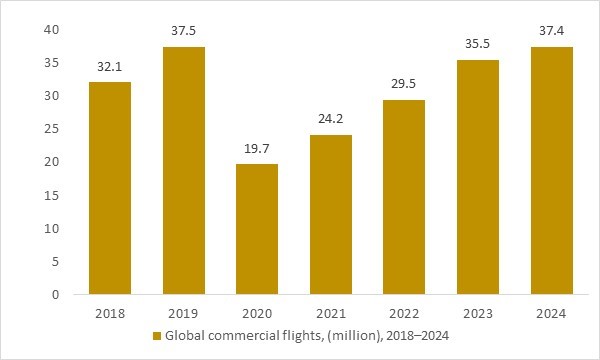
Global commercial airline flights 2018–2024 illustrating rising aircraft utilization and demand for MRO services

The Aircraft Maintenance, Repair and Overhauling (MRO) Services Market is strongly influenced by the rebound in global commercial airline flights nearing pre-pandemic activity levels. Rising flight cycles and extended aircraft utilization intensify the need for airframe checks, engine overhauls, component repairs and predictive maintenance programs. As airlines operate older fleets longer due to delivery delays, demand for advanced inspection tools—including radiographic, sensing and monitoring technologies—continues to expand. This sustained growth in worldwide flight activity reinforces long-term investment in MRO capacity, digital workflows and safety-critical diagnostic systems.

Market Scope

Parameter

Aircraft Maintenance, Repair And Overhauling Services Market Detail

Base Year

2025

Estimated Year

2026

Forecast Period

2026-2034

Market Size-Units

USD billion

Market Splits Covered

By Type, By aircraft Divition, By Size, and By service type

Countries Covered

North America (USA, Canada, Mexico)
Europe (Germany, UK, France, Spain, Italy, Rest of Europe)
Asia-Pacific (China, India, Japan, Australia, Rest of APAC)
The Middle East and Africa (Middle East, Africa)
South and Central America (Brazil, Argentina, Rest of SCA)

Analysis Covered

Latest Trends, Driving Factors, Challenges, Trade Analysis, Price Analysis, Supply-Chain Analysis, Competitive Landscape, Company Strategies

Customization

10% free customization (up to 10 analyst hours) to modify segments, geographies, and companies analyzed

Post-Sale Support

4 analyst hours, available up to 4 weeks

Delivery Format

The Latest Updated PDF and Excel Data file

Aircraft Maintenance, Repair And Overhauling Services Market Segmentation

By Type
- Commercial Aircraft MRO Services
- Commercial Helicopters MRO Services
- Commercial Gliders
- Drones MRO Services
- Aircraft Turbines MRO Services
- Aircraft Engines MRO Services
- Rocket Engines MRO Services

By Aircraft Division
- Engine
- Cabin Interior
- Airframe
- Avionics
- Others

By Size
- Narrow-Body
- Wide-Body
- Regional
- Others

By Service Type
- Engine Overhaul
- Airframe Maintenance
- Component
- Line
- Modification

By Geography
- North America (USA, Canada, Mexico)
- Europe (Germany, UK, France, Spain, Italy, Rest of Europe)
- Asia-Pacific (China, India, Japan, Australia, Vietnam, Rest of APAC)
- The Middle East and Africa (Middle East, Africa)
- South and Central America (Brazil, Argentina, Rest of SCA)

Key Companies Analysed

Lockheed Martin Corporation, Airbus Group SE, The Boeing Company, Leonardo SpA, Bae Systems plc, Allen Aircraft Radio Corp, Aeroman Inc., Air France Industries-KLM Engineering & Maintenance, British Airways Engineering Services Ltd., Etihad Airways Engineering LLC, General Electric Aircraft Engines, Korean Air Lines Co Ltd., Lufthansa Technik Aktiengesellschaft, Safran Aerosystems., Raytheon Technologies Corporation, SIA Engineering Company Ltd., TAP Maintenance & Engineering, Singapore Technologies Engineering Ltd., MTU Aero Engines AG, Rolls-Royce Holdings plc, Air India Engineering Services Ltd., Emirates Engineering Construction Pvt Ltd., StandardAero Aviation Holdings Inc., Air France Industries-KLM Engineering & Maintenance, Avia Solutions Group PLC, Garuda Indonesia Tbk, Delta Air Lines Inc., Hong Kong Aircraft Engineering Co Ltd., Air Works India pvt Ltd., AJW China Co Ltd., Gama Aviation Ltd.

Recent Industry Developments

April 2026 - LS Technics expanded its maintenance capabilities to include Airbus A220 and Pratt & Whitney geared turbofan engines, while also introducing virtual-reality-based training tools. The move strengthens next-generation aircraft support and workforce training innovation in MRO operations.

March 2026 - Tata Advanced Systems Limited partnered with Ramco Systems to deploy advanced digital aviation software for a new C-130J MRO facility. The initiative enhances maintenance planning, digital workflows, and operational efficiency for military fleet support.

February 2026 - CFM International extended its global engine maintenance agreement with airlines through 2033, reinforcing long-term aftermarket collaboration. The extension reflects growing pressure on engine MRO capacity and the need for sustained maintenance partnerships.

February 2026 - AI Engineering Services Ltd conducted base maintenance and structural checks for a foreign airline aircraft at its Thiruvananthapuram facility. The project highlights increasing cross-border MRO activity and expanding international servicing capabilities.

December 2025 - Embraer signed cooperation agreements with Poland’s PGZ group covering aviation services including MRO, component manufacturing, and technical collaboration. The partnership supports industrial cooperation and expansion of MRO capabilities in Europe.

November 2025 - Hindustan Aeronautics Limited expanded into civilian aircraft MRO by completing overhaul work on Embraer and Airbus aircraft. The move marks diversification from defense-focused maintenance into commercial aviation services.

September 2025 - Reliance Defence Limited partnered with Coastal Mechanics Inc to deliver MRO and upgrade services for military aircraft. The agreement strengthens local MRO capability and cross-border technical collaboration in aviation services.


You can purchase individual sections of this report. Explore pricing options for specific sections.

FAQ's

The Global Aircraft Maintenance, Repair And Overhauling Services Market is estimated to generate USD 79.4 billion in revenue in 2026.

The Global Aircraft Maintenance, Repair And Overhauling Services Market is expected to grow at a Compound Annual Growth Rate (CAGR) of 7.08% during the forecast period from 2026 to 2034.

The Aircraft Maintenance, Repair And Overhauling Services Market is estimated to reach USD 137.3 billion by 2034.

License

Didn’t find what you’re looking for? TALK TO OUR ANALYST TEAM

Need something within your budget? NO WORRIES! WE GOT YOU COVERED!

Related Products

Offshore Mooring Systems Market Analysis and Outlook Report: Industry Size, Share, Growth Trends, and Forecast (2026-2034)

The Offshore Mooring Systems Market is a critical component of offshore energy infrastructure, providing essential anchoring and positioning solutions for floating structures such as oil rigs, production platforms, floating storage units, and increasingly, offshore renewable installations. Mooring systems are designed to ensure stability and safety in challenging marine environments, using combinations of chains, ropes, anchors, and connectors to secure floating assets against environmental forces such as waves, wind, and currents. Key applications and end-use sectors include offshore oil and gas exploration and production, floating liquefied natural gas units, offshore wind farms, and marine infrastructure projects. Recent trends indicate a growing shift toward advanced mooring technologies that support deeper water operations, higher load capacities, and improved durability. Additionally, the expansion of floating renewable energy projects, particularly offshore wind, is creating new demand for innovative and adaptable mooring solutions. Market growth is driven by increasing offshore exploration activities, rising investments in deepwater and ultra-deepwater projects, and expanding adoption of floating production systems. The competitive landscape is characterized by specialized engineering companies, offshore equipment manufacturers, and integrated service providers offering customized mooring solutions. Technological advancements in materials such as synthetic ropes, corrosion-resistant alloys, and advanced anchoring systems are enhancing system performance and lifecycle efficiency. However, the market faces challenges including high installation and maintenance costs, complex engineering requirements, and exposure to harsh environmental conditions. Despite these challenges, the market outlook remains strong, supported by ongoing energy demand, growth in offshore renewable projects, and continuous innovation in mooring system design and materials that improve reliability and operational efficiency. Regional Insights North America Offshore Mooring Systems Market North America represents a technologically advanced and well-established market, driven by offshore oil and gas activities in regions such as the Gulf of Mexico and increasing interest in offshore renewable energy projects. The region is witnessing growing adoption of advanced mooring systems designed for deepwater and ultra-deepwater operations, supported by strong engineering capabilities and technological innovation. Recent trends include integration of digital monitoring systems, use of high-performance synthetic materials, and expansion of floating production infrastructure. Opportunities lie in modernization of existing offshore assets, development of floating wind projects, and adoption of smart mooring solutions. The market outlook remains strong, supported by energy demand and continuous advancements in offshore technologies. Europe Offshore Mooring Systems Market Europe demonstrates a sustainability-driven and innovation-focused market, characterized by strong growth in offshore wind energy and advanced marine engineering capabilities. The region is experiencing increasing demand for mooring systems in floating wind farms, particularly in deeper waters where traditional fixed structures are not viable. Recent developments include advancements in environmentally friendly materials, integration of mooring systems with renewable energy platforms, and expansion of offshore infrastructure. Opportunities are emerging in renewable energy projects, hybrid offshore systems, and advanced anchoring technologies. The market is expected to evolve steadily, supported by regulatory support for clean energy and ongoing investment in offshore development. Asia Pacific Offshore Mooring Systems Market Asia Pacific is the fastest-growing and most dynamic market, driven by expanding offshore exploration activities, increasing energy demand, and rising investments in both oil and gas and renewable energy projects. The region is witnessing strong demand for mooring systems in deepwater projects and floating production units. Recent trends include growth in offshore wind installations, adoption of cost-effective mooring solutions, and expansion of local manufacturing capabilities. Significant opportunities exist in large-scale offshore projects, infrastructure development, and integration of advanced technologies. The market outlook is highly promising, supported by economic growth, government initiatives, and increasing offshore investments. Middle East & Africa Offshore Mooring Systems Market The Middle East & Africa market is heavily driven by offshore oil and gas exploration and production activities, with increasing focus on deepwater and ultra-deepwater developments. The region requires robust and high-performance mooring systems capable of operating in harsh marine environments. Recent developments include expansion of offshore projects, adoption of advanced materials for durability, and integration of digital monitoring solutions. Opportunities lie in large-scale energy projects, development of specialized mooring systems, and technology partnerships. Future growth will depend on energy investments, technological adoption, and expansion of offshore infrastructure. South & Central America Offshore Mooring Systems Market South & Central America is an emerging market characterized by significant offshore oil and gas activities, particularly in deepwater regions. The region is experiencing increasing demand for mooring systems to support floating production units and offshore infrastructure. Recent trends include expansion of offshore exploration, adoption of advanced mooring technologies, and growing interest in offshore renewable energy. Opportunities are centered around development of deepwater projects, modernization of existing infrastructure, and integration of innovative mooring solutions. The market outlook remains positive, driven by resource development, investment in offshore energy, and increasing focus on operational efficiency and safety. Key Market Insights The offshore oil and gas sector has historically been the primary driver of mooring system demand, particularly for floating production, storage, and offloading units operating in deepwater environments. These systems are essential for maintaining stability and operational safety. Continued exploration activities are sustaining demand in this segment. The transition toward deeper and more complex offshore environments is increasing the need for advanced mooring systems capable of handling higher loads and extreme conditions. Innovations in engineering design and materials are enabling operations in ultra-deepwater regions. This trend is expanding the technical capabilities of mooring solutions. Floating offshore wind projects are emerging as a significant growth driver, requiring specialized mooring systems to support turbines in deeper waters where fixed foundations are not feasible. This segment is creating new opportunities for innovation and market expansion. Renewable energy integration is reshaping market dynamics. Synthetic ropes and advanced materials are gaining traction due to their lightweight properties, high strength, and resistance to corrosion. These materials offer advantages over traditional steel chains in certain applications. Their adoption is improving performance and reducing operational challenges. Customization and project-specific design are critical in the mooring systems market, as each offshore installation requires tailored solutions based on environmental conditions and operational requirements. Engineering expertise plays a key role in system development. This trend is driving demand for specialized service providers. Technological advancements in monitoring and maintenance systems are enhancing the reliability and safety of mooring systems. Real-time monitoring and predictive maintenance capabilities are helping operators reduce downtime and operational risks. Digital integration is becoming increasingly important in system management. High installation and lifecycle costs remain a key challenge, particularly for complex offshore projects requiring specialized equipment and expertise. Cost optimization and efficiency improvements are becoming important considerations for operators. This is driving innovation in design and materials. The future of the market will be shaped by the convergence of traditional offshore energy and renewable projects, with increasing emphasis on sustainability, durability, and operational efficiency. Companies that can deliver advanced, cost-effective, and adaptable mooring solutions will gain a competitive advantage. As offshore activities expand, mooring systems will remain essential for safe and efficient operations. Report Scope Parameter Offshore Mooring Systems Market Detail Base Year 2025 Estimated Year 2026 Forecast Period 2026-2034 Market Size-Units USD billion Market Splits Covered By Type,By Anchorage,By Depth Of Operation,By Application Countries Covered North America (USA, Canada, Mexico) Europe (Germany, UK, France, Spain, Italy, Rest of Europe) Asia-Pacific (China, India, Japan, Australia, Rest of APAC) The Middle East and Africa (Middle East, Africa) South and Central America (Brazil, Argentina, Rest of SCA) Analysis Covered Latest Trends, Driving Factors, Challenges, Trade Analysis, Price Analysis, Supply-Chain Analysis, Competitive Landscape, Company Strategies Customization 10% free customization (up to 10 analyst hours) to modify segments, geographies, and companies analyzed Post-Sale Support 4 analyst hours, available up to 4 weeks Delivery Format The Latest Updated PDF and Excel Data file

Published:Mar-2026

Satellite Based Augmentation Systems Market Analysis and Outlook Report: Industry Size, Share, Growth Trends, and Forecast (2026-2034)

The satellite-based augmentation systems (SBAS) market is a crucial segment within the global navigation and satellite communication industry, focused on enhancing the accuracy, integrity, and availability of satellite-based navigation systems, such as GPS, for various applications. SBAS provides corrections and improvements to satellite navigation signals by using ground stations and geostationary satellites to augment the positioning accuracy, especially in areas with limited or unreliable satellite coverage. These systems are primarily used in aviation for precise navigation and landing, but they also have applications in land transportation, marine navigation, agriculture, surveying, and geospatial mapping. The market's growth is driven by the increasing adoption of GPS and other satellite navigation systems across industries, as well as the demand for high-precision, real-time location data for improved decision-making and operational efficiency. North America and Europe are the leading regions in the SBAS market, supported by strong regulatory frameworks, widespread adoption of satellite navigation systems in aviation, and major investments in infrastructure development. The Asia-Pacific region is experiencing significant growth due to the expanding aviation sectors in countries like China and India, as well as the growing need for accurate navigation systems in land and marine transport. Key trends in the market include the increasing integration of SBAS with unmanned aerial systems (UAS) for autonomous operations, advancements in regional SBAS networks, and the growing demand for seamless, global positioning systems that provide reliable, high-precision data for commercial and government applications. However, challenges such as high infrastructure costs, the need for ongoing maintenance of ground stations, and regulatory complexities in certain regions may impede market growth. Despite these challenges, the satellite-based augmentation systems market is expected to continue its growth trajectory, driven by the increasing need for enhanced positioning and navigation systems across industries. Regional Insights North America Satellite Based Augmentation Systems Market Analysis The North American satellite-based augmentation systems (SBAS) market is driven by the increasing demand for precise, reliable navigation and positioning services across various sectors such as aviation, maritime, agriculture, and defense. The U.S. government plays a significant role in driving the market with ongoing investments in the development and enhancement of SBAS technologies for air traffic management and national security applications. Opportunities in this market lie in the expansion of SBAS solutions to support emerging technologies like autonomous vehicles and unmanned aerial systems (UAS), as well as the integration of SBAS with advanced satellite constellations for better coverage and enhanced precision. The growing demand for high-accuracy GPS and real-time data in sectors such as logistics, agriculture, and emergency response also presents substantial growth opportunities. Asia Pacific Satellite Based Augmentation Systems Market Analysis The Asia Pacific SBAS market is expanding rapidly due to the increasing adoption of advanced navigation systems in countries like China, India, Japan, and South Korea. The region’s growing infrastructure projects, air traffic, and maritime activities are key drivers for the adoption of SBAS solutions. Moreover, the region’s increasing reliance on GPS for agriculture, transportation, and emergency services creates significant demand for enhanced accuracy and real-time positioning data. Opportunities in this market include developing region-specific SBAS solutions that cater to the needs of local industries, integrating SBAS with emerging technologies such as drones and autonomous vehicles, and improving cross-border cooperation for global satellite navigation systems to ensure seamless navigation and positioning services across countries in the region. Europe Satellite Based Augmentation Systems Market Analysis Europe’s satellite-based augmentation systems market is shaped by the growing demand for enhanced GPS accuracy in aviation, transportation, and agriculture, as well as the region’s strong commitment to maintaining high standards of safety and operational efficiency. The European Union’s Galileo program, designed to provide an independent and secure global navigation satellite system, is a key driver in the adoption of SBAS solutions in Europe. Opportunities in Europe include integrating SBAS with new applications such as autonomous vehicle navigation and smart city infrastructure, expanding SBAS services for maritime and aviation sectors, and developing multi-constellation SBAS solutions that combine Galileo, GPS, and other satellite systems to offer better precision and reliability. The emphasis on sustainability also presents opportunities for energy-efficient SBAS technologies in the transportation and logistics sectors. Key Market Insights North America and Europe dominate the SBAS market due to established satellite navigation infrastructure, regulatory support, and significant adoption in aviation and other sectors. SBAS enhances the accuracy, integrity, and availability of satellite navigation systems, improving positioning precision for a wide range of applications. SBAS is widely used in aviation for precise navigation, landing, and air traffic management, ensuring the safety and efficiency of flight operations. The Asia-Pacific region is experiencing rapid growth, driven by expanding aviation industries and the increasing demand for accurate navigation systems in land and marine transport. The integration of SBAS with unmanned aerial systems (UAS) is a key trend, allowing for autonomous navigation and improving the safety of drone operations. Regional SBAS networks are improving the accessibility and reliability of high-precision navigation data in areas with limited satellite coverage. The growing need for high-precision, real-time location data in industries such as agriculture, surveying, and geospatial mapping is driving the adoption of SBAS technologies. High infrastructure costs, including the setup and maintenance of ground stations, and regulatory complexities in some regions pose challenges for market growth. The market is expected to expand as the demand for accurate positioning and navigation systems increases across both developed and emerging economies. Technological advancements in SBAS capabilities, such as the integration of multi-frequency GNSS signals and the development of global augmentation systems, will continue to drive the market's growth. Report Scope Parameter satellite-based augmentation systems (SBAS) market scope Detail Base Year 2024 Estimated Year 2025 Forecast Period 2026-2032 Market Size-Units USD billion Market Splits Covered By Type ,By Component ,By Application Countries Covered North America (USA, Canada, Mexico) Europe (Germany, UK, France, Spain, Italy, Rest of Europe) Asia-Pacific (China, India, Japan, Australia, Rest of APAC) The Middle East and Africa (Middle East, Africa) South and Central America (Brazil, Argentina, Rest of SCA) Analysis Covered Latest Trends, Driving Factors, Challenges, Trade Analysis, Price Analysis, Supply-Chain Analysis, Competitive Landscape, Company Strategies Customization 10% free customization (up to 10 analyst hours) to modify segments, geographies, and companies analyzed Post-Sale Support 4 analyst hours, available up to 4 weeks Delivery Format The Latest Updated PDF and Excel Data file

Published:Mar-2026

Border Security Market Analysis and Outlook Report: Industry Size, Share, Growth Trends, and Forecast (2026-2034)

The border security market is a rapidly expanding segment within the global security and defense industry, focused on the deployment of technologies and solutions to protect and monitor national borders from a wide range of threats, including illegal immigration, human trafficking, drug smuggling, and terrorism. These systems include surveillance tools such as cameras, drones, radar, sensors, biometric identification systems, and advanced access control solutions to secure border checkpoints, ports, and other entry points. The market is driven by rising security concerns, increasing geopolitical tensions, and the growing need for more efficient and integrated solutions to protect national security and maintain border integrity. North America and Europe are key players in the border security market, with countries like the United States, Canada, the United Kingdom, and France investing heavily in advanced security technologies to secure their borders. The Asia-Pacific region is also experiencing significant growth due to rising border security threats and increasing defense spending in countries such as India, China, and Japan. Key trends in the market include the integration of artificial intelligence (AI), machine learning, and biometric technologies for real-time threat detection and decision-making, as well as the increasing use of unmanned aerial vehicles (UAVs) for surveillance and monitoring of border regions. However, challenges such as high implementation costs, privacy concerns, and the complexity of coordinating cross-border security efforts may hinder market growth. Despite these challenges, the border security market is expected to grow steadily, supported by the need for advanced security measures, technological innovation, and the continued focus on national defense and public safety. Regional Insights North America Border Security Market Analysis The North American border security market is driven by increasing concerns over national security, illegal immigration, human trafficking, and cross-border crimes. The United States, with its significant defense and homeland security budgets, is heavily investing in advanced border surveillance technologies such as drones, sensors, and biometric identification systems. The rising demand for integrated border security systems that combine physical barriers with advanced technologies is creating lucrative opportunities for companies. Furthermore, the ongoing focus on securing both land and maritime borders, alongside the need for enhanced data analytics and real-time monitoring, presents substantial growth potential. The market is also seeing a rise in the adoption of automated border control systems and AI-driven solutions for predictive security measures. Asia Pacific Border Security Market Analysis The Asia Pacific border security market is witnessing rapid growth due to increasing regional security concerns, cross-border terrorism, and the rise in illegal immigration. Countries like China, India, and Japan are significantly investing in border security infrastructure, including surveillance systems, facial recognition technologies, and advanced monitoring systems. The market is also driven by the expanding use of smart border solutions and the growing adoption of automated border control systems to streamline security processes and improve efficiency. Opportunities in Asia Pacific include the development of cost-effective, scalable border security solutions for emerging markets, and the integration of AI and machine learning technologies for threat detection and risk assessment. Additionally, as the region focuses on enhancing regional cooperation and security infrastructure, there is an increased demand for cross-border security initiatives and technologies. Europe Border Security Market Analysis Europe’s border security market is shaped by the region's focus on maintaining the safety and integrity of both internal and external borders, particularly with the ongoing migration challenges and the rising threat of cross-border terrorism. The European Union is investing heavily in integrated border security solutions, which include advanced surveillance, biometric identification systems, and real-time data analytics to monitor and control border crossings. Opportunities in Europe include expanding the use of AI-driven technologies for border control and security operations, enhancing cooperation between EU member states for joint security initiatives, and developing solutions for smart borders that ensure compliance with privacy laws while improving efficiency. The market is also driven by the demand for solutions that integrate physical and digital security measures to ensure comprehensive protection and operational effectiveness. Key Market Insights North America and Europe dominate the market due to high investments in border security technologies, strong regulatory frameworks, and increasing demand for advanced surveillance and detection systems. Border security systems include surveillance cameras, drones, biometric identification systems, radar, and sensors to monitor and control movement across borders and checkpoints. Asia-Pacific is seeing rapid growth, driven by rising border security threats, increasing defense spending, and the adoption of advanced technologies in countries like China, India, and Japan. AI, machine learning, and biometric systems are playing a major role in enhancing the effectiveness of border security systems by automating threat detection and analysis. Unmanned aerial vehicles (UAVs) are gaining popularity in border security for providing real-time aerial surveillance, particularly in remote or difficult-to-access border areas. Advancements in smart access control systems, including facial recognition and fingerprint scanning, are improving border security and reducing human error. Cross-border cooperation and data-sharing between neighboring countries and security agencies are becoming increasingly important to address transnational security threats effectively. Challenges in the market include the high costs of implementing advanced security technologies, concerns over privacy and civil liberties, and the need for seamless integration of various security systems across borders. The demand for integrated, multi-layered border security solutions, which combine physical, technological, and intelligence capabilities, is growing to address complex threats. The border security market is expected to continue growing as nations prioritize protecting their borders, ensuring the safety of citizens, and mitigating the increasing number of security risks. Report Scope Parameter border security market scope Detail Base Year 2024 Estimated Year 2025 Forecast Period 2026-2032 Market Size-Units USD billion Market Splits Covered By Component ,By System ,By Platform Countries Covered North America (USA, Canada, Mexico) Europe (Germany, UK, France, Spain, Italy, Rest of Europe) Asia-Pacific (China, India, Japan, Australia, Rest of APAC) The Middle East and Africa (Middle East, Africa) South and Central America (Brazil, Argentina, Rest of SCA) Analysis Covered Latest Trends, Driving Factors, Challenges, Trade Analysis, Price Analysis, Supply-Chain Analysis, Competitive Landscape, Company Strategies Customization 10% free customization (up to 10 analyst hours) to modify segments, geographies, and companies analyzed Post-Sale Support 4 analyst hours, available up to 4 weeks Delivery Format The Latest Updated PDF and Excel Data file

Published:Mar-2026