Anti Venom Market Outlook 2026–2034: Polyvalent Antivenom Demand, Emergency Care Access, Growth Drivers, Leading Companies, and Future Opportunities
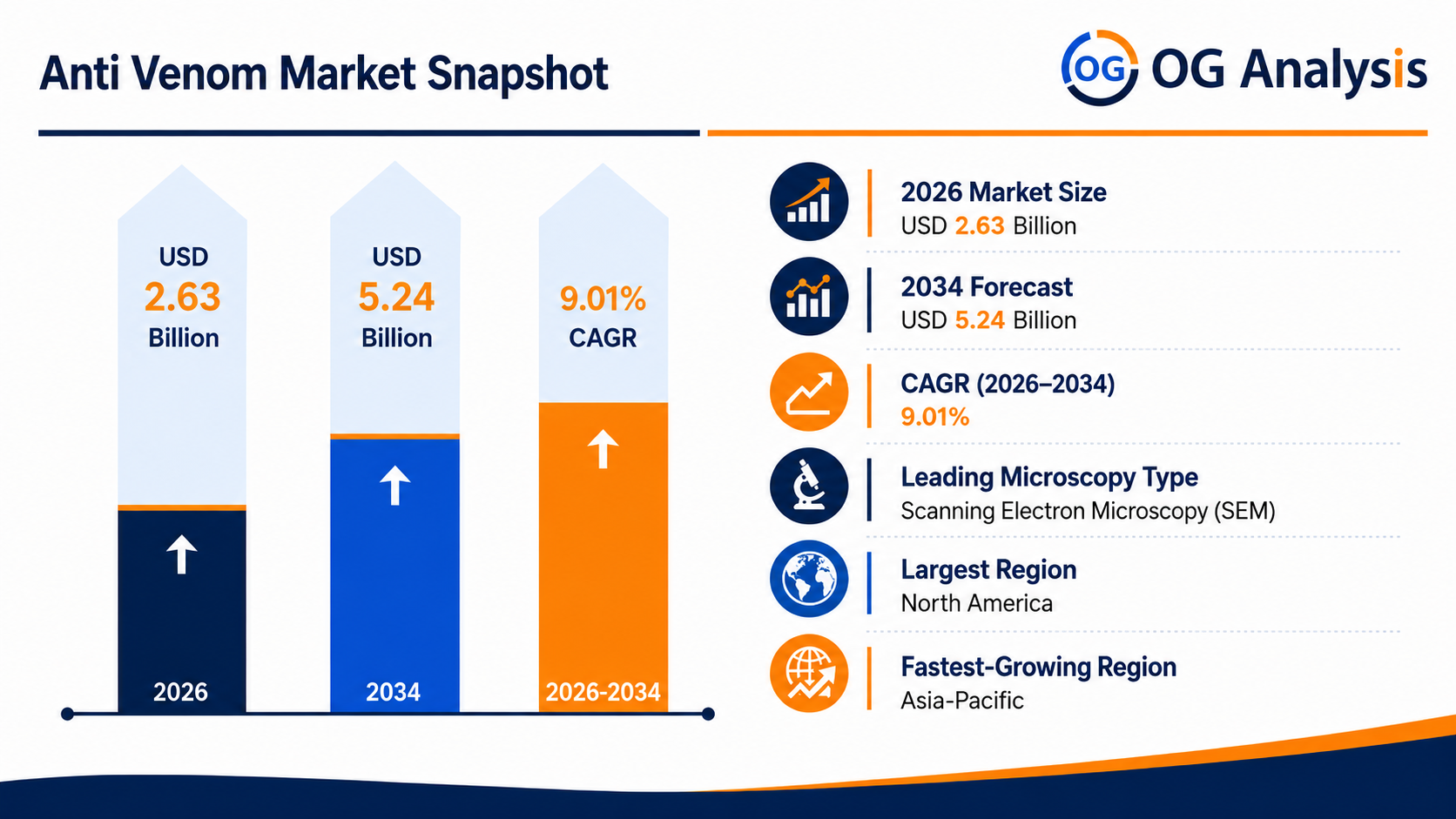
The Anti Venom Market is estimated to be valued at $ 2.63 billion in 2026 and is projected to reach $ 5.24 billion by 2034, expanding at a CAGR of 9.01% from 2026 to 2034.
Anti-venom, or antivenom, is a life-saving biologic therapy used to neutralize venom toxins caused by bites or stings from snakes, scorpions, spiders, and other venomous species. These products are generally manufactured using antibodies derived from immunized animals and are supplied in liquid or lyophilized formulations for hospital and emergency use. Market growth is supported by the high burden of venomous bites in tropical and subtropical regions, increasing public health focus on snakebite envenoming, rising awareness among rural communities, and government procurement of essential emergency medicines. WHO identifies antivenom availability, accessibility, safety, affordability, and clinical effectiveness as central to reducing the severe consequences of snakebite envenoming.
Get Your Free Sample Report for In-Depth Market Insights :
https://www.oganalysis.com/industry-reports/anti-venom-market
1. What is the latest trend in the Anti Venom Market?
The latest trend is the development of region-specific, polyvalent, and improved-quality antivenoms that can address locally prevalent venomous species.
Research is also moving toward recombinant antibodies, monoclonal antibody-based antivenoms, and broader-spectrum formulations.
Lyophilized products are gaining attention because they can improve storage, transport, and availability in remote healthcare settings.
Public-private partnerships and government-supported procurement are becoming important to improve access in high-risk regions.
2. What are the key challenges in the Anti Venom Market?
Key challenges include limited access in rural areas, high production complexity, cold-chain requirements, pricing pressure, and inconsistent product quality.
Antivenoms must match local venom profiles, as venom composition varies by species and geography.
Delayed treatment, weak emergency transport, lack of trained healthcare workers, and low awareness also affect clinical outcomes.
Manufacturers face challenges related to plasma sourcing, purification, regulatory approval, quality testing, and small commercial volumes in some markets.
3. What is the major driving factor for the Anti Venom Market?
The major driving factor is the continued need to treat life-threatening envenomation from snakebites and other venomous animal encounters.
Snakebite envenoming remains a serious public health issue, especially in rural farming communities, tropical regions, and low-resource healthcare settings.
Demand is also driven by emergency medicine, hospital preparedness, and national essential-medicine procurement programs.
Improved diagnosis, stronger surveillance, and better treatment protocols are further supporting market development.
4. What is the major segment in the Anti Venom Market and why?
Polyvalent antivenom is a major segment because it can neutralize venom from multiple species and is useful when the biting species is unknown.
This is important in emergency settings where rapid species identification may not be possible.
Snake antivenom remains the largest product category due to the high global burden of snakebite envenoming.
Monovalent antivenoms remain important where a specific venomous species is clearly identified and targeted treatment is available.
5. Which application or end-user is driving more demand?
Hospitals, clinics, emergency departments, trauma centers, public health agencies, and rural healthcare facilities are driving demand.
Hospitals remain the leading end users because antivenom administration requires clinical monitoring, supportive care, and management of adverse reactions.
Government health systems and public procurement agencies are important buyers in snakebite-endemic countries.
Research institutes and biotechnology companies also support demand through venom research, product development, and clinical evaluation.
6. Which region offers the highest growth potential and why?
Asia Pacific offers strong growth potential due to large rural populations, high exposure to venomous snakes, agricultural activity, and expanding healthcare infrastructure.
India, Southeast Asia, China, Bangladesh, and other tropical markets have strong demand for affordable and locally effective antivenoms.
Latin America and Africa also represent important demand regions due to snakebite burden and public health treatment needs.
North America and Europe remain specialized markets, supported by emergency preparedness, toxicology centers, and rare venom exposure management.
7. What strategies are major companies adopting in the market?
Major companies are focusing on polyvalent products, region-specific antivenoms, improved purification, better safety profiles, and lyophilized formulations.
They are strengthening collaborations with research institutes, public health agencies, hospitals, and government procurement bodies.
Manufacturers are also working on production scale-up, quality control, venom characterization, and regulatory compliance.
Innovation is increasingly focused on recombinant antivenoms, monoclonal antibodies, and broader-spectrum neutralization technologies.
8. What are the leading companies in the Anti Venom Market?
Leading companies include Bharat Serums and Vaccines, Haffkine Bio-Pharmaceutical Corporation, VINS Bioproducts, Serum Institute of India, Incepta Pharmaceuticals, MicroPharm, Rare Disease Therapeutics, CSL, South African Vaccine Producers, Instituto Butantan, Instituto Vital Brazil, Instituto Bioclon, Laboratorios Silanes, and Inosan Biopharma.
These companies compete through species coverage, regional relevance, product safety, supply reliability, hospital relationships, and public procurement access.
Several market sources identify Bharat Serums and Vaccines, Haffkine Bio-Pharmaceutical, Incepta, MicroPharm, Serum Institute of India, and VINS Bioproducts among key antivenom players.
9. Why is anti venom strategically important for public health systems?
Anti venom is strategically important because it is the only specific treatment that neutralizes venom toxins after serious envenomation.
It helps reduce deaths, tissue damage, amputations, disability, and long-term socioeconomic consequences caused by venomous bites and stings.
For healthcare systems, antivenom availability is critical for emergency preparedness in rural and high-risk regions.
For governments, reliable antivenom supply supports neglected tropical disease control, rural health protection, and preventable death reduction.
10. What is the future outlook for the Anti Venom Market?
The market outlook remains positive as governments, healthcare agencies, and manufacturers focus on improving antivenom access, quality, and regional effectiveness.
Future growth will be supported by polyvalent formulations, cold-chain improvement, lyophilized products, recombinant technologies, and stronger rural healthcare distribution.
Demand will remain concentrated in snakebite-endemic countries, while innovation will focus on safer, broader-spectrum, and more affordable products.
Companies offering clinically effective, region-specific, high-quality, and reliably supplied antivenoms are expected to gain market share.
Browse Related Reports
https://www.oganalysis.com/industry-reports/pharmacovigilance-market
https://www.oganalysis.com/industry-reports/clinical-trial-market
https://www.oganalysis.com/industry-reports/bioanalytical-testing-services-market
https://www.oganalysis.com/industry-reports/biologics-cdmo-market
https://www.oganalysis.com/industry-reports/biotechnology-market
Stay Connected With Us
