Biohacking Market Outlook 2026–2034: Wearable Health Tracking, Personalized Wellness, Growth Drivers, Leading Companies, and Future Opportunities
The Biohacking Market is estimated to be valued at $ 46.69 billion in 2026 and is projected to reach $ 190.2 billion by 2034, expanding at a CAGR of 19.2% from 2026 to 2034.
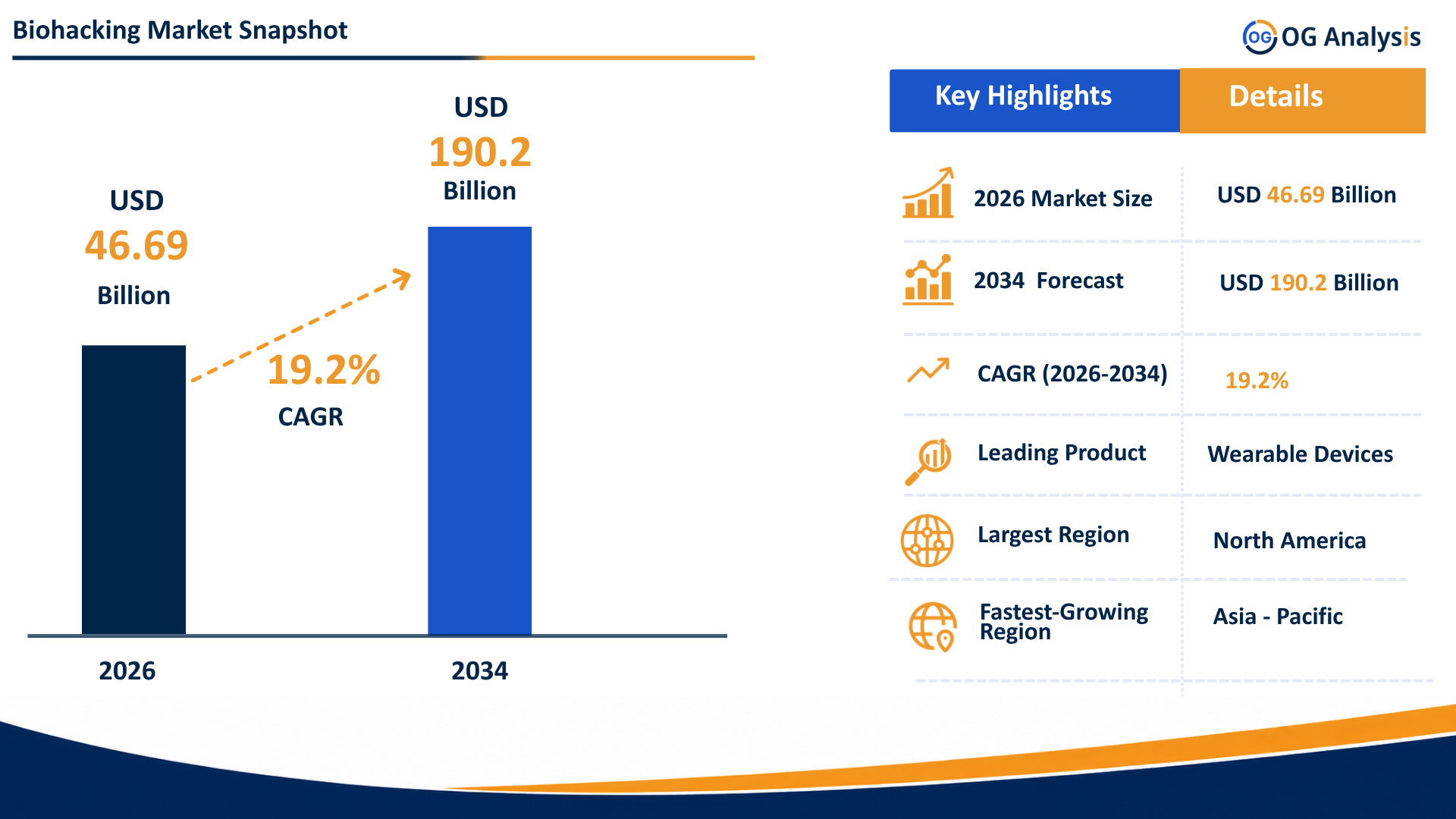
Biohacking refers to the use of technology, supplements, lifestyle interventions, diagnostics, wearable devices, implants, apps, and biological tools to monitor, optimize, or enhance physical performance, cognitive function, sleep, metabolism, longevity, and overall wellness. Key product categories include wearables, implants, smart drugs, nutraceuticals, genetic testing kits, mobile health applications, biosensors, and personalized health platforms. Market growth is supported by rising consumer interest in preventive healthcare, self-quantification, longevity, fitness optimization, mental performance, and personalized wellness. Wearable health trackers, continuous glucose monitors, sleep trackers, DNA testing, microbiome testing, nootropics, and wellness apps are helping consumers track health data and make lifestyle decisions. Adoption is increasing across individual consumers, athletes, wellness clinics, longevity clinics, fitness centers, digital health companies, and research organizations. However, market development is also influenced by safety concerns, data privacy, product claims, regulation, and the need for stronger clinical validation.
Get the Complete Analysis :
https://www.oganalysis.com/industry-reports/biohacking-market
Get Your Free Sample Report for In-Depth Market Insights :
https://www.oganalysis.com/industry-reports/biohacking-market/free-sample
1. What is the latest trend in the Biohacking Market?
The latest trend is the rapid adoption of wearable biosensors, personalized health tracking, and longevity-focused wellness programs.
Consumers are using smart rings, watches, continuous glucose monitors, sleep trackers, heart-rate monitors, and digital health apps to track real-time health data.
Nutrigenomics, microbiome testing, biological-age testing, and personalized supplement plans are gaining stronger interest among health-conscious users.
AI-enabled health insights, remote diagnostics, and connected wellness platforms are also becoming important market trends.
2. What are the key challenges in the Biohacking Market?
Key challenges include scientific validation, safety concerns, data privacy, regulatory uncertainty, exaggerated health claims, and inconsistent product quality.
Some biohacking products, especially supplements, nootropics, implants, and experimental interventions, may face scrutiny due to unclear benefits or safety risks.
Consumers may also struggle to interpret health data from wearables, genetic tests, and self-ordered diagnostics without proper medical guidance.
Companies must balance innovation with clinical credibility, cybersecurity, responsible marketing, and compliance with healthcare and consumer protection rules.
3. What is the major driving factor for the Biohacking Market?
The major driving factor is rising consumer demand for preventive, personalized, and data-driven health optimization.
People are increasingly interested in improving sleep, energy, focus, fitness, recovery, metabolic health, and longevity through measurable interventions.
Wearables, apps, at-home tests, and connected devices make health tracking more accessible and convenient.
Growing awareness of chronic disease prevention, fitness, wellness, and healthy aging is strengthening market demand.
4. What is the major segment in the Biohacking Market and why?
Wearables represent a major product segment because they are widely used for continuous health monitoring, fitness tracking, sleep analysis, heart-rate measurement, and activity tracking.
Smartwatches, smart rings, biosensors, and connected health devices provide users with real-time biometric data.
Nutraceuticals and nootropics are also important because consumers use them for energy, focus, recovery, immunity, and longevity positioning.
Implants and gene modification tools remain smaller but technologically significant segments due to their advanced and specialized nature.
5. Which application or end-user is driving more demand?
Health monitoring, sleep optimization, fitness performance, longevity, personalized nutrition, and cognitive enhancement are driving strong demand.
Individual consumers are the largest demand base because many biohacking products are purchased directly through online, retail, and wellness channels.
Athletes, executives, wellness clinics, longevity clinics, biohacking communities, and digital health users are also important end-user groups.
Demand is strongest where consumers seek measurable health improvement, convenience, personalization, and better control over wellness outcomes.
6. Which region offers the highest growth potential and why?
North America remains a leading region due to strong consumer wellness spending, advanced digital health adoption, wearable device penetration, and presence of major technology and healthcare companies.
The United States is especially important due to demand for fitness tracking, longevity clinics, personalized nutrition, genetic testing, and consumer diagnostics.
Asia Pacific offers strong growth potential due to rising disposable income, expanding digital health use, urban wellness trends, and increasing adoption of wearables.
Europe is supported by preventive health awareness, fitness culture, nutraceutical demand, and growing interest in personalized wellness.
7. What strategies are major companies adopting in the market?
Major companies are focusing on wearable sensors, AI-driven health insights, subscription wellness platforms, personalized nutrition, and integrated health data ecosystems.
They are expanding product portfolios across smart wearables, supplements, diagnostics, apps, metabolic health tools, and longevity solutions.
Partnerships with healthcare providers, fitness platforms, wellness clinics, research organizations, and technology companies are becoming important for growth.
Companies are also investing in clinical validation, data security, user experience, and app-based personalization to build trust and improve customer retention.
8. What are the leading companies in the Biohacking Market?
Leading companies include Apple, Garmin, Google/Fitbit, Oura Health, WHOOP, Abbott, Dexcom, Levels, Nutrisense, InsideTracker, Viome, 23andMe, Thorne, HVMN, Muse/InteraXon, Biostrap, Neuralink, Kernel, Synthego, and The ODIN.
These companies compete through device accuracy, sensor quality, app experience, data analytics, personalization, brand trust, clinical partnerships, and ecosystem integration.
Market sources commonly identify wearables, implants, gene modification kits, smart drugs, supplements, and mobile applications as important product categories, with companies such as Apple, Fitbit, HVMN, Dexcom, Oura, Abbott, Synthego, and InteraXon active across the ecosystem.
Vendors with credible science, secure data platforms, and strong consumer engagement are better positioned for long-term growth.
9. Why is biohacking strategically important for healthcare, wellness, and technology companies?
Biohacking is strategically important because it sits at the intersection of consumer health, digital wellness, preventive care, and personalized medicine.
It allows companies to build recurring engagement through connected devices, apps, subscriptions, diagnostics, supplements, and personalized recommendations.
For healthcare and wellness providers, biohacking tools can support early risk awareness, lifestyle tracking, and patient engagement.
For technology companies, biometric data platforms create opportunities in wearables, AI health analytics, digital coaching, and connected wellness ecosystems.
10. What is the future outlook for the Biohacking Market?
The market outlook remains positive as consumers continue to invest in personalized wellness, health monitoring, longevity, fitness optimization, and cognitive performance.
Future growth will be supported by advanced wearables, continuous biomarker tracking, AI-based health coaching, personalized nutrition, microbiome testing, and longevity-focused services.
Regulation, clinical evidence, privacy protection, and responsible health claims will become increasingly important as the market matures.
Companies offering safe, validated, user-friendly, data-secure, and integrated biohacking solutions are expected to gain market share.
Browse Related Reports
https://www.oganalysis.com/industry-reports/brain-computer-interface-market
https://www.oganalysis.com/industry-reports/personalized-medicine-market
https://www.oganalysis.com/industry-reports/probiotics-market
https://www.oganalysis.com/industry-reports/brain-health-supplements-market
https://www.oganalysis.com/industry-reports/fitness-tracker-market
