Biscuits Market Outlook 2026–2034: Healthier Snacking Trends, Premium Cookie Growth, Leading Companies, and Future Opportunities
The Biscuits Market is valued at $ 127.3 billion in 2026 and is expected to grow at a CAGR of 6.2% to reach $ 206.6 billion by 2034.
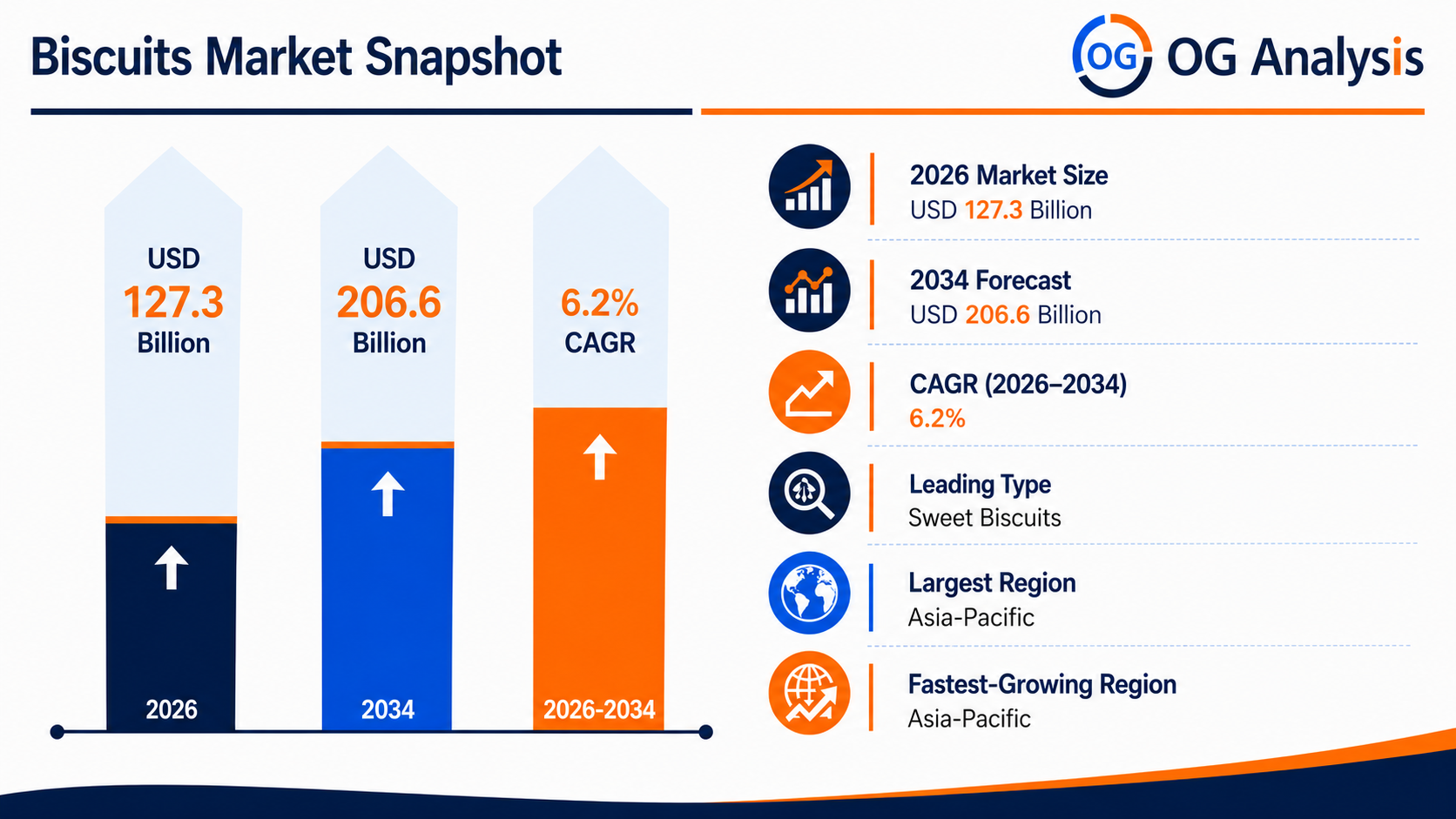
Biscuits include sweet biscuits, cookies, crackers, cream-filled biscuits, digestive biscuits, sandwich biscuits, wafer biscuits, breakfast biscuits, functional biscuits, and premium bakery snacks consumed across households, foodservice, travel retail, institutional channels, and on-the-go snacking occasions. Demand is supported by rising urbanization, changing eating habits, growth in packaged snacks, affordable indulgence, convenience-led consumption, premium flavor innovation, and increasing demand for healthier biscuit variants. Manufacturers are focusing on whole-grain, high-fiber, low-sugar, gluten-free, protein-enriched, fortified, portion-controlled, and clean-label biscuits to meet evolving consumer preferences.
Get Your Free Sample Report for In-Depth Market Insights :
https://www.oganalysis.com/industry-reports/biscuits-market/free-sample
1. What is the latest trend in the Biscuits Market?
The latest trend is the growth of healthier, premium, functional, and indulgent biscuit formats.
Consumers are looking for biscuits that combine taste with better ingredients, portion control, fiber, protein, whole grains, and reduced sugar.
Premium cookies, sandwich biscuits, digestive biscuits, breakfast biscuits, and flavored crackers are gaining visibility.
Manufacturers are also expanding limited-edition flavors, smaller packs, resealable packaging, and e-commerce-ready product formats.
2. What are the key challenges in the Biscuits Market?
Key challenges include raw material price volatility, sugar and fat reduction pressure, packaging cost increases, and intense private-label competition.
Manufacturers must manage fluctuations in wheat flour, sugar, cocoa, dairy, edible oils, energy, and logistics costs.
Health-conscious consumers are scrutinizing calorie density, palm oil use, artificial ingredients, and high sugar content.
Maintaining taste, texture, shelf life, affordability, and clean-label positioning remains a major formulation challenge.
3. What is the major driving factor for the Biscuits Market?
The major driving factor is rising demand for convenient, affordable, shelf-stable, and ready-to-eat snack products.
Biscuits are widely consumed across breakfast, tea-time, school snacks, travel, office breaks, and impulse snacking occasions.
Growth in modern retail, convenience stores, online grocery, and quick-commerce platforms is improving product availability.
Increasing demand for snacking as a meal replacement or mini-meal is further supporting market growth.
4. What is the major segment in the Biscuits Market and why?
Sweet biscuits and cookies represent a major segment because they have broad household penetration and strong repeat purchase behavior.
Cream-filled, chocolate-coated, sandwich, butter, and premium cookies are widely consumed across age groups.
Crackers and savory biscuits are also growing due to demand for lighter snacks, cheese pairings, lunchbox products, and healthier positioning.
Breakfast and digestive biscuits are gaining momentum among consumers seeking convenient morning and wellness-oriented snacking options.
5. Which application or end-user is driving more demand?
Household consumers are driving the highest demand, supported by daily snacking, children’s consumption, tea-time eating, and family packs.
Foodservice, travel, hotels, airlines, offices, schools, and institutional buyers also support packaged biscuit demand.
Retailers and e-commerce platforms are expanding impulse packs, multipacks, premium assortments, and festive gifting packs.
Health-focused consumers are increasing demand for digestive, whole-grain, sugar-reduced, fortified, and gluten-free biscuits.
6. Which region offers the highest growth potential and why?
Asia Pacific offers strong growth potential due to large population, rising disposable income, urban lifestyles, and high snack consumption.
India, China, Indonesia, Vietnam, Japan, South Korea, and Australia are important markets for sweet biscuits, crackers, cookies, and premium bakery snacks.
North America remains important due to strong cookie, cracker, and convenience snacking culture.
Europe maintains steady demand through premium biscuits, private labels, bakery heritage brands, and healthier snacking innovation.
7. What strategies are major companies adopting in the market?
Major companies are focusing on premiumization, healthier recipes, smaller pack sizes, local flavors, brand extensions, and omnichannel distribution.
Manufacturers are reformulating products with whole grains, fiber, reduced sugar, plant-based ingredients, and cleaner labels.
Companies are investing in digital marketing, seasonal packs, gifting formats, quick-commerce partnerships, and modern retail visibility.
Automation, supply-chain efficiency, sustainable packaging, and regional manufacturing expansion are also key strategies.
8. What are the leading companies in the Biscuits Market?
Leading companies include Mondelēz International, Britannia Industries, Parle Products, pladis, Kellanova, Campbell’s, Nestlé, ITC, Lotus Bakeries, Bahlsen, Arnott’s Group, Burton’s Biscuit Company, Grupo Bimbo, PepsiCo, Ferrero, Barilla, Danone, and Yıldız Holding.
These companies compete through brand equity, flavor innovation, distribution reach, pricing strategy, pack formats, and product quality.
Mondelēz holds a leading global position in biscuits, while pladis owns major biscuit and snacking brands including McVitie’s, Ülker, Jacob’s, Carr’s, and Go Ahead.
Regional players remain highly competitive through value packs, local taste profiles, and deep retail penetration.
9. Why are biscuits strategically important for food companies?
Biscuits are strategically important because they offer high-frequency consumption, broad demographic appeal, strong retail visibility, and scalable manufacturing economics.
They support mass-market, premium, health-focused, children’s, gifting, and on-the-go snacking portfolios.
For food companies, biscuits create opportunities for brand extensions, flavor launches, cross-category innovation, and recurring household purchases.
The category also supports strong distribution across supermarkets, convenience stores, traditional trade, online grocery, and vending channels.
10. What is the future outlook for the Biscuits Market?
The market outlook remains positive as consumers continue to seek convenient, affordable, tasty, and portable snack products.
Future growth will be supported by premium cookies, healthy biscuits, crackers, breakfast biscuits, gluten-free options, and functional formulations.
Digital commerce, quick delivery, emerging-market consumption, and modern retail expansion will further strengthen demand.
Companies offering a strong mix of taste, health positioning, value packs, premium innovation, and distribution reach are expected to gain market share.
Browse Related Reports
https://www.oganalysis.com/industry-reports/energy-bar-market
https://www.oganalysis.com/industry-reports/ready-meals-market
https://www.oganalysis.com/industry-reports/customized-premixes-market
https://www.oganalysis.com/industry-reports/normal-and-specialty-fats-market
https://www.oganalysis.com/industry-reports/egg-and-egg-products-market
Stay Connected With Us
