Dimethyl-5-Sulfoisophthalate Sodium Salt Market Outlook 2025–2034: Water-Dispersible Polyester Demand, Specialty Polymer Growth, Leading Companies, and Future Opportunities
The Dimethyl-5-Sulfoisophthalate Sodium Salt Market was valued at $ 325.8 million in 2026 and is projected to reach $ 496.6 million by 2034, growing at a CAGR of 5.41%.
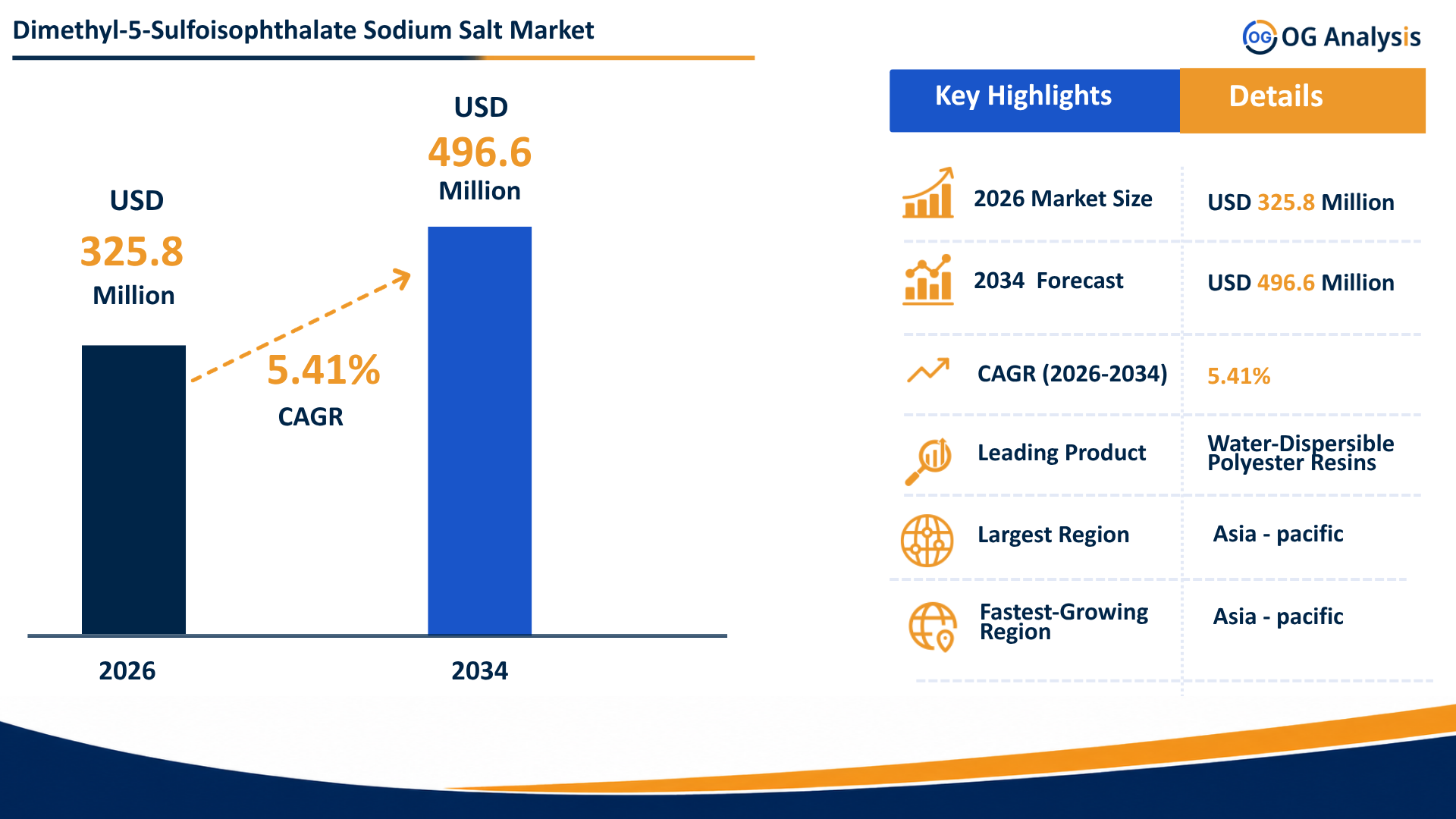
Dimethyl-5-Sulfoisophthalate Sodium Salt is a specialty sulfonated aromatic monomer used in the manufacture of water-dispersible polyester resins, PET copolymers, polyester ionomers, specialty fibers, coatings, inks, adhesives, and engineering polymers. The compound improves hydrophilicity, dyeability, moisture management, antistatic performance, and water dispersibility, making it valuable for advanced polymer formulations. Market growth is driven by increasing demand for sustainable packaging materials, functional textiles, waterborne coatings, environmentally friendly polymer systems, and specialty chemicals with improved processing characteristics.
Get the Complete Analysis :
https://www.oganalysis.com/industry-reports/dimethyl5sulfoisophthalate-sodium-salt-market
Get Your Free Sample Report for In-Depth Market Insights :
https://www.oganalysis.com/industry-reports/safety-light-curtains-market/free-sample
1. What is the latest trend in the Dimethyl-5-Sulfoisophthalate Sodium Salt Market?
The latest trend is the growing adoption of water-dispersible polyesters and environmentally friendly polymer systems.
Manufacturers are increasingly incorporating this monomer into sustainable coatings, recyclable packaging films, and functional textile materials.
Demand is also increasing for specialty copolyesters with enhanced moisture management, dye uptake, and antistatic performance.
Bio-based and recyclable polymer development continues to create new opportunities for specialty sulfonated monomers.
2. What are the key challenges in the Dimethyl-5-Sulfoisophthalate Sodium Salt Market?
Key challenges include raw material price volatility, specialty chemical manufacturing costs, stringent environmental regulations, and limited supplier concentration.
Manufacturers must maintain consistent product purity, polymer compatibility, and process stability while meeting customer-specific performance requirements.
High technical qualification requirements and lengthy customer approval cycles can slow commercialization.
Competition from alternative polymer modifiers and changing regulatory standards also influences market dynamics.
3. What is the major driving factor for the Dimethyl-5-Sulfoisophthalate Sodium Salt Market?
The major driving factor is increasing demand for advanced polyester materials with improved functionality and sustainability.
The compound enhances polymer dispersibility, dyeability, hydrophilicity, and processability while supporting water-based formulations.
Growing use of waterborne coatings, high-performance fibers, packaging materials, and engineering plastics continues to expand consumption.
Demand for environmentally friendly specialty chemicals is further supporting long-term market growth.
4. What is the major segment in the Dimethyl-5-Sulfoisophthalate Sodium Salt Market and why?
Water-dispersible polyester resin production represents the major segment because the compound serves as a key functional monomer in these formulations.
It improves resin compatibility, water dispersibility, adhesion, and coating performance while reducing reliance on solvent-based systems.
Polyester copolymers for packaging, fibers, and industrial materials also represent significant applications.
Textile-grade polymer formulations continue to generate steady demand due to improved dyeability and moisture management.
5. Which application or end-user is driving more demand?
Polyester resin manufacturers, textile producers, coating formulators, packaging companies, specialty polymer manufacturers, and chemical processors are driving demand.
Waterborne coatings and inks use this compound to improve formulation stability and application performance.
Functional textile manufacturers benefit from improved fiber dyeability, moisture transport, and antistatic properties.
Packaging materials and biodegradable polymer developers are also increasing adoption of specialty polyester modifiers.
6. Which region offers the highest growth potential and why?
Asia Pacific offers the highest growth potential due to expanding chemical manufacturing, textile production, polyester processing, and packaging industries.
China, India, Japan, South Korea, and Southeast Asia remain major production and consumption centers for specialty polymers and polyester intermediates.
North America and Europe maintain strong demand through advanced coatings, engineering materials, and sustainable polymer innovation.
Growing environmental regulations are also supporting adoption of waterborne polymer technologies across developed markets.
7. What strategies are major companies adopting in the market?
Major companies are focusing on specialty polymer innovation, sustainable chemistry, high-purity manufacturing, and customer-specific product development.
Manufacturers are investing in process optimization, capacity expansion, and improved product consistency to support high-performance polymer applications.
Strategic collaborations with resin producers, textile manufacturers, and specialty chemical companies are strengthening market reach.
Research efforts are also targeting biodegradable plastics, advanced packaging materials, and low-emission coating systems.
8. What are the leading companies in the Dimethyl-5-Sulfoisophthalate Sodium Salt Market?
Leading companies include Eastman Chemical Company, TCI Chemicals (Tokyo Chemical Industry), Alfa Aesar (Thermo Fisher Scientific), Hangzhou Meite Chemical Co., Ltd., Wuhan Bright Chemical Co., Ltd., Henan Tianfu Chemical Co., Ltd., Haihang Industry Co., Ltd., Shanghai Macklin Biochemical Co., Ltd., Toronto Research Chemicals, AK Scientific, Capot Chemical Co., Ltd., Combi-Blocks Inc., Yancheng Longshen Chemical Co., Ltd., Finetech Industry Limited, and Santa Cruz Biotechnology.
These companies compete through product purity, specialty chemistry expertise, polymer application support, manufacturing capability, and global distribution networks.
Specialty chemical suppliers are strengthening their portfolios with high-performance monomers for sustainable polymer systems.
Technical support, product quality, and application-specific customization remain important competitive differentiators.
9. Why is Dimethyl-5-Sulfoisophthalate Sodium Salt strategically important?
This specialty monomer is strategically important because it enables the production of advanced polyester materials with enhanced functional performance.
It improves hydrophilicity, water dispersibility, dyeability, and antistatic properties while supporting environmentally friendly formulations.
Manufacturers use it to develop higher-value specialty polymers for coatings, fibers, packaging, and engineering applications.
Its versatility across multiple polymer systems strengthens its long-term industrial importance.
10. What is the future outlook for the Dimethyl-5-Sulfoisophthalate Sodium Salt Market?
The market outlook remains positive as demand increases for sustainable polymer materials, waterborne coatings, advanced textiles, and recyclable packaging.
Future growth will be supported by specialty copolyesters, biodegradable plastics, performance fibers, and environmentally compliant chemical formulations.
Innovation will focus on higher-performance polymer modifiers, greener production processes, and specialty application development.
Companies offering consistent quality, technical expertise, and sustainable specialty chemical solutions are expected to strengthen their competitive position.
Browse Related Reports
https://www.oganalysis.com/industry-reports/recyclable-packaging-market
https://www.oganalysis.com/industry-reports/antistatic-films-market
https://www.oganalysis.com/industry-reports/coating-base-paper-market
https://www.oganalysis.com/industry-reports/butanediol-bdo-market
https://www.oganalysis.com/industry-reports/polyurethane-fabric-market
Stay Connected With Us
