Fiber Optic Connector Market Outlook 2026–2034: High-Density Connectivity, Data Center Expansion, 5G Deployment, Growth Drivers, and Future Opportunities
The Fiber Optic Connector Market is estimated to be valued at $ 7.58 billion in 2026 and is projected to reach $ 12.27 billion by 2034, expanding at a CAGR of 6.2% from 2026 to 2034.
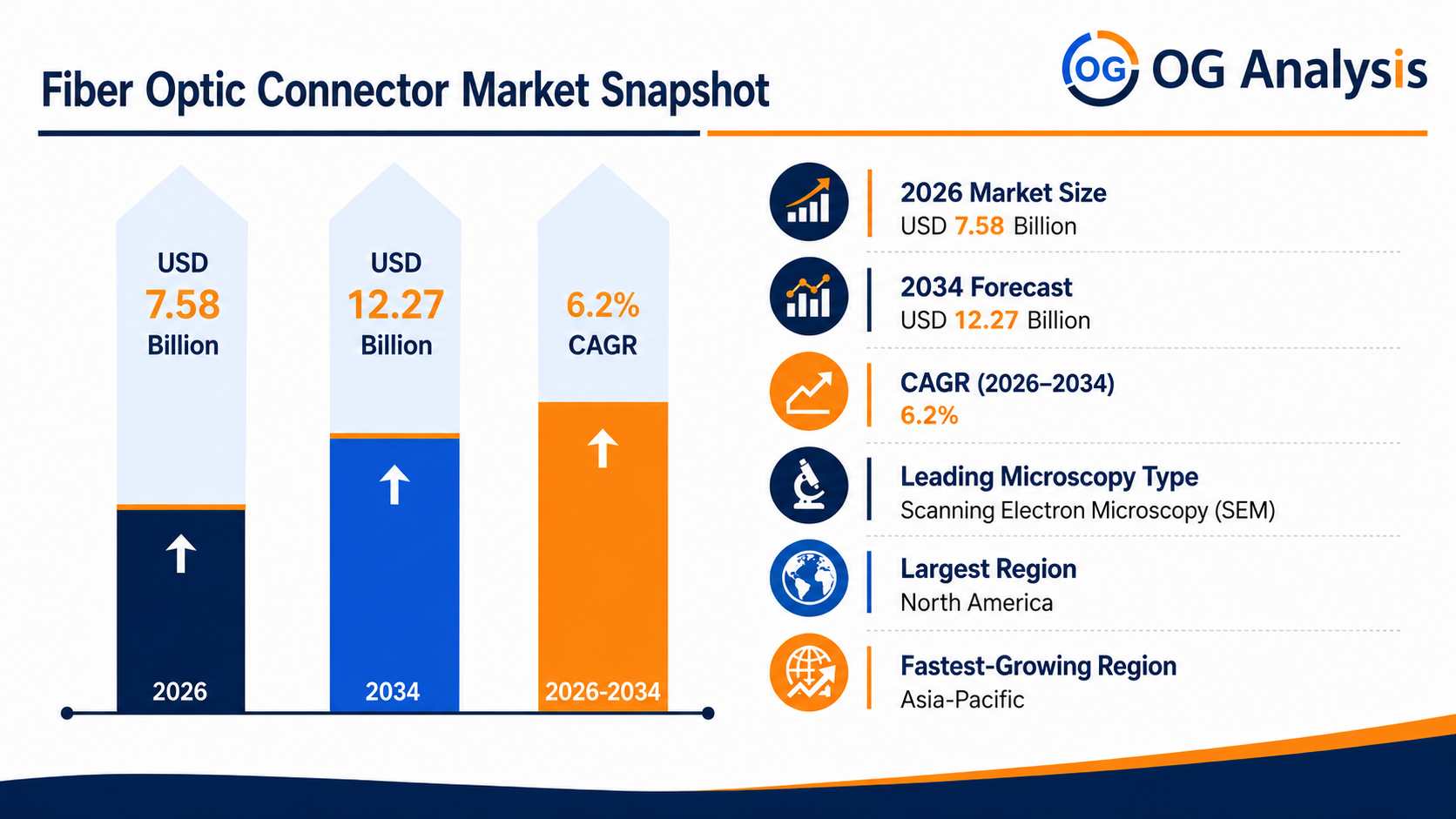
Fiber optic connectors are precision components used to align and join optical fibers for low-loss transmission of data, voice, and video signals across telecom, broadband, enterprise, industrial, defense, medical, and data center networks. Major connector types include LC, SC, ST, FC, MTP/MPO, MU, E2000, and other specialized fiber interfaces. Market growth is supported by rising demand for high-speed internet, cloud computing, 5G networks, fiber-to-the-home deployment, hyperscale data centers, AI infrastructure, and industrial digitalization. Fiber optic connectors are critical for reliable optical network performance because they directly influence signal loss, return loss, installation efficiency, density, and network scalability. Demand is increasing for compact, high-density, pre-terminated, ruggedized, and low-loss connectors that support faster deployment and higher bandwidth.
Get Your Free Sample Report for In-Depth Market Insights :
https://www.oganalysis.com/industry-reports/fiber-optic-connector-market
1. What is the latest trend in the Fiber Optic Connector Market?
The latest trend is the rising adoption of high-density MPO/MTP and small-form-factor connectors for data centers, telecom networks, and high-speed optical systems.
Hyperscale data centers are using multi-fiber connectors to support 400G, 800G, and next-generation Ethernet architectures.
Pre-terminated fiber assemblies, plug-and-play cabling, and low-loss connector designs are becoming important for faster deployment.
AI data centers, 5G fronthaul, FTTH expansion, and cloud infrastructure are accelerating connector innovation.
2. What are the key challenges in the Fiber Optic Connector Market?
Key challenges include insertion loss control, return loss performance, dust contamination, installation errors, connector damage, and price pressure.
Fiber connectors require precise end-face geometry, polishing quality, cleanliness, and alignment to maintain optical performance.
Network operators must manage skilled installation needs, testing requirements, and compatibility across connector standards.
Low-cost products with inconsistent quality can increase network faults, signal degradation, and maintenance cost.
3. What is the major driving factor for the Fiber Optic Connector Market?
The major driving factor is rapid growth in bandwidth demand across telecom, broadband, cloud, and enterprise networks.
Streaming, AI workloads, 5G services, remote work, smart cities, and IoT applications require faster and more reliable optical connectivity.
Fiber optic connectors enable scalable network expansion by supporting high-speed transmission with low signal loss.
Rising FTTH rollouts and data center construction are creating steady demand for connectors, adapters, patch cords, and fiber assemblies.
4. What is the major segment in the Fiber Optic Connector Market and why?
LC connectors remain a major segment because they offer compact size, reliable performance, and high port density for telecom and data center applications.
They are widely used in transceivers, patch panels, enterprise networks, and high-density rack environments.
MPO/MTP connectors are the fastest-growing segment because they support multiple fibers in a single connector and are ideal for high-bandwidth data center architectures.
SC connectors also remain important in FTTH, telecom access networks, and legacy optical systems.
5. Which application or end-user is driving more demand?
Telecommunications, data centers, broadband service providers, cloud companies, enterprises, and network equipment manufacturers are driving strong demand.
Telecom operators use fiber connectors for FTTH, metro networks, 5G transport, backhaul, fronthaul, and long-haul optical networks.
Data centers require high-density connectors for server interconnects, switches, optical transceivers, and structured cabling.
Industrial automation, defense, medical imaging, broadcasting, and transportation systems also contribute to specialized connector demand.
6. Which region offers the highest growth potential and why?
Asia Pacific offers strong growth potential due to telecom network expansion, 5G deployment, FTTH penetration, data center investments, and electronics manufacturing.
China, India, Japan, South Korea, Taiwan, and Southeast Asia are important markets for fiber infrastructure and optical components.
North America remains a high-value market due to hyperscale data centers, AI infrastructure, broadband upgrades, and cloud connectivity.
Europe is supported by fiber broadband expansion, enterprise networking, industrial automation, and digital infrastructure modernization.
7. What strategies are major companies adopting in the market?
Major companies are focusing on low-loss connectors, high-density designs, pre-terminated assemblies, ruggedized connectors, and faster installation systems.
They are improving polishing technology, ceramic ferrules, connector reliability, inspection tools, and dust-resistant product designs.
Partnerships with telecom operators, data center builders, network equipment providers, and fiber cable manufacturers are becoming important.
Companies are also expanding production capacity and product portfolios to support AI data centers and next-generation optical networks.
8. What are the leading companies in the Fiber Optic Connector Market?
Leading companies include Corning, Amphenol, TE Connectivity, Molex, Hirose Electric, Senko Advanced Components, US Conec, CommScope, Fujikura, Sumitomo Electric, Furukawa Electric, Belden, HUBER+SUHNER, Radiall, and Rosenberger.
These companies compete through connector performance, product reliability, low-loss designs, density, manufacturing scale, technical support, and global distribution.
Research and Markets identifies Corning, Amphenol, TE Connectivity, Molex, and Hirose Electric among major fiber optic connector companies.
Industry consolidation is also visible, with Amphenol announcing a major acquisition of CommScope’s connectivity and cable solutions unit to strengthen its position in broadband and fiber-optic interconnect technologies.
9. Why are fiber optic connectors strategically important for digital infrastructure?
Fiber optic connectors are strategically important because they determine the reliability and scalability of optical communication networks.
Poor connector quality can increase signal loss, downtime, service interruptions, and network maintenance costs.
High-performance connectors support faster data transmission, dense cabling environments, and reliable interconnection across telecom and cloud infrastructure.
For data centers, telecom operators, and enterprises, connector quality directly affects network speed, uptime, and future upgrade readiness.
10. What is the future outlook for the Fiber Optic Connector Market?
The market outlook remains positive as global demand for faster broadband, cloud services, AI computing, 5G, and data center connectivity continues to expand.
Future growth will be supported by MPO/MTP connectors, LC connectors, very-small-form-factor designs, low-loss assemblies, and plug-and-play fiber systems.
Telecom operators and hyperscale data centers will remain major buyers as they upgrade networks for higher capacity and lower latency.
Companies offering reliable performance, high-density solutions, clean installation systems, and scalable supply capabilities are expected to gain market share.
Browse Related Reports
https://www.oganalysis.com/industry-reports/artificial-intelligence-ai-hardware-market
https://www.oganalysis.com/industry-reports/cellular-m2m-market
https://www.oganalysis.com/industry-reports/modular-wiring-systems-market
https://www.oganalysis.com/industry-reports/5g-device-testing-market
https://www.oganalysis.com/industry-reports/data-center-asset-management-market
Stay Connected With Us
