Polyurethane Fabric Market Outlook 2026–2034: Sustainable PU Coatings, Synthetic Leather Demand, Growth Drivers, Leading Companies, and Future Opportunities
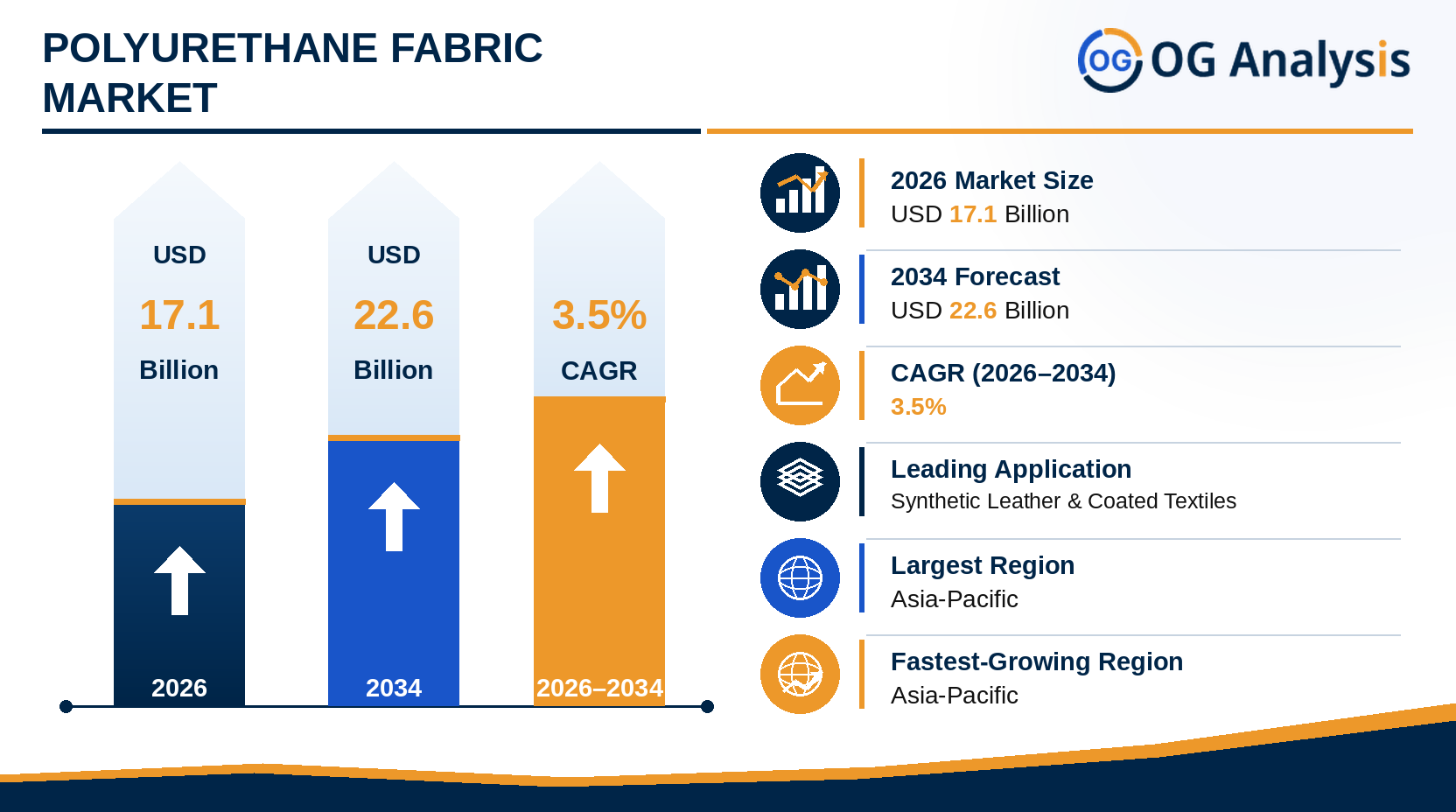
The Polyurethane Fabric Market is valued at $ 17.1 billion in 2026 and is projected to grow at a CAGR of 3.5% to reach $ 22.6 billion by 2034.
Polyurethane fabric refers to textiles coated, laminated, or bonded with polyurethane to enhance flexibility, abrasion resistance, water resistance, softness, durability, stretch, and surface finish. It is widely used in synthetic leather, apparel, footwear, bags, upholstery, automotive interiors, protective clothing, medical textiles, sportswear, inflatable products, industrial covers, and outdoor gear. Growth is supported by demand for lightweight and durable coated textiles, vegan leather alternatives, waterproof breathable fabrics, comfort-focused automotive interiors, and performance materials for consumer and industrial applications. Manufacturers are focusing on solvent-free coatings, waterborne polyurethane, bio-based polyurethane, recyclable coated textiles, improved hand feel, antimicrobial finishes, enhanced abrasion resistance, and better compliance with environmental and chemical safety regulations.
Get Your Free Sample Report for In-Depth Market Insights :
https://www.oganalysis.com/industry-reports/polyurethane-fabric-market/free-sample
1. What is the latest trend in the Polyurethane Fabric Market?
The latest trend is the shift toward sustainable, lightweight, waterborne, and solvent-free polyurethane-coated fabrics.
Brands are looking for materials that offer durability, soft touch, stretch, water resistance, and reduced environmental impact.
Bio-based PU coatings, recycled textile backings, vegan leather alternatives, and breathable performance fabrics are gaining attention.
Innovation is also increasing in antimicrobial, easy-clean, abrasion-resistant, and high-comfort surface finishes.
2. What are the key challenges in the Polyurethane Fabric Market?
Key challenges include raw material price volatility, environmental concerns, chemical compliance, recyclability limitations, and competition from PVC, silicone, TPU films, and natural leather.
Some polyurethane-coated fabrics face scrutiny because of petroleum-based inputs, solvent use, and end-of-life recycling difficulties.
Manufacturers must improve durability, hydrolysis resistance, color fastness, flame retardancy, and comfort while controlling cost.
Regulatory pressure on chemicals, emissions, and sustainability claims is also increasing across textile and automotive supply chains.
3. What is the major driving factor for the Polyurethane Fabric Market?
The major driving factor is rising demand for durable, lightweight, flexible, and cost-effective alternatives to leather and traditional coated materials.
PU fabrics provide a balance of softness, design flexibility, water resistance, and processing efficiency.
Growth in footwear, apparel, automotive interiors, furniture, bags, and sports goods is supporting wider adoption.
Consumer preference for vegan leather and performance textiles is further strengthening demand.
4. What is the major segment in the Polyurethane Fabric Market and why?
Synthetic leather and coated textile applications represent a major segment because PU fabric is widely used as a leather-like material.
It provides a soft surface, attractive finish, design versatility, and lower cost compared with genuine leather.
Automotive seats, furniture upholstery, footwear uppers, handbags, wallets, belts, and fashion accessories create steady consumption.
Performance-coated fabrics for outdoor gear and protective products are also gaining importance.
5. Which application or end-user is driving more demand?
Footwear, apparel, automotive interiors, furniture, and accessories are driving strong demand for polyurethane fabric.
Footwear manufacturers use PU materials for uppers, linings, overlays, and synthetic leather components.
Automotive and furniture producers use PU-coated fabrics for seating, panels, trims, and upholstery surfaces.
Sportswear, outdoor gear, medical textiles, and protective clothing are also expanding demand for functional PU fabrics.
6. Which region offers the highest growth potential and why?
Asia Pacific offers the highest growth potential due to its large textile, footwear, furniture, automotive, and consumer goods manufacturing base.
China, India, Vietnam, Indonesia, South Korea, Japan, and Taiwan are important producers and consumers of PU-coated fabrics.
The region benefits from integrated textile processing, synthetic leather production, export-oriented manufacturing, and rising domestic consumption.
North America and Europe remain important markets for premium automotive interiors, performance apparel, medical textiles, and sustainable coated fabrics.
7. What strategies are major companies adopting in the market?
Major companies are focusing on sustainable PU chemistries, waterborne coatings, solvent-free processes, bio-based inputs, and recyclable textile structures.
Suppliers are improving abrasion resistance, hydrolysis resistance, softness, breathability, flame retardancy, and color consistency.
Companies are working closely with footwear, automotive, furniture, fashion, and technical textile brands to develop application-specific materials.
Capacity expansion in Asia, product customization, compliance support, and premium synthetic leather innovation remain key strategies.
8. What are the leading companies in the Polyurethane Fabric Market?
Leading companies include Trelleborg AB, Sioen Industries, Serge Ferrari Group, Saint-Gobain, Continental AG, Freudenberg Performance Materials, Spradling International, Seaman Corporation, Heytex Group, SRF Limited, Covestro, BASF, The Lubrizol Corporation, Kuraray, Toray Industries, and Teijin.
These companies compete through coating technology, polymer expertise, product durability, sustainability credentials, design flexibility, and customer-specific development.
Technical textile suppliers are strong in protective, industrial, architectural, and transport applications.
Chemical and material companies support the market through PU resins, films, dispersions, and performance additives.
9. Why is polyurethane fabric strategically important for manufacturers and brands?
Polyurethane fabric is strategically important because it provides a versatile material platform across fashion, mobility, healthcare, sports, and industrial uses.
It allows brands to combine aesthetics, comfort, water resistance, durability, and lower material cost in one product.
For manufacturers, PU fabric supports high-volume production, surface customization, embossing, lamination, and functional coating options.
It also helps companies respond to demand for vegan leather, lightweight design, and performance-oriented textile products.
10. What is the future outlook for the Polyurethane Fabric Market?
The market outlook remains positive as demand continues from footwear, apparel, automotive interiors, furniture, medical textiles, and technical fabrics.
Future growth will be shaped by sustainable PU chemistry, recyclable structures, bio-based materials, and stricter chemical compliance.
Performance improvements in breathability, durability, antimicrobial protection, and flame resistance will create new application opportunities.
Companies offering eco-conscious, high-performance, cost-competitive, and design-flexible PU fabric solutions are expected to gain market share.
Browse Related Reports
https://www.oganalysis.com/industry-reports/dearomatic-solvents-market
https://www.oganalysis.com/industry-reports/pvc-compound-market
https://www.oganalysis.com/industry-reports/advanced-materials-market
https://www.oganalysis.com/industry-reports/formic-acid-market
https://www.oganalysis.com/industry-reports/uvresistant-adhesive-tape-market
Stay Connected With Us
