Polyurethane (PU) Hot Melt Adhesives Market Outlook 2026–2034: Solvent-Free Bonding, Reactive PUR Innovation, Growth Drivers, Leading Companies, and Future Opportunities
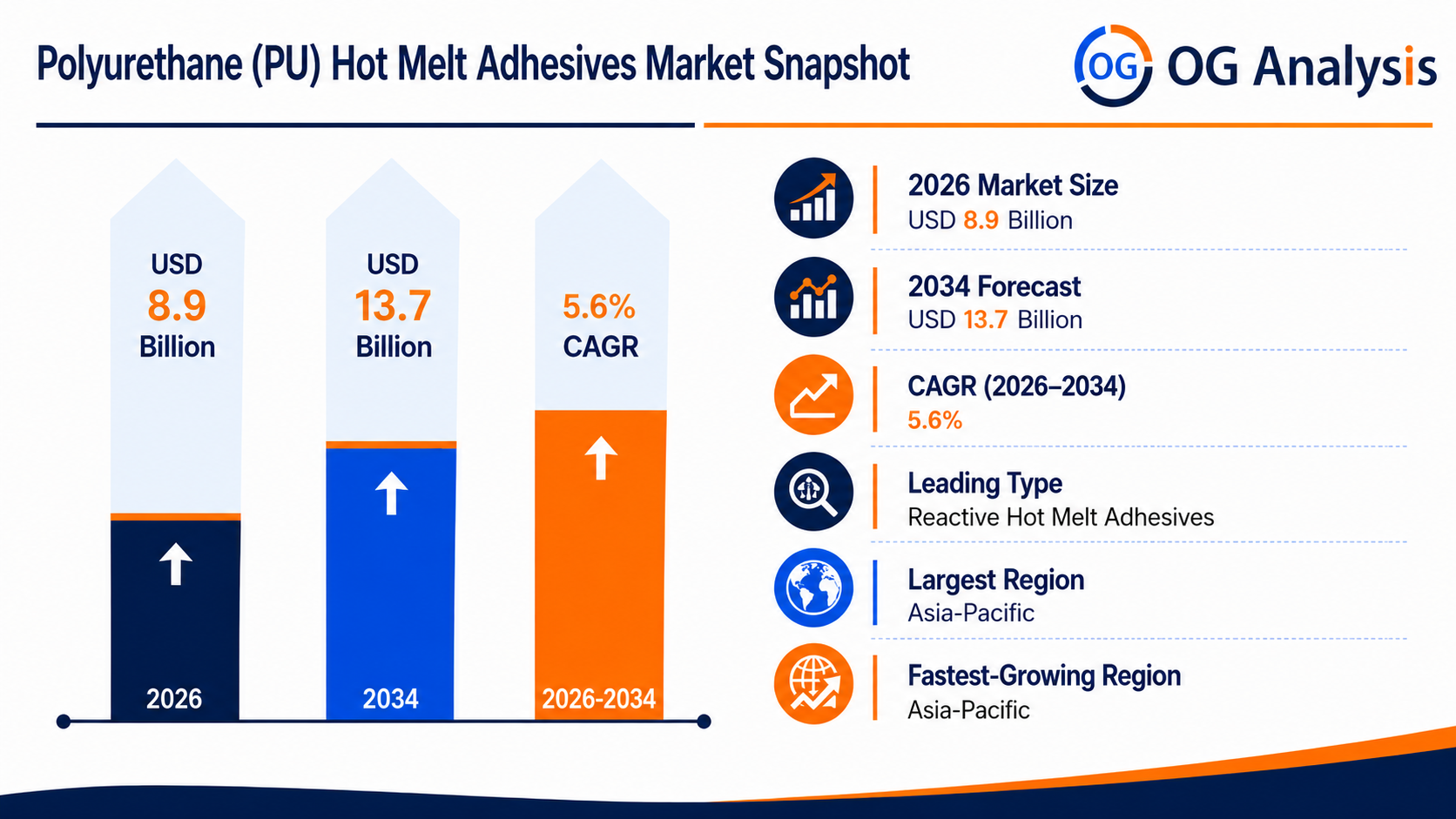
The Polyurethane (PU) Hot Melt Adhesives Market is valued at $ 8.9 billion in 2026. Worldwide sales of polyurethane (PU) hot melt adhesives are expected to grow at a CAGR of 5.6%, reaching $ 13.7 billion by the end of the forecast period in 2034.
PU hot melt adhesives, especially reactive polyurethane hot melts, are used where manufacturers require fast setting, high bond strength, flexibility, heat resistance, moisture resistance, and strong adhesion to difficult substrates. These adhesives are widely used in packaging, woodworking, furniture, automotive interiors, footwear, textiles, bookbinding, electronics, appliances, filters, and industrial assembly. Growth is supported by demand for solvent-free bonding, lightweight material joining, faster production lines, durable lamination, premium surface finishing, and high-performance adhesives for automated manufacturing. Manufacturers are focusing on low-emission PUR systems, bio-based formulations, improved open time, stronger green strength, lower monomer content, and application-specific grades for automotive, furniture, packaging, and electronics.
Get Your Free Sample Report for In-Depth Market Insights :
https://www.oganalysis.com/industry-reports/polyurethane-pu-hot-melt-adhesives-market/free-sample
1. What is the latest trend in the Polyurethane (PU) Hot Melt Adhesives Market?
The latest trend is the shift toward solvent-free, low-emission, bio-based, and high-performance reactive PUR hot melt adhesives.
Manufacturers are developing products with lower carbon footprint, improved safety profile, stronger initial tack, and better long-term durability.
Automotive interiors, appliance assembly, furniture lamination, and electronics bonding are seeing increased innovation in specialized PUR grades.
Demand is also rising for adhesives that support faster production, cleaner processing, and reduced rework or waste.
2. What are the key challenges in the Polyurethane (PU) Hot Melt Adhesives Market?
Key challenges include raw material price volatility, isocyanate-related handling requirements, moisture sensitivity, equipment cost, and storage stability concerns.
Reactive PU hot melts require controlled application conditions, proper packaging, and careful temperature management during processing.
Manufacturers must balance fast curing, open time, heat resistance, flexibility, and bonding strength across different substrates.
Competition from EVA hot melts, polyolefin hot melts, pressure-sensitive adhesives, water-based adhesives, and structural tapes can also pressure pricing.
3. What is the major driving factor for the Polyurethane (PU) Hot Melt Adhesives Market?
The major driving factor is growing demand for high-strength, flexible, and durable bonding in automated manufacturing.
PU hot melt adhesives provide fast initial bonding while later curing into stronger, more resistant adhesive networks.
This makes them suitable for furniture, automotive interiors, packaging, footwear, textiles, appliances, and electronics.
Rising use of lightweight materials, decorative laminates, engineered panels, and multi-substrate assemblies is further supporting demand.
4. What is the major segment in the Polyurethane (PU) Hot Melt Adhesives Market and why?
Reactive polyurethane hot melt adhesives represent a major segment because they offer strong final bond strength, heat resistance, moisture resistance, and broad substrate compatibility.
They are widely used where standard thermoplastic hot melts cannot provide enough durability or environmental resistance.
Furniture and woodworking applications are especially important because PUR hot melts support edge banding, flat lamination, profile wrapping, panel bonding, and engineered wood products.
Automotive interiors and industrial assembly are also high-value segments due to performance and reliability requirements.
5. Which application or end-user is driving more demand?
Furniture, woodworking, automotive interiors, packaging, footwear, textiles, electronics, and appliance manufacturers are driving demand.
Furniture producers use PU hot melts for decorative surfaces, laminates, panels, doors, and profiles.
Automotive manufacturers use them for interior trims, panels, consoles, headliners, and lightweight material bonding.
Packaging and flexible packaging users adopt PUR hot melts where solvent-free bonding, heat resistance, and reliable adhesion are required.
6. Which region offers the highest growth potential and why?
Asia Pacific offers the highest growth potential due to large-scale manufacturing in furniture, footwear, textiles, packaging, electronics, appliances, and automotive components.
China, India, Vietnam, Indonesia, South Korea, Japan, and Taiwan are important demand centers for industrial adhesives and lamination technologies.
Europe remains strong in automotive interiors, furniture, woodworking, packaging regulation, and low-emission adhesive innovation.
North America also maintains strong demand from packaging, construction products, engineered wood, transportation, and industrial assembly.
7. What strategies are major companies adopting in the market?
Major companies are focusing on low-monomer PUR adhesives, bio-based formulations, solvent-free systems, and application-specific bonding solutions.
Suppliers are improving heat resistance, open time, green strength, flexibility, substrate adhesion, and equipment compatibility.
Companies are working closely with OEMs, furniture producers, packaging converters, and electronics manufacturers to customize adhesive performance.
Strategic focus areas include sustainability, safety, automation support, technical service, and long-term supply reliability.
8. What are the leading companies in the Polyurethane (PU) Hot Melt Adhesives Market?
Leading companies include Henkel, H.B. Fuller, Bostik, 3M, Jowat, Sika, Dow, Arkema, Avery Dennison, Beardow Adams, Kleiberit, Franklin International, Toyo-Morton, DIC Corporation, and TEX YEAR Industries.
These companies compete through formulation expertise, application engineering, global supply networks, sustainability positioning, and customer-specific adhesive systems.
Henkel, H.B. Fuller, Bostik, 3M, and Jowat have strong positions across industrial hot melt, reactive hot melt, and polyurethane adhesive technologies.
Product performance, technical service, process efficiency, and compliance support remain key competitive differentiators.
9. Why are polyurethane hot melt adhesives strategically important for manufacturers?
Polyurethane hot melt adhesives are strategically important because they help manufacturers improve production speed, bond strength, durability, and product design flexibility.
They enable bonding of plastics, wood, fabric, leather, glass, metals, foams, composites, and decorative films.
For manufacturers, PUR adhesives support cleaner processing, reduced solvent use, automated application, and lightweight assembly.
They also help improve finished product performance in furniture, automotive, packaging, footwear, electronics, and industrial goods.
10. What is the future outlook for the Polyurethane (PU) Hot Melt Adhesives Market?
The market outlook remains positive as manufacturers continue shifting toward high-performance, solvent-free, and durable adhesive technologies.
Future growth will be supported by automotive interior innovation, furniture lamination, flexible packaging, electronics miniaturization, footwear production, and appliance assembly.
Sustainability will become more important, with stronger demand for low-emission, bio-based, low-monomer, and recyclable-friendly adhesive systems.
Companies offering reliable technical support, customized formulations, automated dispensing compatibility, and sustainable product portfolios are expected to gain market share.
Browse Related Reports
https://www.oganalysis.com/industry-reports/butanediol-bdo-market
https://www.oganalysis.com/industry-reports/uvresistant-adhesive-tape-market
https://www.oganalysis.com/industry-reports/epoxy-curing-agents-market
https://www.oganalysis.com/industry-reports/tall-oil-fatty-acid-market
https://www.oganalysis.com/industry-reports/coating-base-paper-market
Stay Connected With Us
